
 Ishan Crawford
 Five financial rule changes took effect across India on June 1, and they pull in opposite directions. Commercial cooking gas got dearer, the rules for quoting a PAN (Permanent Account Number, the tax ID every Indian filer carries) on cash and property deals eased for ordinary households, UPI (Unified Payments Interface, the instant bank-to-bank payment rail) gained an extra security check, and the first advance tax installment for the new financial year falls due on June 15.
The list looks like housekeeping. Two of the items trace to the same place. A war in West Asia is lifting the cost of the fuel India imports, while the tax department is raising the threshold at which everyday cash and property transactions get logged.
Why the ₹42 LPG Hike Traces Back to Hormuz
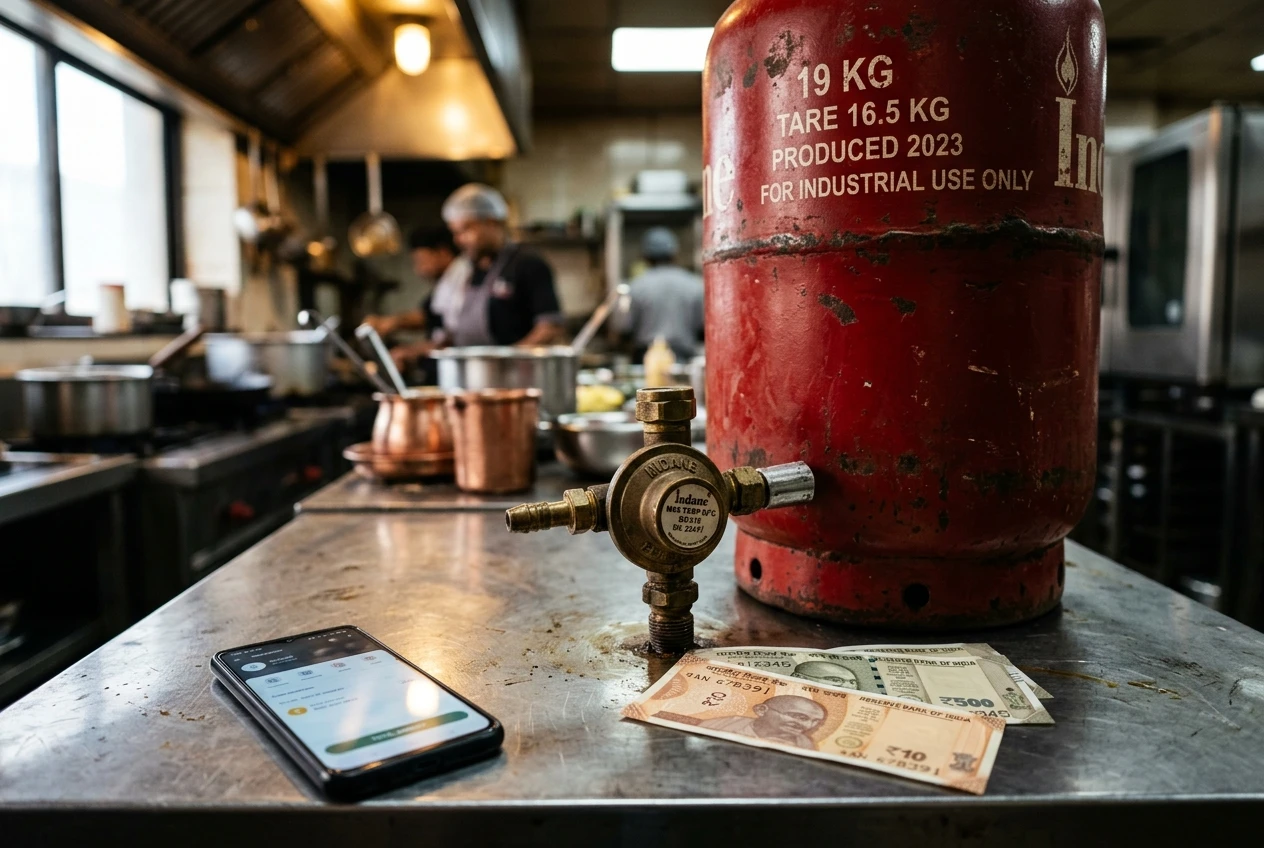
State oil marketing companies raised the price of a 19-kg commercial LPG (liquefied petroleum gas) cylinder by ₹42 on June 1, the kind used by hotels, restaurants and tea stalls rather than home kitchens. It was the latest in a run of increases that began when supply tightened in late February.
- ₹3,113.50 (about $36) for a 19-kg commercial cylinder in Delhi after the ₹42 rise
- ₹3,255.50 in Kolkata, where the increase ran steeper at ₹53.50
- ₹821.50 for a 5-kg Free Trade LPG (FTL) cylinder in Delhi, up ₹11, the small bottle favoured by kiosks and caterers
The Import Math Behind the Hike
India buys roughly 60% of its LPG from abroad, and most of those cargoes move through the Strait of Hormuz. When traffic through the strait seized up during the conflict, that fuel got scarce fast. Industry tracker Argus Media noted propane prices in northwest Europe jumped 64% between late February and mid-March, a swing that fed straight into the landed cost of Indian imports.
New Delhi has been scrambling to cushion the blow. Refiners were told to lift domestic LPG output by about a quarter, and the government has moved to build a 30-day strategic LPG reserve after the Hormuz disruption exposed how thin the country’s storage buffer was.
What Households Still Pay
Domestic 14.2-kg cylinders, the ones that sit in home kitchens, saw no change on June 1. That gap is deliberate. The government has held the line on subsidised home cooking gas while letting commercial rates float closer to the import cost.
The split does not mean households are insulated. Restaurants and caterers absorbing the repeated commercial LPG increases through 2026 tend to pass them down the menu, and the broader rise in imported energy is already showing up in pump and transport costs.
PAN Rules Loosen for Small Deposits, Tighten on Big Money
The PAN changes move in two directions at once. Routine cash handling gets easier; large transactions face sharper reporting. Quoting the number is no longer mandatory for cash deposits above ₹50,000 in a single day in specified cases, removing a friction point at bank counters.
At the same time, the thresholds that trigger reporting to the tax department have been reset across deposits, withdrawals and property. Here is how the framework compares before and after June 1.
| Transaction | Old threshold | New threshold |
|---|---|---|
| Annual cash deposit reporting | ₹2.5 lakh | ₹10 lakh |
| Annual cash withdrawal reporting | Not separately flagged | Above ₹10 lakh |
| Mandatory PAN on property deals | ₹10 lakh | ₹20 lakh |
| Property transaction reporting | ₹30 lakh | ₹45 lakh |
One lakh is 100,000 rupees, so the revised annual cash-deposit reporting bar of ₹10 lakh sits at roughly $11,700. The practical effect is that small traders and households moving modest sums of cash drop out of the reporting net, while gift deeds and joint development agreements (JDAs, the contracts landowners sign with builders) are now folded into the high-value scope. Form 60, long used by people without a PAN, has been replaced by a new Form 97.
UPI Adds a Second Lock on Bigger Payments
Digital payments now lean on a stricter authentication standard. Under the Reserve Bank of India (RBI, the country’s central bank) rules that took hold this year, domestic digital transactions must use two authentication factors from different categories, with at least one that changes per transaction. A static UPI PIN on its own no longer clears the bar for every payment.
In practice, that means biometrics are stepping in. NPCI (National Payments Corporation of India, the body that runs UPI) rolled out fingerprint and facial-recognition approval on the BHIM app for payments up to ₹5,000, while transactions above that level continue to require the UPI PIN. The shift targets fraud built on stolen credentials, SIM-swap attacks and phishing, where a leaked PIN alone used to be enough.
Payment apps are also displaying the verified, bank-registered name of whoever you are paying, instead of an editable nickname. The detail sounds minor. It closes a common scam where a fraudster sets a trustworthy-looking display name to coax a transfer. NPCI’s own guidance on UPI biometric authentication spells out how the device-based checks work.
ATM Withdrawals and the June 15 Tax Clock
Two changes hit the calendar and the cash machine. UPI-enabled cardless ATM withdrawals will now count toward a bank’s monthly free-withdrawal limit, the same way a debit-card withdrawal does. Cross the free count and the usual per-transaction charge applies, closing a loophole that let frequent withdrawers sidestep the cap.
The tax deadline is the firmer date. For anyone earning beyond a fixed salary, the June 15 milestone matters in a specific order:
- June 15 is the due date for the first advance tax installment of financial year 2026-27.
- At least 15% of the estimated annual liability must be paid by then, but only if total tax owed after TDS (tax deducted at source, the amount your payer already withholds) tops ₹10,000.
- People aged 60 or above with no business or professional income are exempt from advance tax altogether.
Freelancers, traders and consultants are the group most likely to be caught here, since little or none of their income is withheld at source before it reaches them. The Income Tax Department’s advance tax payment portal handles the installment online.
Where the Squeeze Lands First
Read the five items together and the weight falls unevenly. The household kitchen is protected for now. The small commercial operator is not.
A restaurant or a tea stall is paying the LPG increase directly, and it is the same kind of business whose owner files advance tax in person rather than through a salary slip. For that operator, June stacks a higher fuel bill on top of a tax deadline in the same fortnight. The PAN relaxation offers a little relief at the bank counter, but it does nothing for the input costs that the war has pushed up.
The UPI changes cut the other way, and they help almost everyone. Tighter authentication and verified payee names are aimed squarely at the fraud that has tracked UPI’s explosive growth. The cost there is a few extra seconds at checkout, not rupees out of pocket.
What ties the list together is timing. The cost-of-living items, LPG above all, are downstream of a conflict India does not control and a shipping chokepoint it cannot reroute around quickly. The compliance items are domestic policy choices that happened to land in the same week. One set the government can ease; the other it can only wait out.
Frequently Asked Questions
Has the price of domestic LPG cylinders changed in June 2026?
No. The June 1 increase applied only to commercial cylinders, including the 19-kg bottle used by businesses and the 5-kg FTL cylinder. Subsidised domestic 14.2-kg cylinders used in home kitchens saw no change.
Do I still need to give my PAN for cash deposits over ₹50,000?
Not in the same way. PAN is no longer mandatory for cash deposits exceeding ₹50,000 in a single day in specified cases. However, total annual cash deposits crossing ₹10 lakh now fall under reporting rules, up from the earlier ₹2.5 lakh limit.
When is the first advance tax installment due for FY 2026-27?
June 15, 2026. By that date, eligible taxpayers must pay at least 15% of their estimated annual tax liability, provided their total tax after TDS exceeds ₹10,000.
Will UPI ATM withdrawals now cost money?
Only if you exceed your free limit. UPI-enabled cardless ATM withdrawals are now counted within your bank’s monthly free-withdrawal allowance. Once you go past the permitted free transactions, charges apply just as they do for debit-card withdrawals.
What is the new authentication rule for high-value UPI payments?
Digital payments must use two authentication factors from different categories, with at least one that changes per transaction. Biometric approval covers payments up to ₹5,000 on the BHIM app, while payments above that level still require the UPI PIN.
Who is exempt from paying advance tax?
Residents aged 60 or above who have no income from a business or profession during the financial year are exempt from advance tax, even if their other income is taxable.
Disclaimer: This article is for informational purposes only and does not constitute tax, investment or financial advice. Rules around PAN reporting, advance tax and digital payments can carry case-specific conditions, and readers should consult a qualified tax professional or their bank before acting. All prices and thresholds are accurate as of publication.
 Billionaires Pay Record Sums for Dinosaur Bones Science Cannot Study
  How a New Jersey Homeowner’s Quick Thinking Preserved a Rare Meteorite
  Iceland’s Eclipse Boom Looks Like the Faroe Islands All Over Again
  NASA Confirms Near-Earth Object 1998 SH2 Is a Hidden Comet
  Bharatgas Lite ZIP Pushes India’s LPG Giants Into a Delivery Race
  Toyota’s Next Five SUVs Reveal a Quiet Role Reversal With Suzuki