
 Ishan Crawford
 Samsung Display will ship four custom OLED panels into Ferrari’s first electric car, and one of them carries a hole roughly 100 millimetres across, around 20 times wider than the selfie-camera cutouts the same company punches into Galaxy phones. The supplier disclosed the deal on May 26, a day after Ferrari unveiled the Luce in Maranello with a €550,000 (about $640,000) sticker and a cabin co-designed by Sir Jony Ive’s LoveFrom studio. The driver’s binnacle is the part everyone is photographing: two stacked OLED layers, three physical metal needles, no glass overlay between them.
The car will dominate every gallery in the automotive press for the next month. The supply chain story sitting under the dashboard is the one display analysts will be reading.
Samsung’s Four-Panel Cockpit, Mapped
The Luce uses three digital zones and four panels, all from Samsung Display’s exclusive supply agreement disclosed on May 26. None of them is rectangular in the traditional sense, and two of them sit on top of each other.
The binnacle in front of the driver is built from a 12.9-inch upper panel and a 12-inch lower panel. The lower layer paints background graphics, gauge faces, indexes. The upper layer carries three circular cutouts that real, machined hands move through, driven the same way an analogue chronograph would be. Look at it from the driver’s seat and the depth is physical, not simulated by parallax shading.
The centre console gets a 10.1-inch OLED running configurable readouts (clock, stopwatch, compass), again with three physical hands threading through the surface. The 6.3-inch panel sits between the rear seats and handles climate, audio, and a live readout of driving dynamics for back-seat passengers who paid for a share of the €550,000 ticket.
| Panel | Size | Position | Function |
|---|---|---|---|
| Upper binnacle | 12.9 inches | Driver, top layer | Three HIAA cutouts for physical needles |
| Lower binnacle | 12 inches | Driver, base layer | Gauge faces, background graphics |
| Central console | 10.1 inches | Centre stack | Clock, stopwatch, compass with physical hands |
| Rear console | 6.3 inches | Rear cabin | Climate, audio, driving telemetry |
The freeform cutting matters as much as the stacking. Samsung confirmed it processed the panels into shapes that combine straight edges and curves, dropping the rectangular bezel logic that has defined automotive displays for two decades. That sounds cosmetic. It is not.
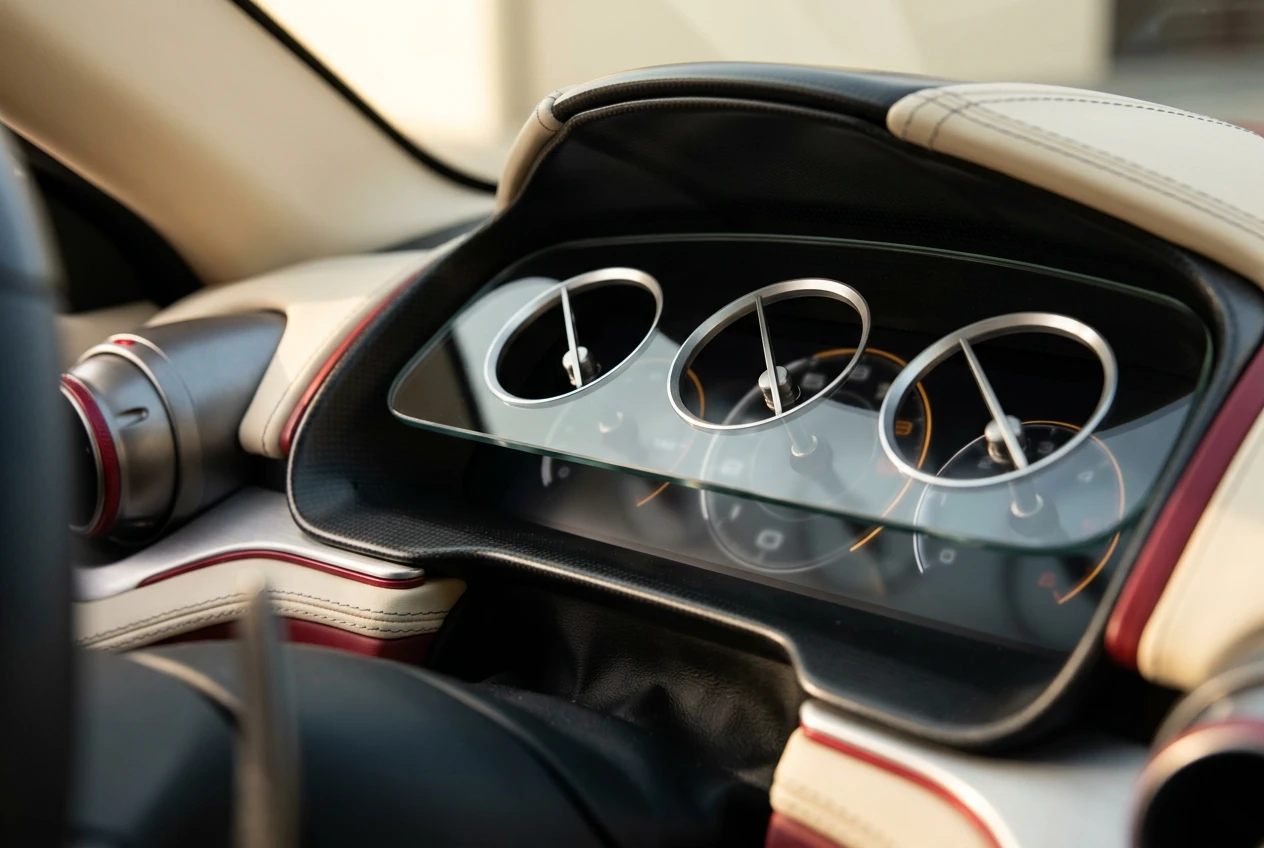
From Galaxy Selfie Holes to a 100mm Dashboard Cutout
HIAA, short for Hole In Active Area, is the technique Samsung Display introduced on the Galaxy S10 in 2019 to punch a single camera opening through an active OLED panel without breaking the surrounding pixels. The company says it now holds more than 500 patents tied to the method.
The smartphone version of the hole is, at most, around 5 millimetres across. The new dashboard cutout is roughly 100 millimetres. The maths is straightforward: about a 20× jump in opening diameter, which means a far larger run of cut edges that have to be sealed against moisture and oxygen ingress, the two things that kill organic LED material over time.
Samsung Display was able to fully support the Ferrari Luce’s design philosophy of seamless software and hardware integration. The all-new display system implemented in the Ferrari Luce delivers an unprecedented cockpit experience, where Ferrari’s heritage and future-oriented technology coexist in harmony.
That is Ernesto Lasalandra, Ferrari’s chief research and development officer, in the official supplier statement. The diplomatic phrasing hides the engineering brief: build a 12-year automotive-grade panel with a hole big enough to fit a thumb through, in a cabin that will sit in 40°C parking lots and bake in direct sun.
Samsung’s answer was its Thin Film Encapsulation process, the same coating technique it uses to seal foldable phones. The company is repurposing a moisture barrier developed for the Galaxy Z Fold hinge zone to protect a needle-piercing instrument cluster. Strip away the supercar packaging and the Luce is, in display terms, a very expensive showcase of smartphone manufacturing IP scaled up by an order of magnitude.
Why Ferrari Went to Samsung, Not LG
LG Display has owned the automotive OLED conversation for most of the past decade, supplying flexible panels to Cadillac, Mercedes-Benz, Porsche, and Cadillac’s Celestiq programme. Samsung Display has been the challenger, with a smaller share concentrated in Hyundai Motor Group brands at home in Korea.
The Premium Wedge Strategy
Picking up the Luce is not a volume win. Ferrari will build the car in the low thousands per year, and at €550,000 a unit the panel order is rounding error against Samsung Display’s wider sales. The value is positional. A Ferrari supply contract, with on-record praise from the chief R&D officer, is the kind of marquee deal a Tier 1 display vendor uses to walk into BMW M, Bentley, and the next Aston Martin programme with a shorter pitch.
The Tech Differentiator
LG’s automotive OLED strength has been in tandem-stack brightness and curved form factors. HIAA is something LG does not currently sell into the auto channel at this scale, and the multi-layer binnacle is what Omdia’s January 2026 automotive OLED outlook identified as the kind of differentiated cockpit feature European premium brands are still willing to pay a margin for, even as Chinese OEMs pivot to cheaper FALD LCD alternatives.
The Korean Industrial Read
South Korea’s display industry has been hunting a flagship Western automotive win for three years. Reporting in The Korea Times’ coverage of the supply deal framed it as a strategic counter to BOE’s expansion into mid-tier automotive contracts. Samsung’s geopolitical positioning has been complicated by tariff pressure in the United States, and a Maranello-stamped reference customer gives Seoul a clean export story to sit alongside the broader trade conversation our newsroom has been tracking in Samsung chief Lee Jae-yong’s last-minute Seoul-Washington trade push.
The Car Wrapped Around the Screens
The hardware spec sheet is its own headline. Ferrari is putting four permanent-magnet motors, one per wheel, into a five-seat liftback with rear coach doors. Combined output sits at 1,035 horsepower and 730 pound-feet of torque, and the 122 kWh pack (roughly 112 kWh usable) draws on SK On pouch cells.
- 0 to 62 mph in 2.5 seconds
- WLTP range of 530 kilometres, or 329 miles
- Peak DC charging at 350 kilowatts
- Five seats, four doors, 21 cubic feet of cargo
- Active suspension derived from the F80 hypercar programme
Deliveries start in the fourth quarter of 2026 in Europe. United States arrivals are scheduled for the second quarter of 2027, pending federal certification. That gap matters for Samsung: it means the first wave of automotive press reviews, the ones that fix a product’s perception, will all be European, all be on European panel-supply news cycles, and all run before US tariff schedules for finished autos can shift the conversation.
Marc Newson worked alongside Ive on the cabin. Flavio Manzoni’s Ferrari Style Center retained authorship of the exterior. The screens are not the only design statement, but they are the only one that ships with a Korean supplier’s logo on the parts list.
Where the OLED Bet Could Still Snap
The automotive OLED segment is having a harder year than the consumer-electronics OLED segment. Omdia’s outlook, cited above, calls out that adoption is shifting from feasibility to practicality, with cost the binding constraint. Chinese OEMs are choosing FALD-backlit LCD over OLED in the volume tiers. Incremental OLED demand in 2026 is coming almost entirely from European premium brands and a narrow band of Korean and Japanese launches.
The Cost Wall Below Ferrari Money
A Ferrari can absorb a multi-thousand-euro display BOM without changing its price story. A €70,000 luxury sedan cannot, and that is where the volume sits. If Samsung wants to repeat the Luce playbook on a Mercedes EQS successor or a BMW Neue Klasse flagship, the cost curve on freeform-cut, multi-layer panels has to bend hard inside the next 24 months.
The Halo Risk
Halo products generate headlines without generating contracts. The danger for Samsung is that the Luce becomes the only car the company can point to, with the next German or Italian premium OEM choosing LG for a more conventional tandem-OLED dashboard at half the per-panel cost. The 500+ patent portfolio is a moat only if it gets exercised in another paying production programme before Ferrari delivers car number 500.
The Ferrari Variable
And Ferrari itself is not a guaranteed volume customer. The Luce is the marque’s first EV, the reception inside the Tifosi has been openly divided, and Maranello has not yet committed to a second electric model on the same display architecture. If the Luce underperforms on order intake, the follow-on contracts evaporate before they are signed.
Frequently Asked Questions
What is HIAA technology in the Ferrari Luce?
HIAA stands for Hole In Active Area, a Samsung Display technique for cutting an opening through an active OLED panel without breaking the pixel grid around it. Samsung introduced it on the Galaxy S10 smartphone in 2019 for the front camera, and the Luce binnacle scales the same idea to a hole roughly 100 millimetres across, around 20 times the diameter of the smartphone version.
How many OLED screens does the Ferrari Luce have?
Four panels from Samsung Display, in three cockpit zones. The driver’s binnacle uses a stacked 12.9-inch and 12-inch pair, the centre console runs a 10.1-inch panel, and a 6.3-inch screen sits between the rear seats for climate and telemetry. All four are OLED, not LCD.
How much does the Ferrari Luce cost?
The European starting price is €550,000, equivalent to about $640,000 at current exchange rates. Ferrari has not published a finalised United States MSRP, with US deliveries scheduled for the second quarter of 2027 pending federal certification.
When can I buy a Ferrari Luce?
Customer deliveries begin in the fourth quarter of 2026 in Europe. United States customers will receive cars from the second quarter of 2027. Allocation is expected to follow Ferrari’s standard invitation-led process for limited models, which favours existing customers over new buyers.
Did Jony Ive design the whole Ferrari Luce?
No. Sir Jony Ive’s LoveFrom studio, working with Marc Newson, co-designed the cabin in collaboration with Flavio Manzoni’s Ferrari Style Center. Manzoni’s team retained authorship of the exterior. The OLED-led cockpit is the most visible LoveFrom contribution and the part most directly tied to the Samsung Display supply deal.
Why is Samsung supplying the displays instead of LG?
Samsung’s HIAA portfolio gave Ferrari a stacked, hole-pierced binnacle architecture that LG Display does not currently sell into the automotive channel at this scale. LG remains the volume leader in automotive OLED, with deeper Western premium relationships, but Samsung’s smartphone-derived hole-cut and thin-film-encapsulation IP fit the Luce’s analogue-needle design brief more directly.
The first Luce reaches a European driveway in roughly five months. The second flagship Samsung Display contract, the one that decides whether HIAA becomes a Korean automotive franchise or a Maranello footnote, has not yet been announced.
 Scotland Reader Photos Capture Eclipse Week Beyond the Sky
  Scotland’s Rare World Cup Win Over Haiti Still Echoes
  Scottish Morning Roll Campaign Echoes Baguette Path to Unesco
  Samsung Passport Fold8 Turns Apple Fans Into Switchers
  Android’s Quiet Shift to Ambient AI Hardware This Week
  Poco F9 Leak Hands Global Buyers Less Battery for More Money