
 Ishan Crawford
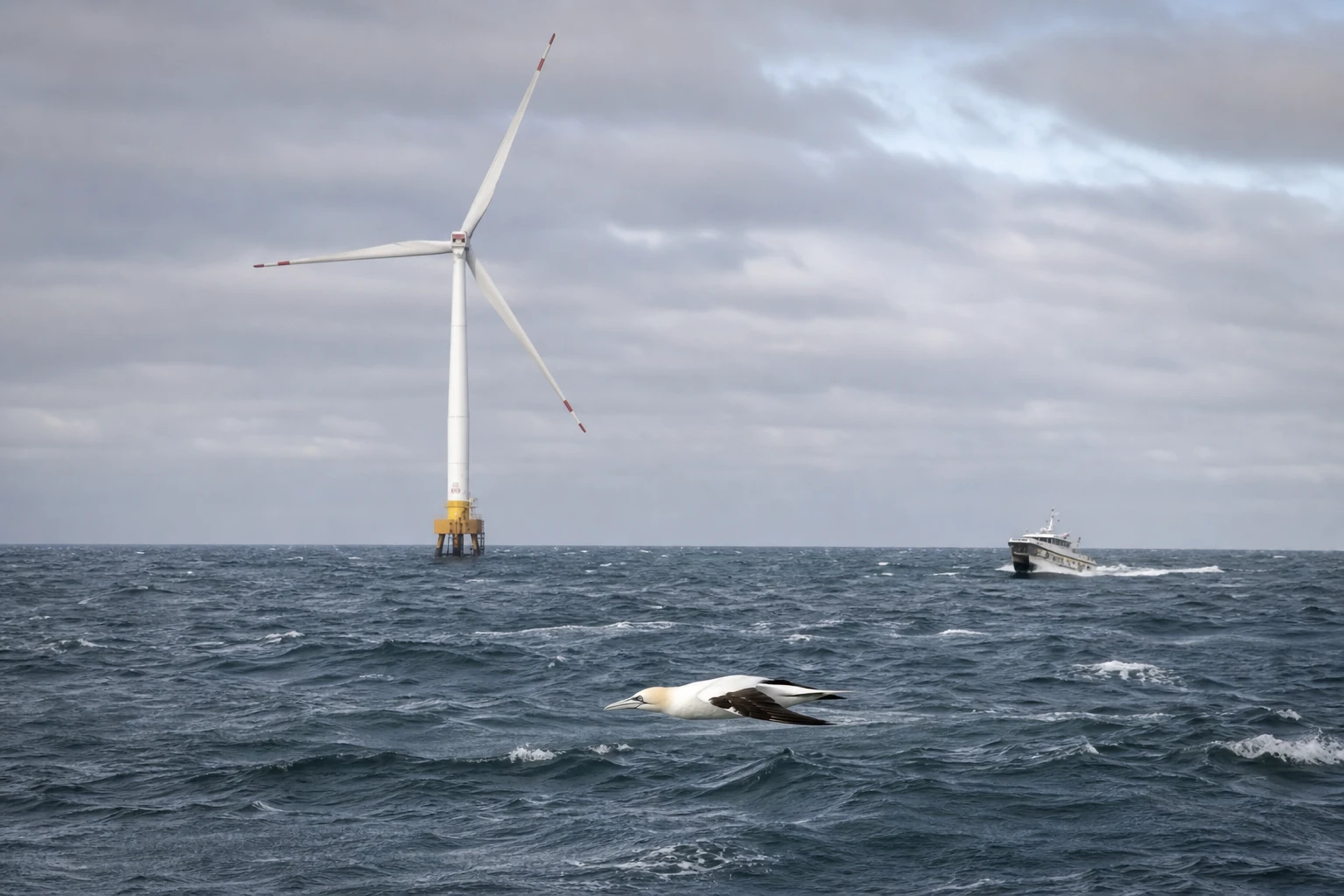
 Scotland has approved two offshore wind farms big enough to power roughly two million homes, though the turbines still cannot turn until regulators sign off on a seabird protection plan. The Caledonia North and South projects in the Moray Firth received government consent and marine licences this month, clearing the way for up to 140 turbines across 429 square kilometres of the outer firth.
That is the headline. The harder part sits behind it. Consent is not a construction permit, and the specific condition still outstanding, a detailed seabird compensation plan, is the exact same requirement that has kept Scotland’s other big approved offshore wind farm tangled in petitions, objection letters and a contested phasing application nearly a year after it won the same government sign-off.
Ocean Winds Commits £1.7 Billion to the Moray Firth
The developer behind both projects is Ocean Winds, a company formed in 2019 as a 2019 joint venture between EDPR and Engie, the Portuguese and French energy groups. Ocean Winds is not new to these waters. It already operates in the same firth through the Moray East and Moray West wind farms built with the same two parent companies.
For Caledonia, Ocean Winds has committed to spend £1.7 billion (about $2.2 billion) in Scotland across the two developments, according to the Scottish Government. Combined, the projects are expected to generate around two gigawatts of electricity, enough by government estimates to supply about two million households.
The two wind farms are built differently, which matters for how quickly each can move. Caledonia North uses fixed bottom foundations only. Caledonia South mixes fixed bottom with floating turbines, a technology Scotland is trying to lead globally.
| Project | Foundation | Distance From Wick | Distance From Banff | Capacity | Turbines |
|---|---|---|---|---|---|
| Caledonia North | Fixed bottom | About 28km | About 48km | 1 gigawatt | Up to 77 |
| Caledonia South | Fixed bottom and floating (up to 39 floating) | About 45km | About 35km | 1 gigawatt | Up to 78 |
Ministers capped the combined total at 140 turbines even though the individual project ceilings add up to more than that, leaving Ocean Winds to work out the final mix once detailed engineering is locked in. First Minister John Swinney called the decision a milestone, saying the government had given the applications very careful consideration and that the consent marked a significant step in reaching net zero.
What Has to Happen Before Construction Can Start?
Consent and marine licences cover the principle of the wind farms. Four practical steps still separate that paperwork from steel going into the water, and none of them has a confirmed date yet.
- Ocean Winds must submit a detailed seabird compensation plan and get it approved by Scottish ministers before any construction begins.
- The company still needs to reach a final investment decision covering both projects.
- Caledonia needs a confirmed slot in the transmission grid, an area the sector already flags as congested.
- Supply chain and construction contracts for turbines, foundations and vessels still need to be finalised.
The seabird plan is the most legally sensitive of the four. Scottish offshore consents require a Habitats Regulations Appraisal, and where a project is expected to harm protected seabird colonies, the developer has to fund measures elsewhere that produce an equivalent benefit. Regulators have flagged a limited supply of like-for-like compensatory measures across the UK, which is precisely why this step keeps stretching out for other developers.
Berwick Bank Shows How Long That Can Take
Scotland’s other large approved offshore project offers a preview. The Scottish Government consented Berwick Bank on the same condition in August 2025, requiring developer SSE Renewables to produce its own detailed seabird compensation plan before proceeding.
Almost a year on, that plan still has not cleared. Conservation groups have kept up a sustained campaign against it. The Scottish Seabird Centre delivered a petition carrying more than 12,500 signatures to SSE’s offices in March, and in June it wrote to the Scottish Government objecting to a new phasing variation application for the project.
If the compensation system isn’t robust, we risk pushing some colonies towards local extinction.
That warning came from the Scottish Seabird Centre, which has also criticised the government’s wider reform plans for strategic compensation, arguing they could allow real harm in exchange for compensation that is vague or poorly targeted. The group supports offshore wind broadly. It just does not trust the current compensation framework to protect colonies that are already in decline.
Where the two sides disagree:
- The Scottish Government and developers argue that consent already followed a full Environmental Impact Assessment and public consultation, and that a seabird plan is a standard, solvable next step rather than a barrier.
- The Scottish Seabird Centre and allied groups including RSPB Scotland say the compensation model is not rigorous enough for colonies of gannets, kittiwakes, guillemots and puffins already under pressure from other threats.
- Crown Estate Scotland says industry confidence remains steady, but acknowledges grid capacity and transmission charging are unresolved problems across the whole pipeline, not just for one project.
Nothing about Caledonia guarantees the same fight. Its Moray Firth site is not the same battleground as Berwick Bank’s Firth of Forth location, and the two projects carry different seabird risk profiles. But the process both must clear is identical, and Berwick Bank is the only working example of how long that process can run.
Four Years, Twenty Projects, Two Consents
Zoom out and the pace looks slower than the celebratory language suggests. Crown Estate Scotland’s original ScotWind leasing round was announced on 17 January 2022, handing out roughly 25 gigawatts across 17 projects, with a clearing round that August adding three more and 2.8 gigawatts.
Four and a half years later, only two batches of those projects have actually secured offshore consent. West of Orkney was first. Caledonia North and South is the second. As of early June, the Scottish Government’s Marine Directorate was still working through 14 further applications.
Some ScotWind bets have not survived the wait at all. Shell handed back its 3 gigawatt CampionWind lease in November 2025, and Ocean Winds itself, the same developer now celebrating Caledonia, relinquished its 500 megawatt Arven South lease in March 2026. The leasing round that once totalled close to 29 gigawatts has already shrunk at the edges before most of it has even reached consent.
The Grid Queue Waiting on the Other End
Even a cleanly approved seabird plan does not solve everything. Crown Estate Scotland’s latest supply chain analysis, produced with EY-Parthenon, found that grid connection delays and transmission charging remain live risks across the ScotWind pipeline, alongside rising costs and skills shortages.
The same analysis put average planned spend per ScotWind project at £1.6 billion, up from £1.5 billion in 2023, totalling £25.5 billion across sixteen projects that have published supply chain commitments. Ocean Winds’ £1.7 billion figure for Caledonia sits close to that average, not far above it.
Mike Spain, Crown Estate Scotland’s interim director of energy and infrastructure, put the tension plainly: confidence in the sector remains steady, he said, but the prize will only be secured by targeting support where it is needed most. ScotWind has already returned more than £750 million in revenue to the public purse, money collected regardless of whether any particular project ever reaches the water.
Scotland’s government has set out ambitions running as high as 40 gigawatts of offshore wind by 2040, feeding into a UK-wide Clean Power target of 43 to 50 gigawatts by 2030. Caledonia’s two gigawatts are a real, countable step toward that number. They are also a reminder of how much of the remaining pipeline has not yet cleared the stage Caledonia just reached.
Frequently Asked Questions
What is ScotWind?
ScotWind is Crown Estate Scotland’s offshore wind seabed leasing round, which awarded roughly 25 gigawatts across 17 projects in January 2022, followed by a clearing round that added three more projects and 2.8 gigawatts that August. Only two batches of those projects, West of Orkney and now Caledonia North and South, have secured full offshore consent so far.
What is a seabird compensation plan?
It is a developer-funded package of measures meant to offset harm to protected seabird colonies, required under Habitats Regulations when a wind farm is expected to affect species such as kittiwakes, guillemots or puffins. In practice, if a project is projected to cost a colony a set number of birds a year, the developer has to fund conservation work elsewhere designed to produce an equivalent gain.
Who owns Ocean Winds?
Ocean Winds is a 50:50 joint venture between EDP Renewables and Engie, formed in 2019. In Scotland it already operates the Moray East and Moray West wind farms in the same firth as the new Caledonia projects, alongside other developments across Europe and North America.
Why did Ocean Winds give up its Arven South lease?
Ocean Winds relinquished its 500 megawatt Arven South floating wind lease in March 2026, one of two ScotWind-linked leases handed back within a few months, alongside Shell’s 3 gigawatt CampionWind site returned the previous November. Neither company has attached a public seabird or environmental reason to those specific decisions.
When could the Caledonia wind farms start generating power?
No construction start date has been published. Ocean Winds still needs ministers to approve its detailed seabird compensation plan, needs to reach a final investment decision, and needs a confirmed grid connection slot before building can begin, and none of those steps carries a confirmed timeline yet.
 ONGC licence frees Venezuela cash and operatorship talks
  Anthropic Hits $65 Billion Run Rate and Flips the AI Cash Test
  Supreme Court grounds the fare free-for-all with three-week clock
  Gold Nears $4400 as Soft Data Meets Oil Inflation Risk
  Nifty Slips as Zaggle Circuits and Dhoot Debuts Big
  Diesel Crack Tops $100 as Iran Rhetoric Lifts Crude