
 Ishan Crawford
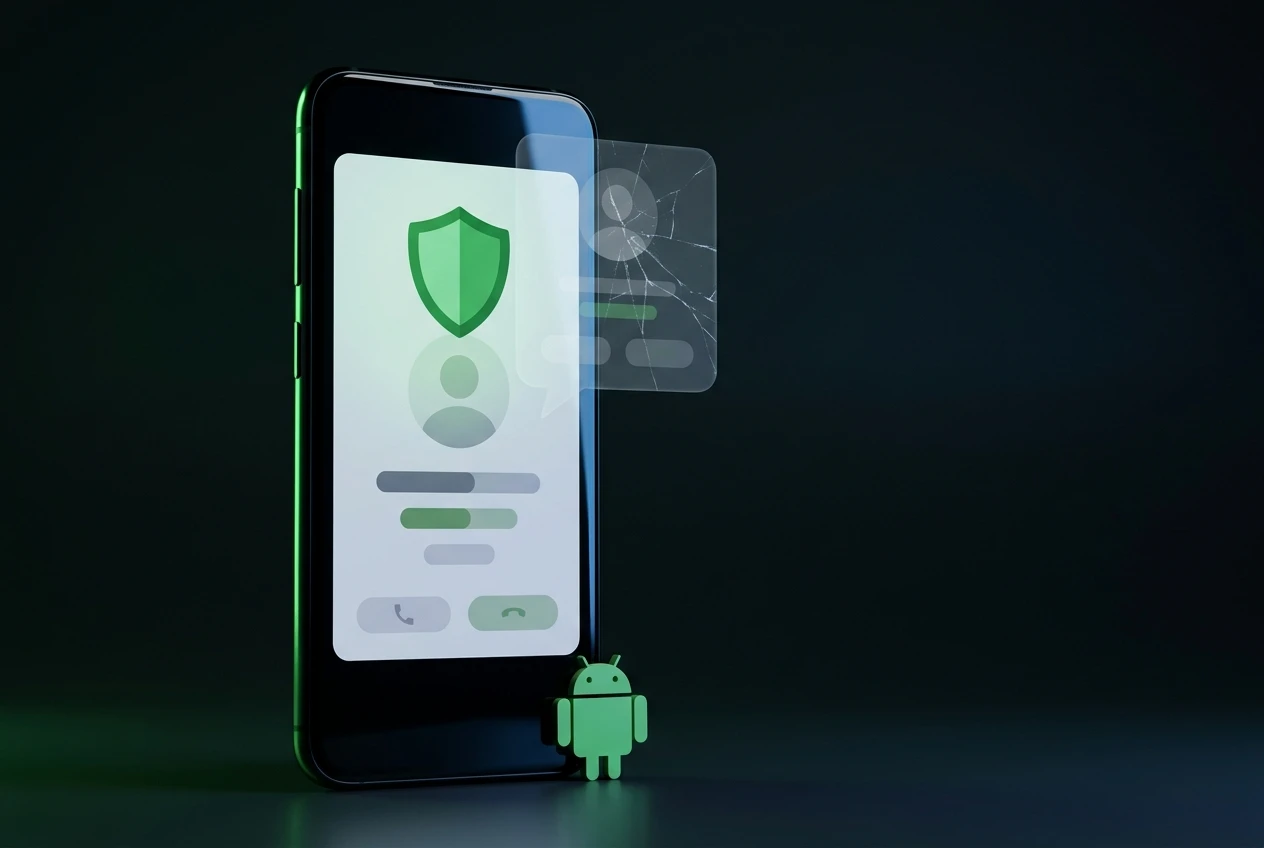
 Android fake call detection is rolling out as Google’s answer to a problem caller ID can’t solve: a saved contact name can be spoofed before an artificial intelligence (AI) voice clone starts talking. The new Phone by Google feature checks whether the call is coming from the contact’s device through an encrypted Rich Communication Services (RCS) signal, then warns the recipient when the check fails.
Google announced the feature on June 2, 2026, as part of its June Android Drop, with rollout to Android 12+ devices starting on Pixel phones in June. The catch sits in the requirements: Phone by Google, Google Contacts, Google Messages and RCS must all line up, and both sides of the call need Google’s dialer.
The Device Handshake Behind the Warning
Google’s fake call detection launch note describes a quiet exchange between devices. When a saved contact calls, the caller’s phone sends a confirmation signal in real time. The receiving phone checks that signal before the person answering has to decide whether the voice sounds right.
That changes the security question from voice recognition to origin. The check asks whether the call is coming from the device linked to the contact. A scammer who spoofs the number through internet calling software may still make the contact name appear on screen, but the spoofed call lacks the device confirmation that Google’s system expects.
Google’s caller ID and spam protection help page lists the moving parts behind the rollout:
- Android 12 or higher on the receiving device.
- The Google dialer, Contacts and Messages apps installed.
- RCS turned on in Messages.
- The caller and recipient both using the Google dialer.
The feature is on by default, Google says, and users can turn it off in the dialer settings. The warning appears before the caller has a chance to build urgency, which is where family emergency and bank impersonation scams usually earn their money.
Caller ID Gets a Second Check
Caller ID was built to display a number, then a name. It was never built to prove that the person holding the device owns the identity shown on the screen. Carriers, regulators and app makers have spent years adding reputation filters, call labels and authentication frameworks around that older system.
Google’s move adds a phone-app layer for saved contacts. The device behind the contact becomes the signal. The voice can be ignored for the first decision: answer, hesitate or hang up.
| Protection | Main Signal | Best Use | Gap |
|---|---|---|---|
| Caller ID and spam labels | Number reputation, business data and carrier signals | Unknown callers and known spam campaigns | Contact-name spoofing can still look familiar |
| Android device-origin check | Encrypted RCS confirmation from the contact’s device | Calls that appear to come from saved contacts | The app and RCS chain has to be present on both sides |
| Manual call-back | A known number or separate trusted channel | Emergency money requests and sensitive instructions | People under pressure often stay on the live call |
The table also shows why the feature is narrow by design. It does one job: check a contact-device claim. Unknown numbers, business calls, landlines and iPhones sit outside that first version.
The Scam Window Opens Before the Victim Thinks
The Federal Trade Commission (FTC), the U.S. consumer protection agency, said consumers reported losing more than $12.5 billion to fraud in 2024. Its FTC 2024 fraud loss data put imposter scams second by reported losses, behind investment scams.
- $12.5 billion in reported consumer fraud losses in 2024.
- $2.95 billion in reported losses to imposter scams.
- No. 2 contact method for fraud reports in 2024 was phone calls, after email.
The FTC has warned that voice cloning makes family and workplace requests feel more believable, especially when a caller sounds like a relative or boss. Its voice cloning scam warning tells people to call the supposed sender back using a number they already know.
That advice works when the victim pauses. Many don’t. CN Media reported on an AI voice cloning fake kidnapping scam that cost Deborah Del Mastro of Martinez, California, $5,400 after criminals used a fake version of her daughter’s voice during a five-hour call. A device check cannot solve every step in that kind of crime, but it can challenge the familiar name on the screen before the story takes hold.
Why Many Calls Won’t Be Checked
Google built the system around its own phone, contacts and messaging stack. That makes the first rollout easier to control, but it also limits coverage. A contact using an iPhone, a landline, a corporate softphone or a different Android dialer cannot provide the same confirmation signal in this version.
The support requirements also show why RCS is doing more work than ordinary messaging. SMS and MMS do not provide the same encrypted verification path. Google’s design uses RCS in the background, separate from the spoken call, so the person receiving the call doesn’t have to scan a code or compare numbers during an emergency.
The app chain may be the hardest part for ordinary users to understand. Someone can own a compatible Android phone and still miss coverage because RCS is off, Messages is absent, Contacts is out of date or a manufacturer dialer is handling calls. Google says other calling apps and device makers can adopt the technology because it rests on RCS, but adoption is still an open handoff.
Quick Share Shows Google’s Other June Priority
The same June Android Drop also expands Quick Share support for Apple’s AirDrop on selected devices. Google’s Quick Share to AirDrop instructions say an iPhone must be nearby, within Bluetooth range, and set to Everyone for 10 Minutes before the Android user sends the file.
Compatibility starts with recent Samsung Galaxy S and Z Fold or Flip models, recent Pixel devices and selected phones from Xiaomi, OnePlus, OPPO, Vivo and Honor. Samsung users also have to enable sharing with Apple devices in Quick Share settings.
The call-warning feature and the file-sharing update solve different annoyances. One is a fraud check. The other is cross-platform transfer. Both put Google in the middle of phone-to-phone trust, where the operating system decides whether another device can be treated as the one it claims to be.
CN Media’s recent coverage of Google and Samsung’s intelligent eyewear followed Android into head-worn devices. The June Drop brings the same platform ambition back to ordinary phone behavior: calls, contacts and nearby sharing.
RCS Carries the Adoption Burden
The GSM Association (GSMA), the mobile industry body behind RCS standards work, describes the RCS Universal Profile standard as a single industry-agreed set of features for operators, device makers and operating-system providers. That is the route Google points to when it says other companies can implement similar checks.
RCS gives the feature a shared technical base. It also gives the rollout a dependency outside the call screen. Carriers, device makers, phone apps and messaging apps all influence whether the confirmation path exists when a call arrives.
Apple’s move into RCS messaging has already made the standard more visible to iPhone users, but Google’s call check is still an Android-side feature at launch. AirDrop support in Quick Share shows Google can build bridges around Apple workflows when it wants to. Contact-call verification needs a different kind of bridge because it deals with identity, encryption and live phone behavior.
Default Protection Moves to the Phone
Mobile security is moving closer to the moment a user acts. CN Media’s report on Apple’s anti-snatch auto-lock work covered a similar shift in theft protection: detect the risky moment on the device, then interrupt it before the user loses control.
Google is applying that pattern to voice scams. The warning lands before the scammer has explained the fake emergency, named the bank transfer or asked for a code. A victim still has to make the final choice, but the phone can now challenge the caller’s claimed device before the conversation becomes a test of nerve.
For Android users, the practical step is plain: keep caller ID and spam protection on, keep Messages’ RCS chats enabled, and treat urgent money requests as suspect even when the caller name is familiar. The rollout starts on Pixel phones in June, and wider protection depends on other Android apps and manufacturers making the same handshake commonplace.
 Scotland Reader Photos Capture Eclipse Week Beyond the Sky
  Scotland’s Rare World Cup Win Over Haiti Still Echoes
  Scottish Morning Roll Campaign Echoes Baguette Path to Unesco
  Samsung Passport Fold8 Turns Apple Fans Into Switchers
  Android’s Quiet Shift to Ambient AI Hardware This Week
  Poco F9 Leak Hands Global Buyers Less Battery for More Money