
 Ishan Crawford
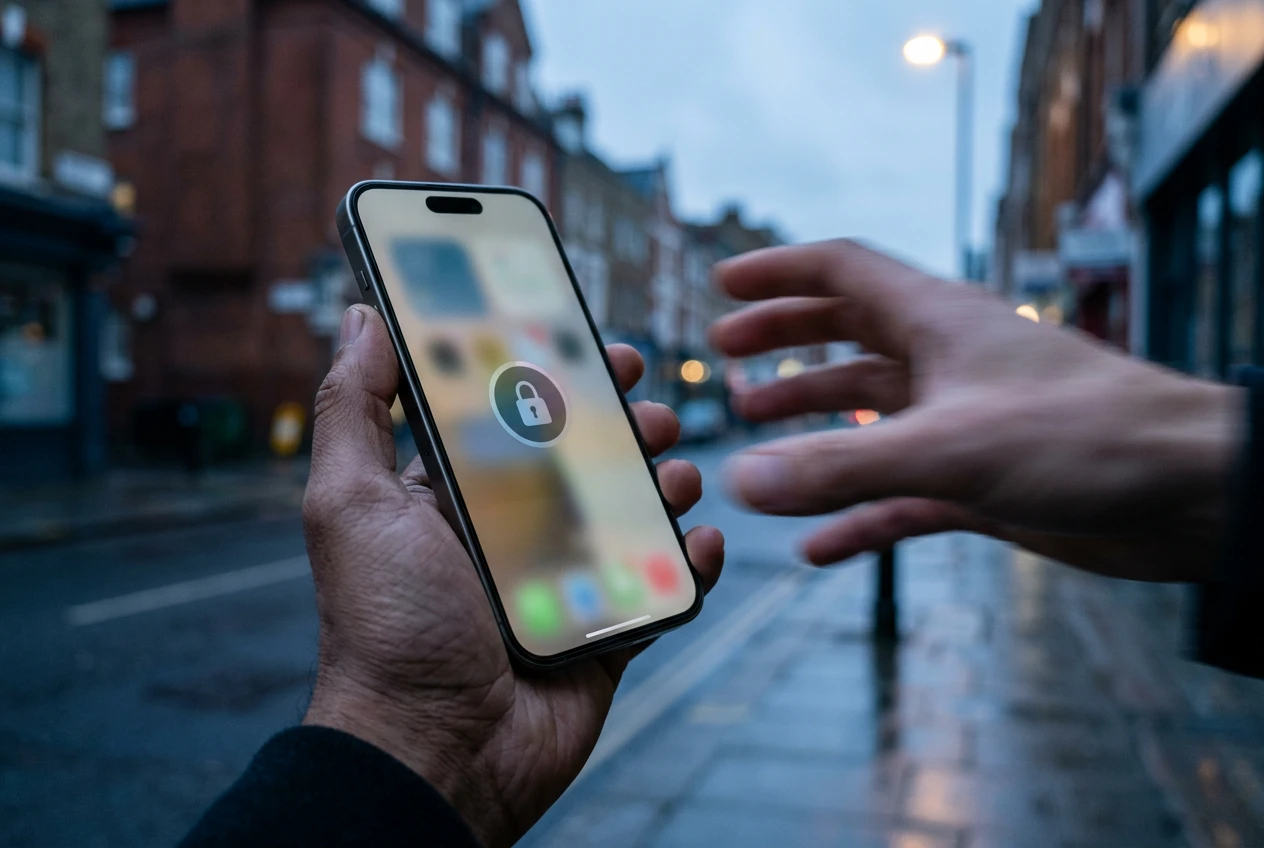
 Apple is building an iPhone feature that locks the device the instant it is yanked from a user’s hand, according to unreleased code surfaced by 9to5Mac. The detection system reads the accelerometer, watches the distance to a paired Apple Watch, and checks whether the iPhone is sitting on a known Wi-Fi network before deciding to slam the lock screen down and trigger Stolen Device Protection rules.
The work lands at the end of an ugly stretch for Apple’s anti-theft messaging. London recorded roughly 71,391 mobile-phone thefts in 2025, a 12.3% drop on the previous year but still one device snatched every seven minutes, according to the Metropolitan Police. The Met blamed Apple in November. India tried to force a government tracking app on every iPhone in December. Apple said no to both. This new feature is the company’s first concrete answer.
What the Code Reveals
The discovery is buried in iOS development code, not in any marketing page. There is no shipping date, no product name, and no Apple press confirmation. What the code shows is intent: Apple has built the logic scaffolding for a snatch-detection system, and the signals it reads are specific enough to rule out an accidental drop or a normal hand-off.
Three categories of signal carry the detection decision:
- Motion data from the accelerometer, looking for the sharp velocity spike that distinguishes a yank from a pocket transfer.
- Distance from a paired Apple Watch, which acts as a proxy for the original owner’s body staying behind while the iPhone moves rapidly away.
- Context flags, including whether the iPhone is on a familiar Wi-Fi network and whether it sits at a saved home or work location.
When the three combine into a high-confidence snatch reading, the device locks and inherits the protections that Apple’s Stolen Device Protection rules already apply: biometric-only access to passwords and payment cards, a one-hour security delay before an Apple Account password can be changed, and no passcode fallback for sensitive flows.
How the Snatch-Detection Logic Works
The interesting engineering sits in the fusion layer. A motion spike alone is not enough; people throw their phones onto sofas, drop them from chairs, and pass them between hands every day. Apple’s logic appears to require corroboration before the lock fires.
The Accelerometer Reads the Yank
iPhones already use the accelerometer for crash detection, fall detection on Apple Watch, and image stabilisation. Snatch detection borrows the same hardware but tunes the threshold for the horizontal sprint pattern that a thief on a moped or e-bike produces. The Met has spent the last two years documenting that exact pattern in London, where suspects on two wheels grab phones off pavements at high speed.
The Apple Watch Becomes the Tell
The Watch is the elegant part of the design. If the phone races away from the Watch within seconds, the wearer almost certainly did not move with it. That asymmetry is hard to fake and easy to measure, because both devices already exchange proximity data over Bluetooth for unlock and handoff features. Users without a Watch get a weaker version of the system, since the logic falls back on motion plus location context.
The Familiar-Location Exemption
The final layer is the false-positive guard. If the iPhone is on the home Wi-Fi, at a saved work address, or at a location it sees every day, the system relaxes. That mirrors how Stolen Device Protection turned on by default in iOS 26.4: protection is strict when you are out, lenient when you are home.
Android Got There Nineteen Months Earlier
Google shipped Theft Detection Lock as part of Android’s anti-theft bundle in October 2024. It uses the same core idea: an AI model trained on accelerometer patterns that look like a snatch followed by a sprint, ride, or drive. When the model fires, the screen locks. Google made it work on any Android phone running version 10 or later, which covers about 90% of the active install base.
Apple’s planned version reads as more cautious and more contextual. Where Google leans on a single sensor signal plus an on-device model, Apple appears to want at least two independent confirmations before it acts.
| Feature | Android Theft Detection Lock | Apple snatch-lock (in code) |
|---|---|---|
| Launch | October 2024 | Under active development |
| Primary signal | Accelerometer plus on-device AI model | Accelerometer plus contextual fusion |
| Secondary signal | None required | Distance from paired Apple Watch |
| Suppression rules | Stable Wi-Fi or Bluetooth, recent unlocks | Familiar Wi-Fi, saved home or work location |
| Device coverage | Android 10 and later, about 90% of base | Not yet confirmed |
| Action on trigger | Screen locks | Screen locks plus Stolen Device Protection rules |
The shipped-versus-rumoured gap explains why London police spent late 2025 holding up Google as the cooperative example and Apple as the holdout. The technology was already on the market. Apple’s absence from the list was conspicuous, and it was loud.
Why London’s Phone-Snatch Crisis Forced the Question
The political pressure built through 2024 and exploded last autumn. Over the four years to early 2025, more than 224,000 phones were reported stolen in London. City Hall responded with a dedicated mobile-phone theft Command Cell and £4.5 million in fresh funding, sited in the West End where the snatches cluster.
The Met’s November Charge
In November 2025, the Metropolitan Police went public with a sharper accusation. The Met said Apple had access to the UK’s National Mobile Phone Register but only queried it to validate trade-in devices, never to identify stolen ones sitting on the live network. Police framed that as a choice. Apple, the Met implied, treated registered theft data as a commercial input, not a recovery tool.
Apple’s Response
We are not seeing that.
That was Apple’s Gary Davis in June 2025, telling the Met to file traditional stolen-device requests through formal channels. The line played as dismissive in the British press, and it set the tone for the November escalation. By then thieves were openly preferring iPhones over Samsung handsets on London streets because resale value held up better in the Shenzhen parts market. Apple’s brand strength had become a theft incentive.
The Foil Workaround
The other awkward fact for Apple is how easily Find My gets defeated. London thieves wrap snatched iPhones in aluminium foil within seconds, blocking the tracking signal long enough to clear the area. Police footage showed suspects buying foil by the kilometre at Costco. Find My is built for lost phones, not adversarial ones. A snatch-lock that fires at the moment of theft, before the foil comes out, closes that specific gap.
The India Standoff Sits Over Any Government-Sharing Layer
While London was pressing for more cooperation, India was pressing for too much. In December 2025, the Department of Telecommunications ordered every smartphone maker to preinstall a non-removable government app called Sanchar Saathi within 90 days. The stated purpose was theft and fraud tracking, including IMEI blocking. The implied capability was broader.
Apple refused. The company told Delhi it does not preinstall government apps in any market, citing privacy and security risk, and pointed to the surveillance potential of a state-controlled, undeletable client running on every device. Within days, after intense industry backlash, the government withdrew the mandate.
That standoff frames the snatch-lock work in a specific way. Apple’s pitch to regulators worldwide is that it can solve the theft problem inside the device, on the user’s terms, without handing a government a tracking pipe. Snatch-lock is the technical proof of that pitch. If it works at the sensor level, Apple has a credible answer the next time a national police force asks for a backdoor in the name of stolen-device recovery. The framing matters: London’s 71,000-device figure becomes a problem for engineering, not for policy.
An iOS 27 Slot Looks Plausible
Code in a development branch is not a shipping feature. Apple has had snatch-detection logic sitting alongside crash detection and fall detection for some time, and not every internal prototype reaches a public build. What is different now is the political calendar. WWDC opens on June 9, three weeks from publication. Apple’s pattern is to announce its major security features there, with rollout following in the autumn iOS release.
If the snatch-lock is named on stage in June, expect three things to follow. A British government statement praising the move within 48 hours, because the Met needs the win. A demonstration that the feature works without a paired Apple Watch, because the install base of Watch-less iPhones is too large to leave behind. And a quiet expansion of Stolen Device Protection to cover more sensitive flows, since the snatch-lock is more useful when the locked state itself protects more.
If WWDC passes with no mention, the feature stays in code and the Met fight resumes. That is the test worth watching. Apple does not usually let a finished anti-theft mechanism sit on a shelf when a European capital is publicly accusing it of indifference; but Apple also does not announce on anyone else’s timetable. The next signal arrives on June 9. Until then, the foil is still selling.
 Scotland Reader Photos Capture Eclipse Week Beyond the Sky
  Scotland’s Rare World Cup Win Over Haiti Still Echoes
  Scottish Morning Roll Campaign Echoes Baguette Path to Unesco
  Samsung Passport Fold8 Turns Apple Fans Into Switchers
  Android’s Quiet Shift to Ambient AI Hardware This Week
  Poco F9 Leak Hands Global Buyers Less Battery for More Money