
 Ishan Crawford
 Hyundai has been spotted testing a new sub-4-metre electric SUV on South Korean roads, the most concrete evidence yet that the model codenamed HE1i is moving from planning to production. The compact battery-powered crossover is expected to reach Indian showrooms by the end of 2026 or in the early months of 2027, and the stakes for the brand go well beyond a single nameplate.
The HE1i is the first test of a strategy Hyundai has been telegraphing since its Investor Day 2025: build a subcompact electric SUV in India, sell it to Indian buyers, and ship it around the world. India is positioned as the primary manufacturing hub for the SUV. With the Tata Punch EV cited as the most direct rival in the sub-4-metre bracket, the new model will enter a segment where Tata is the dominant player.
The HE1i Takes Shape on Korean Roads
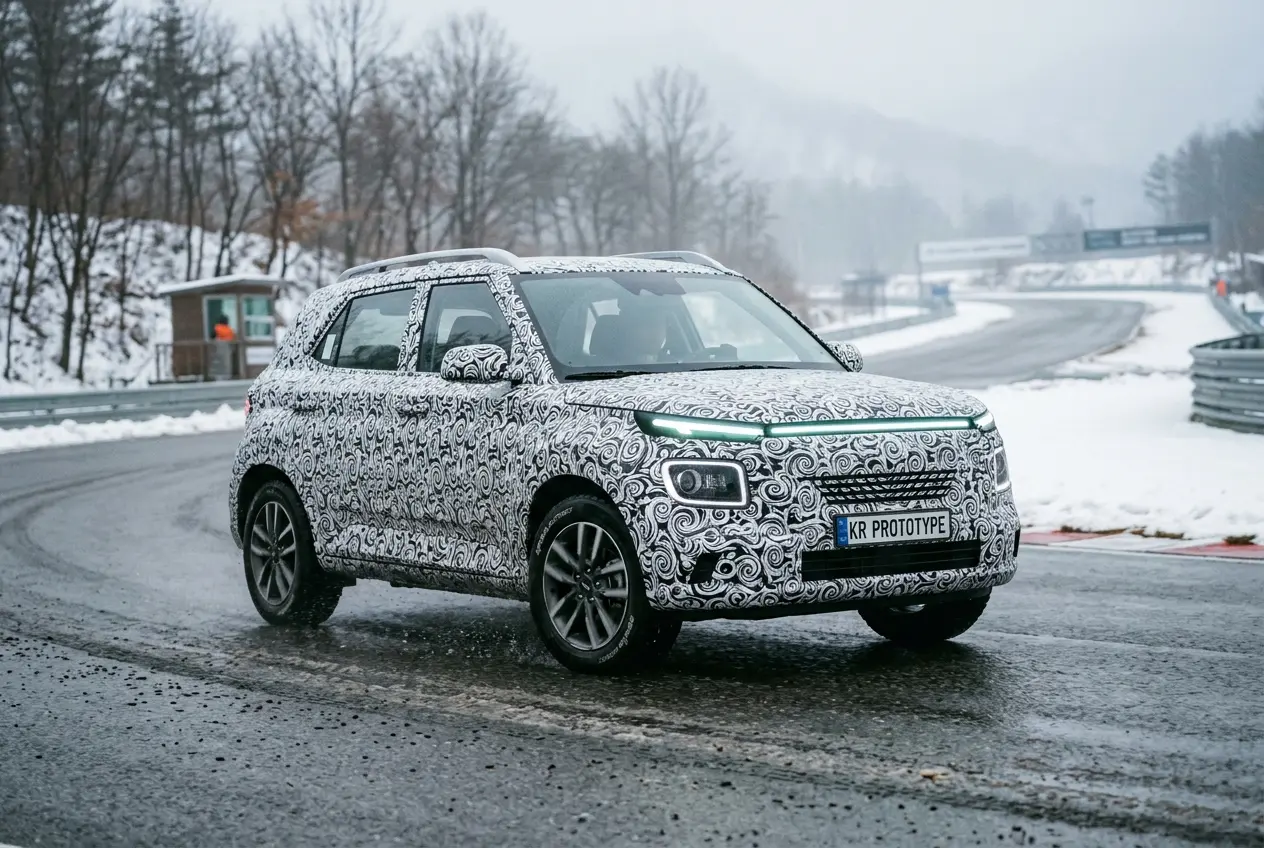
Test mules for the sub-4-metre electric SUV have been spotted on multiple occasions, and the latest sighting, reported from South Korea per a fresh round of camouflaged test mule imagery, gives the clearest view of the production body. The vehicle has a tall, boxy aesthetic, and the profile echoes the Hyundai Inster EV that is already on sale in Europe and other markets.
Top-mounted LED DRLs sit high on the front fascia, with split headlamps placed lower above the bumper. The grille is closed off, in line with EV convention. The bodywork is intentionally simple, with flat panels that give the SUV a sturdy, upright presence. The roofline and window line run almost parallel to the ground, per the spy-shot writeup.
Design highlights visible in the latest spy shots include:
- A flat roof and a roofline that runs almost parallel to the ground
- Blacked-out ORVMs and functional roof rails
- Body cladding along the lower edges
- 17-inch alloy wheels wrapped with Apollo tyres
- A raked windshield at the rear, a chunky bumper, and one of the shortest rear overhangs in the segment
Pixel-style lighting elements at the front and rear remain a possibility for the production version, though Hyundai has not confirmed that detail. The overall footprint is meant to slot below the Creta, putting the HE1i directly into the sub-4-metre bracket that attracts India’s highest-volume price-conscious buyers.
Built on E-GMP (K), Built to Take On the Punch EV
The HE1i sits on a modified version of the modular E-GMP (K) platform, the same affordable architecture that underpins the Inster EV sold overseas. The platform supports 800V fast charging capability, a configuration that would put the India-built HE1i in rare company among subcompact EVs.
designed, engineered and built in India for Indian customers
The line above comes from Jose Munoz, president and CEO of Hyundai Motor Company, speaking at Hyundai’s Investor Day 2025. That positioning, building in India for Indian customers first, explains the choice of a modular platform designed to scale across markets. The model is being developed in India with the explicit purpose of challenging the Tata Punch EV, the segment leader. It is also expected to be a sister car to the Kia Syros EV, sharing powertrain, dimensions, and features.
The FY27 commitment of two new SUV nameplates sets out the broader Hyundai plan: two brand-new SUV nameplates for India, the first new Hyundai nameplates here in over four years, with a mid-size SUV sitting above the HE1i in the launch queue. With the Creta moving up in size and price, the mid-size slot is expected to be filled by a model similar in size to the Bayon sold in Europe.
Two Battery Packs, Two WLTP Ranges
Powertrain configurations for the new electric SUV are expected to mirror the Inster EV that already ships in Europe, which means two battery sizes, two motor outputs, and two certified ranges. The Inster Standard Range pairs a 42 kWh pack with a 97 hp, 147 Nm motor, while the Long Range uses a 49 kWh pack with a 115 hp, 147 Nm motor. The same two packs are likely to be carried over to the India-spec HE1i, though Hyundai has not formally confirmed local outputs. Certified WLTP range for the Inster sits at 300 km on the 42 kWh pack and 355 km on the 49 kWh pack.
India-spec numbers may move once the local testing cycle is complete, but the order of magnitude gives buyers a useful starting point. The HE1i is expected to support DC fast charging of up to 120 kW, taking the battery from 10% to 80% in around 30 minutes under the right conditions. With heavy localisation, including battery packs from Exide sourced locally, the HE1i will carry a price band of around Rs 10 lakh for the base variant and roughly Rs 14 to 15 lakh for the top variant.
A Loaded Cabin With Level 2 ADAS
Interior details of the HE1i have not been revealed yet, but the Inster EV that the subcompact is broadly based on points to a loaded equipment list. Confirmed and expected features include the dual-screen setup, ADAS, and Vehicle-to-Load capability already seen on the Inster.
Hyundai is expected to fit the HE1i with the following:
- Dual 10.25-inch screens for infotainment and instrument cluster
- Automatic climate control, wireless Android Auto and Apple CarPlay
- Ventilated front seats and a sunroof
- Vehicle-to-Load (V2L) capability
- Flexible interior layouts for bulky cargo
On the safety side, the HE1i is set to ship with 6 or 7 airbags and a 360-degree camera with blind-spot monitoring. The Level 2 ADAS suite, which handles adaptive cruise control, lane-keep assist, and autonomous emergency braking, is positioned as a class-above feature in the sub-4-metre EV bracket. Hyundai has confirmed that Level 2 ADAS is locked in for the India-spec HE1i, with each of those safety items standard equipment on the Inster EV sold abroad.
Made in Sriperumbudur, Sold Around the World
The HE1i’s most distinctive strategic feature is where it will be built. Hyundai plans to manufacture the sub-4-metre electric SUV at its Sriperumbudur factory in Tamil Nadu, source battery packs from Exide, and ship the model to global markets.
The broader Indian auto market is already moving on price: Hyundai India has flagged a June 2026 price hike of up to Rs 12,800, while rival Tata has lined up a July 2026 EV price increase of up to 1.5%. The HE1i will lean on its localised supply chain to stay competitive. The model is also expected to share its powertrain, dimensions, and features with the Kia Syros EV, giving the Hyundai Motor Group a second sub-4-metre EV nameplate built on the same platform.
The First Domino in 26 New Models
The HE1i is one piece of a much larger product offensive. Hyundai has committed to introducing 26 new models in India by FY2030, with two of those new SUVs landing in the current financial year, the HE1i and a mid-size SUV.
The HE1i is the first of the two to be formally identified, and the first to surface in test-mule form. Tata Motors already sells the Punch EV and the Nexon EV in the same sub-4-metre EV segment, and has had them in market longer than Hyundai has had the HE1i in development. The HE1i enters a category where Tata is the established player, not the challenger.
Munoz confirmed at Investor Day 2025 that the HE1i will be the 2027 India launch. Production is confirmed at Sriperumbudur, and the E-GMP (K) platform is in place.
Frequently Asked Questions
What is the Hyundai HE1i?
The HE1i is the internal codename for Hyundai’s upcoming sub-4-metre electric SUV for India, a model built on a modified version of the E-GMP (K) platform used by the Inster EV sold in Europe.
When will the HE1i launch in India?
The HE1i is expected to launch by the end of 2026 or in the early months of 2027, with Hyundai Motor CEO Jose Munoz confirming a 2027 India launch at Investor Day 2025.
What is the expected price of the HE1i?
Industry coverage points to an expected price band of around Rs 10 lakh for the base variant and roughly Rs 14 to 15 lakh for the top variant, anchored by heavy localisation including Exide-sourced battery packs.
How far will the HE1i go on a single charge?
The HE1i is expected to mirror the Inster EV’s two battery options, a 42 kWh pack with a 300 km WLTP range and a 49 kWh pack with a 355 km WLTP range, with India-spec numbers to be confirmed at launch.
What cars will the HE1i compete with?
The HE1i is aimed at the Tata Punch EV, the Tata Nexon EV, the Mahindra XUV 3XO EV, and the Kia Syros EV, with the Punch EV cited as the most direct rival in coverage of the model.
 Billionaires Pay Record Sums for Dinosaur Bones Science Cannot Study
  How a New Jersey Homeowner’s Quick Thinking Preserved a Rare Meteorite
  Iceland’s Eclipse Boom Looks Like the Faroe Islands All Over Again
  NASA Confirms Near-Earth Object 1998 SH2 Is a Hidden Comet
  Bharatgas Lite ZIP Pushes India’s LPG Giants Into a Delivery Race
  Toyota’s Next Five SUVs Reveal a Quiet Role Reversal With Suzuki