
 Ishan Crawford
 Samsung’s Galaxy Watch 9 is losing its in-house chip. Marketing images leaked three days before the device’s official debut show the smartwatch running on Qualcomm’s Snapdragon Wear Elite instead of the Exynos W1000 that powers the current Galaxy Watch 8, according to renders posted by longtime leaker Evan Blass.
That reverses what most of the leak world expected only months ago, when reports pegged the Snapdragon chip as an Ultra-only upgrade. Samsung’s cheaper watch is set to run the exact same processor as the one still carrying a premium price tag on the Watch Ultra 2, and that has consequences for both watches that go well past a spec sheet.
Marketing Images Confirm the Chip Swap
The images come from Blass’s Substack newsletter and include an official “Powered by Snapdragon Wear Elite” slide alongside a detailed exploded view diagram of the watch’s internals, giving the clearest visual confirmation yet of the hardware switch rather than just another spec sheet leak.
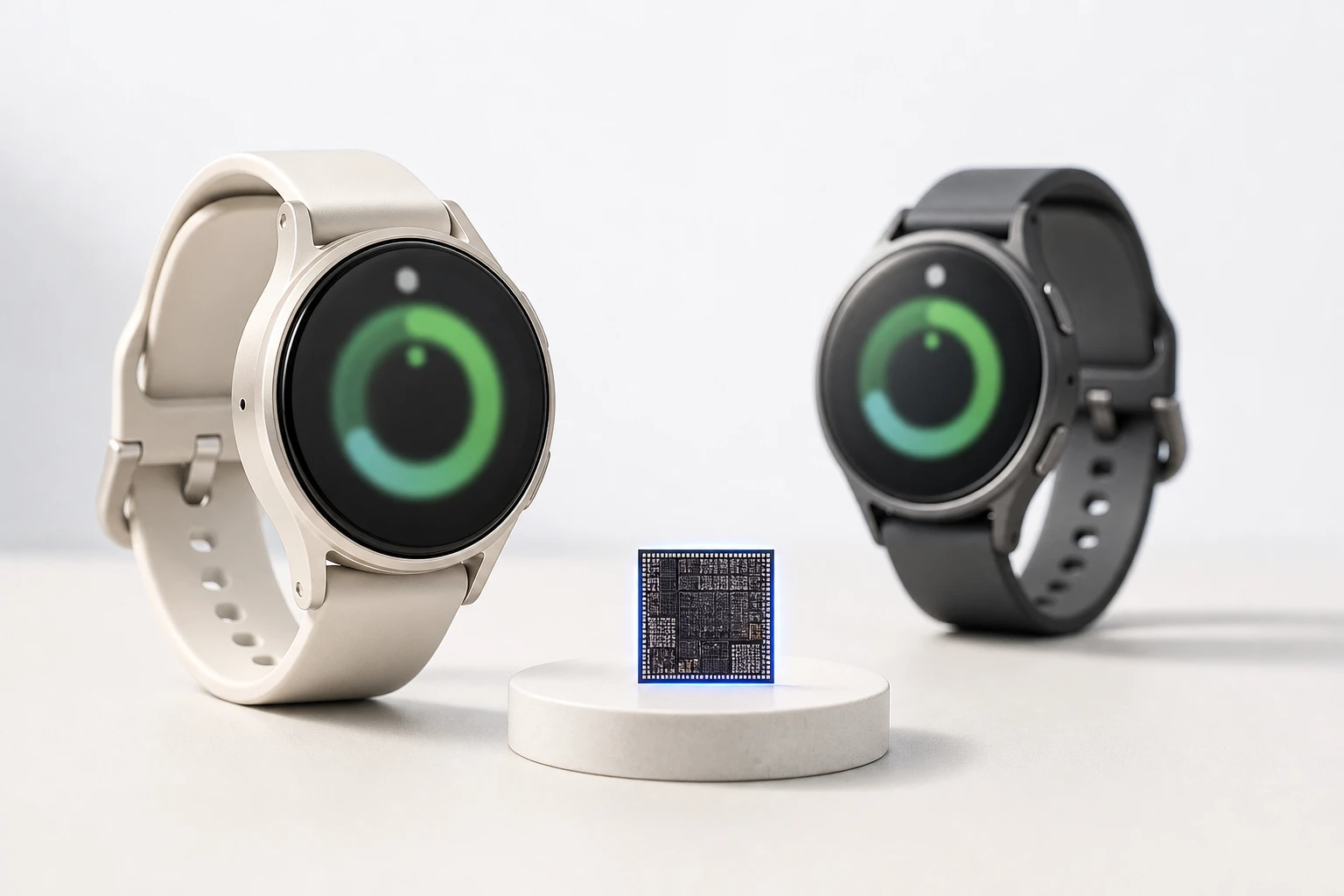
The renders also settle the color lineup. Samsung’s Galaxy Watch 9 will ship in Cream, Graphite and Silver, with the Cream and Graphite cases getting color matched bands and the Silver model bundled with a green band instead. A few outlets covering the same batch of images have listed Green as a fourth standalone case color, though that likely describes the Silver model’s bundled band rather than a separate finish.
Case sizes land at 40mm and 44mm, continuing the squircle shape Samsung introduced on the Watch 8. The leaked spec sheet lists 2GB of RAM, 32GB of storage, and a 390 mAh battery, alongside an accelerometer, altimeter, barometer, compass, GPS, heart rate sensor and skin temperature sensor. Cellular models are expected to add LTE on top of Wi-Fi, Bluetooth 6.0 and NFC. Samsung’s Galaxy Unpacked event is set for July 22, a date confirmed across multiple outlets covering the same leaked material, which lines up with the three day countdown in the original marketing image drop.
Exynos Loses Its Spot on Samsung’s Own Wrist
The bigger story sitting inside these renders is what Samsung is walking away from. The Galaxy Watch line has used Samsung’s own Exynos chips exclusively for years, and industry chatter through most of this year assumed the Watch 9 would keep that arrangement while only the pricier Ultra 2 got Qualcomm’s new silicon. The leaked images say otherwise.
Both chips are built on a 3nm process, but the Exynos W1000 comes from Samsung’s own foundry while the Snapdragon Wear Elite is fabricated by TSMC, a manufacturer generally credited with better battery life, less heat and steadier performance at the same node size. Dropping a chip built in your own fab for one built by a rival supplier is not a small call for a company that has spent years pitching vertical integration as a selling point.
Qualcomm’s own pitch for the switch goes past raw speed. Ziad Asghar, Qualcomm’s senior vice president of XR and spatial computing, told Android Central that buyers get the performance and battery gains even if they never touch a single AI feature, framing the chip as a safe bet regardless of how Samsung’s software team uses it.
Inside the Chip Qualcomm Built to Chase Apple
Qualcomm unveiled the Snapdragon Wear Elite at MWC 2026, its first wearable chip to carry the Elite name previously reserved for flagship phone and laptop silicon. The 3nm platform pairs one 2.1GHz prime core with four efficiency cores near 1.9GHz in a big.LITTLE layout, a first for Qualcomm’s wearable lineup.
Qualcomm’s Snapdragon Wear Elite platform page and the company’s own briefings point to roughly five times the single core CPU performance and up to seven times faster graphics compared with the outgoing Snapdragon W5+ Gen 2, plus about 30 percent longer battery life. A dedicated Hexagon NPU rated at up to 12 TOPS can run on-device AI models with as many as 2 billion parameters, and fast charging can reportedly push a compatible battery to 50 percent in around 10 minutes. Connectivity includes Wi-Fi 6, Bluetooth 6.0, UWB, 5G RedCap and NB-NTN satellite messaging, though Qualcomm lets device makers strip out individual radios.
Samsung signed on early. When Qualcomm introduced the chip, a Samsung executive was already on record welcoming it.
By integrating the new Snapdragon Wear Elite platform, the next-generation Galaxy Watch will be an even more holistic wellness companion.
InKang Song, executive vice president and head of the technology strategy team for Samsung’s MX Business, said that when Qualcomm announced the chip, according to Wareable’s report from the launch. Google and Motorola signed on as launch partners too, with Motorola building its AI companion concept Project Maxwell around the same silicon.
The Same Chip Now Spans Two Price Tiers
Here is where the leak gets uncomfortable for Samsung’s pricing strategy. If both watches run identical silicon, the case for paying hundreds more for the Ultra 2 rests almost entirely on battery size, titanium build and a handful of software extras rather than raw processing power.
| Spec | Galaxy Watch 9 | Galaxy Watch Ultra 2 |
|---|---|---|
| Processor | Snapdragon Wear Elite, 3nm TSMC | Snapdragon Wear Elite, 3nm TSMC |
| RAM / storage | 2GB / 32GB | Not detailed in current leaks |
| Largest battery reported | About 445 mAh (44mm) | About 800 mAh, up from 590 mAh |
| Leaked starting price | About 409 euros (40mm, Bluetooth) | About 749 euros (LTE) |
| Software | Wear OS 7 based One UI 9 Watch | Wear OS 7 based One UI 9 Watch |
Samsung has already leaned toward pricing both watches upward this generation, a move covered in Samsung’s new chips and higher prices for the Watch 9 and Ultra 2. Layering a shared processor on top of that increase makes the Ultra 2’s premium a harder sell than it was when the two watches ran different silicon entirely. Separate renders covered in Samsung’s Galaxy Watch Ultra 2 press renders leak suggest Samsung is at least trying to keep the Ultra visually distinct, even if the chip inside no longer is.
The Skeptics Are Already Doing the Math
Not everyone thinks the new silicon covers the cost of admission. Writing about the same leaked pricing, PhoneArena’s Polina Kovalakova was blunt about her own reaction.
“It’s the leaked price that bothers me the most,” she wrote, estimating that even a US price near $700 for the pricier model, well under a direct currency conversion of roughly $857, still wouldn’t be enough to justify the jump given the chip and battery gains alone.
The battery numbers themselves are still moving. Leaked spec sheets reviewed by The Gadgeteer disagree on the 40mm Watch 9, with one figure at 382 mAh and another claiming it stays flat at the Watch 8’s 325 mAh, while the 44mm size is said to inch up to roughly 445 mAh. That 382 mAh figure sits close to, but doesn’t exactly match, the 390 mAh number printed in the marketing images Blass posted, a reminder that battery specs are usually the last thing to lock down before a launch event. The Ultra 2’s jump to about 800 mAh from 590 mAh is the one battery claim that leak outlets largely agree on.
What Else Did the Leaked Images Reveal?
Beyond the chip, the renders confirm a health and fitness push built around five named features, running on Wear OS 7 based One UI 9 Watch software with deeper Gemini integration than previous generations.
- Energy Score – a daily readiness rating built from overnight sleep and recent activity data.
- Sleep Score – a graded breakdown of sleep quality across stages rather than a simple hours-slept count.
- Sleep Apnea Detection – a feature that flags possible interrupted breathing during sleep for a wearer to raise with a doctor.
- Running Coach – real time pacing guidance during a run based on the wearer’s training history.
- Vitals – a combined snapshot of heart rate, skin temperature and other daily readings.
Separate reporting on the same firmware points to Samsung retiring the Vascular Load metric for US users in favor of a new Blood Pressure Trend feature that checks at intervals rather than on demand, and a first-of-its-kind Hearing Health tool that warns when ambient noise or earbud volume climbs into risky territory. As with past Galaxy Watch health tools, the accuracy of any single reading still depends on proper fit and calibration, a limitation smartwatch health tracking has never fully solved. Samsung has not confirmed any of this. The confirmation, or the correction, arrives July 22.
Frequently Asked Questions
When is the Samsung Galaxy Watch 9 release date?
Samsung’s Galaxy Unpacked event is scheduled for July 22, 2026, where the Galaxy Watch 9 is expected to launch alongside the Galaxy Watch Ultra 2 and Samsung’s new foldable phones. Preorders are reportedly set to open immediately after the event ends.
How much will the Galaxy Watch 9 cost?
Leaked European pricing points to about 409 euros for the 40mm Bluetooth model and roughly 489 euros for the 44mm LTE version, both of which would be a modest increase over the Galaxy Watch 8. US pricing typically undercuts a straight currency conversion, so the eventual dollar price could land somewhat lower than those euro figures suggest.
Does the Galaxy Watch 9 support satellite messaging?
The Snapdragon Wear Elite chip inside it supports NB-NTN satellite connectivity, but Qualcomm allows device makers to ship versions of the chip with specific radios disabled. Nothing in the leaked marketing images confirms whether Samsung is activating satellite messaging on the Watch 9 at launch.
What happened to Samsung’s Exynos W1000 chip?
Leaked renders show the Galaxy Watch 9 dropping the Exynos W1000 entirely in favor of Qualcomm’s Snapdragon Wear Elite, ending Samsung’s run of using only in-house silicon in its mainline smartwatch. Samsung has alternated between its own chips and outside suppliers on phones before, so a return to Exynos in a future watch generation isn’t out of the question.
Is the Galaxy Watch 9’s battery bigger than the Watch 8’s?
Leaks disagree on the smaller 40mm model, with reports split between a 382 mAh cell and one claiming it stays flat at the Watch 8’s 325 mAh. The 44mm size is more consistently reported around 445 mAh, a modest gain, while the Watch Ultra 2 sees the clearest jump, reportedly rising to about 800 mAh from 590 mAh.
 One UI 9’s Privacy Display Fix Reaches Just One Galaxy Phone
  Samsung Drops Its Own Exynos Chip for the Galaxy Watch9 and Ultra 2
  Marathon’s Vault Breaker Arrives as Bungie’s Bigger Bet Keeps Faltering
  Sony’s PlayStation Disc Cutoff Erases the Last Proof of Ownership
  Tesla’s Summer Update Hands Grok the Keys, and Musk’s Empire More Reach
  Apple’s $634 Million Masimo Payment Is Final After Appeal Denial