
 Ishan Crawford
 The U.S. Food and Drug Administration told consumers on September 16, 2025 not to use unauthorized blood pressure devices, and it named smartwatches and smart rings by category. The safety communication covers any software feature on a wearable that claims to measure or estimate blood pressure. The agency said these products do not fall under its general-wellness policy because they are not low risk. Inaccurate readings, the FDA warned, can lead to delayed treatment for hypertension, missed strokes, and inappropriate medication changes. The advisory lands in the middle of a federal push to put a wearable on every American wrist, and it cuts straight through the marketing.
Health Secretary Robert F. Kennedy Jr. told members of Congress on June 24, 2025 that it is his vision that every American is wearing a wearable within four years. The Department of Health and Human Services is preparing what Kennedy called one of the biggest advertising campaigns in HHS history to encourage Americans to use wearables. The pitch rests on a simple claim: a wrist sensor can catch disease early. The FDA’s September warning draws a sharp line around how much of that claim is currently safe to act on, and where the marketing has gotten ahead of the medicine.
The honest reading of the evidence is that wearables are better at pattern detection than the marketing suggests, and worse at clinical diagnosis than the marketing implies. Doctors interviewed by The New York Times recently pointed to a short list of metrics they actually trust, and a much longer list they do not. The line between those two lists is what every smartwatch owner needs to understand.
What Wearables Have Actually Gotten Right
Three things on a modern smartwatch carry real clinical weight, and they share a common trait. Each is a pattern-detection feature rather than a diagnostic one, and each was validated against an external gold standard rather than the device’s own algorithm. AFib alerts, presymptomatic infection flags, and resting heart rate trend watching are the categories physicians point to when asked what they find useful.
Each of those features works because it spots a deviation from the wearer’s own baseline, then prompts the wearer to do something a clinician can act on, like run a 12-lead ECG, take a PCR test, or describe symptoms in a follow-up visit. The wearable is not the doctor. It is the alarm that gets you to the doctor earlier.
- Atrial fibrillation detection, validated by the Apple Heart Study’s 400,000+ participants and now FDA-cleared as a clinical feature.
- Presymptomatic infection detection, with reported wearable accuracy near 90% for flu and 88% for COVID-19 in peer-reviewed research.
- Resting heart rate trend watching, the metric physicians most often ask patients to track because it catches infection, dehydration and overtraining alike.
Why AFib Is the Standout, and Why It Took a 400,000-Person Study
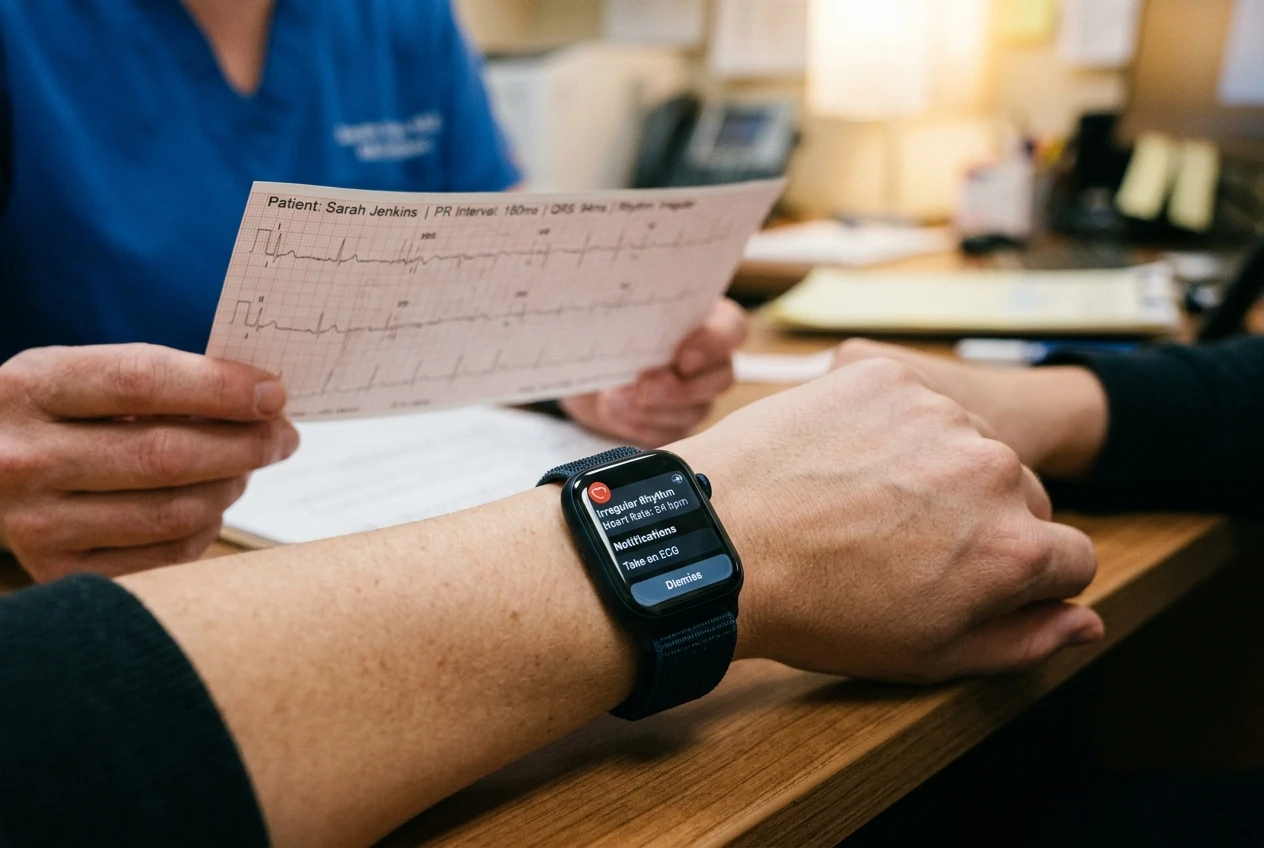
Atrial fibrillation is the cleanest win in wearable health, and the reason it works is that the condition has a clear physiological signature. A-fib produces an irregular pulse pattern that a photoplethysmography sensor on the back of a watch can pick up, and an irregular rhythm is rare enough in healthy adults that flagging it produces a useful signal rather than background noise. The Apple Heart Study, a partnership between Stanford Medicine and Apple, enrolled more than 400,000 participants in eight months and remains the largest virtual study of its kind.
The headline number is the one most often quoted. Of participants who received an irregular pulse notification and were simultaneously monitored by an ECG patch, 84% of those simultaneous readings were confirmed as atrial fibrillation. That figure, an 84% positive predictive value, is the metric doctors cite when they explain why the Apple Watch AFib alert earns a place in clinical conversation.
The supporting numbers matter just as much. Only 0.52% of participants in the Apple Heart Study ever received an irregular pulse notification, which the Stanford researchers called reassuring because it meant over-notification in healthy users was low. And of those who did receive a notification, 76% contacted either a telehealth provider or a non-study provider, suggesting the alert actually pushed people into care rather than just into anxiety. The companion feature, AFib History, received 510(k) clearance from the FDA in 2022 and is cleared for use by people aged 22 and older who have already been diagnosed with the condition.
The clinical value here is narrow but real. A wearable can flag possible AFib, then a clinician confirms or rules it out with a medical-grade ECG. The wearable does the screening, not the diagnosis. That division of labor is exactly what makes the feature trustworthy, and it is the structure the rest of the field is trying to replicate for other conditions.
Smartwatches Catch Infections Before You Feel Them
The second validated win is presymptomatic infection detection, and it is the one that drew the heaviest federal interest in 2025. The body starts shifting before the user notices: resting heart rate ticks up, skin temperature drifts, breathing rate changes, sleep gets worse. Wearables measure all four continuously. The question is whether the algorithms can read the pattern.
A study published in PNAS Nexus on March 4, 2025 by researchers at Aalto University, Stanford and Texas A&M put a number on it. Lead author Märt Vesinurm reported that everyday smartwatches can tell with 88% accuracy if a wearer is coming down with COVID-19, based on respiration, heart rate, skin temperature and other markers. The figure rises to 90 percent accuracy for the flu. The same research found that 44% of COVID-19 infections were spread several days before the sufferer came down with symptoms, so even a 24-hour head start on isolation could matter at population scale. Vesinurm’s team estimated that a 66% to 75% reduction in social contacts soon after a wearable warning can lead to a 40% to 65% decrease in disease transmission compared with isolation from the onset of symptoms.
Unlike during the pandemic, we now have concrete data on how pandemics develop, and how effective different measures are at curbing the spread. Add to this that wearable technology is now extremely effective when it comes to detecting the very early physiological signs of infection, and we are much better prepared.
Vesinurm, from Aalto University’s Department of Industrial Engineering and Management, is the lead author of the study. Oura has commercialized the same underlying idea in its Symptom Radar feature, which was rolled out to Ring Gen 3 and Ring 4 users in late 2024 and which Oura says can detect signs of strain up to two days before a wearer tags an illness. Oura’s head of science, Shyamal Patel, has acknowledged publicly that the algorithm is not 100% accurate and that false positives and negatives are possible.
Where the Marketing Runs Ahead of the Medicine
Outside AFib alerts and presymptomatic infection detection, the list of metrics clinicians will act on gets short fast. A September 2025 FDA safety communication drew a hard line under one of the most heavily marketed categories, blood pressure. Here is where the limits sit today.
- Blood pressure readings on consumer smartwatches and smart rings, which the FDA warned against on September 16, 2025 because so many products lack marketing authorization.
- Sleep-stage breakdowns (REM, core, deep), which physicians told The New York Times are not measured accurately enough to guide medical decisions.
- Calorie burn estimates, which research has consistently shown are off by hundreds of calories a day compared to lab measurement.
- Daily recovery or readiness scores from Oura, Whoop and similar apps, which rely on proprietary algorithms and leave clinicians without anything they can act on.
The FDA’s September communication is the bluntest of those warnings. The agency told consumers not to use unauthorized blood pressure devices, including software features on wearables such as smartwatches and smart rings, that claim to measure blood pressure. Many such products currently sold over the counter do not have FDA marketing authorization, and the agency said the safety and effectiveness of those products have not been reviewed. The FDA listed failure to detect changes in blood pressure, delays in seeking treatment, inaccurate alerts leading to unnecessary medical interventions, and inappropriate medication changes among the harms.
The same pattern holds for VO2 max and heart rate variability, both of which wearables present as precise numbers and both of which physicians treat as rough estimates of fitness and recovery rather than diagnostic readouts. Erica Spatz, MD, director of Yale’s preventive cardiovascular health program, told The New York Times that metrics like blood oxygen, blood pressure, VO2 max, heart rate variability, biological age and stress scores are not yet considered reliable enough for most medical decisions. Cheri Mah, MD, a sleep physician and adjunct lecturer at the Stanford Sleep Medicine Center, made the same point about sleep stages in particular, which she said are not measured accurately enough to guide care.
The practical rule is older than the devices. Even the reliable metrics will throw false positives, because a spike in resting heart rate can mean an infection, dehydration, a poor night of sleep, or one drink too many. Today’s devices are good at noticing that something looks different. They are not good at telling you what it is.
The New Layer: AI Coaches Built on Your Wrist Data
The newest layer of wearable health is not a sensor. It is a chatbot. Companies have started layering AI coaches on top of the existing sensor data, promising to interpret trends, generate workout plans, and answer free-text health questions. The coaches sit on top of the same data the limitations above apply to, and almost all of them ship with explicit disclaimers that they are not medical devices.
- Google’s Fitbit AI Personal Health Coach, built on Gemini, set to roll out as a preview in October 2025 as part of Fitbit Premium in the U.S.
- Apple’s Workout Buddy for the Apple Watch, which delivers in-ear coaching during runs and walks.
- Oura’s Symptom Radar, which combines resting heart rate, skin temperature and breathing rate to flag early illness signs.
Google announced the Gemini-powered Fitbit coach on August 20, 2025, describing it as a fitness trainer, a sleep coach and a health and wellness advisor in one product. The same announcement included a footnote: Not a medical device. This product is intended for general wellness and fitness purposes only. Always consult with a healthcare provider before making changes regarding your health. The disclaimer is doing real work, because the coach is generating personalized plans and answering health questions based on the same wearable data that physicians have just told The New York Times is not reliable enough for clinical decisions.
The risk is not that these coaches are dishonest. It is that the wrapper around the data, a friendly AI that speaks in confident sentences, can feel more authoritative than the noisy signal underneath. A readiness score from a proprietary algorithm becomes a workout recommendation, then a health answer, then something a user takes to a doctor. The pipeline from sensor to advice is short, and the medical-device regulation stops at the sensor boundary.
The Numbers a Doctor Will Actually Look At
Almost 40% of Americans now use some type of wearable, according to figures cited by The New York Times. Most of them are getting more data than their doctor can use. The physicians interviewed for that reporting converged on the same short list of metrics they consider clinically meaningful: AFib alerts, daily step counts, basic sleep duration and schedule, and resting heart rate trends over time. They told readers to share weekly or monthly trends rather than single readings, and to bring changes to a visit rather than alarm over a single bad night.
The federal wearables push that Kennedy announced in June 2025 is being built on top of this short list, even as the marketing implies a much longer one. Kennedy told the House Energy and Commerce Subcommittee on Health that wearables are a way people can take control of their own health, and he said the Ozempic is costing $1300 a month, while you can achieve the same thing with an $80 wearable. The HHS advertising campaign he announced is the policy test of whether a mass consumer audience can use pattern-detection tools without sliding into self-diagnosis, and the FDA’s September 16, 2025 blood pressure warning is the agency drawing the first line of that test.
The realistic expectation is closer to a quiet coach than a wrist-worn Tricorder. A watch that watches for patterns, nudges you when something looks off, and gives you another piece of useful information to discuss with your doctor is the version of wearable medicine the evidence supports today. The version sold in keynote slides still needs the validation, the FDA clearance, and the clinical study to catch up.
Frequently Asked Questions
Are smartwatches accurate for detecting health problems?
They are accurate at pattern detection, not at diagnosis. The strongest validated result remains the Apple Heart Study’s 84% positive predictive value for atrial fibrillation, and that figure applies to a specific alert paired with simultaneous ECG confirmation. Everything else sits below that bar.
What did the FDA say about smartwatch blood pressure features?
On September 16, 2025, the FDA told consumers not to use unauthorized blood pressure devices, including software features on smartwatches and smart rings, and said these products do not fall under its general-wellness policy because they are not low risk.
Can a smartwatch detect a heart attack?
No consumer wearable is cleared or designed to detect a heart attack. They can flag atrial fibrillation and other arrhythmias, and they can prompt a user to seek care, but a heart attack diagnosis requires a clinical workup that no wrist sensor replaces.
Which wearable metrics do doctors actually trust?
Physicians interviewed by The New York Times pointed to atrial fibrillation alerts, daily step counts, basic sleep duration, and resting heart rate trends. They do not yet consider blood oxygen, blood pressure, VO2 max, heart rate variability, biological age, or proprietary stress and recovery scores reliable enough for medical decisions.
How accurate are smartwatches at detecting COVID or the flu?
A study published in PNAS Nexus on March 4, 2025 by researchers at Aalto University, Stanford and Texas A&M reported wearable accuracy of 88% for COVID-19 and 90% for influenza based on respiration, heart rate and skin temperature markers, with detection typically running ahead of symptoms.
Disclaimer: This article is for informational purposes only and is not medical advice. Wearable health metrics are screening signals, not diagnoses, and figures cited above reflect published research and regulatory statements as of the publication date. Always consult a qualified healthcare professional before making decisions about your health, and confirm any blood pressure, cardiac, or other readings with an FDA-authorized clinical device.
 ONGC licence frees Venezuela cash and operatorship talks
  Anthropic Hits $65 Billion Run Rate and Flips the AI Cash Test
  Supreme Court grounds the fare free-for-all with three-week clock
  Gold Nears $4400 as Soft Data Meets Oil Inflation Risk
  Nifty Slips as Zaggle Circuits and Dhoot Debuts Big
  Diesel Crack Tops $100 as Iran Rhetoric Lifts Crude