
 Ishan Crawford
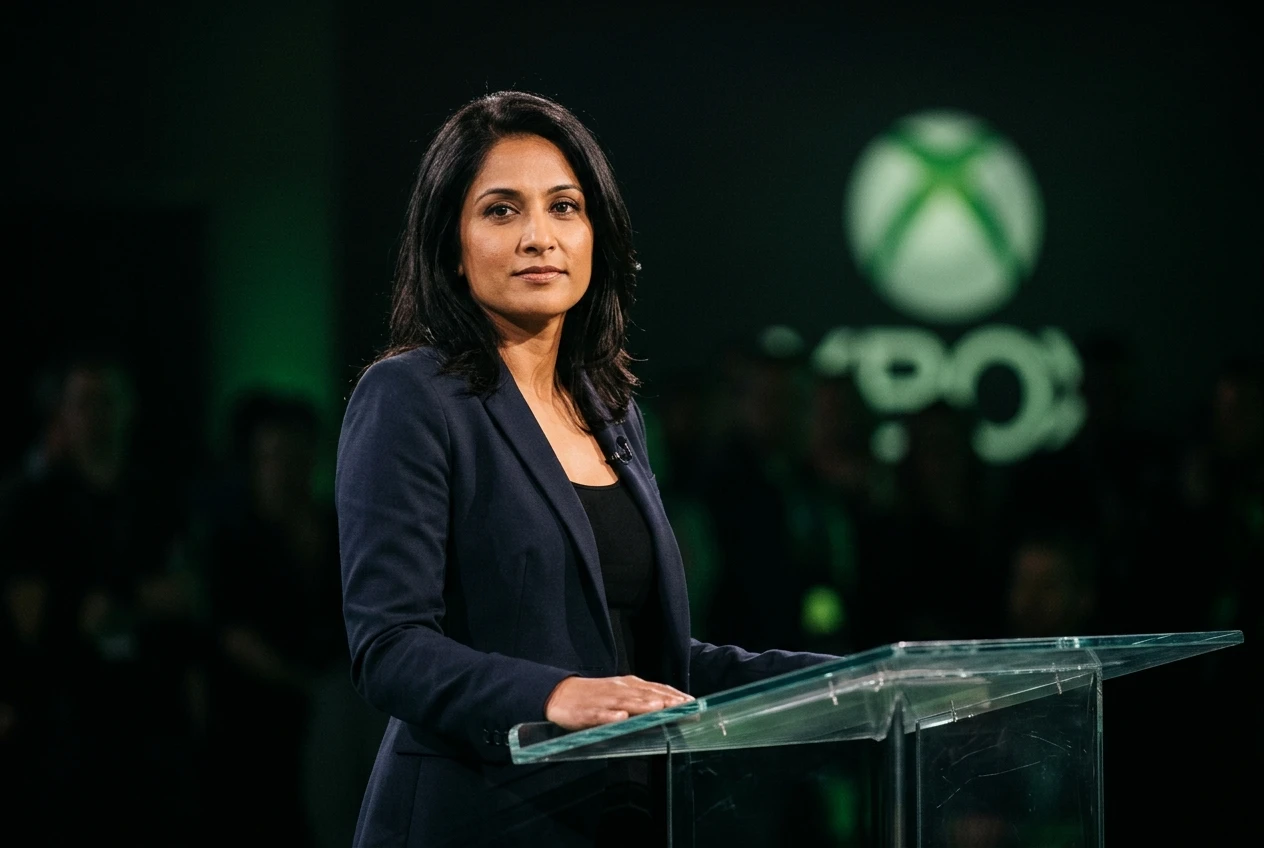
 Xbox chief executive Asha Sharma told employees on Monday that the company will cut 3,200 roles, roughly 20 percent of the gaming division’s workforce, in what she called the most significant restructure in Xbox history. The cuts, which begin with about 1,600 role eliminations effective Monday, run through fiscal year 2027 and include the divestiture of four game studios. Mojang and King join Sharma’s direct line. Posted publicly on her social account and republished on Xbox Wire, the letter lands inside a broader 4,800-person Microsoft layoff round.
Sharma has run Xbox since February 2026, after years leading Mojang and the Minecraft franchise inside the same division. Her June 10 letter to staff named the same problem in similar terms without the cut detail. Monday’s memo finally publishes the math, with cut numbers, divestitures, and a flatter operating model in one public document.
The Memo and What It Says
The memo went out Monday under the headline “Resetting XBOX.” Sharma framed the restructuring as a direct response to a business she described as not healthy and a hardware market that the company calls the most severe components crisis in industry history. The full text of Asha Sharma’s Monday memo commits the company to roughly 3,200 reductions through fiscal year 2027, with about 1,600 effective Monday and the remaining reductions spread across the next several quarters. Sharma said the span was deliberately drawn out so that the cost would stay visible to staff. Game Pass, multi-platform publishing, and a broader content portfolio have not, the memo says, delivered the returns Microsoft expected.
Our business today is not healthy. We are operating at margins that are 3-10x lower than comparable platform and publishing businesses. And now the industry is facing the most severe hardware crisis in its history. We must reset XBOX.
Asha Sharma, the Xbox chief executive since February 2026, closed the memo with a single line that frames the reset: “History is full of companies that mistake longevity for inevitability. We will not be one of them.” The same paragraph names the people in the reshuffle and the structure they are inheriting, including Mojang and King, the studios behind Minecraft and Candy Crush, who now report directly to her. Sharma described the same change in her own public post of the staff memo.
Where the Money Went Wrong
Sharma ran the numbers herself. In Sharma’s June 10 letter mapping the reset, she disclosed an accountability margin of about 3 percent for the fiscal year, down year over year. She also said Microsoft has spent more than $20 billion on content, platform, and hardware subsidies over the past five years, excluding the Activision Blizzard King acquisition, while Xbox revenue has fallen by nearly half a billion dollars. The current memo calls the resulting gap “unacceptable” and frames it as the reason the cuts had to start now.
The studio portfolio has been the single largest weight. In a typical year, Xbox “lost 64 cents for every dollar” it invested across the studios it bought, according to the memo. That figure covers the four studios leaving Microsoft in this round and the wider stable of acquired developers that has grown fast since 2018. The portfolio expansion peaked with the 2023 Activision Blizzard acquisition, the largest single check Microsoft has written for gaming content.
Platform teams have grown faster than the players on them. Sharma noted that platform engineering is now 40 percent larger than at the start of the current console generation, even as overall player base and playtime have declined. The same memo notes that storage and memory costs are now more than five times what they were two years ago, with another significant increase expected before the 2027 holiday season. None of Microsoft’s publicly announced first-party games or projects are being cancelled as part of the cuts, a reassurance the company gave developers and players in the same paragraph. Microsoft has also said the hardware component costs are a structural challenge that connects the studio cuts to the platform cuts.
The math drives the cuts. With margin near 3 percent and a five-year content subsidy of more than $20 billion against a half-billion-dollar revenue decline, every quarter of unchanged cost looks like a quarter of value destruction. The cuts are the answer: a flatter organization, a smaller studio portfolio, with the savings redirected into games, services, and hardware the company still plans to fund. Sharma’s plan, in short, is to return to growth in 2027.
| Xbox financial signal | What the company said |
|---|---|
| Accountability margin for fiscal 2026 | about 3 percent |
| Studio investment loss | 64 cents lost per dollar invested, in a typical year |
| Content, platform, and hardware subsidy over five years (excluding Activision Blizzard King) | over $20 billion |
| Xbox revenue trend over the same period (excluding Activision Blizzard King) | down nearly half a billion dollars |
| Platform team size vs. start of generation | 40 percent larger, player base and playtime down |
The Quiet Elevation of Mojang and King
Buried in the memo is a winner. Mojang and King, the two studios being elevated, will now report directly to Sharma, the move framed as pulling them into the operating core of the division. The same paragraph calls them “platforms” and “our largest by monthly active players,” with the geographic and demographic reach that, the memo argues, Xbox cannot replicate by owning studios alone.
The framing matters. The four studios leaving Xbox are not the ones being elevated; they are the ones Microsoft spent the better part of a decade integrating after its 2023 Activision Blizzard acquisition and an earlier Bethesda deal. The two studios being elevated are the ones whose products long ago moved past the Xbox hardware itself. The contrast runs through the memo, even if no single sentence names it.
King built Candy Crush, a free-to-play mobile title. Mojang built Minecraft, a multi-platform franchise that runs on phones, PCs, consoles, and competing platforms. Both studios now reach far beyond the Xbox console. Studios built around moving players onto Xbox hardware are leaving the company. The Mojang and King elevation is the memo’s quiet argument for what Xbox will become, and the silent counterweight to every layoff number inside the same letter.
Studios Out, an Operating Model Rebuilt
Five named studios are touched. The largest moves are the studios Microsoft is letting go. Compulsion Games, the developer of South of Midnight, will return to its existing management team as an independent studio with its catalog and a runway for the next project. Double Fine Productions will do the same with its own IP, and Ninja Theory and Undead Labs have entered terms with new owners, with funding attached to finish Senua’s next chapter and State of Decay 3.
- Compulsion Games returns to its management team and runs as an independent studio.
- Double Fine Productions becomes independent with its IP and catalog.
- Ninja Theory has entered terms to join new ownership, with funding for Senua’s next chapter.
- Undead Labs has entered terms to join new ownership, with funding for State of Decay 3.
- Arkane Studios has begun a required consultation with its French Works Council over potential strategic options.
Sharma also installed Xbox’s first Chief Operating Officer. Helen Chiang, who spent close to two decades at Xbox and led Mojang and the Minecraft franchise, takes the role with end-to-end P&L responsibility across content, hardware, platform, and services. Longtime platform leader Dave McCarthy, a 17-year Xbox veteran, is retiring.
The $190 Billion Microsoft Around It
Monday’s Xbox cuts are part of a larger Microsoft restructuring announced the same day. Across the company, Microsoft is eliminating about 4,800 jobs, roughly 2.1 percent of its global workforce, the latest in a series of AI-era cost cuts across big tech. Two-thirds of those jobs sit inside Xbox. Amy Coleman, Microsoft’s executive vice president and chief people officer, said in her own memo that the cuts reflect a changing market and that the affected jobs are not being replaced by artificial intelligence.
The technology spending behind those cuts runs in the opposite direction. Microsoft said in its most recent earnings call that it plans $190 billion in capital and infrastructure spending for fiscal 2026 to fund AI capacity and cloud demand, a buildout that has put pressure on cash flow and required a more aggressive cost stance elsewhere in the business. AI demand has driven memory and storage prices sharply higher across the industry, a side effect that has already hit Microsoft’s consumer products and its console business in particular.
Console pricing is the front edge. Xbox will raise console prices by $100 to $150 on August 1, with the console pricing update set for August 1 already confirming the change earlier in the year and memory costs five times what they were two years ago as a wider pressure also reshaping the memory crisis behind $1,049 Steam Machine pricing. Game Pass, Microsoft’s subscription bet for reaching players who already own a console or a phone, has lost “millions” of subscribers since the Ultimate tier was effectively doubled in October 2025, per chief strategy officer Matthew Ball. The same week’s cuts come alongside a voluntary retirement program that more than 30 percent of eligible US employees chose to participate in, with the broader cost stance extending from gaming to commercial sales. Microsoft shares closed the first half of 2026 down nearly 23 percent, their worst first-half run since 2022.
What the Reset Will and Won’t Touch
Mechanics are aggressive too. Sharma disclosed that, in some parts of the company, work currently passes through as many as 14 layers of management, a count the reset will compress to no more than five. Where the structure can support it, Xbox will reduce layers further, to three. Vendor spending across the division is being cut by 50 percent.
The new operating model is built around what Microsoft calls makers, player-coaches, and directly responsible individuals, a flatter structure the memo says will shorten decision-making. Platform teams are being trimmed back to a footprint closer to the start of the console generation, with fewer engineers producing more updates than at any point in the past year. No public first-party games are being cancelled.
For players, the email offers two reassurances. No first-party project is being cancelled, and this year’s Xbox investment is the same in dollars as last year’s, just redirected with more focus. A roadmap is what is missing. Sharma names the structure of the reset but not the games, the hardware, or the services that will carry Xbox into the growth year the letter promises for 2027. Her forward-looking ambition lands in a single line about entertaining more than a billion people each day, the structural change framed as preparation for any 2027 return to growth.
The 14-layer detail is the piece of the memo that shows how much the company thinks it has overbuilt. Microsoft has spent the better part of a decade acquiring studios to support Game Pass, multi-platform publishing, and a broader content portfolio, and it added the management structure to run all of it. The cuts collapse both at once. The memo’s paired moves, divesting five studios and tightening the parent reporting line in the same document, fit the same logic.
Frequently Asked Questions
Who is Asha Sharma?
Asha Sharma is Xbox’s chief executive. She was appointed in February 2026 after leading Mojang and the Minecraft franchise, a role she held for years. Her Monday memo is the first time the division has put concrete cut numbers, divestiture names, and forward financial math into a single public document.
Which studios are leaving Xbox?
Four studios will leave. Compulsion Games and Double Fine Productions are transitioning to independence, while Ninja Theory and Undead Labs are entering terms with new owners, with funding attached to their in-progress games. Arkane Studios, a fifth, has begun a required French Works Council consultation over its strategic options and is the one studio whose final outcome is not yet publicly named.
Why are Xbox console prices going up again?
Microsoft points to a single cause. A global memory and storage components crisis, the company says, with storage and memory costs now more than five times what they were two years ago. The new pricing raises 512 GB consoles by $100 and 1 TB consoles by $150, effective August 1, 2026. The wider squeeze has hit console rivals and component-heavy industries elsewhere, with Microsoft framing it as a market problem coming from outside the company.
Will any Xbox games be cancelled?
No. Sharma stated in the memo that no publicly announced first-party Xbox projects are being cancelled as part of the reductions. The cuts instead shift investment across Activision, Bethesda and ZeniMax, Blizzard, King, Mojang, and Xbox Game Studios, with the named departing studios inheriting their own IP and in-progress funding.
What happened to Game Pass subscribers?
How many Game Pass subscribers does Xbox now have? The company has not said. What it has said is that the Game Pass Ultimate tier was effectively doubled from $14.99 to $29.99 per month in October 2025, an increase the company’s chief strategy officer, Matthew Ball, has acknowledged cost it “millions” of subscribers. Game Pass is also the surface where the reset promises reinvestment, with this year’s Xbox investment being held flat and reallocated.
 One UI 9’s Privacy Display Fix Reaches Just One Galaxy Phone
  Samsung Drops Its Own Exynos Chip for the Galaxy Watch9 and Ultra 2
  Marathon’s Vault Breaker Arrives as Bungie’s Bigger Bet Keeps Faltering
  Sony’s PlayStation Disc Cutoff Erases the Last Proof of Ownership
  Tesla’s Summer Update Hands Grok the Keys, and Musk’s Empire More Reach
  Apple’s $634 Million Masimo Payment Is Final After Appeal Denial