
 Ishan Crawford
 Indian stocks surged on Friday, June 12, 2026, as reports of a US-Iran peace deal pulled oil prices sharply lower and freed up room for a broad-based rally. The 30-share BSE Sensex was up 1,554.82 points, or 2.11%, at 75,387.37 in afternoon trade, according to Moneycontrol. The broader Nifty 50 advanced 416.25 points, or 1.8%, to 23,577.85.
All 16 major sectoral indices on the NSE traded in the green, with oil marketing companies, airlines, and infrastructure stocks exposed to West Asia leading the move. The trigger was a double dose of news from Washington: an Iranian state-linked report that the proposed memorandum of understanding with Tehran includes lifting sanctions and ending the US naval blockade at the Strait of Hormuz, and President Donald Trump’s declaration that the US had “ended the war with Iran.” Iran has not confirmed any agreement.
What Triggered the 1,550-Point Sensex Rally
Iranian state-linked news agency Mehr reported that the proposed MoU between Tehran and Washington includes the lifting of sanctions, an end to the US naval blockade at the Strait of Hormuz, and the withdrawal of American military forces positioned around Iran. The two sides are working toward a one-page framework deal to end a war that has roiled energy markets since early in the year. India, which imports a large share of its crude oil, has been one of the most exposed Asian economies to each flare-up in West Asia tensions.
I don’t know if you heard, but we ended the war with Iran today (Thursday), and they have agreed never to have a nuclear weapon, something that we insisted on. That was the whole purpose.
US President Donald Trump said this in the Oval Office on Thursday, hours after calling off military strikes he had threatened earlier in the day, citing progress in the negotiations. A deal to end the war is “nearly complete” and could be signed over the weekend in Europe, Trump added, with Vice President J D Vance expected to attend. Trump’s claim of a great settlement with Iran drew an immediate counter from Tehran, where foreign ministry spokesman Esmaeil Baqaei told Agence France-Presse that “so far, Iran has not reached a final conclusion on the agreement.”
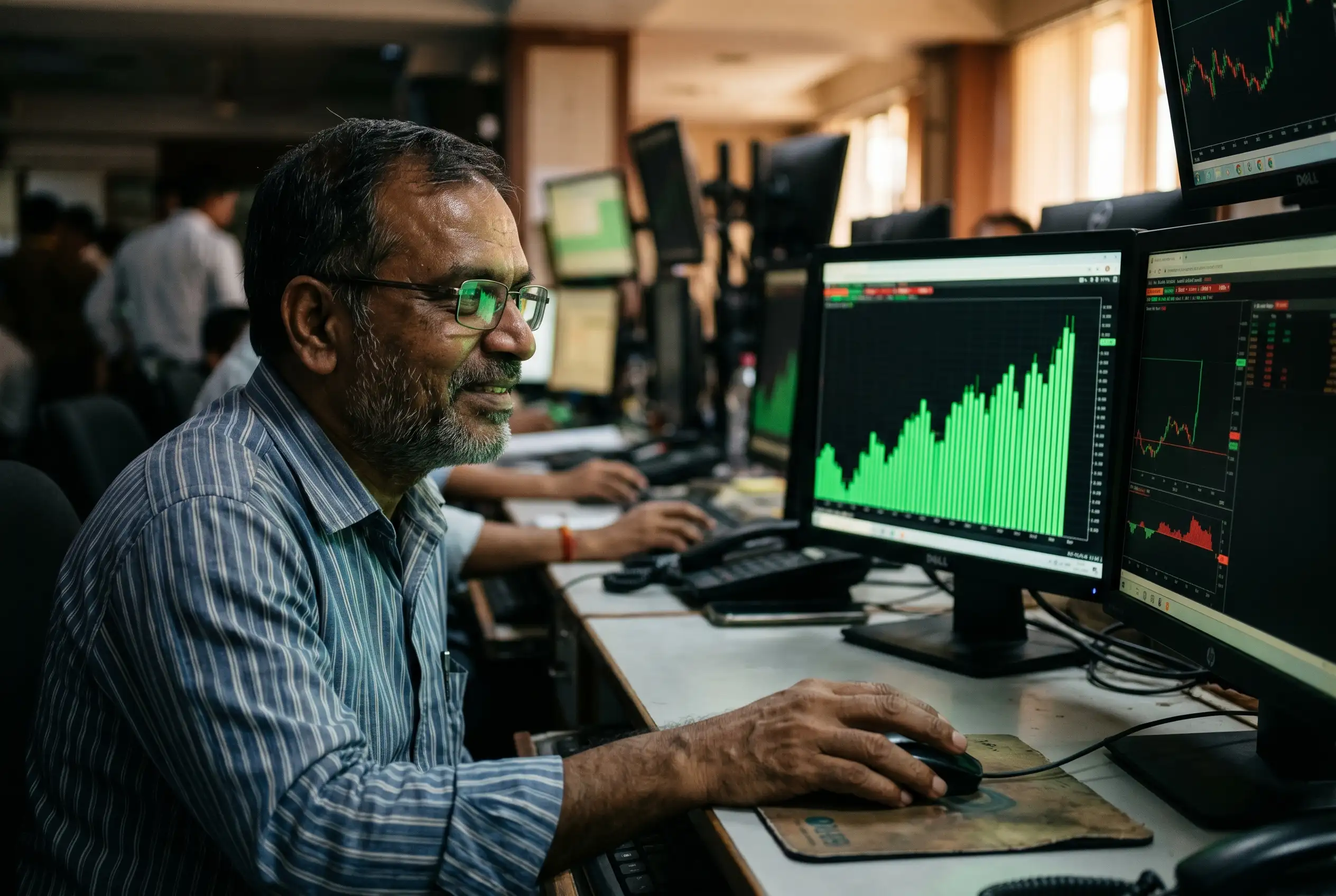
The Sector Map of Friday’s Oil Relief
The energy relief was broad-based. All 16 major sectoral indices on the NSE traded in the green, and the Sensex sector breakdown shows the broader Nifty Smallcap 100 and Nifty Midcap 100 advancing 1.6% and 1.4% respectively. Participation went well beyond the energy and infrastructure names that have the most direct read on crude.
Oil marketing companies BPCL, HPCL and Indian Oil gained between 2.4% and 3.8%, while airline operator IndiGo rose 3.5% as lower crude eased the cost outlook for jet fuel. Shares of paint, tyre and cement companies, which also benefit from softer crude prices, were trading higher, though the Moneycontrol piece did not give individual figures for those segments. The shift left the energy-cost-sensitive corners of the market with the clearest direct exposure to the price move.
Infrastructure major Larsen & Toubro, which has significant West Asia exposure, climbed 2.8%. Heavyweight banking and financial stocks rose 1.4% each, headed for their third gain in four sessions, after the Reserve Bank of India detailed a concessional forex swap facility for banks’ overseas foreign-currency borrowings. The opening trade and winners list from The Hindu pegs InterGlobe Aviation, L&T, Bajaj Finance, Eternal, Trent and HDFC Bank among the biggest winners on the 30-share Sensex, with Tech Mahindra the only laggard from the pack.
- OMCs (BPCL, HPCL, IOC): +2.4% to +3.8%
- IndiGo: +3.5%
- Larsen & Toubro: +2.8%
- Banking and financial stocks: +1.4% each
- Nifty Smallcap 100: +1.6%
- Nifty Midcap 100: +1.4%
Banks Get a Second Tailwind From the RBI Swap Window
The banking leg of the rally has its own story. The 1.4% gain in banking and financial stocks came after the Reserve Bank of India detailed a concessional forex swap facility for banks’ overseas foreign-currency borrowings, the third gain in four sessions for the segment.
Under the facility, banks can swap dollar deposits with the RBI. The mechanism is designed to push rupee liquidity back into the banking system at a moment when global rate dynamics have made dollar funding comparatively expensive. Nomura analysts said the swap should improve banks’ rupee liquidity positions over a defined window.
The broader banking and financial sector has its own trigger distinct from the oil price move. The RBI swap facility is a structural change in how banks fund their foreign-currency books, and the immediate tape reaction is the 1.4% gain. Over a longer horizon, the credit growth angle is the payoff the market is pricing in. Bank lending capacity, after years of muted growth, is the metric the Street will be watching next.
Nomura analysts said this in a research note, laying out the deposit-cost dynamic and the timeline for the swap. The note framed the move as a way for banks to reduce their reliance on the higher cost of deposits and to expand their lending capacity. Banking and financials sit one step further back from the oil move than OMCs and airlines do, and the swap is what gave them a direct catalyst.
As banks swap dollar deposits with the RBI, this should improve their rupee liquidity positions over the next four months, reducing their reliance on the higher cost of deposit, allowing them to increase lending.
How the Rupee and VIX Tell the Same Story
The currency and the volatility gauge moved in tandem on Friday. The rupee appreciated 65 paise to 95.20 against the US dollar, Moneycontrol reported, after opening at 95.40 at the interbank foreign exchange market. A weaker dollar and positive sentiment in domestic equities both supported the local currency, according to forex traders cited in the report.
India VIX, the market’s fear gauge, declined 5.16% to 14.81, the article said. A fall in the volatility index indicates easing concerns among investors and reflects improved market sentiment, with lower volatility generally supporting risk appetite. The two moves together, a stronger rupee and a softer VIX, are the textbook signal of a risk-on session after a period of geopolitical pressure.
Hariprasad K, Research Analyst and Founder of Livelong Wealth, framed the macro case in the same direction. “For India, the most significant macro development is the sharp decline in crude oil prices,” he told Moneycontrol, adding that “Brent crude has corrected nearly 4 percent, easing concerns around imported inflation, the current account deficit, and rupee stability.” The case is that a lower oil price widens India’s macro runway on three fronts at once.
- Brent crude fell 5% to $86.4 per barrel, near a two-month low
- Rupee recovered to 95.20 from an open of 95.40 against the US dollar
- India VIX fell 5.16% to 14.81
- Banking and financial stocks rose 1.4% on RBI swap detail and a broader risk-on tone
Asian Markets Lead the Global Bid
India was not alone. South Korea’s Kospi rose more than 8% on the day, while Japan’s Nikkei 225 advanced over 3%, Moneycontrol reported. China’s Shanghai SSE Composite and Hong Kong’s Hang Seng index also traded in positive territory, and US markets had ended “significantly higher” on Thursday after Trump’s remarks. The regional move was sized in roughly the same direction as the Indian rally, with energy-importing Asia capturing the bulk of the relief.
“The biggest overnight trigger came from the United States, where markets rebounded strongly after President Donald Trump signalled a diplomatic breakthrough with Iran and called off planned military strikes,” Hariprasad K said. The development significantly reduced geopolitical risk premiums that had been weighing on global equities and energy markets over the past week, he added. Indian markets had been caught in the same risk-off move earlier in the week, when Brent was trading well above the current $86.4 level; the prior session’s pressure on the index is reflected in Sensex closing flat as Brent crossed $111.
The 23,200 Pivot Holds the Day’s Direction
Charts were already calling the day’s levels before the rally extended. Anand James, Chief Market Strategist at Geojit Investments, said that for the second consecutive day, upswing attempts got turned lower from the vicinity of the 10-day SMA. The drop thereafter eased after testing June 8’s low, suggesting that bears are not that dominant either.
The 10-day SMA is a closely watched short-term moving average, and a rejection from that level on consecutive sessions would have pointed to a softer tape even on a day of headline gains. June 8’s low held intraday, which is the structural read James is signalling. The implication is that the rally is real but the range is tight.
“Directional trades appear to be waiting for a breach of the 23,400-23,070 range, with 23,500-23,800 and 22,800 seen as the initial upside and downside objectives, respectively,” James said. “That said, we prefer to see 23,200 as the key pivot for the day.” The setup means a clean break above 23,400 invites a push toward 23,800, while a slip below 23,070 puts 22,800 on the table.
The expiry-day dynamics that traders watched earlier in the month around the 23,000 level set the stage for Friday’s pivot, with the Nifty 23,000 expiry-day trade setup laying out the option-chain risk around the round number. If the Iran framework is signed over the weekend, the upper end of James’s range is the more likely first stop. If the deal slips, the lower bound is back in play; CBS News reported that Iran’s Tasnim news agency noted Trump had “announced a deal was imminent 38 times in the previous two months.”
Frequently Asked Questions
What is driving the Sensex rally on June 12, 2026?
Indian stocks rallied on reports that the US and Iran are close to a memorandum of understanding to end the war, which would lift US sanctions on Tehran and end the naval blockade at the Strait of Hormuz. Brent crude fell 5% to $86.4 a barrel, removing a key macro headwind for India, which imports a large share of its crude. The Sensex was up 1,554.82 points, or 2.11%, in afternoon trade, and all 16 major NSE sectoral indices were in the green.
How much did Brent crude fall, and why does it matter for India?
Brent crude, the global benchmark, fell 5% to $86.4 a barrel, Moneycontrol reported, hovering near a two-month low. India imports a large share of its crude requirements, so a price fall of this size eases pressure on the import bill, the trade deficit, the rupee, and input costs for airlines and oil marketing companies. The 5% drop was the proximate cause of Friday’s biggest sector-level gains, including BPCL, HPCL, Indian Oil, and IndiGo.
Which Indian sectors and stocks gained the most on Friday?
Tech Mahindra was the lone laggard on the 30-share Sensex. The leaders were oil marketing companies (BPCL, HPCL, and Indian Oil up 2.4% to 3.8%), IndiGo (up 3.5% on cheaper jet fuel), and infrastructure major Larsen & Toubro (up 2.8% on its West Asia exposure). The Hindu also flagged InterGlobe Aviation, Bajaj Finance, Eternal, Trent, and HDFC Bank among the broader winners.
What is the technical outlook for the Nifty on Monday?
Anand James of Geojit Investments frames the 23,400-23,070 range as the trading band, with 23,500-23,800 as the initial upside objective and 22,800 as the downside risk. He calls 23,200 the key pivot for the day: a clean break above 23,400 invites a push toward 23,800, while a slip below 23,070 puts 22,800 back on the table.
Has Iran confirmed the US peace deal?
Iran has not publicly confirmed the framework. Foreign ministry spokesman Esmaeil Baqaei told Agence France-Presse that Iran has not reached a final conclusion, and the Fars News Agency, linked to the Islamic Revolutionary Guard Corps, cited a source denying that any text had been approved. Trump said the deal is “nearly complete” and that Vice President JD Vance will attend a signing in Europe this weekend; Iran’s Tasnim news agency noted that Trump had announced a deal was imminent 38 times in the previous two months.
Disclaimer: This article is for informational purposes only and does not constitute investment advice. Indian equity markets carry substantial volatility, geopolitical risk, and currency risk; the figures and views above are accurate as of publication on June 12, 2026. Readers should consult a SEBI-registered investment adviser before making any investment decisions.
 ONGC licence frees Venezuela cash and operatorship talks
  Anthropic Hits $65 Billion Run Rate and Flips the AI Cash Test
  Supreme Court grounds the fare free-for-all with three-week clock
  Gold Nears $4400 as Soft Data Meets Oil Inflation Risk
  Nifty Slips as Zaggle Circuits and Dhoot Debuts Big
  Diesel Crack Tops $100 as Iran Rhetoric Lifts Crude