
 Ishan Crawford
 OpenAI’s first piece of branded hardware sold out within about a day of going on sale. The $230 Codex Micro is a keyboard built with Work Louder for developers running multiple AI coding agents at once, and by most early accounts it does that job well.
It also runs into its own limit almost immediately. The signature feature is a row of six lights showing what each agent is doing, and six is the entire display. The launch landed days after Apple sued OpenAI over an unrelated hardware project, while the company’s actual consumer device, designed with former Apple chief design officer Jony Ive, sits delayed into 2027.
A Macro Pad Wearing OpenAI’s First Hardware Badge
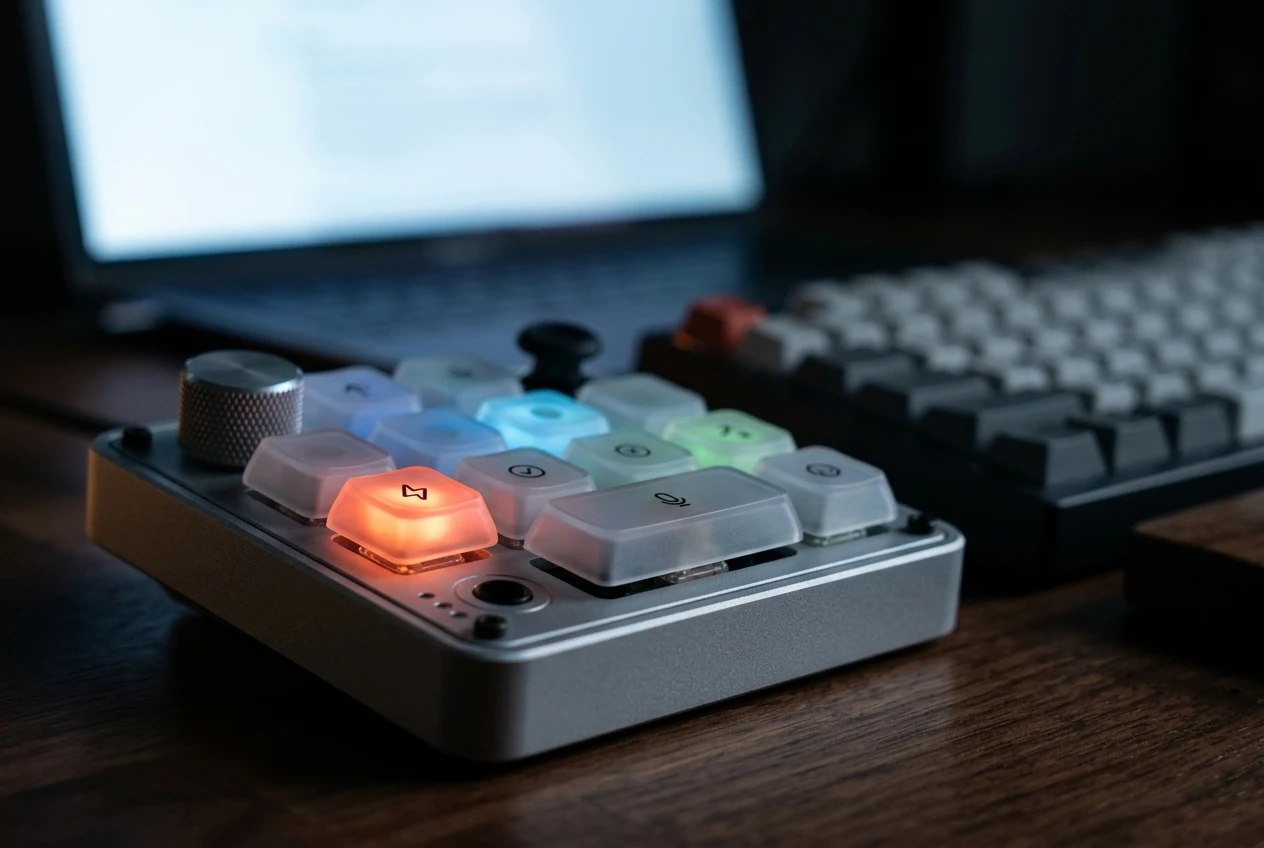
OpenAI calls it the kbd-1.0-codex-micro, Codex Micro for short. It sits beside a regular keyboard rather than replacing one, built around 13 mechanical switches, a planar joystick, a touch sensor and a rotary encoder. It connects over USB-C or Bluetooth and works on both Mac and Windows.
OpenAI’s own page says the device maps your most used actions to tactile controls built for how you ship, and the box includes a Codex Icon Keyset with 32 extra keycaps for remapping. Work Louder builds the shell from a sandblasted, anodized aluminum base with an anti-slip ring, wrapped in a polycarbonate frame that diffuses the RGB lighting evenly across the keys.
None of this is new. The device is built on Work Louder’s existing Creator Micro 2 chassis, the same hardware the company previously reskinned for Figma and for the design tool Framer.
A Creator Micro 2 costs around $174 on its own. Tom’s Hardware found that adding roughly $50 in icon keycaps gets you almost exactly to $230. The premium buys one thing: Codex-specific integration. Everything else already ships in the cheaper box.
| Device | Price | Connectivity | Standout Feature |
|---|---|---|---|
| Codex Micro | $230 | USB-C or Bluetooth | Live RGB keys tied to Codex agent status |
| Work Louder Creator Micro 2 | About $174 | USB-C, Bluetooth on Pro model | Same chassis, no Codex-aware firmware |
| Elgato Stream Deck Plus | $160 | USB-C | Wider plugin library, no agent status awareness |
The teaser alone hinted at the appetite. A silhouette clip posted by OpenAI’s developer account on June 29 racked up nearly one million views within 24 hours, before anyone outside the company knew the price or the name.
Six Agent Keys, and a Ceiling Built Into the Pitch
What the Lights Actually Show
The agent keys are the part worth noticing. Each one lights up with live status pulled straight from Codex, so a developer can tell whether a thread is thinking, running, waiting or finished without switching windows.
- Single tap selects the agent tied to that key
- Double tap brings that agent’s thread to the front
- Joystick flick launches a saved workflow, such as a pull request review, a debug pass or a refactor
- Rotary dial turn raises or lowers how much reasoning effort Codex spends on the task in front of it
Developers choose what the six keys track: pinned tasks, the most recent tasks, tasks waiting on a human, or specific agents assigned by hand.
What the colors mean is less settled. OpenAI’s own materials describe white for idle, blue for thinking, green for finished, amber for needing input and red for an error. Tom’s Hardware, testing the same unit, recorded white for idle, green for an unread chat, blue for thinking, peach for a question and red for an error. OpenAI’s product page shows an “Idle” state in its imagery but never spells out the full legend in text, so the mismatch stays unresolved.
Where the System Hits Its Limit
Six lights is also the whole budget. That ceiling stops scaling the moment a developer runs a seventh thread, which is exactly the audience OpenAI says it is chasing: people managing fleets of agents, not single conversations.
The keys that carry real authority still work everywhere as ordinary keyboard input. The standard command row, accept, reject, push to talk, new chat, sends plain keyboard events that function in Cursor, VS Code, JetBrains and a bare terminal. The colored Agent Keys are different. That RGB feedback only updates while the ChatGPT desktop app runs in the background as a bridge, translating Codex’s live thread data into light. Anyone using Codex purely through the CLI, an IDE plugin or a browser tab will find those six keys dark.
Physical accept and reject keys carry real authority over a codebase, not just a shortcut. It is the same expanding-permissions question researchers have raised about other AI assistants that now hold onto memory features attackers are already probing, just applied here to a keyboard instead of a chat window.
OpenAI built that bridge into Codex’s own session architecture rather than bolting it on afterward. The company organizes every conversation into three pieces: an Item for a single message or action, a Turn for one complete request, and a Thread that holds the whole session so a client can reconnect later. OpenAI published a detailed breakdown of that App Server design in February 2026. The status lights read directly off that system.
Why Is OpenAI Selling Hardware Right Now?
OpenAI opened orders for Codex Micro on July 15, 2026, days after Apple sued the company over stolen hardware trade secrets, and while its far bigger consumer device sits delayed into 2027. The macro pad tests manufacturing and developer demand cheaply before OpenAI risks real money on that larger bet.
Apple’s suit accuses OpenAI’s senior leadership of a deliberate strategy to extract confidential information and claims OpenAI used it while building its own hardware. OpenAI has denied wrongdoing. The complaint names two current OpenAI employees, Tang Yew Tan and Chang Liu, both of whom previously worked at Apple.
The bigger project has real money behind it. OpenAI acquired Jony Ive’s hardware startup in May 2025 for $6.5 billion. The Financial Times reported technical and design hurdles by October of that year. Bloomberg now reports OpenAI plans to unveil a screen-free smart speaker with ChatGPT built in later this year, aiming for a 2027 release, a timeline the Apple suit could still complicate.
The timing sits awkwardly against internal messaging. TechRadar reported the keyboard launched weeks after OpenAI’s CEO of Apps told staff not to get distracted by “side quests.” A $230 keyboard aimed at a slice of the user base arrived right after that memo. Using a boutique partner and a limited production run commits OpenAI to nothing. It is a cheap way to learn whether developers want hardware before building a factory around the Ive device.
The Agentmaxxers OpenAI Is Betting On
A Fast Growing, Splitting User Base
Codex’s audience has moved quickly. Coverage around the launch put its active users at about 5 million in early June, climbing past 8 million and toward 9 million by mid-July. Axios has taken to calling this crowd agentmaxxers, developers who monitor and direct AI agents rather than just chatting with one assistant.
OpenAI is also splitting that audience in two. The company launched ChatGPT Work last week for people who use agents for tasks other than coding, so anyone who is not building software no longer needs to open Codex’s cloud coding agent platform at all. Codex Micro is built for the half that remains. The same bet, that agents can carry out engineering work rather than just assist with it, is why Salesforce redirected engineering hiring budget toward Anthropic earlier this year.
Praise, Skepticism and a Free Alternative
Reaction split fast. Developer Thomas Ricouard posted a launch day walkthrough on X praising the setup process.
I don’t want to spoil all the Codex Micro experience in the ChatGPT Desktop App because it’s magical, but it’s really flexible.
Ricouard wrote that alongside a video of himself remapping keys inside the desktop app on launch day.
Not everyone agreed. Forums compared the $230 price to a five dollar Raspberry Pi Pico, asking why anyone would pay that much when a hobbyist board does the same job for free. Reaction on Slashdot leaned the same way, with one commenter noting their existing keyboard already handled the job for $18. Every action those keys perform, accepting a change, rejecting one, starting a new thread, is also available at no cost through Codex’s free command line agent on GitHub.
One Button Became a Whole Control Surface
The closest precedent for Codex Micro is a single button. Microsoft added a dedicated Copilot key to Windows keyboards in January 2024 to summon a chatbot. Two years later, this is an entire control surface for people who spend their whole day supervising agents instead of writing every line themselves.
Work Louder has run this playbook before. The keyboard maker previously co-produced a similar device with Figma in 2023, and anyone who has used the company’s Framer Micro, built with the website builder Framer, will recognize the same fit and finish here. An early post from AI commentary account Chubby described the new device as a compact control deck for agentic coding, capturing how the launch read to much of the developer audience within hours.
Codex itself is younger than the keyboard’s chassis. OpenAI introduced it as a cloud-based software engineering agent research preview that could work on many tasks in parallel, and it has since grown into the platform this keyboard now sits beside. The instinct to own the physical layer between developer and agent is not limited to OpenAI. Google’s own Genkit framework reaching TypeScript and Go preview shows a rival platform chasing the same developer loyalty through code instead of keycaps.
The Ive Speaker Waits Behind a Courtroom Fight
OpenAI’s store currently lists Codex Micro as out of stock, though the company says more units are coming. It has not said how many units shipped in the first run, or when the next batch arrives.
- Confirmed price – $230, sold through OpenAI’s Supply Co. store and directly through Work Louder
- Confirmed dependency – the colored Agent Key display only updates while the ChatGPT desktop app runs in the background
- Confirmed base hardware – the Work Louder Creator Micro 2 chassis, previously sold under Figma and Framer branding
- Unconfirmed unit count – OpenAI has not said how many Codex Micro units existed in the first run
- Unconfirmed restock date – Work Louder describes availability only as while supplies last
- Unconfirmed color legend – OpenAI and outlets that tested the device do not fully agree on what each light color means
The bigger device is on a slower clock regardless. Bloomberg reports OpenAI plans to unveil a screen-free smart speaker with ChatGPT built in later this year, aiming for a 2027 release, a timeline the Apple litigation could still complicate.
For now, the only OpenAI hardware anyone can actually own is a backordered keyboard with six lights and a waiting list.
Frequently Asked Questions
What does the Codex Micro actually do?
Codex Micro gives developers physical keys, a joystick and a dial for controlling Codex, OpenAI’s AI coding agent, instead of navigating menus. Beyond Codex, Work Louder’s Input software supports up to five additional custom layers, so the same keys can trigger shortcuts in other applications entirely, not just OpenAI’s tools.
How much does the Codex Micro cost, and is it in stock?
It costs $230 and is sold through OpenAI’s Supply Co. store or directly from Work Louder. The first run sold out within about a day, and OpenAI has said only that more units are coming, without giving a date.
Is the Codex Micro connected to OpenAI’s Jony Ive hardware project?
No. Codex Micro is a developer accessory available now. The Ive collaboration is a separate, unreleased screen-free smart speaker that OpenAI plans to unveil later this year for a 2027 launch, built around a startup OpenAI acquired from Ive in May 2025 for $6.5 billion.
Do I need the Codex Micro to use Codex?
No. Codex already runs through a terminal CLI, a desktop app for Mac and Windows, IDE extensions and a ChatGPT-integrated cloud interface, and every action on the keyboard has a menu or shortcut equivalent in those tools already.
Can the Codex Micro be used for anything besides Codex?
Yes. Work Louder’s Input app lets owners build custom layers for other software, so the keys are not locked to Codex even though that is the integration OpenAI is selling.
 ONGC licence frees Venezuela cash and operatorship talks
  Anthropic Hits $65 Billion Run Rate and Flips the AI Cash Test
  Supreme Court grounds the fare free-for-all with three-week clock
  Gold Nears $4400 as Soft Data Meets Oil Inflation Risk
  Nifty Slips as Zaggle Circuits and Dhoot Debuts Big
  Diesel Crack Tops $100 as Iran Rhetoric Lifts Crude