
 Ishan Crawford
 Jio Platforms filed its draft red herring prospectus with the Securities and Exchange Board of India on June 19, 2026, kicking off the process for what is set to become India’s largest share sale on record. The Reliance Industries unit is targeting to raise close to ₹37,700 crore, about $3.8 billion, through a pure fresh issue that channels every rupee raised into the company itself.
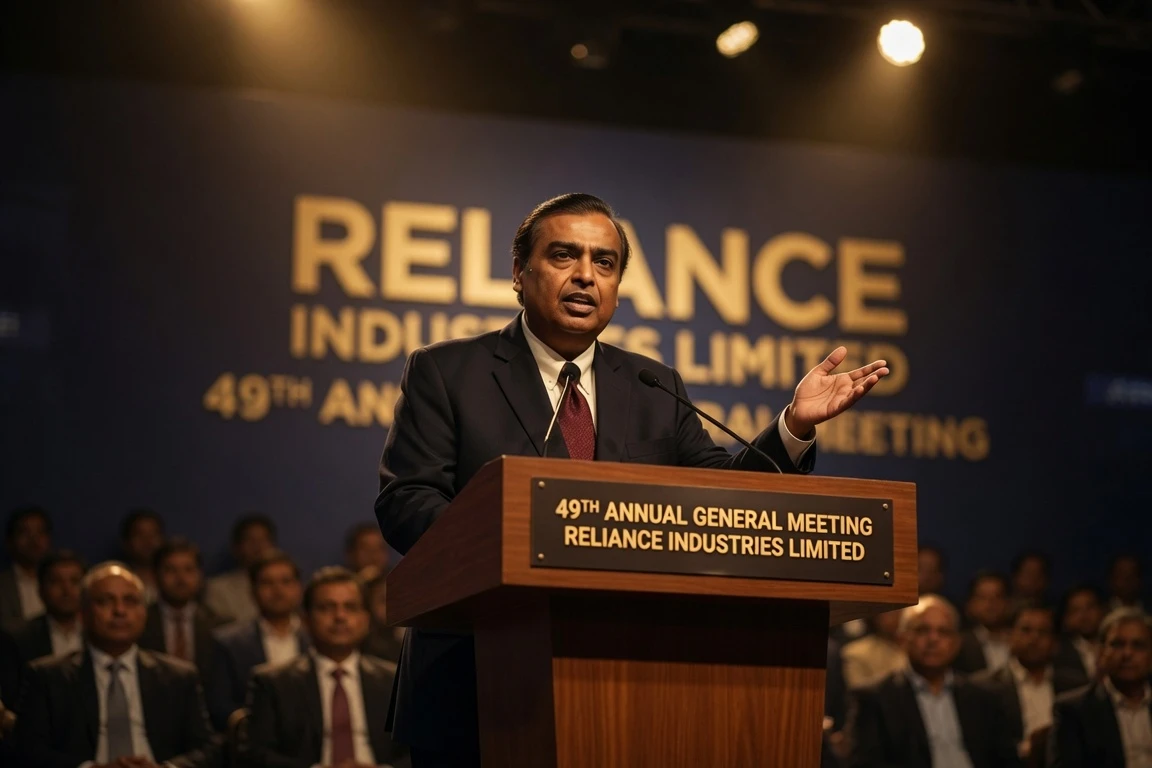
Mukesh Ambani, chairman of Reliance Industries, framed the moment at the group’s 49th annual general meeting the same day, calling the proposed listing “the most important value creation milestone this year.” Three of his children, Akash, Isha and Anant Ambani, will lead the Jio Platforms IPO process as part of the group’s wider leadership transition. With the DRHP now on the regulator’s desk, the question for Indian markets is not whether Jio lists, but at what kind of multiple.
The ₹37,700 Crore Filing
Jio Platforms, the digital and telecom arm of Reliance Industries, has filed its DRHP with SEBI for what The Week describes as set to become the largest IPO in Indian stock market history. The full text of the offer document is on the regulator’s site as the Jio Platforms DRHP filed with SEBI. The proposed fresh issue covers up to 27 crore equity shares of face value ₹10 each. Those shares represent around 2.9% of post-issue equity capital, in a deal sized to raise close to ₹37,700 crore.
There is no offer for sale component. CNBC TV18 calls the structure a “complete fresh issue,” with every rupee raised going to the company itself. None of the existing global investors, including Meta, Google, Silver Lake or KKR, are selling shares in the IPO.
The deal carries 19 book running lead managers, the second highest on record, according to Moneycontrol, and a wall-street-grade roster that includes Morgan Stanley, Kotak Mahindra Capital, Goldman Sachs, J.P. Morgan and BofA Securities. The DRHP itself positions Jio as a “technology platform” and notes that the company has applied for 6,817 patents and employs over 11,000 people. The IPO is the first major public offering from the Reliance group since Reliance Petroleum was listed in 2006, per the BBC, and the timing path that finally brought the filing to the regulator is mapped out in Jio’s IPO filing timeline and delay risk. The deal lands a day after the National Stock Exchange of India filed its own draft papers for a separate ₹30,000 crore listing.
- $110 billion: Reliance’s 7-year AI infrastructure investment pledge, announced at the same AGM
- 35%: share of the issue reserved for retail investors, per the DRHP
- $90.6 billion: Mukesh Ambani’s net worth, per Forbes
- $15.6 billion: Jio’s FY26 operating revenue in USD, per the DRHP via TheNextWeb
Most of the Money Goes to Debt, Not AI
Jio Platforms plans to use up to ₹27,500 crore of the net proceeds to prepay or repay borrowings of its telecom subsidiary Reliance Jio Infocomm, according to the DRHP. The remaining amount, capped at 25% of gross proceeds, is earmarked for general corporate purposes. The single biggest use of the IPO money is deleveraging, not the much-discussed AI build-out.
The targeted debt comprises three syndicated term-loan facilities in dollars and yen, with a total principal outstanding of ₹30,057.2 crore as of March 31, 2026, per CNBC TV18. Lenders include Australia and New Zealand Banking Group, Bank of America, Barclays, BNP Paribas and Citibank, according to TheNextWeb, and the facilities were originally raised to fund capex and spectrum acquisition, scheduled for repayment between March and June 2028. Net debt at Jio Platforms stood at ₹27,579.20 crore as of March 2026, down from ₹45,273.4 crore a year earlier. Net leverage fell to 0.36x in FY26, from 0.88x in FY24, a trajectory the filing itself frames as evidence of a “strong balance sheet.” Prepaying the foreign-currency loans would clear the bulk of the remaining exposure, lower Jio’s annual servicing costs, and free capacity for the wider Reliance AI build-out that Ambani has committed to fund separately.
Why Every Major Investor Is Sitting This One Out
Reliance Industries holds 66.43% of Jio Platforms. Of the rest, Meta is the largest foreign shareholder at 9.99%, held through Jaadhu Holdings LLC, and Google holds 7.73%, per CNBC TV18.
Silver Lake holds 1.88%, Vista Equity Partners 2.31%, Mubadala 1.85%, ADIA 1.16%, General Atlantic Singapore 1.34%, TPG Capital 0.93%. The wider cap table includes KKR, the Public Investment Fund, Intel Capital and Qualcomm Ventures. None of these shareholders is selling in the IPO.
That 2020 fundraising round raised ₹1.52 lakh crore, about $20.3 billion, for roughly 33% of the company, according to the draft paper quoted in The New Indian Express, and at the time valued Jio at between $57 billion and $65 billion, per Forbes. By FY26 the same business posted revenue of ₹1.47 lakh crore and a profit after tax of ₹30,049 crore, the first time the annual profit crossed the ₹30,000 crore mark, per Moneycontrol. Investors who choose to sit out an offering they could sell into are pricing the public-market listing as the higher number, and the IPO prospectus as the cheaper one. The pattern matters for the band the bookrunners will set when the price range is announced.
Telecom or Tech: The Question That Will Define the Valuation
Reliance Retail is the sole distributor of Jio’s prepaid services, and prepaid connectivity made up 77.08% of Jio Platforms’ consolidated revenue in FY26, per CNBC TV18. That share is the heart of the pitch problem: telecom is a capital-heavy, licence-dependent, spectrum-buying business that the market historically values at utility multiples.
Jio’s management wants the market to look elsewhere. The DRHP describes Jio as a “technology platform” spanning mobile, broadband, cloud, IoT and AI services under one roof. In FY26 Jio carried about 60% of India’s wireless data traffic, with monthly data consumption of 42.3 GB per customer in Q4 FY26, per The New Indian Express. Jio’s 5G standalone network, built at around ₹2 lakh crore in capex, is the structural edge, per the Indian Express.
Mukesh Ambani, chairman of Reliance Industries, made the case at the 49th AGM on June 19, 2026, the same day the DRHP was filed. Jio has 524.4 million subscribers, including 268.5 million 5G customers and 27.1 million fixed broadband customers, per CNBC TV18, the largest single-country 5G operator outside China, and Jefferies estimated the business at around $180 billion as recently as November, per the BBC.
The proposed listing of Jio will demonstrate to the world that India can build technology companies of global scale, global capability, and global value.
| FY26 metric | Jio Platforms | Bharti Airtel |
|---|---|---|
| Revenue from operations | ₹1.47 lakh crore | ₹2.11 lakh crore |
| Profit after tax | ₹30,053 crore | ₹33,823 crore |
| Average revenue per user (monthly) | ₹214 | ₹257.4 |
| India subscribers | 52.4 crore | 48.2 crore |
The numbers that justify the “tech platform” label are the same ones that make an Airtel comparison the obvious benchmark. Jio’s mobile broadband customer base is 1.4x the second player in India and 1.9x in fixed broadband, per The New Indian Express, but Airtel leads on per-user revenue and net profit. How that mix is read will decide whether the IPO prices closer to a Bharti Airtel multiple or a global tech-platform multiple.
Airtel Is the Real Rival
Bharti Airtel is the only competitor that matters at Jio’s scale. Vodafone Idea added 53,257 wireless subscribers in April 2026, its third straight month of net gains, but a rounding error next to Jio’s 524.4 million base. BSNL remains far behind on network quality and subscriber economics. Airtel posted higher revenue (₹2.11 lakh crore) and higher profit (₹33,823 crore) than Jio in FY26, per the Indian Express, but with a smaller Indian subscriber base of 48.2 crore.
Airtel built its business on premium customers and higher ARPU (₹257.4 a month, the highest in the industry), Jio on scale and lower pricing (ARPU of ₹214). Airtel began transitioning to a standalone 5G network in February 2025 in partnership with Ericsson, with rollouts reaching early 2026, and the live question is now whose network is more useful for the AI use cases Jio is trying to monetise.
The Risks the DRHP Itself Flags
The DRHP lists several risk factors that frame the headwinds a Jio investor is taking on. NDTV Profit reports the company has flagged its dependence on Reliance Group companies, the need to continuously secure telecom spectrum and licences, and rising competition from satellite-based communication services.
Other flags include the fact that Jio does not have exclusive control over the “Jio” trademark, that other Reliance Group companies may compete with Jio’s business in the future, and that telecom is a capital-intensive business requiring significant network and spectrum investment.
Jio has never declared or paid dividends since incorporation, and the DRHP offers no assurance of future payouts. Any returns, the company warns, may depend entirely on share price appreciation. The filing also flags cybersecurity and data-privacy risks, evolving telecom regulations and net neutrality rules, and the possibility of a downgrade in India’s sovereign credit rating that could raise Jio’s own financing costs.
Frequently Asked Questions
How big is the Jio Platforms IPO?
Jio Platforms filed for an IPO targeting close to ₹37,700 crore (about $3.8 billion) on June 19, 2026, in a deal that carries 19 book running lead managers, the second highest on record, according to Moneycontrol. The fresh issue covers 27 crore equity shares, or roughly 2.9% of post-issue equity.
Is the Jio Platforms IPO a fresh issue or an offer for sale?
The IPO is structured as a pure fresh issue with no offer for sale (OFS) component, which CNBC TV18 calls a ‘complete fresh issue.’ Every rupee raised flows into Jio Platforms, and none of the existing global investors, including Meta, Google, Silver Lake or KKR, are selling shares in the listing.
What will Jio Platforms use the IPO money for?
Jio Platforms will use up to ₹27,500 crore of net proceeds to prepay or repay three foreign-currency syndicated term loans held by its telecom subsidiary, Reliance Jio Infocomm. The remaining amount, capped at 25% of gross proceeds, is earmarked for general corporate purposes such as strategic initiatives, marketing, and working capital.
How does Jio compare to Bharti Airtel on key metrics?
In FY26, Jio Platforms posted revenue of ₹1.47 lakh crore and a profit of ₹30,053 crore, against Bharti Airtel’s ₹2.11 lakh crore revenue and ₹33,823 crore profit. Jio’s average revenue per user stood at ₹214 a month, lower than Airtel’s ₹257.4, but Jio led on Indian mobile subscribers at 52.4 crore, or about 40% of the country’s mobile users.
When will the Jio Platforms IPO list on Indian markets?
The DRHP was filed with SEBI on June 19, 2026, and is the first major public offering from the Reliance group since Reliance Petroleum was listed in 2006. Listing dates and the price band have not been disclosed, and will follow once SEBI issues its observations and Jio files its final prospectus.
Disclaimer: This article is for informational purposes only and does not constitute investment advice. Securities and IPO investments carry risk, and figures are accurate as of publication. Readers should consult a qualified financial adviser before making any investment decision.
 ONGC licence frees Venezuela cash and operatorship talks
  Anthropic Hits $65 Billion Run Rate and Flips the AI Cash Test
  Supreme Court grounds the fare free-for-all with three-week clock
  Gold Nears $4400 as Soft Data Meets Oil Inflation Risk
  Nifty Slips as Zaggle Circuits and Dhoot Debuts Big
  Diesel Crack Tops $100 as Iran Rhetoric Lifts Crude