
 Ishan Crawford
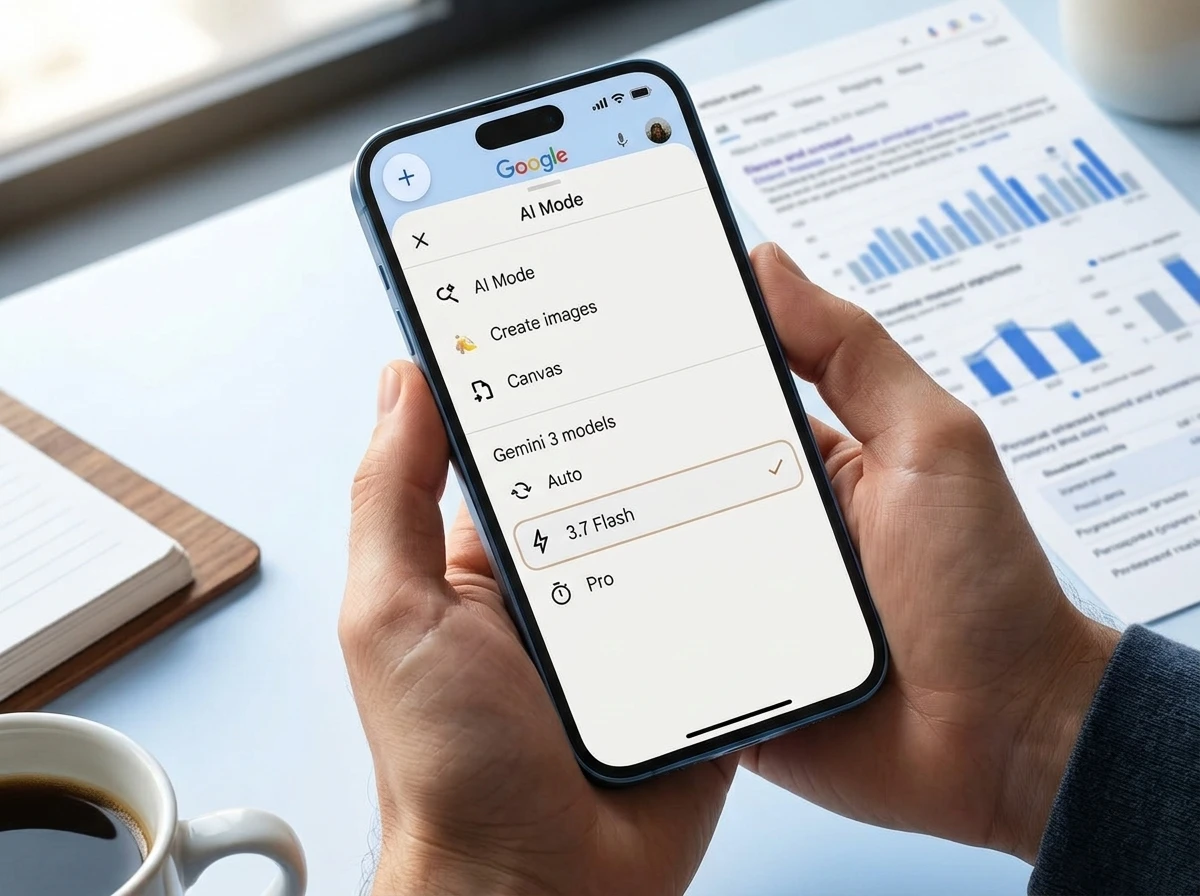
 Google added Gemini 3.7 Flash as a selectable model in AI Mode for Google AI Pro and Ultra subscribers on August 14, one day after the model’s public debut. The update is live globally in English. Robby Stein, VP of Product for Google Search, said the model is better at following instructions and understanding intent.
That speed of handoff from model launch to Search surface is the pattern, and the paid selector creates a new practical layer: power users can now run the same query across 3.7 Flash, Auto and Pro and watch how answers, citations and multi-step reasoning diverge.
The one-day gap matters because it compresses the usual wait between a model card and a consumer surface. Paying subscribers do not need a separate developer console to sample the workhorse. They open AI Mode and pick it.
Robby Stein Puts the New Flash in the Menu
Stein posted the news directly. The model sits under the Gemini 3 models section in the model menu, next to Auto and Pro. Users open it by tapping the + icon in AI Mode’s Ask anything bar.
News Flash We’re bringing Gemini 3.7 Flash to Search! Better at following instructions + understanding your intent, so you get even more helpful responses. Rolling out today globally in AI Mode for Google AI Pro & Ultra subs in English. Click the ‘+’ icon to select the model.
Stein wrote that on X. The post drew tens of thousands of views within hours. Replies quickly noted the contrast with the Gemini app, where some advanced models stay gated, while Search AI Mode now surfaces the fresh Flash option for paying subscribers.
bringing Gemini 3.7 Flash to Search landed as a clean product note rather than a full default flip. Google’s AI Mode support pages still describe older Fast and Pro labels in places and have not fully caught up to Auto or the new Flash tier.
That documentation lag is familiar after prior Flash drops. The live menu moved first. Help text and label maps tend to trail by days or longer. For users the path is still simple: the + icon, then the Gemini 3 block, then 3.7 Flash beside the other paid choices.
Stein’s emphasis on instruction following and intent is the product claim that paid testers can check immediately. A multi-constraint query that once drifted on older Flash tiers is the natural first experiment.
Benchmarks That Matter for Agents and Code
Google framed Gemini 3.7 Flash as its most intelligent workhorse model yet for coding and agents. The gains show up hardest on long-horizon software work, production code quality and multi-step business automation.
| Benchmark | Gemini 3.7 Flash | Gemini 3.6 Flash | Notes |
|---|---|---|---|
| DeepSWE v1.1 | 65.3% | 48.6% | Long-horizon software engineering |
| FrontierCode 1.1 Main | 43.6% | 34.4% | Production code quality |
| Code Arena WebDev Elo | 1588 | 1538 | Web app generation |
| AutomationBench | 30.4% | 17.0% | Enterprise workflow automation |
| GDP.pdf | 34.0% | 22.0% | Complex document comprehension |
The full benchmark table and safety results also list wins on Terminal-bench agentic coding, OSWorld computer use and several knowledge-work evals. Google put the introductory API price at $0.75 per million input tokens and $3.75 per million output tokens through December 31, 2026, half the original 3.6 Flash launch rate. After that the price steps to $1.50 / $7.50.
The model card lists a March 2026 knowledge cutoff with some domains older, standard multimodal inputs (text, image, video, audio, PDF), and text output. Thinking levels are supported at low, medium and high.
Read across the table and the pattern is consistent. DeepSWE and AutomationBench show the steepest relative lifts, which aligns with Google’s agent and workflow framing. FrontierCode and Code Arena move in the same direction on production and web generation quality. GDP.pdf’s jump speaks to long-document work that Search users already attempt inside AI Mode.
Those scores do not guarantee identical gains on every Search query. They do explain why Google pushed the model into the paid selector so quickly after the API debut.
Three-Week Sprint From 3.6 Flash
Gemini 3.7 Flash arrived only three weeks after 3.6 Flash. The Flash line has moved from 3.5 through 3.6 to 3.7 in roughly three months. That cadence is deliberate.
- November 2025, Gemini 3 Pro reaches AI Mode as a selectable option alongside the then-default model.
- December 2025, Gemini 3 Flash becomes the global default in AI Mode.
- May 2026 (I/O), Gemini 3.5 Flash replaces it as the new global default.
- July 2026, Gemini 3.6 Flash and related lite variants ship with efficiency and agentic gains.
- August 13, 2026, Gemini 3.7 Flash launches for coding, agents and API use.
- August 14, 2026, 3.7 Flash appears as a selectable model in AI Mode for Pro and Ultra.
Tulsee Doshi, Senior Director of Product Management on the Gemini team, wrote that the release came from developer feedback plus algorithmic improvements. Early customer notes highlighted better first-pass code accuracy, fewer retries and tighter instruction following on multi-step plans.
The timeline also shows how Search access trails API access by a single day at the end of the chain. Selectable Pro access came earlier in the Gemini 3 cycle. Default flips for Flash arrived weeks or months after each workhorse landed. 3.7 Flash is still in the selectable phase.
Doshi’s feedback loop description matches what paid Search users can now probe themselves: fewer retries and tighter multi-step plans are observable behaviors, not only benchmark lines.
Paid Users Now Run Side-by-Side Tests
The second-order effect sits here. Free AI Mode users stay on the current default (still described around the 3.5 Flash generation in recent coverage). Pro and Ultra subscribers can switch models on the same query.
- Run an identical multi-constraint question on 3.7 Flash, Auto and Pro and compare how constraints are honored.
- Check citation consistency and source selection across models when AI Mode answers look unstable.
- Test long-document or agent-style follow-ups that previously required manual re-prompting.
- Measure latency and completeness on coding or workflow prompts that mirror real Search use.
Search Engine Journal noted the practical value for anyone tracking inconsistent AI Mode citations. The model menu turns a black-box experience into a controlled experiment for people already paying for higher limits. That gap between free and paid Search quality is now visible and measurable in real time.
Developers on X have already treated 3.7 Flash as fast enough to trust in auto-mode fleets for personal projects, especially when Google AI Pro storage is already in the budget. The same speed and instruction fidelity now sits inside Search for those same subscribers.
The comparison habit will likely spread among SEOs and publishers first. They already screenshot AI answers. A three-model pass on one query is only a small extra step, and it isolates model choice from prompt wording.
Why Flash Models Own Search Production
Flash models remain the production tier for Search for the same reasons Jeff Dean and others have stated in earlier cycles: lower latency and lower cost at massive query volume. AI Mode has scaled past a billion monthly users in recent Google statements. A frontier Pro model on every query would break the economics and the response-time targets.
1M input token context and 64k output tokens give 3.7 Flash room for long pages and multi-turn agent steps without leaving the Flash cost band. The API page confirms the 1M input tokens and 64k output limit along with function calling, search grounding, code execution and computer-use preview.
Google’s broader AI spending, including Google’s $80 billion AI capital raise, funds exactly this loop: rapid Flash iteration that can ship into Search surfaces quickly while Pro-class models handle the hardest reasoning slices or stay behind the paid selector.
- Latency first, Flash keeps AI Mode snappy enough for everyday search volume.
- Cost control, Introductory pricing and efficient inference let Google scale agentic answers.
- Rapid feedback, Three-week cycles let developer and Search signals land in the next workhorse.
The pattern holds: new Flash ships, paid users get early selectable access, then a later default flip often follows once Google is confident at scale.
Context length is part of that production story. A 1M-token window lets AI Mode hold long pages or multi-turn threads while output stays capped at 64k. Function calling, search grounding, code execution and computer-use preview keep the same model useful beyond plain chat.
Token Pricing Tracks the Workhorse Plan
API pricing for 3.7 Flash is staged on a clear calendar, and that schedule reinforces why Flash stays the Search volume tier.
| Period | Input per 1M tokens | Output per 1M tokens | Relative note |
|---|---|---|---|
| Through December 31, 2026 | $0.75 | $3.75 | Introductory rate, half of 3.6 Flash launch |
| After December 31, 2026 | $1.50 | $7.50 | Step-up from the intro window |
Half-price intro rates through late 2026 lower the cost of heavy agent and coding trials. The later step to $1.50 and $7.50 still aims to keep Flash inside a workhorse band rather than a frontier one. Search can absorb high query volume only while unit costs and latency stay in that band.
Thinking levels at low, medium and high give another dial on the same cost and latency tradeoff. Multimodal inputs and a March 2026 knowledge cutoff define what the model can see; text output defines what it returns into AI Mode threads.
None of those API details auto-translate into free Search defaults. They do explain why Google can afford to put a stronger Flash behind the paid + menu without waiting for a full default decision.
How the Plus-Icon Picker Works Today
Open AI Mode. Tap the + icon beside the Ask anything bar. Look under Gemini 3 models. Choose Gemini 3.7 Flash. It sits beside Auto and Pro. The option is English-only for now and limited to active Google AI Pro or Ultra plans.
Google has not said whether 3.7 Flash feeds into Auto’s routing logic. It has not said whether the model will become the next global default. Support documentation still lags the live menu in several places. Those details remain open.
For publishers and SEOs the immediate use is empirical. Same query, three models, side-by-side screenshots of answers and cited links. Differences that used to feel random now have a clearer source: the model itself.
English-only scope and plan gating keep the experiment pool smaller than full AI Mode traffic. That limit is useful for Google while citation and safety signals accumulate. It is also useful for testers who want cleaner A/B reads without mixed locales.
Instruction Gains Meet Everyday Search Prompts
Stein’s claim on instruction following and intent parsing is the bridge between the agent benchmarks and ordinary AI Mode use. Multi-constraint questions, long PDF-style comprehension and workflow-style follow-ups are already common in Search threads.
Early customer notes on first-pass code accuracy and fewer retries map onto those same habits. A user who once re-prompted after a missed constraint can now swap to 3.7 Flash and re-run the identical wording. If the answer holds the constraints, the model change is the variable.
- Intent parsing, closer reads on what the query asks before drafting.
- Constraint honor, fewer dropped limits on multi-part asks.
- Multi-step plans, tighter follow-through when AI Mode chains actions.
- Document load, stronger handling on complex file-style comprehension tasks.
AutomationBench and GDP.pdf sit behind that list as supporting evidence, not as Search scorecards. The paid menu is where those lab gains become visible on live queries.
Pro remains available beside Flash for harder reasoning slices. Auto remains the routed choice when users do not want to pick. The new Flash entry simply widens the set of controlled comparisons.
Default Status Still Unwritten
Google has kept the default path for AI Mode on a predictable but never fully announced cadence. 3 Flash became default weeks after launch. 3.5 Flash took the slot at I/O. 3.7 Flash is currently an option, not the baseline. If history holds, a broader rollout or default change could follow once latency, safety and citation quality clear internal bars.
Until then the practical change is already live for paying subscribers. They can force the newest workhorse on any AI Mode conversation and watch how instruction following and intent parsing shift. Free users keep the prior default. That split is the part of the story that compounds past the announcement itself.
The free path, still described around the 3.5 Flash generation in recent coverage, will not show the same instruction and citation behavior on every prompt. Paid users who log differences now will have a clearer baseline if a default flip arrives later.
The model is available now in the menu. The diagnostic window is open for anyone with a Pro or Ultra plan.
 Scotland Reader Photos Capture Eclipse Week Beyond the Sky
  Scotland’s Rare World Cup Win Over Haiti Still Echoes
  Scottish Morning Roll Campaign Echoes Baguette Path to Unesco
  Samsung Passport Fold8 Turns Apple Fans Into Switchers
  Android’s Quiet Shift to Ambient AI Hardware This Week
  Poco F9 Leak Hands Global Buyers Less Battery for More Money