
 Ishan Crawford
 Fingal’s Cave on Scotland’s Isle of Staffa carries the Gaelic name An Uaimh Bhinn, the melodious cave. The “music” is real, a sustained, cathedral-like echo produced by Atlantic waves striking the cave’s hexagonal basalt columns. It is also the sound of those columns being slowly dismantled, a reverberation that exists only because the cave is being unmade.
How a Sea Cave Got Called An Uaimh Bhinn
Fingal’s Cave sits on the uninhabited island of Staffa, in the Inner Hebrides of Scotland, and the National Trust for Scotland owns it as part of a national nature reserve. The name is older than the English-speaking attention the cave now receives.
The acoustics come from the shape of the stone. The cave’s walls are lined with thousands of hard basalt columns whose smooth, angular faces reflect sound in many directions at once, a pattern researchers call a diffuse reverberant field. As ocean swells enter the narrow entrance, each wave throws echoes that overlap and linger, so the cave produces layers of resonant sound rather than a single returning note. Researchers who modelled the cave in 2018, in a study that paired a laser scan with audio capture, found that the basalt is unusually reflective, and that low frequencies travel deeper into the chamber before bouncing back. The result, the author wrote, depends on the weather, the tide and the wind direction. Under some conditions the sound is gentle humming; under others, the caves of the island make a loud booming noise that was said to terrify the inhabitants. Locals had a name for it long before the wider world did. The cave’s Gaelic name, An Uaimh Bhinn, means the melodious cave, and it survives in the 2018 acoustic study of the cave as the working title for the research project that mapped its sound.
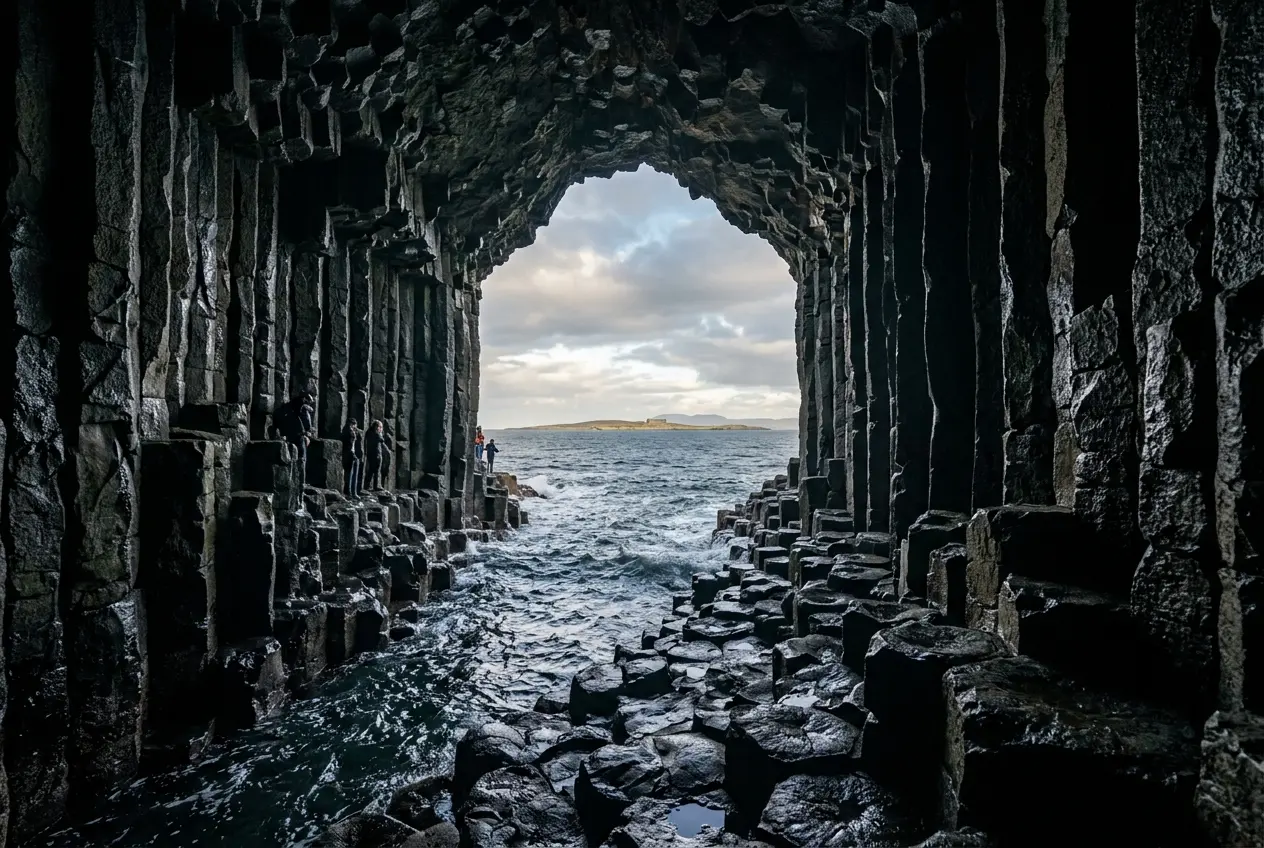
From Lava Flow to Stone Cathedral
The basalt columns were laid down as a Paleocene lava flow. The eruption happened sometime between 66 and 56 million years ago, when enormous volumes of basaltic lava spread across what is now western Scotland, and the flow that built Staffa also reached Northern Ireland. The island sits to the west of the Isle of Mull, between Iona and Gometra, and is roughly one mile long by half a mile across. The Paleocene age matters because the same volcanic event that carved out the cave’s silhouette also produced the Giant’s Causeway more than a hundred miles to the south.
The hexagonal pattern came from cooling. As the thick lava flow lost heat from its upper and lower surfaces, those surfaces contracted and fractured, starting in a blocky tetragonal pattern and transitioning to a regular hexagonal fracture pattern with cracks running perpendicular to the cooling surfaces. As cooling continued, the cracks extended toward the centre of the flow, producing the long hexagonal pillars that now stand exposed in the wave-eroded cross-section. The same geometry shows up in desiccation cracks in drying mud, where the loss of water plays the role that heat loss plays here.
Staffa carries at least twelve prominent sea caves around its cliffs, by the count of researchers who surveyed the island in 2017, and Fingal’s Cave is the largest and the most visited. Wave action did the carving, exploiting the same fractures that gave the columns their geometry. The result is a chamber that looks and sounds like a building, but was never built, a point made clear in the explainer on how the basalt columns and sound chamber were formed.
- 66 to 56 million years ago, the age of the Paleocene lava flow that built the cave
- At least twelve prominent sea caves carved into Staffa’s basalt cliffs
- One mile long, half a mile across, Staffa’s footprint at sea level
- One lava flow, reaching from western Scotland to the Causeway Coast of Northern Ireland
- Hexagonal, the dominant fracture pattern in the columnar basalt
The Atlantic’s Long, Slow Takeover
The same waves that produce the sound are the waves dismantling the columns. The reverberation exists because the cave is being unmade.
The swells find the natural fractures between the columns first, loosen material grain by grain, then exploit the joints. Over time the chamber widens, the causeway at the entrance lowers, the columns lose their footing and topple inward. None of it is fast. All of it is relentless, and the Atlantic has had roughly 60 million years to work on Staffa since the lava cooled.
The other end of the same lava flow sits across the sea. Northern Ireland’s Giant’s Causeway, with more than 40,000 interlocking basalt pillars, was produced by the same Paleocene eruption. Both are products of the same lava flow’s contraction on cooling. Both are slowly being trimmed by the same ocean, and the table below sets out what they share and what separates them.
| Attribute | Fingal’s Cave | Giant’s Causeway |
|---|---|---|
| Site | Sea cave on Staffa, Inner Hebrides, Scotland | Coastal cliffs on the Causeway Coast, County Antrim, Northern Ireland |
| Origin | Paleocene lava flow, 66 to 56 million years ago | Same Paleocene lava flow |
| Structure | Hexagonal basalt columns forming a sea cave | More than 40,000 interlocking basalt pillars |
Even the cave’s depth has shifted as the chamber has been remodelled. Different sources have measured the cave at noticeably different sizes, and the entrance has been reported in the 60 to 85 metre range across surveys. The Mendelssohn of 1829 would not have stood in quite the same chamber a visitor steps into today, and the visitor of 2129 will not stand in the one we have now. The slow erosion is the point. The “music” the cave is famous for is the by-product of the same forces that will, over geological time, take the cave apart.
The Botanist Who Put Staffa on the Map
Sir Joseph Banks, the naturalist who had sailed around the world with Captain Cook, landed on Staffa in 1772 and brought the cave to the attention of the English-speaking world. He had not set out to see it. The island appeared almost by chance on a westward journey, and his published account of the columns turned a remote Hebridean rock into a destination. For a fuller sense of the island that holds the cave, the volcanic story of the Isle of Staffa is worth a detour.
Locals already knew the place. The cave had been part of the Ulva estate of the Clan MacQuarrie from an early date until 1777, five years after Banks’s visit, and Gaelic-speaking communities on Mull and the surrounding islands had passed names for the chamber down through generations. The English name that now sticks came from a different direction. The 18th-century Scottish writer James Macpherson published “Fingal, an Ancient Epic Poem in Six Books” in 1762, the same hero Fingal is identified with the Irish legend’s Fionn mac Cumhaill, said to have built a causeway between Ireland and Scotland, and the cave is the causeway’s last Scottish remnant. Banks’s 1772 account married the legend to the rock, and the marriage held.
Walter Scott was among the first to react. He called the cave “one of the most extraordinary places I ever beheld,” comparing its basalt pillars to a cathedral roof “eternally swept by a deep and swelling sea.” His description sealed the cave’s place in the Romantic imagination, and the visitors who followed in the next half century were, in part, chasing his sentence.
The Overture That Came Before the Cave
Felix Mendelssohn reached the Isle of Mull in early August 1829 with his friend Karl Klingemann, after a week travelling from Edinburgh through the Scottish Highlands. On 7 August 1829, in lodgings at Tobermory, before he had set foot in the cave, Mendelssohn jotted down the opening theme of what would become The Hebrides Overture, complete with indications on orchestration. The note he sent his sister read, “In order to make you understand how extraordinarily the Hebrides affected me, the following came into my mind there.” The two companions did not cross to Staffa until 8 August. The opening of the Overture was, in the strictest sense, written before its composer had reached the place that inspired it, a fact laid out in the 1829 journey to the Hebrides.
The original title Mendelssohn chose was “The Lonely Isle Overture.” By the time the first version was completed at the end of 1830 he had changed the name to “Die Hebriden,” and a further layer of confusion was added in 1834 when the score was published as “Fingals Höhle” and the orchestral parts as “Die Hebriden.” A revised version was ready for its first performance in London at the Philharmonic Society in May 1832, conducted by Thomas Attwood, Mozart’s former pupil. In the UK the title used today is The Hebrides. The piece is also known as the Fingal’s Cave Overture, and the double name has stuck.
A Cathedral of Words and Paint
The Romantic pilgrimage to Staffa began in earnest after Scott. William Wordsworth, John Keats and Alfred, Lord Tennyson all made the crossing, and J. M. W. Turner painted Staffa, Fingal’s Cave in 1832, the year of the Overture’s London premiere. Each arrived expecting something like a building, and each described the cave in the language of a building.
Keats took the architectural comparison as far as it would go. He cast the cave as a church organ, the dolphins and the seabirds as the congregation, and the waves as the organist, a conceit he set down in the poem “Staffa, the Island / Fingal’s Cave.” The poem is the most cited Romantic response to the cave, and the lines that captured the comparison were these.
This was architectured thus
By the great Oceanus! –
Here his mighty waters play
Hollow organs all the day;
Here, by turns, his dolphins all,
Finny palmers, great and small,
Come to pay devotion due, –
Each a mouth of pearls must strew!
Many a mortal of these days
Dares to pass our sacred ways;
Dares to touch, audaciously,
This cathedral of the sea!
The wider cultural afterlife stretched well beyond poetry. Jules Verne used the cave in his novels Journey to the Center of the Earth, The Mysterious Island and Le Rayon Vert (The Green Ray). Queen Victoria made the trip during her reign, and the German novelist Theodor Fontane described his 1860 visit in Jenseit des Tweed, Beyond the Tweed, Pictures and Letters from Scotland. Pink Floyd wrote an early instrumental called “Fingal’s Cave” for the film Zabriskie Point; the film-makers did not use it, but the track survives in the band’s early catalogue. The numbered timeline below sets out the three dated visits the sources confirm.
- 1772, Sir Joseph Banks, naturalist
- 1829, Felix Mendelssohn, composer
- 1832, J. M. W. Turner, painter
Wildlife Above the Waves
Staffa is a wildlife sanctuary as well as a rock formation. The island has no permanent human residents, and the National Trust for Scotland manages it to keep disturbance to nesting birds low. Atlantic puffins arrive in spring and summer, and the island’s cliff ledges and grassy tops host a dense seabird colony through the breeding season.
The surrounding sea carries a richer cast. Fulmars nest on the same cliffs as the puffins, and grey seals haul out on the lower rocks around the island. The waters offshore host dolphins, porpoises and minke whales, and basking sharks are recorded in the area during the warmer months. The list below is drawn from the species recorded around Staffa, though it is not a complete census.
- Atlantic puffins
- Fulmars
- Dolphins
- Gray seals
- Minke whales
- Pilot whales
- Basking sharks
Crossing the Causeway Today
The cave is still accessible, and the only way in is by sea. Sightseeing cruises from the Isle of Mull and other points along Scotland’s west coast run from April to September, and landings depend on weather. The Atlantic swell that gives the cave its voice is the same swell that can make a landing unsafe, and operators decide at short notice whether to attempt a disembarkation. Calm conditions are not guaranteed, and a planned visit can be cancelled at the pier.
What visitors see in good weather is the walk Romantic visitors described. A short crossing of the columnar causeway leads to the cave’s entrance, and a row of fractured columns forms a walkway just above high-water level. From inside, the entrance frames the island of Iona across the water, a view that Wordsworth, Keats and Turner all returned to in their different mediums.
The National Trust for Scotland owns Fingal’s Cave as part of a national nature reserve that was established in 2001, and the Trust works with boat operators to manage access. The cave’s appearance and acoustics shift with every tide, wind and season. The light changes through the day, the swell changes the volume, the rain changes the sound of water dripping from the columns. No two visits sound the same. That variability is part of the appeal, and it is also a reminder of the erosion that continues today. The cathedral is being played, slowly, to its own end.
Frequently Asked Questions
What is Fingal’s Cave famous for?
Fingal’s Cave is a sea cave on the Isle of Staffa, off Scotland’s west coast, known for the cathedral-like echoes produced by Atlantic waves striking its hexagonal basalt columns. The reverberations earned it the Gaelic name An Uaimh Bhinn, “the melodious cave,” and inspired Felix Mendelssohn’s overture The Hebrides, completed at the end of 1830.
How did Fingal’s Cave get its name?
The English name was popularised by the 18th-century Scottish writer James Macpherson, who published “Fingal, an Ancient Epic Poem in Six Books” in 1762. The poem’s hero Fingal is identified with the Irish legend’s Fionn mac Cumhaill, said to have built a causeway between Ireland and Scotland; the cave is the causeway’s last Scottish remnant.
How old is Fingal’s Cave?
The basalt columns that form the cave were laid down as a Paleocene lava flow between 66 and 56 million years ago, the same volcanic event that produced Northern Ireland’s Giant’s Causeway. The cave itself was hollowed out later, as Atlantic swells exploited the natural fractures in the cooled lava.
Is Fingal’s Cave the same as the Giant’s Causeway?
They are not the same place, but they were formed by the same Paleocene lava flow, whose contraction on cooling produced hexagonal basalt columns at both sites. LiveScience notes the two formations may lie within a single ancient flow.
Can you visit Fingal’s Cave today?
Yes. Sightseeing cruises run from April to September from the Isle of Mull and other points along Scotland’s west coast, weather permitting. In calm conditions, boats land at Staffa’s landing place and visitors walk the short distance across the columnar causeway to the cave.
Who owns Fingal’s Cave?
The National Trust for Scotland owns the cave as part of a national nature reserve that was established in 2001.
 Culbin Forest: Sand, Sorcery and a Greek Epic on the Moray Firth
  Europe Bought Its First China-Free Solar Auction at a 17% Premium
  SpudCell: First Synthetic Cell With a Complete Life Cycle
  Euclid Telescope Spots the Oldest Quasars Ever Observed
  An AI Audit of 16 Ways to Describe Supercooled Water
  Indian Man Jailed 6 Months for Molesting a Singapore Airlines Crew