
 Ishan Crawford
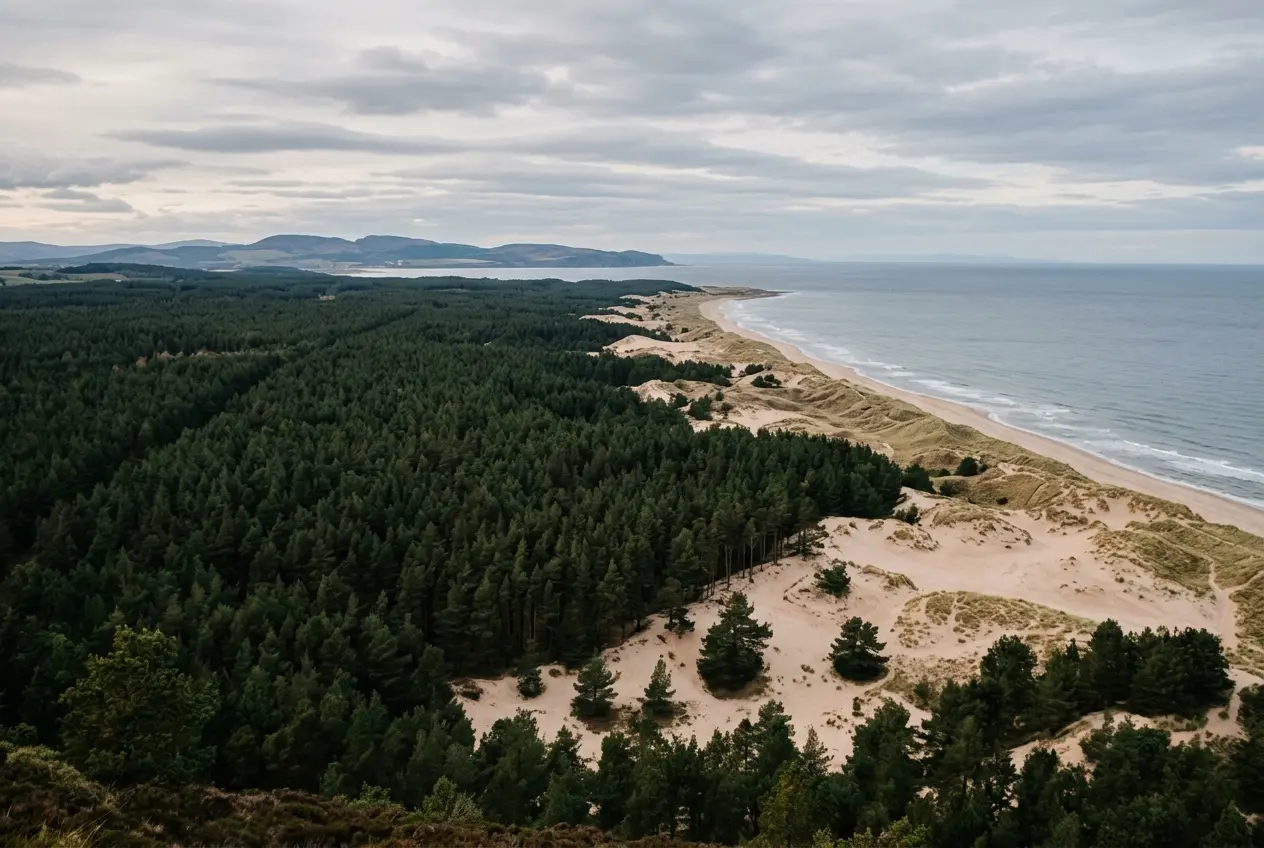
 Christopher Nolan’s The Odyssey premieres in London on July 6 and opens in cinemas across the United States and United Kingdom on July 17, 2026, and among the locations used for its mythic battles is one of the strangest stretches of woodland in Britain. Culbin Forest sits on the southern shore of the Moray Firth in northeast Scotland, and it has played more parts than most landscapes ever do. A working farm, a sand-buried ruin, a wartime target and a fire-scarred plantation have each reshaped it, and now a Hollywood crew is the latest force to put the place on screen.
Filming took place at Culbin in 2025 as part of a worldwide shoot that also took in Morocco, Greece, Italy, Iceland, Western Sahara and Malta, according to filming locations and cast for the 2026 Odyssey film. On the Moray coast the stand-ins included stretches of woodland used for a battle between warriors and giants, the BBC report on Culbin Forest’s appearance in Nolan’s The Odyssey notes. The forest the cameras rolled over has a stranger backstory than any of the scenes.
A Forest That Buried Its Own Farms
Until the late 1690s, Culbin was a thriving agricultural community on flat, fertile land beside the Moray Firth. Sand had been creeping inland from a wide dune system along the coast for hundreds of years, slowly choking the fields. In 1694, the Great Sand Drift is said to have engulfed 16 farms and the local laird’s home in wind-blown sand in a single night, the BBC reports. By the next generation the same ground was, in the source’s words, a “virtual desert.”
An eyewitness named John Martin, of Elgin, left the most quoted account at the time. He wrote that “the wind comes rushing down through the openings between the hills, carrying with it immense torrents of sand with a force and violence almost overpowering,” and that “you dare not open your eyes but must grope your way about as if blindfolded.” The laird himself blamed a curse on witches for the loss of his estate.
Villagers who fled the storm carried that story with them, and the empty ground stayed with the next two centuries of Scottish rural memory.
Isobel Gowdie and the Prophecy That Fit Too Well
The residents had a ready explanation for the 1694 storm, and it sat thirty-two years in the past. Isobel Gowdie, a woman from nearby Auldearn, had been accused of witchcraft in 1662, during the last and most severe wave of the Great Scottish Witch Hunt. Her four confessions over six weeks, the first dated 13 April 1662, are among the most detailed witchcraft statements recorded in Britain. During her trial, Gowdie is reported to have foretold that a farm at Culbin would be smothered by sand.
Modern historians treat that prophecy with more care. The BBC has noted that “it has been suggested that she made up the stories, telling the trial what it wanted to hear, to spare herself from a more violent interrogation,” and her confessions are seen by many scholars as a remarkable piece of folklore rather than testimony. Following her trial, Gowdie is believed to have been strangled and then burned at the stake, an account supported by the Auldearn witchcraft confessions of 1662. Geology swallowed Culbin, not anyone named at Auldearn. The legend, however, stuck.
Trees Pinned on Shifting Sand
The dunes held the coast for more than two centuries after the 1694 drift. Then, in the 1920s, the Forestry Commission bought Culbin in part to stabilise the shifting system of sand. Workers planted marram grass and Corsican pines to pin the dunes down, according to a history of the forest held in FLS archives. A working forest rose from the sand.
It did not last untouched. In June 1939, a wildfire swept through Culbin and damaged 382 acres. The history book describes a rare “crown fire” breaking out 60ft (18m) up in the tops of trees. A crown fire climbs into the canopy itself, rather than running along the ground, and it leaves a plantation with little left to recover. Just under six years later, the woodland faced a very different kind of damage.
During World War Two, Culbin Forest and part of the surrounding area were used as a mock battleground, with some of the training there used in preparations for 1944’s D-Day Landings. That crossover from canopy fire to live shelling is the hinge of the forest’s modern life.
Live Rounds and D-Day Rehearsals
Between 1939 and 1945, Culbin’s second life as a military range reshaped what remained of the plantation. Royal Navy ships shelled Culbin from the Moray Firth, leaving scars that were visible for years, and tank crews also trained with live rounds within the tree line, both written up in the same forest history. Shells from frigates and destroyers left craters that visitors could still pick out from the coastal paths decades later. Tank tracks cut new lines through the dunes that the sand itself had already drawn.
Those drills were part of the wider rehearsal programme that fed into the 1944 Normandy landings. After the war, the site slowly returned to its quieter role, this time under a much more deliberate forestry regime than the one that planted the pines.
Today’s Continuous Cover Forest
Forestry and Land Scotland (FLS), which now manages Culbin, runs the forest largely under what it calls a continuous cover system. “This involves selectively felling trees and retaining a cover of mature trees,” environment forester Ruaridh Maxwell told the BBC. “This method has benefits for biodiversity whilst producing quality timber.” Much of the restocking is done through natural regeneration of trees suited to the sandy ground.
What that policy has produced is a protected habitat that supports birds, dragonflies and more than 500 species of flowering plants, including the rare single-flowered wintergreen. Long tracks pull in hundreds of walkers and cyclists, and the car parks around the forest are busy in summer. Wildlife designations sit on top of a landscape that has been, by turns, farmland, desert, plantation, range and, now, a film set.
Any single chapter of Culbin’s history reads like an oddity. Stack them on top of each other, and the place feels closer to a stage set than a working forest.
The Greek Heroes on the Moray Firth
Filming for The Odyssey ran from February to August 2025 across Morocco, Greece, Italy, Scotland, Iceland, Western Sahara and Malta. On the Moray coast, Culbin Forest stood in for stretches of the mythic landscape, including parts of the witch Circe’s island of Aeaea. The Odyssey, Nolan’s take on Homer’s poem about the Greek king of Ithaca and his long journey home after the Trojan War, has a reported budget of $250 million and is the first film Nolan has shot entirely on IMAX’s 70 mm cameras.
The cast reflects the project’s reach. Matt Damon plays Odysseus, the Greek king of Ithaca; Tom Holland plays his son Telemachus; Anne Hathaway plays Penelope fending off suitors in Ithaca; Zendaya plays the goddess Athena; and Charlize Theron plays the nymph Calypso, who tries to keep Odysseus on her island of Ogygia. The ensemble, the IMAX commitment and the seven-country shoot make it the largest and most challenging production of Nolan’s career to date.
For Culbin the timing lands neatly. The Odyssey arrives in cinemas on the same coast that, in summer 2025, was already pulling visitors onto those long tracks through the dunes. For a closer look at the Scottish shoot, the local report on Tom Holland and Zendaya filming The Odyssey in the Scottish Highlands lays out the on-the-ground detail. The forest itself does not need mythology to feel strange. Sand, fire, iron and now silver halide crystals have each written their own line in it.
Frequently Asked Questions
Where is Culbin Forest?
Culbin Forest sits on the southern shore of the Moray Firth in northeast Scotland, between Nairn and Forres, and is managed by Forestry and Land Scotland.
When does The Odyssey release?
Universal Pictures premiered the film in London on July 6, 2026, with a theatrical release in the United States and United Kingdom on July 17, 2026.
Can visitors walk through Culbin Forest?
Yes. The forest is open to walkers and cyclists on long tracks that criss-cross the dunes, and the coastal car parks pull in regular visitors through the summer.
What was the Great Sand Drift of 1694?
The Great Sand Drift was a sandstorm that, in a single night, is said to have buried 16 farms and the local laird’s home at Culbin under wind-blown sand, ending centuries of farming on the site.
Who was Isobel Gowdie?
Isobel Gowdie was a Scottish woman from Auldearn, near Nairn, who confessed to witchcraft in 1662 during the Great Scottish Witch Hunt. Her trial statement was reported to include a prediction that a Culbin farm would be smothered by sand.
 Toddler Seatbelt Standoff Grounds Porter Flight Past Curfew
  Scotland France Ferry Gains £6m But Old Risks Linger
  NGS Strike Closes Galleries Just as Festival Crowds Arrive
  Rhys Bowen Returns to Skye and Refreshes Scottish Crime Fiction
  Scotland’s Europe Sleeper Study Revives Nightstar’s Unfinished Business
  Air India Easy Connect Opens Amritsar to 27 Global Cities