
 Ishan Crawford
 Italy just discovered what solar manufacturing without China costs: a 17% premium per megawatt hour. The bill came in a December 2025 auction where Italy’s energy agency, GSE, restricted projects above 1 megawatt to equipment built without Chinese modules, cells and inverters. The cleared price of €66.38 ($75.80) per megawatt hour was 17% above the €56.82 set in Italy’s unrestricted auction earlier in 2025, a deliberate premium the government accepted to send a market signal about supply chain risk.
Of 273 project proposals totalling 3.16 gigawatts (GW), only 88 cleared, awarding 1.1 GW of capacity. The exercise barely dented Europe’s reliance on Chinese kit: more than 90% of solar modules installed in the European Union are still imported from China. The deeper question is whether India and Europe can build a non-Chinese solar supply chain fast enough to make such auctions the rule rather than the exception, or whether China-plus-one is destined to remain a slogan. India has spent five years and roughly $2.5 billion trying. Europe has yet to match that scale.
Italy’s First China-Free Solar Auction Cleared at a 17% Premium
The December round was the second auction under Italy’s FER X incentive scheme and the first to impose the resilience criteria from the EU’s Net Zero Industry Act. For projects above 1 MW, GSE excluded the use of solar modules, cells and inverters from China. The procurement closed at an average final price of €0.06637 ($0.078) per kilowatt hour, 27.7% below the €0.073 cap, but roughly €0.010 per kWh higher than the first FER X auction, which did not apply the same criteria. GSE reviewed 273 project proposals with a combined capacity of 3.16 GW before settling on the 88 winners.
Only two of the 88 winning plants topped 100 MW. The largest is a 180 MW project proposed by Alta Capital 3 Srl, a London-based fund’s subsidiary, planned for Butera in Sicily. The second, a 107.9 MW plant in Monreale, Sicily, comes from Solaer Clean Energy Italy 18 Srl, a subsidiary of Spanish developer Zelestra. Both projects accepted reductions on the upper strike price in exchange for the awarded capacity, a sign that developers will discount returns to win a non-Chinese ticket in a market that does not require one. The first Italy FER X auction, by contrast, attracted 1,387 proposals for 17,537 MW and awarded 7.7 GW.
| Round | Capacity awarded | Avg. clearing price | Chinese equipment |
|---|---|---|---|
| Italy FER X (1st round, 2025) | 7.7 GW | €0.05682/kWh | Allowed |
| Italy FER X (2nd round, Dec 2025) | 1.1 GW | €0.06637/kWh | Excluded |
The full results are laid out in Italy’s December 2025 FER X non-Chinese solar auction.
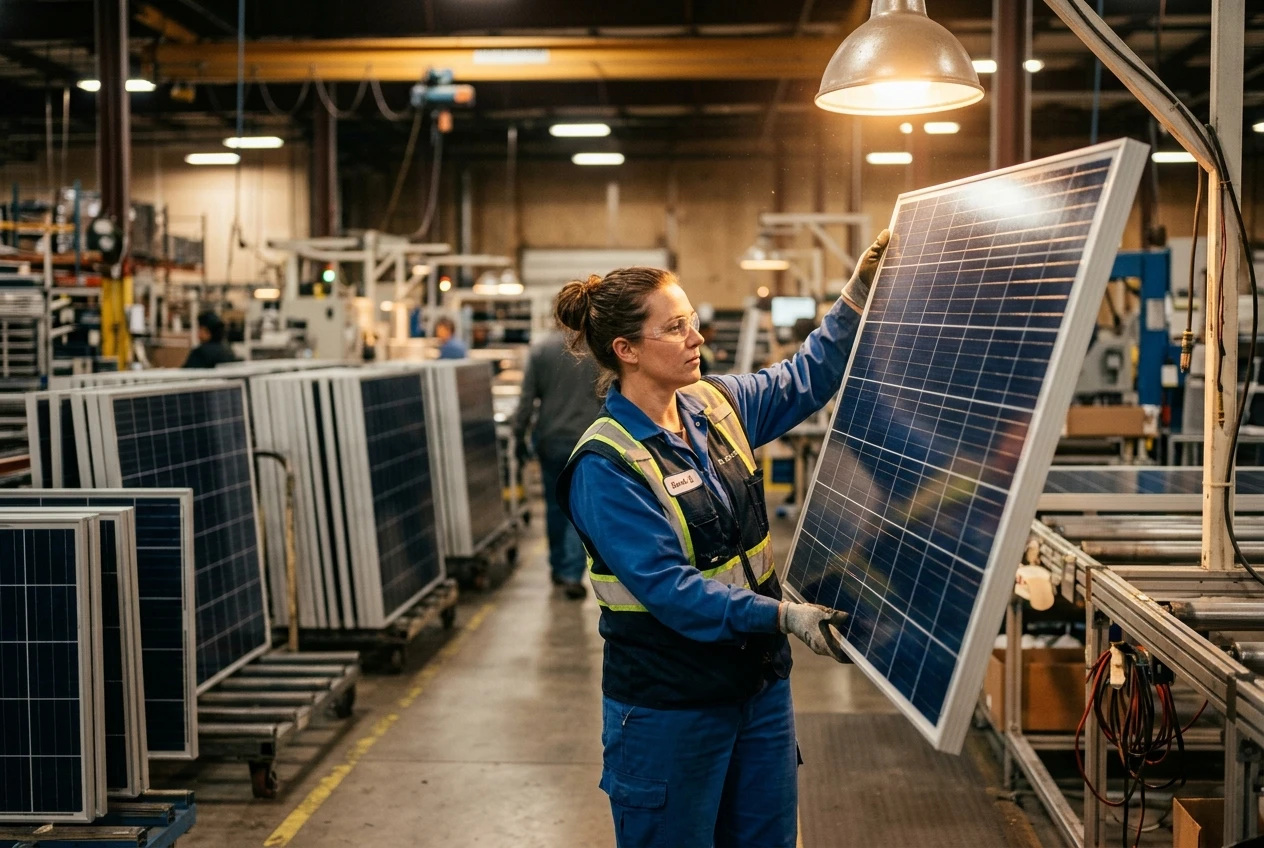
China Owns the Chain from Polysilicon to Finished Module
China produces more than 80% of the world’s solar components and dominates every stage of the value chain, from polysilicon through wafers and cells to finished modules. That scale has delivered cheap panels to global markets. It has also concentrated supply, and the dependence, in one country.
“China is present in almost every global solar supply chain,” Ajay Srivastava, founder of the Global Trade Research Initiative, told DW. Panels assembled in India or Vietnam, he said, typically rely on Chinese-made cells, wafers or polysilicon further up the chain. The result is a supply chain whose Chinese share runs well above what a finished-module label would suggest. That structural reality is the hard part of any country attempting a clean break from Chinese solar inputs.
The numbers behind that statement are stark. Roughly 99% of the world’s photovoltaic wafers are still made in China, according to Jochen Rentsch, head of technology transfer at the Fraunhofer Institute for Solar Energy Systems, who also warned that Chinese manufacturers can price wafers below production cost. More than 90% of solar modules installed in the European Union are imported from China, making it “nearly impossible” for new entrants to compete on economics alone without state support at a similar scale to what Chinese makers have built.
India’s Buildout Has Reached the Cell Layer and Stopped at the Wafer
India’s transformation from buyer to builder has been rapid, at least on paper. The country’s solar photovoltaic module manufacturing capacity reached 172 GW in early 2026, and cell capacity had nearly tripled to 30 GW. Sanjay Varghese, a senior executive at Indian renewables firm ReNew, credited the government’s Make in India push, including tariffs and the Approved List of Models and Manufacturers (ALMM) backed by a roughly $2.5 billion Production-Linked Incentive (PLI) scheme, with reshaping the sector almost overnight. The PLI scheme channels government support toward measurable industrial output, a deliberate choice meant to convert subsidies into installed capacity.
“Five years ago, all solar modules being installed in India were being imported from China,” Varghese said. “But today, all modules, and about 50% of the cells being consumed in India, are made in India.” Varghese is hopeful that the complete value chain from modules through cells, wafers, ingots and polysilicon to metallurgical-grade silicon will become domestic within five to seven years.
Dries Acke, CEO of SolarPower Europe, said India’s capacity now outstrips its own demand. “This clearly means that you will have a country looking for export opportunities,” Acke said. The IEEFA assessment of the PLI scheme, dated to June 2025, recorded India’s PV capacity at that point at 3.3 GW polysilicon, 5.3 GW wafer, 29 GW cell and 120 GW module, with all upstream capacity driven by the PLI scheme (more in the PLI scheme’s mid-term progress in India). Post-2022 additions totalled 82 GW in modules and 22.7 GW in cells, a 216% and 344% rise from 2022 levels.
Analysts cautioned against reading the 172 GW module number as a substitute for China. The PLI scheme had met only 56% of its module target and 14% of its polysilicon target as of June 2025. Only 31 GW of the targeted 65 GW module capacity had been commissioned by that date. India’s reliance on imported machinery, components and Chinese technical expertise has further slowed capacity ramp-up, a situation worsened by visa restrictions and limited equipment availability. The remaining gaps span every stage above the finished module.
- Wafers. Roughly 99% of the world’s supply still comes from China. India had 5.3 GW of wafer capacity in June 2025.
- Polysilicon. India had 3.3 GW of domestic capacity in June 2025, against a PLI target that was only 14% met.
- Cells. Roughly 50% of cells consumed in India are still imported from China.
- Equipment and tools. Indian manufacturers rely on Chinese firms for the machinery needed to make solar products, and Chinese firms continue to lead the world in solar technology development.
Europe Has Targets but No Tooling to Hit Them
Europe’s predicament is different in kind. Germany alone has set a target of sourcing 80% of its electricity from renewables by 2030, a goal that requires enormous volumes of imported clean-energy hardware, much of it still tied to Chinese supply chains. According to BSW-Solar, the German solar association, domestic module production in Germany has shrunk to a small, niche operation, though the country retains stronger positions in inverters, mounting systems, battery storage and upstream manufacturing equipment.
Acke argued Europe needs its own version of India’s PLI scheme, an output-based subsidy similar in spirit to the US Inflation Reduction Act’s tax credits, to make local manufacturing commercially viable (SolarPower Europe, his employer, has set out its own path to reshore solar manufacturing in Europe). The EU’s forthcoming Industrial Accelerator Act, intended to build on the Net Zero Industry Act of 2024, has drawn criticism from Acke and other industry advocates for defining “Made in Europe” broadly enough to include free-trade partners rather than requiring literal European production. China’s grip on Europe’s clean-energy buildout extends past solar: plans by Ming Yang Smart Energy Group for a £1.5 billion wind turbine factory in Scotland drew UK security concerns, a parallel case of how Chinese clean-energy firms face political pushback even when their technology is needed (see the UK security review of a Scottish wind factory). Without an EU PLI of its own, the Industrial Accelerator Act’s loose definition of “Made in Europe” risks importing the same Chinese dependency through the back door.
At present, however, that political and industrial leadership is missing.
Srivastava, founder of the Global Trade Research Initiative, made the comment in an interview with DW, calling the coordinated “China-plus-one” path the only realistic alternative to single-source dependence on Beijing.
The Geography Adds Cost, Not Savings
Trade barriers add another layer of friction. Varghese noted that anti-dumping and countervailing duties on Indian-origin cells and modules in the US now exceed 250%, effectively closing that market for now. The tariff wall pushes Indian manufacturers to look harder at Europe, where the policy framework is more open but the demand signal is muddier. Europe’s open market comes with its own guardrails: the EU’s Net Zero Industry Act, under which Italy ran its December auction, was designed in part to keep Chinese kit out of subsidised projects.
Rahul Sharan, deputy director and shipping specialist at Drewry, an independent maritime research consultancy, said India’s west coast ports connect efficiently to Europe via the Suez Canal, potentially shortening delivery times compared with East Asian rivals. Still, Sharan cautioned that logistics “alone is unlikely to eliminate the structural cost advantages that China has built through scale and integration.” The shipping maths favours India, but the manufacturing maths still favours China.
Sharan also flagged the Strait of Malacca, through which more than 60% of global maritime trade passes, as a persistent chokepoint. Any disruption there, whether from South China Sea tensions or US-China rivalry, could ripple through solar supply chains far beyond Asia. India’s west coast ports sit on the right side of that chokepoint to reach Europe without it. China ships most of its solar exports through the same narrow waterway, with all the disruption risk that implies.
A Decade of Decisions Before ‘China-Plus-One’ Becomes Real
India remains, for now, the most credible alternative to China emerging anywhere in solar manufacturing. It is not yet a substitute. Srivastava, of the Global Trade Research Initiative, said genuine manufacturing capability takes 10 to 20 years to build, and that incentive schemes like India’s PLI often encourage assembly rather than deep manufacturing.
He believes the only realistic path is a coordinated China-plus-one strategy, with the US, Europe, India and others investing in parallel supply chains even if the output costs 10 to 15% more initially. The premium would be the price of redundancy against a single point of failure in the global energy transition. The Italy auction shows how the diversification is being bought one tender at a time. The harder question is who pays to scale it.
Frequently Asked Questions
Why is China’s solar dominance hard to replace?
China produces more than 80% of the world’s solar components and roughly 99% of photovoltaic wafers. Even panels assembled in India or Vietnam typically depend on Chinese cells, wafers or polysilicon further up the chain, so a country importing finished modules from a non-Chinese factory is usually still tied to Chinese inputs at one or more stages.
How much did Italy’s China-free solar auction cost?
Italy’s December 2025 non-Chinese solar auction cleared 1.1 GW across 88 projects at an average price of €66.38 ($75.80) per megawatt hour, a 17% premium over the €56.82 cleared in the country’s unrestricted solar auction earlier in 2025. The price was still 27.7% below the auction’s €0.073 per kWh cap.
How big is India’s solar manufacturing capacity?
India’s solar module manufacturing capacity reached 172 GW in early 2026, with cell capacity at 30 GW. Upstream capacity is far thinner: 3.3 GW of polysilicon and 5.3 GW of wafer capacity as of June 2025. The PLI scheme had met only 56% of its module and 14% of its polysilicon targets at that point.
What is the PLI scheme and is it working?
India’s Production-Linked Incentive (PLI) scheme, launched in 2021 with roughly $2.5 billion in support, is an output-based subsidy that pays manufacturers for hitting production milestones across modules, cells, ingots, wafers and polysilicon. An IEEFA assessment from June 2025 found that only 56% of module and 14% of polysilicon capacity targets had been met, with 31 GW of the targeted 65 GW module capacity commissioned.
Can Europe make solar panels without China?
European module manufacturing has shrunk to a niche operation, according to Germany’s BSW-Solar. The EU’s forthcoming Industrial Accelerator Act, intended to expand on the Net Zero Industry Act of 2024, has drawn criticism from industry advocates for defining “Made in Europe” broadly enough to include free-trade partners rather than requiring literal European production.
 ONGC licence frees Venezuela cash and operatorship talks
  Anthropic Hits $65 Billion Run Rate and Flips the AI Cash Test
  Supreme Court grounds the fare free-for-all with three-week clock
  Gold Nears $4400 as Soft Data Meets Oil Inflation Risk
  Nifty Slips as Zaggle Circuits and Dhoot Debuts Big
  Diesel Crack Tops $100 as Iran Rhetoric Lifts Crude