
 Ishan Crawford
 Samsung Electronics on Tuesday flagged a 19-fold jump in second-quarter operating profit to 89.4 trillion won ($58.44 billion), surpassing its combined earnings of the prior three years, yet Seoul’s KOSPI triggered a circuit breaker and Samsung shares closed sharply lower as the market read the result as a sign the AI memory cycle is closer to its peak than to a fresh leg up. The benchmark fell 4.91% on the session, wiping more than $80 billion off Samsung’s market value on the day, and pulled chip stocks across Asia into a broad selloff.
Samsung’s Record Quarter Met the Market’s Verdict
Samsung’s 89.4 trillion won operating profit for the three months to June beat the LSEG SmartEstimate of 87.3 trillion won, according to its preliminary Samsung’s preliminary Q2 earnings filing on July 7. Revenue was guided up 129% year on year to 171 trillion won. A year earlier, Samsung reported operating profit of 4.7 trillion won, so the latest print moves the company past its combined earnings of the previous three years.
Shares still sold off. Samsung’s stock fell as much as 10.1% intraday before closing down 6.9%, and SK Hynix finished 6% lower. The KOSPI ended the day down 4.9%, underperforming regional peers as the two chip leaders, which together make up around half the index’s total weight, dictated the tape.
Analysts reading the filing through a market-structure lens said the print itself was not the problem. Albert Yong, managing partner at Petra Capital Management, told clients the result was widely expected and “had largely been priced in after its shares rallied ahead of the results.” The second-guessing sits further out on the curve, where investors are weighing whether the run in memory pricing, and the capex plans of Meta, Microsoft, Amazon and Alphabet, can carry the cycle through 2027 at the pace the current share prices imply.
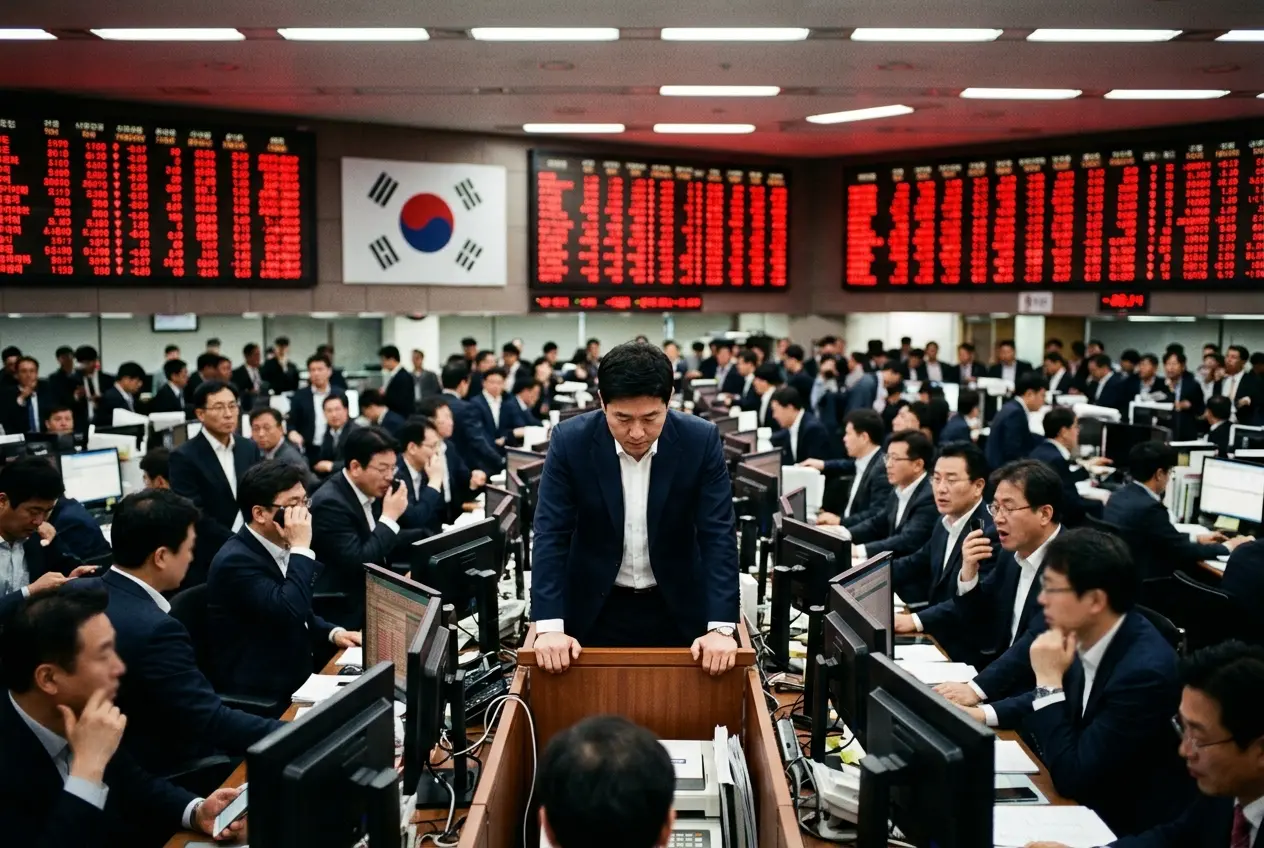
How the KOSPI Circuit Breaker Tripped
The Korea Exchange activated a stage-one circuit breaker on Tuesday after the KOSPI fell more than 8% intraday, suspending trading in all KOSPI-listed shares for 20 minutes, according to the bourse operator. Selling was concentrated and broad. By the close the index had given back 395.02 points to 7,656.31, and 509 listed stocks had fallen against 358 gainers, per UPI’s report on the KOSPI’s 4.91% close and 20-minute circuit breaker.
The flow data underline who carried the move. Foreign investors net sold 2.92 trillion won of Korean equities on the session, and institutions were net sellers of 309.1 billion won. Retail buyers absorbed 3.13 trillion won of stock, yet the demand was not deep enough to offset the foreign-led rotation. Trade volume reached 512.29 million shares worth 39.66 trillion won (US$25.9 billion), and the Korean won weakened to 1,528.20 per US dollar by mid-afternoon, down 2.1 won on the day.
- KOSPI close: 7,656.31 (-4.91%, -395.02 points)
- Intraday drop that tripped the halt: more than 8%
- Halt duration: 20 minutes
- Session decliners vs gainers: 509 to 358
- Foreign net selling: 2.92 trillion won
The Selloff Spreads Across Asia’s Chip Supply Chain
Seoul was the worst-hit exchange on the day, but the pressure radiated through every link of Asia’s chip supply chain. Samsung and SK Hynix’s combined dominance of the KOSPI, accounting for half the Kospi’s total weight, up from roughly a quarter at the end of last year, means a sharp move in either name now drags the broader Korean market before the other nine hundred listed companies get a say, market analyst Zavier Wong of eToro noted in a session report.
Taiwan’s TAIEX staged an even more violent reversal. After opening 410 points higher and approaching the 47,000 mark, the index collapsed 1,077.28 points to close at 45,479.11, the 8th largest single-day point decline in Taiwan’s stock market history, per BigGo Finance’s breakdown of the Taiwan TAIEX’s 1,077-point slide. TSMC gave up an intraday high of NT$2,500 to close at NT$2,440, down 0.81%, and trading volume across the market exploded to NT$1.16 trillion (about $36.1 billion).
Japan’s Nikkei 225 fell more than 1,300 points intraday before paring losses. The pattern was the same: chip and AI hardware names led the leg down, while defensive sectors and rate-sensitive domestic plays held up. Capital that had flowed into Korean and Taiwanese AI names through the first half of 2026 is now being measured against the cost of those bets, a rotation visible in why foreign capital was rotating from India into Korea and Taiwan AI names through the first half of the year.
The selloff left a clear hierarchy of losers and a handful of holdouts. On the KOSPI, Samsung closed at 296,000 won (-6.92%) and SK Hynix at 2,201,000 won (-6.06%) ahead of the chipmaker’s planned US listing later this week. Hyundai Motor fell 4.48% to 479,000 won and Hanwha Aerospace lost 3.19% to 1,122,000 won. Hanwha Ocean dropped 22.65% to 89,800 won after a South Korean consortium that includes the shipbuilder failed to win a multibillion-dollar Canadian submarine contract. On the winners’ side, Amorepacific gained 4.2% and refiner SK Innovation climbed 7.56%.
- Taiwan TAIEX: -1,077.28 points, 8th largest single-day point decline on record
- TSMC: closed at NT$2,440, down 0.81% after touching NT$2,500 intraday
- Japan’s Nikkei 225: fell more than 1,300 points intraday
- Seoul’s KOSPI: closed down 4.91% after the circuit breaker
Why Record Earnings Could Not Reassure
The asymmetry of the reaction, a record print and a record selloff, is the most useful piece of evidence in the file. Morningstar analyst Jing Jie Yu said the revenue guidance came in “not as strong as expected,” driven by “more moderate DRAM price hikes than expected, which likely spooked investors who are increasingly pricing in structural strength in memory prices.” Citi Research had already shown the underlying pricing strength, with DRAM average selling prices up 44% quarter on quarter and NAND up 53% in the second quarter, yet a sequential moderation is enough to reset the marginal buyer.
We’re confident the earnings are going to come through, but we’re going to see a moderation in returns, with the triple-digit gains of the first half of the year unlikely to be replicated.
Raisah Rasid, global market strategist at JPMorgan Asset Management in Singapore, said the first-half surge is unlikely to be replicated, even as fundamentals hold. Morgan Stanley told clients on Monday that recent weakness in semiconductor stocks would likely continue as investors brace for “more capex discipline in the near-term” on the part of the hyperscalers, calling it the moment “the semis trade finally started to lose momentum after a historic run since the end of March.” The wiring of the AI trade, in other words, is being re-graded on a slower capex path rather than a softer demand path.
The Billions of Dollars Stacked on This Week
Two more tests of investor conviction land before this story fades. SK Hynix on Monday launched a formal marketing process for its US share sale to raise 43 trillion won, with the American depositary receipts set to begin trading on Nasdaq on Friday at a target of around $28 billion, per the company’s filings and the lead banks. SK Hynix CEO Kwak Noh-jung last week laid out a 100 trillion won domestic investment plan, 80 trillion won for a new M17 NAND plant and 20 trillion won for the P&T7 advanced packaging facility, with M17 operations targeted for the first half of 2029, as SK Hynix’s $100 trillion won Korea expansion and CEO capex plan sets out. Combined with Samsung’s parallel commitments, the two chipmakers are sitting on roughly 800 trillion won in announced semiconductor investment through the back end of the decade.
Oil is the second overlay. Brent crude ticked higher on Tuesday after reports that Iran’s IRGC had struck a commercial vessel in the Strait of Hormuz last week, and Asian traders were watching the tape into the European open, even as the broader macro story remained one of easing US monetary policy expectations. Indian markets, where the Nifty 50 was set to open higher on GIFT Nifty signals, bucked the regional trend, as noted in Indian markets set to track the Wall Street AI rally on the same session. The US Fed minutes due mid-week will set the next leg of the discount-rate story for chips.
What Sits Between This Selloff and the Memory Cycle’s Next Move
The path back to risk-on, or to a deeper drawdown, runs through a small number of dated events. Samsung has said it will release detailed Q2 results, with a full segment breakdown for memory, foundry and logic chips, on July 30. That filing will tell investors how much of the operating profit was carried by the high-bandwidth memory line and how much by conventional DRAM, and the mix matters more than the headline.
Morgan Stanley’s call that semis weakness “would likely continue” into the second half frames the base case.
- SK Hynix ADRs begin trading on Nasdaq on Friday (July 10), with the listing targeted at $28 billion
- Samsung’s detailed Q2 results and segment breakdown due July 30
- US Federal Reserve minutes due mid-week for fresh policy guidance
- Ongoing Strait of Hormuz shipping risk after the late-June IRGC strike on a commercial vessel
- Morgan Stanley’s standing call that semis weakness “would likely continue” as hyperscaler capex discipline sets in
Disclaimer: This article is for informational purposes only and does not constitute investment advice. Market figures are accurate as of publication on July 7, 2026 and may change. Consult a qualified financial professional before making investment decisions.
 ONGC licence frees Venezuela cash and operatorship talks
  Anthropic Hits $65 Billion Run Rate and Flips the AI Cash Test
  Supreme Court grounds the fare free-for-all with three-week clock
  Gold Nears $4400 as Soft Data Meets Oil Inflation Risk
  Nifty Slips as Zaggle Circuits and Dhoot Debuts Big
  Diesel Crack Tops $100 as Iran Rhetoric Lifts Crude