
 Ishan Crawford
 Nvidia is in talks to guarantee roughly $250 billion in financing for a single OpenAI data center in Ohio, according to a Wall Street Journal report Sunday. The backstop would help OpenAI’s development partner borrow on better terms to build a 10 gigawatt site on former federal uranium enrichment land in the southern part of the state. Total cost of the campus, land, power plant, construction and chips combined, tops $500 billion, and Nvidia is separately discussing financing up to $350 billion of the OpenAI chip purchases that would fill it.
Terms are not final. It is the second time in less than a year that Nvidia has put a giant, round number on the table for OpenAI. The first one, a $100 billion pledge from September 2025, shrank to a fraction of that before a single dollar of it closed.
A Former Uranium Site Becomes an AI Chip Customer
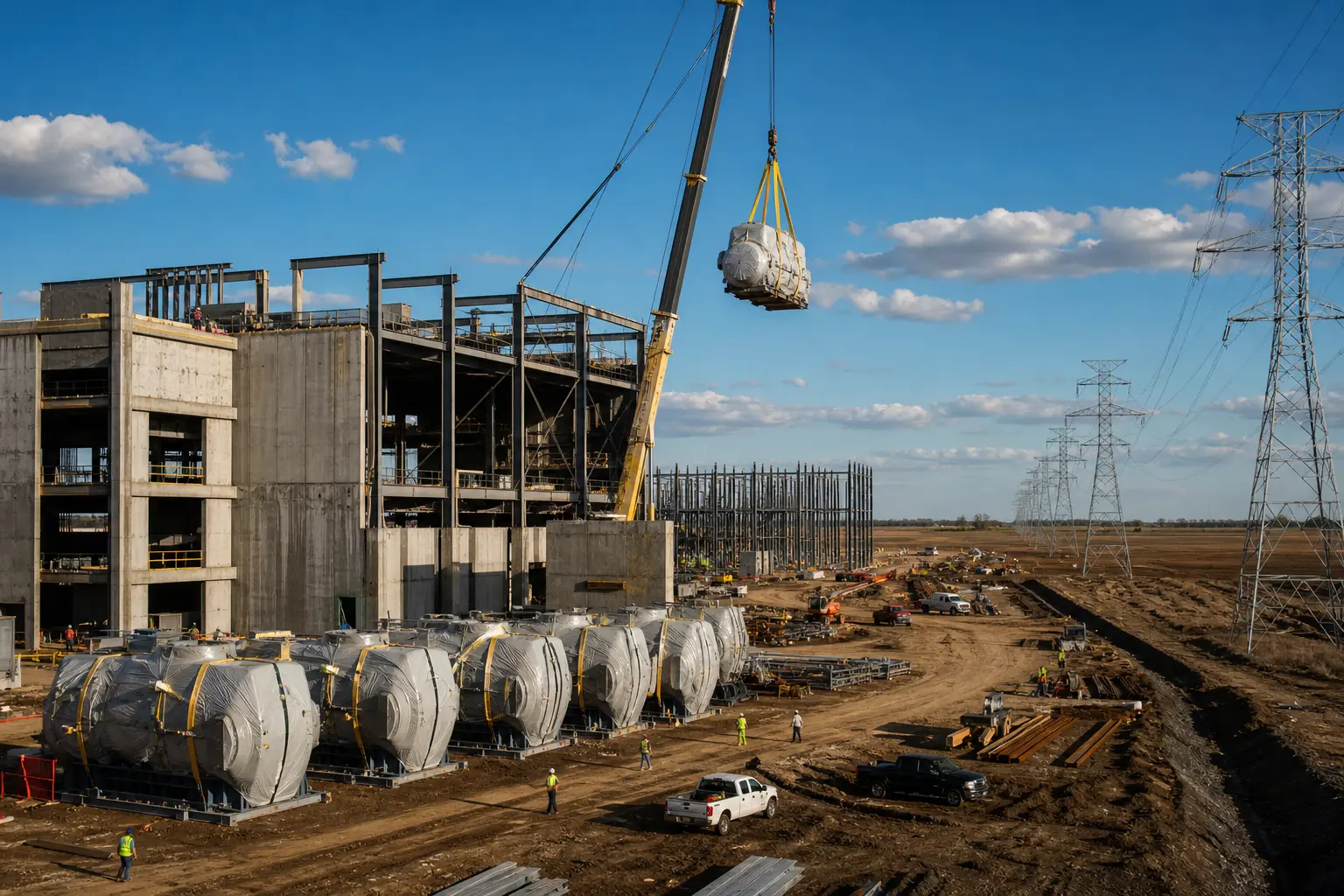
The site under discussion sits on grounds once used by the old Portsmouth Gaseous Diffusion Plant, a Cold War era uranium enrichment complex the Department of Energy still manages through its Portsmouth Paducah site office. Federal officials and SoftBank detailed plans this spring to turn part of the property into what could be the largest data center on the planet: 10 gigawatts of computing capacity, backed by 9.2 gigawatts of new natural gas power built specifically to run it.
That gas plant alone is estimated to cost $33 billion, roughly the output of nine nuclear reactors. The buildout runs through SB Energy, the SoftBank affiliated venture formed with OpenAI to build and operate next generation AI data centers under the Stargate banner, the roughly $500 billion infrastructure push OpenAI, SoftBank and Oracle unveiled at the White House last year. The power demand adds to a broader strain already pushing data center operators toward liquid cooling that trims water use but not the power draw.
| Financing Layer | Reported Amount | What It Covers | Status |
|---|---|---|---|
| Site | 10 gigawatts | Former DOE uranium enrichment land in southern Ohio, plus a dedicated 9.2 gigawatt gas plant | Groundwork under way |
| Lease and debt guarantee | About $250 billion | Nvidia backstop for SB Energy’s borrowing to build and lease the campus | In talks, not finalized |
| Chip financing | Up to $350 billion | Would help OpenAI pay for the Nvidia processors installed inside it | Discussed separately |
| Total project cost | More than $500 billion | Land, power plant, construction and chips combined | Confirmed by SoftBank chief Masayoshi Son |
Add the lease guarantee to the chip financing and the number tops $600 billion, more than the roughly $500 billion topline Son himself has cited for the whole campus. The talks are still moving, and the public figures do not yet agree with each other.
Why OpenAI Needs Nvidia’s Signature More Than Its Chips
A guarantee is not Nvidia handing over cash. It is a promise to cover the lease and debt payments if SB Energy or OpenAI fall short, a signature that lets lenders price the loan against Nvidia’s balance sheet instead of a borrower with no investment grade credit rating of its own.
That signature is worth real money. Lower perceived risk means a lower interest rate on tens of billions of dollars in project debt, which is reportedly why SoftBank and OpenAI want Nvidia’s name on the paperwork before construction goes much further.
The same signature carries a cost for Nvidia. A guarantee still counts as a contingent liability, the kind of commitment credit analysts add back into their models even when no cash has moved yet. It narrows Nvidia’s own financial flexibility and invites the kind of scrutiny that, at this size, can move Nvidia’s own cost of borrowing.
The $100 Billion Promise That Shrank to $30 Billion
Nvidia has done something like this before. Last September, Nvidia chief executive Jensen Huang and OpenAI chief executive Sam Altman worked out a headline framework in last minute talks: Nvidia would invest up to $100 billion in OpenAI progressively, as each gigawatt of Nvidia powered compute came online. It was a letter of intent, not a contract, and the money was contingent on milestones nobody had hit yet.
- September 2025: Nvidia and OpenAI announce the $100 billion framework, with a $10 billion first tranche said to close within weeks at a $500 billion OpenAI valuation.
- November 19, 2025: Nvidia’s own quarterly filing tells shareholders there is no assurance of a definitive OpenAI agreement, language buried in its own risk factors.
- February 2026: Reporting confirms the framework never converted into a binding contract and no funds had changed hands.
- By June 2026: Nvidia’s actual OpenAI equity position settles at roughly $30 billion, a fraction of the original pledge.
- July 26, 2026: The Wall Street Journal reports fresh talks on the $250 billion guarantee, a separate structure built around debt rather than equity.
The dollar figure changed. The habit of announcing it before the paperwork did not.
Every Guarantee Loops Back Through the Same Balance Sheet
Nvidia does not just sell chips to OpenAI. It has put money into more than 50 AI startups and infrastructure ventures over the past year, including a stake in Anthropic worth up to $10 billion agreed in November. Some of those companies turn around and spend Nvidia’s money on Nvidia hardware.
Stacy Rasgon, a semiconductor analyst at the brokerage Bernstein, flagged the pattern last year, writing that Nvidia’s investments would “clearly fuel circular concerns.” The comparison analysts keep reaching for is the dot com bubble, when telecom equipment makers lent money to their own customers to help manufacture the appearance of revenue growth. A guarantee tied to a customer’s own project debt tightens that loop again: Nvidia’s credit becomes the thing standing between OpenAI and a functioning data center, alongside Nvidia’s chips.
Around and around we go.
Michael Burry, the investor whose bet against the 2008 housing market was dramatized in the film “The Big Short,” posted that line after the WSJ report broke, joining a chorus of skeptics questioning how much of the AI buildout’s financing reflects new demand rather than the same dollars moving in a circle.
Who Pays if the Ohio Site Never Fills Up?
If Ohio’s 10 gigawatts sit half empty, or OpenAI’s growth slows before the lease is paid down, the guarantee structure decides who absorbs the loss first. Lenders holding SB Energy’s project debt would look to Nvidia’s balance sheet. Nvidia shareholders would absorb whatever that costs the company in scrutiny, wider credit spreads or newly disclosed liabilities. OpenAI, still privately held and still without public financial statements, would carry the least direct exposure of the three.
OpenAI is not waiting on Ohio alone. The company says it now has five new Stargate sites in development beyond its original locations, part of a deliberate shift toward owning infrastructure instead of renting all of it. Its current compute landlords include:
- Microsoft – OpenAI’s original exclusive cloud partner, still running large training workloads on Azure
- Oracle – committed to hundreds of billions of dollars in Stargate linked data center leases
- Amazon – added more recently as a separate cloud compute supplier
- SB Energy – the SoftBank affiliated developer building the Ohio project the new guarantee would cover
Oracle already shows what that exposure looks like in practice. Its own Stargate commitments leave bondholders carrying the risk if OpenAI ever falls short, a structure a client alert from law firm Quinn Emanuel flagged as part of emerging litigation risk tied to AI data center financing across the industry. Nvidia’s guarantee, if signed, would add a second and larger version of the same exposure, one contract removed from OpenAI itself.
The Deal Still Needs Two Signatures
Nothing about the $250 billion guarantee or the $350 billion in chip financing is finished business. The Journal’s sources describe talks that are ongoing, with terms still being negotiated and no certainty either figure survives to a signed contract, the same description that applied to the $100 billion pledge in the weeks before it was announced.
Nvidia’s next quarterly filing will be the place to look for whatever language replaces “no assurance.” Until then, the only confirmed fact is that Jensen Huang’s name is back on another enormous number tied to Sam Altman’s company, for the second time in less than a year.
Frequently Asked Questions
What is Stargate?
Stargate is the roughly $500 billion infrastructure venture OpenAI, SoftBank and Oracle unveiled at the White House in January 2025 to build a network of AI data centers across the United States. The Ohio site at the center of Nvidia’s guarantee talks is one of several now under development.
Is a loan guarantee the same as Nvidia writing OpenAI a check?
No. A guarantee is a promise to cover a borrower’s debt payments if a project falls short, not a transfer of cash today. It can still show up later as a liability on Nvidia’s own books if lenders ever call on it.
Does Nvidia own part of OpenAI through this guarantee?
No. The reported $250 billion guarantee is a credit backstop for the Ohio project’s lease and debt, separate from Nvidia’s existing OpenAI equity position, which reporting has put at roughly $30 billion, far below the $100 billion originally pledged in September 2025.
What is SB Energy?
SB Energy is the SoftBank affiliated venture formed with OpenAI, each partner putting in $500 million at launch, to build and operate the data centers underpinning Stargate, including the 10 gigawatt Ohio site.
Could the $250 billion guarantee still fall apart?
Yes. Terms have not been finalized, and Nvidia’s last headline OpenAI commitment, the $100 billion pledge from September 2025, also collapsed before a contract was ever signed.
 ONGC licence frees Venezuela cash and operatorship talks
  Anthropic Hits $65 Billion Run Rate and Flips the AI Cash Test
  Supreme Court grounds the fare free-for-all with three-week clock
  Gold Nears $4400 as Soft Data Meets Oil Inflation Risk
  Nifty Slips as Zaggle Circuits and Dhoot Debuts Big
  Diesel Crack Tops $100 as Iran Rhetoric Lifts Crude