
 Ishan Crawford
 The European Space Agency’s Euclid space telescope has spotted the oldest quasars ever observed, two galaxy cores blazing with the light of a trillion suns when the universe was roughly 670 million years old, just 5% of its current age. The announcement from the Euclid team detailed a haul of 31 newly confirmed ancient quasars, more than doubling the population known from the universe’s first billion years.
The deeper effect is sample size. Euclid is now finding these objects fast enough to study as a group, and the catalogue hands a long-standing puzzle a population it had never had at this scale.
Two New Cosmic Elders
The two new record-holders are EUCL J172902.75+641018.1 and EUCL J125308.55+705432.3, both catalogued in data from the Euclid Wide Survey, which is being assembled to cover more than a third of the entire sky. The paper on the 31-quasar catalogue puts them just over 13 billion light-years away and emerging during the universe’s first 670 million years.
Redshift measures how much the light from a distant object has been stretched by the expansion of space; the larger the value, the older and farther the source. Euclid’s two new entries sit at the top of a small pile that until Monday contained a single previous record-holder, a quasar discovered in 2021. Project scientist Valeria Pettorino, an ESA staff scientist, framed the new objects as ‘time machines that enable us to explore the early Universe and understand how the first generation of galaxies came to be.’
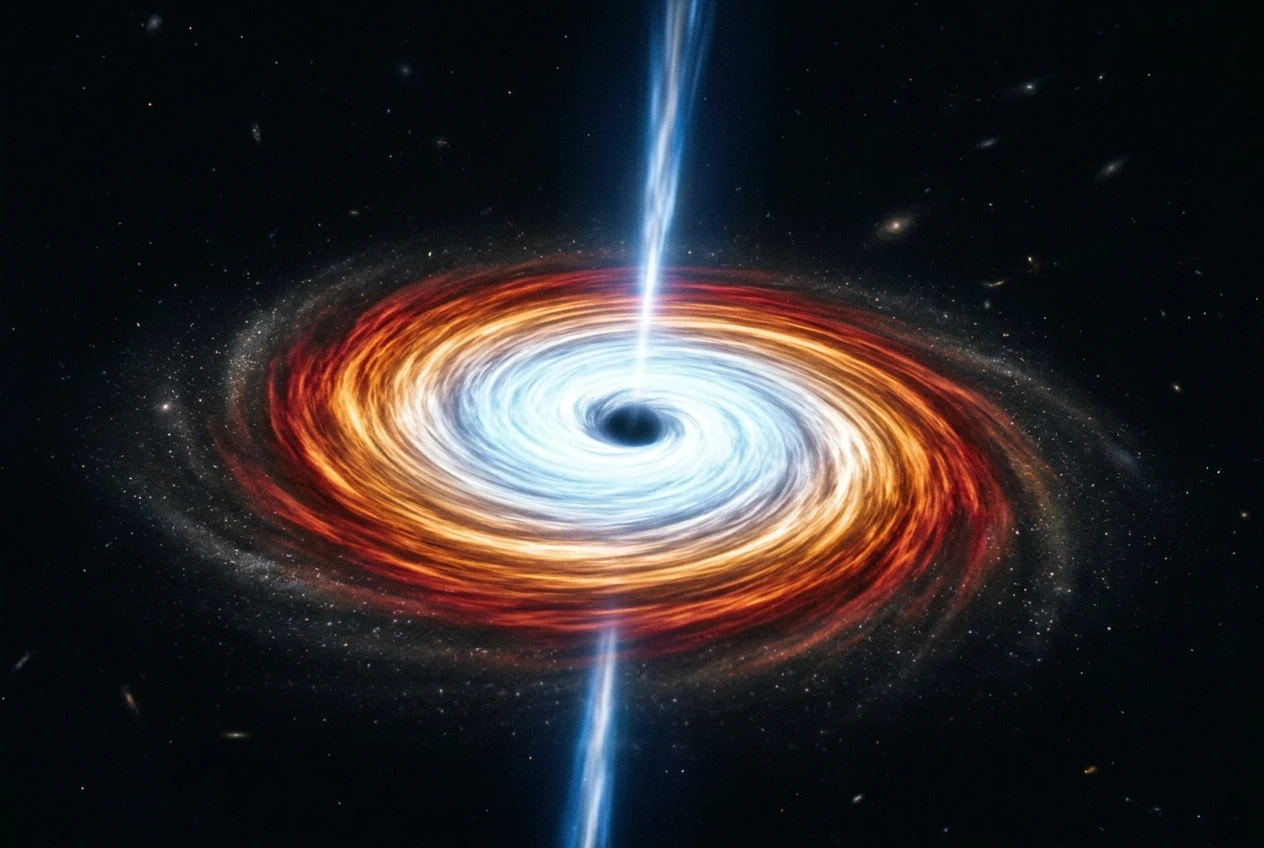
Each of the new quasars shines with the light of a trillion suns, fed by gas spiralling into a central supermassive black hole whose gravity converts the inflow into a torrent of radiation. In this brief phase of a galaxy’s life, the nucleus outshines the rest of its host by hundreds to thousands of times. The two sit so far back in time that their primordial ultraviolet light is now reaching Earth stretched into the near-infrared.
| Quasar | Redshift | Year identified |
|---|---|---|
| EUCL J172902.75+641018.1 (new farthest) | 7.77 | 2026 |
| EUCL J125308.55+705432.3 (second farthest) | 7.69 | 2026 |
| Previous record-holder | 7.64 | 2021 |
From Outlier Hunt to True Census
The headline number is 31 ancient quasars: the size of Euclid’s first confirmed catalogue of such objects, drawn from the mission’s first quarter of sky data. The underlying paper, by Daming Yang of Leiden University and an international team of co-authors, was published Monday as part of a 41-paper special issue of Astronomy & Astrophysics and is the first such census; earlier discoveries were individual trophies won by years of follow-up.
Of those 31, twelve sit at a redshift of 7 or higher, the population from the first 770 million years of cosmic history. Antonio La Marca, an ESA research fellow on the Euclid team, called the haul a true census. ‘Discovering the first 10 or so quasars at a redshift of 7 or above took astronomers more than a decade,’ La Marca said, ‘but Euclid has already discovered more than that in a single year.’ The full team has therefore taken a ‘true “census” of quasars at the dawn of the Universe for the first time,’ he added.
Until Euclid, the ancient-quasar roster was thin. Astronomers had spent more than a decade confirming a handful of extreme outliers, each one fought for in long campaigns. Yang’s paper treats the 31 objects as a sample large enough to study as a group. The shift is partly technical: Euclid’s Near Infrared Spectrometer and Photometer, or NISP, covers the near-infrared band where the redshifted Lyman-alpha emission from z≥7 quasars lands. It is also statistical: the survey’s planned footprint, more than a third of the entire sky at a depth ground-based instruments cannot match, generates a volume large enough to capture rare objects in useful numbers.
Pettorino said the telescope’s combination of area, depth, sharp imaging, and space-based infrared vision lets it pick out rare, extremely distant objects far more efficiently than before.
- 2,000+ scientists in the Euclid Consortium
- 300 institutes across 15 European countries plus the United States, Canada and Japan
- 0.95 to 2.0 µm wavelength range covered by NISP for z≥7 quasars
- 41 papers in the Astronomy & Astrophysics special issue from Euclid’s Q1 data
Why They Are So Hard to Find
Ancient quasars are notoriously difficult to pin down. Few galaxies had yet had time to grow large enough to feed one, so the population is sparse. The primordial ultraviolet light from these objects has been stretched by cosmic expansion into the near-infrared, falling into a wavelength range where Earth’s atmosphere glows brightly and where ground-based surveys struggle to reach faint sources efficiently. In standard visible-light images, a high-redshift quasar looks almost identical to a nearby M-dwarf star. ‘For every one of them there are thousands of stars in our Milky Way and nearby galaxies that look almost identical in the imaging surveys,’ Yang said. To separate the rare true quasars from the imposters, astronomers need both a survey wide enough to capture the rare objects and deep enough to detect their faint light, work that is ‘nearly impossible to carry out on the ground.’
Euclid solves both problems at once. Yang called the mission ‘a true game-changer,’ adding that Euclid ‘lets us search far more efficiently across huge areas of sky to capture much fainter light.’ Yang’s team applied a photometric selection algorithm to Euclid’s Q1 data, identified candidates consistent with z≥7 quasars, and confirmed them using NISP’s spectroscopic mode without a separate ground-based campaign. The result is a single observing run that does what older methods needed months of multi-telescope coordination to manage: candidate selection and spectroscopic confirmation in one pass.
- July 2023 – Euclid launched
- November 2023 – first glimpse of Euclid’s image quality
- 14 February 2024 – routine science observations begin
- May 2024 – second image-quality release
- October 2024 – first piece of the great cosmic map released
- March 2025 – first batch of survey data released, including a preview of Euclid’s deep fields
- 6 July 2026 – Yang et al. publish the 31-quasar catalogue
The Perplexing Puzzle
Every step further back in time makes the puzzle more perplexing: How did the Universe produce supermassive black holes so quickly? We’re finding black holes with hundreds of millions of times the mass of our sun at a time when the universe was barely getting started.
Joseph Hennawi, a co-author on the paper and a physics professor with joint appointments at UC Santa Barbara and Leiden University, said this in a statement accompanying Monday’s release. Hennawi spoke about the discovery through his home institution’s news service, and he supervises Yang at Leiden.
The new quasars date to the epoch of reionisation, when the first stars and galaxies began to ionise the cold, neutral hydrogen that filled the early universe and brought the cosmic dark ages to a close. ESA framed that transitional era as ‘a crucial era that set the stage for everything we see today.’ Silvia Belladitta of the Max Planck Institute for Astronomy in Heidelberg followed up the second-most-distant object in the catalogue with additional spectroscopy and found that the quasar sits inside a dusty, gas-filled galaxy that is furiously forming new stars, a hint at what the host galaxy of an early supermassive black hole may have looked like.
The mechanistic questions are quantitative now, not speculative. Finding a dozen such objects in a single survey year means they cannot be exotic outliers; the population has to form at scale. In the same release, Hennawi called the new finds ‘monsters’ weighing billions of solar masses that ‘somehow already existed when the universe was in its infancy.’ The catalogue hands the question a sample that can be studied as a group, with follow-up planned to make use of that shift.
Webb and Keck Take the Next Look
The 31-quasar catalogue is the discovery; the science comes next. Yang’s team already has approved programs with the James Webb Space Telescope to study many of the new objects in detail, including measuring the masses of their central black holes, probing the chemistry of the surrounding gas, and tracing how reionisation progressed by reading the imprint of intergalactic hydrogen on the quasars’ light. The Atacama Large Millimeter Array will separately target the cosmic dust glowing in the host galaxies themselves, mapping their star formation.
Two-thirds of the new quasars, including the three most distant, were confirmed with the Keck telescopes in Hawaii through the University of California’s privileged access. The pipeline that did the heavy lifting was PypeIt, a software package led by Hennawi’s group at UC Santa Barbara that astronomers use to process Keck data. New machine-learning methods, Hennawi explained, enable scientists to sift through tens of millions of sources and reliably pick out the handful of real quasars from the far more common imposters. The efficiency gain over prior survey methods is the difference between a decade’s cumulative result and twelve confirmed objects in a single year.
The team’s next target sits deeper still. Hennawi’s group has set its sights on the first quasar beyond redshift 8, which would place it within the first 630 million years of cosmic time. The bigger vision, Hennawi said, is to stitch all of this into ‘a coherent timeline,’ a ‘quasar chronicle of the first billion years.’
Frequently Asked Questions
What is a quasar?
A quasar is the intensely luminous core of a galaxy powered by a supermassive black hole that is actively accreting gas. As material in the surrounding accretion disk heats up, it radiates across the electromagnetic spectrum at a brightness that can outshine every star in the host galaxy combined. These objects represent a brief, energetic phase in a galaxy’s life, with large amounts of material spiralling into the central black hole and releasing enormous amounts of energy in the process.
What does redshift measure, and why is a higher redshift older?
Redshift quantifies how much the universe has expanded since a photon left its source, stretching the light toward longer wavelengths. The larger the redshift, the more time has passed and the older the source. The new record-holders’ redshifts of 7.77 and 7.69 sit at the very top of the cosmic distance ladder, with their light leaving when the universe was about 670 million years old, or roughly 5% of its present age.
How many ancient quasars has Euclid found?
The first catalogue, published Monday, lists 31 previously unknown ancient quasars drawn from Euclid’s first quarter of sky data. Twelve of them sit at a redshift of 7 or higher, the cohort from the first 770 million years of cosmic history. The two highest-redshift entries set the new record for the most distant quasars ever observed.
How does Euclid compare to ground-based surveys for this type of object?
Euclid’s Near Infrared Spectrometer and Photometer covers the near-infrared band where redshifted Lyman-alpha emission from z≥7 quasars lands, a range ground-based instruments reach only inefficiently through Earth’s glowing atmosphere. Its wide survey, planned to cover more than a third of the entire sky at a depth ground surveys cannot match, produces a volume large enough to contain useful samples of rare objects. Previous generations of surveys, including the Sloan Digital Sky Survey and the UKIRT Infrared Deep Sky Survey, identified most of the prior z≥7 quasar catalogue over more than a decade of combined observations; Euclid confirmed a dozen in its first year.
What happens next with the catalogue?
Yang’s team has approved programs on the James Webb Space Telescope to study many of the new objects in detail, including measuring the masses of their central black holes, probing the chemistry of the surrounding gas, and tracing the progress of cosmic reionisation. The Atacama Large Millimeter Array will separately target the dust in the host galaxies. The team’s stated next goal is to push the distance frontier to redshift 8 and beyond.
 Hyderabad Gold Dip Freezes Buying as Duty Talk Hits Wedding Season
  India Pushes Japan CEPA Review After 15 Years of One-Way Gains
  HDFC Bank’s US Class Action Turns Deposit Scheme Into Securities Reckoning
  Gold Holds Above $4600 as Treasury Buybacks Fuel Debasement Bid
  Scotland’s Prevention Push Leaves Community Groups Squeezed
  Amazon Locks Three Million Nvidia GPUs Even as Trainium Grows