
 Ishan Crawford
 The 2026 FIFA World Cup kicks off Thursday, June 11, with Mexico facing South Africa at Mexico City Stadium in the opening match. The tournament runs through Sunday, July 19, the first time the men’s World Cup has been held in three countries at once. The United States, Canada and Mexico share hosting duties. It is the largest edition in the men’s tournament’s history.
The format was confirmed by the FIFA Council on March 14, 2023, and adds a Round of 32 to a knockout path that once went straight from groups to the Round of 16. Cape Verde, Curaçao, Jordan and Uzbekistan will all make their World Cup debuts. Argentina enters as defending champion, having won its third title in Qatar two years ago.
- 48 teams
- 12 groups of four
- 104 matches
- 39 days
- 32 of 48 reach the knockouts
How the 48-Team World Cup Will Work
The new format adds a Round of 32 to a knockout path that once went straight from groups to the Round of 16, a change confirmed by the FIFA Council on March 14, 2023. The top two finishers in each group advance automatically, joined by the eight best third-placed teams. Each team plays three group matches before the knockout rounds begin on June 28. The structure gives a longer second life to teams that historically exited after three games.
The three host nations, the United States, Canada and Mexico, qualified automatically. The remaining spots were filled through a two-year qualifying process across FIFA’s six continental confederations, with the final six places decided in European and intercontinental playoffs played on March 26 and 31, 2026. Four teams will make their World Cup debuts.
Spain sits atop the FIFA Men’s World Ranking of November 19, 2025, the date FIFA used to seed the draw, followed by Argentina, France and England. Brazil rounds out the top five. The full top 32 nations were split into four seeded pots, with the three co-hosts taking the A1, B1 and D1 slots.
The 12 Groups, from Mexico vs. South Africa to England vs. Croatia
The Final Draw on December 5, 2025 at the John F. Kennedy Center for the Performing Arts in Washington, D.C. assigned each qualified team a group. FIFA separated Spain and Argentina into different halves of the knockout bracket, and did the same for France and England, so the top four ranked teams cannot meet before the final. All three host nations are seeded: Mexico in Group A, Canada in Group B and the United States in Group D.
Group A opens the tournament with Mexico and South Africa at Mexico City Stadium on June 11. The same day in Guadalajara, South Korea plays Czechia, which won UEFA Path D of the European playoffs in March to take the final Group A slot. Brazil begins its bid on June 13 against Morocco at New York New Jersey Stadium, with Scotland’s Group C draw against Brazil, Morocco and Haiti earlier the same day at Boston Stadium. The full field came together only after the European and intercontinental playoffs in late March.
Co-hosts play all three group matches at home stadiums in their own countries. Several groups stack heavyweight nations: Spain, Cabo Verde, Saudi Arabia and Uruguay share Group H, and Portugal, DR Congo, Uzbekistan and Colombia form Group K. The full 12 groups are listed below.
| Group | Teams | Marquee matchup |
|---|---|---|
| A | Mexico, South Africa, South Korea, Czechia | Mexico vs. South Africa (June 11, opener) |
| B | Canada, Bosnia and Herzegovina, Qatar, Switzerland | Canada vs. Switzerland |
| C | Brazil, Morocco, Haiti, Scotland | Brazil vs. Scotland |
| D | United States, Paraguay, Australia, Türkiye | USA opener vs. Paraguay (June 12) |
| E | Germany, Curaçao, Côte d’Ivoire, Ecuador | Germany vs. Ecuador |
| F | Netherlands, Japan, Sweden, Tunisia | Netherlands vs. Japan |
| G | Belgium, Egypt, Iran, New Zealand | Belgium vs. Egypt |
| H | Spain, Cabo Verde, Saudi Arabia, Uruguay | Spain vs. Uruguay |
| I | France, Senegal, Iraq, Norway | France vs. Norway |
| J | Argentina, Algeria, Austria, Jordan | Argentina vs. Austria |
| K | Portugal, DR Congo, Uzbekistan, Colombia | Portugal vs. Colombia |
| L | England, Croatia, Ghana, Panama | England vs. Croatia (June 17) |
Sixteen Stadiums Across Three Countries
Matches will be played across 11 US venues, three in Mexico and two in Canada, for a total of 16 host cities. The full list of host cities was confirmed by FIFA on June 16, 2022. The 11 American venues include Atlanta, Boston, Dallas, Houston, Kansas City, Los Angeles, Miami, the New York City metropolitan area, Philadelphia, the San Francisco Bay Area and Seattle.
The final is set for July 19 at New York New Jersey Stadium, the MetLife Stadium in East Rutherford rebranded for the tournament to comply with FIFA’s policy on corporate names. MetLife has a capacity of 82,500, the largest venue used at this World Cup, and opened in 2010. Toronto Stadium, the expanded BMO Field, will be the smallest at 45,000 after renovations to meet FIFA’s minimum. The new BMO Field capacity reflects the expansion from 30,000 to 45,000 to meet FIFA’s requirements.
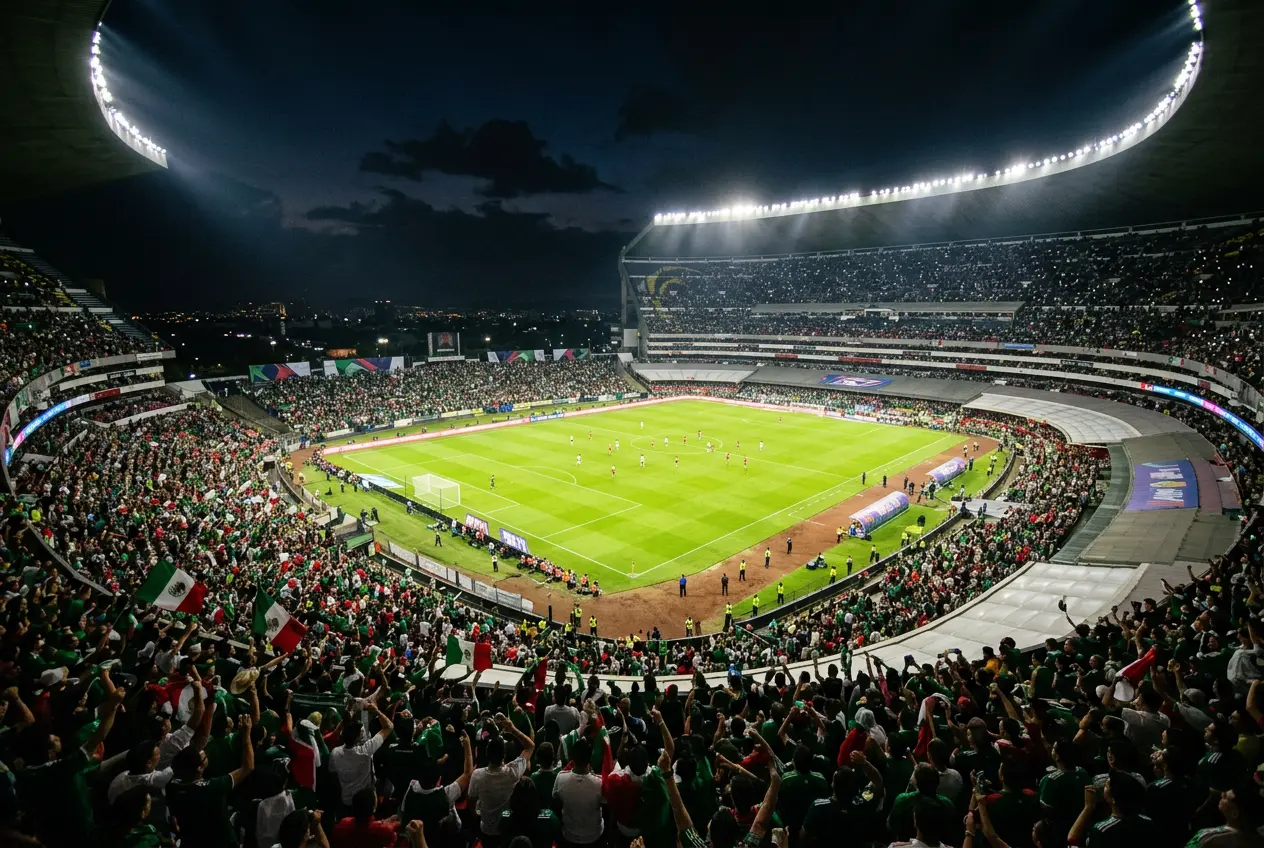
Mexico City Stadium, the tournament name for Estadio Azteca in Coyoacán, has a capacity of 87,523 after a 2024 to 2026 renovation, and the work was carried out under the direction of FIFA and a University of Tennessee and Michigan State University research team that handled the hybrid turf installation. The full venue list, with capacities, is below.
| City | Stadium | Capacity | Country |
|---|---|---|---|
| Toronto | Toronto Stadium | 45,000 | Canada |
| Vancouver | BC Place | 54,000 | Canada |
| Mexico City | Mexico City Stadium (Estadio Azteca) | 87,523 | Mexico |
| Guadalajara | Estadio Guadalajara | 48,000 | Mexico |
| Monterrey | Estadio Monterrey | 53,500 | Mexico |
| Atlanta | Atlanta Stadium | 75,000 | US |
| Boston | Boston Stadium | Renovation | US |
| Dallas | Dallas Stadium | 94,000 | US |
| Houston | Houston Stadium | 72,000 | US |
| Kansas City | Kansas City Stadium | n/a | US |
| Los Angeles | Los Angeles Stadium | 70,000 | US |
| Miami | Miami Stadium | 65,000 | US |
| New York/New Jersey | New York New Jersey Stadium | 82,500 | US |
| Philadelphia | Philadelphia Stadium | 69,000 | US |
| San Francisco Bay Area | San Francisco Bay Area Stadium | 71,000 | US |
| Seattle | Seattle Stadium | 69,000 | US |
Why 32 of 48 Teams Now Reach the Knockouts
For the first time in the tournament’s history, the knockout stage will include a Round of 32 stage that did not exist in any previous men’s World Cup, the first expansion and format change since France 1998 introduced the 32-team field that ran through Qatar 2022. Teams that reach the final four will play eight matches, up from seven at Qatar 2022, with the added game coming in the new round. The Round of 32 is the first new knockout round the men’s World Cup has added since 1998.
The format was settled only after FIFA weighed a different model: 16 groups of three teams, with the top two of each group advancing to a Round of 32 in 80 matches total. Critics argued the three-team groups opened the door to collusion, and FIFA briefly floated penalty shootouts to prevent draws, a step that would have allowed teams to deliberately lose a shootout to knock out a rival. The four-team group format won out and was announced on March 14, 2023.
A deeper knockout field changes the math for the smaller nations. Debutants Cape Verde, Curaçao, Jordan and Uzbekistan, the longest of long shots among the qualifiers, now need only a top-eight third-place finish to extend their tournament by at least one round. For teams that historically treated the group stage as a three-game exit, the new structure leaves a longer second life. Smaller confederations now have a route past the group stage that the 32-team format did not offer.
The trade-off is load. Players go from a possible seven matches to a possible eight, and the total rest-and-release window for clubs remains identical to 2010, 2014 and 2018 at 56 days. The final squad release deadline is May 25, with continental club final exceptions through May 30. The full bracket and matchups will be set when the group stage concludes on June 27, and the knockout rounds then take over from June 28 through the July 19 final.
(More on the 2026 World Cup tournament details and host city list.)
The Record $50 Million Winner and the $727 Million Fund
The winning team will take home $50 million, the largest single payout in the men’s World Cup’s history, up from $42 million for Argentina in Qatar 2022. FIFA announced a record World Cup prize fund of $727 million in December 2025, with $655 million of that allocated as performance-based payments to the 48 participating nations. Each team was initially entitled to $1.5 million to cover preparation costs. The figure represents a 50 percent increase in the prize-money pool compared to Qatar 2022.
FIFA is now in discussions with national associations to increase the pot further, and the proposal must be approved at Tuesday’s FIFA Council meeting, held before the 76th FIFA Congress in Vancouver. UEFA had asked FIFA to lift payments after several of its member associations flagged the cost of travel, operations and taxes, particularly in the United States. FIFA projects it will surpass $11 billion in revenue across the four-year cycle from 2023 to 2026.
The 2025 annual report said 93 percent of FIFA’s total budgeted revenue had been contracted by the end of 2025, a cushion the body attributes in part to the 32-team Club World Cup held in the U.S. last year. The full December announcement and the talks since are detailed in FIFA’s proposed increase in team funding.
The FIFA World Cup 2026 will be groundbreaking in terms of its financial contribution to the global football community, and FIFA is proud to be in its strongest ever financial position to benefit the global game through its FIFA Forward programme.
A FIFA spokesperson told Reuters, as reported by Al Jazeera.
Mexico City, the First Three-Time World Cup Host
The opening match lands at the venue that has defined the World Cup for more than half a century. Mexico City Stadium, the tournament name for the 87,523-seat Estadio Azteca in Coyoacán, is the only stadium to host three World Cups (1970, 1986 and 2026). The same venue staged two World Cup finals, with Brazil beating Italy 4-1 in 1970 and Argentina beating West Germany 3-2 in 1986. The 1986 quarter-final between Argentina and England, in which Diego Maradona scored the Hand of God goal and the Goal of the Century, was also played at Azteca.
Mexico will become the first country to host or co-host the men’s World Cup three times, having staged the tournament solo in 1970 and 1986. The United States previously hosted in 1994, the only prior U.S. edition of the tournament. Canada is hosting or co-hosting the men’s World Cup for the first time. The Azteca reopened on March 28, 2026 with a friendly between Mexico and Portugal that ended scoreless; a spectator died during the pre-match ceremonies after an apparent fall from a box suite. Renovations pushed the seating capacity from 83,000 to 87,523 and added new video screens and a hybrid turf pitch, and The Athletic later flagged uneven concrete work, unfinished furnishings and a chaotic security queue; the stadium’s corporate name, Banorte since March 2025, will not be used during the tournament under FIFA’s policy on sponsored names (see the only stadium to host three World Cups).
From 16 to 32 to 48: The Pattern of Expansion
The 2026 World Cup is the men’s tournament’s first expansion since France 1998 introduced the 32-team format. Before that, Spain 1982 was the first 24-team World Cup, up from the 16-team format that ran from 1934 to 1978. The 32-team model held through seven straight editions, from France 1998 through Qatar 2022.
The 48-team format was approved in principle on January 10, 2017, when FIFA initially settled on 16 groups of three with 80 matches. The current model of 12 groups of four was confirmed by the FIFA Council in March 2023, the version now in use.
This is only the second time the men’s World Cup has been co-hosted by more than one country, after Japan and South Korea staged the 2002 edition. Co-hosting was officially declared unlikely in 2004, when FIFA said its statutes did not allow it. The rule has been overturned, and 2026 is the largest test of multi-nation hosting in the tournament’s history.
FIFA picked the joint United States, Canada and Mexico bid on June 13, 2018 during the 68th FIFA Congress in Moscow, with the United bid winning 134 valid ballots against Morocco’s 65. Canada, Mexico and the United States had each publicly considered bidding separately before announcing a joint bid on April 10, 2017.
Five New IFAB Rule Changes for 2026
The International Football Association Board (IFAB) ratified a package of special rule changes in February 2026 that take effect at the World Cup and in subsequent FIFA competitions. The package is built around cracking down on time-wasting and tightening the use of VAR. Five changes will be most visible on the pitch during the tournament, and more detail sits in the 2026 World Cup format and rule changes guide.
Referees can now signal a five-second countdown on throw-ins and goal kicks, after which possession is awarded to the opposing side. Substituted players have 10 seconds to leave the field; if they fail to leave, the replacement cannot enter until one minute of play has passed.
Any player who receives an on-field medical assessment that interrupts play must leave the pitch and cannot return for at least one minute, except when the injury was caused by a cardable foul or affects a goalkeeper. The Video Assistant Referee will also review second yellow cards leading to a red. It will review cases of mistaken identity on penalties and corner-kick decisions when the review does not delay play.
- Five-second countdown for throw-ins and goal kicks, at referee discretion.
- Substituted players must leave the field within 10 seconds, or the replacement waits one minute.
- Players receiving an on-field medical assessment must leave for at least one minute, with limited exceptions.
- Yellow-card count resets at the end of the group stage, not the quarterfinals.
- New red-card offense for covering the mouth during confrontations, and a red for leaving the field to protest refereeing decisions.
Frequently Asked Questions
When does the FIFA World Cup 2026 start and where is the final?
The tournament runs from Thursday, June 11, 2026 to Sunday, July 19, 2026, a 39-day window. The opening match is Mexico vs. South Africa at Mexico City Stadium at 2 p.m. Central Time. The final is on July 19 at New York New Jersey Stadium in East Rutherford, New Jersey.
How many teams are in the 2026 World Cup?
48 teams, up from 32 in every edition from France 1998 through Qatar 2022. The 48 are split across six confederations: 16 from Europe, 9 from Africa, 6 from South America, 8 from Asia, 6 from North America including the three host nations, and 1 from Oceania, plus 2 intercontinental playoff spots.
What is the new format for the 48-team World Cup?
12 groups of four teams. The top two in each group, plus the eight best third-placed teams, advance to a new Round of 32. From there the tournament proceeds through the Round of 16, quarterfinals, semifinals and the July 19 final. Teams that reach the final four will play eight matches, one more than at Qatar 2022.
How much prize money does the winner get?
$50 million for the champion, up from $42 million in Qatar 2022. FIFA’s announced prize fund is $727 million, of which $655 million is performance-based payments to the 48 teams. FIFA is in discussions with national associations to increase the pot further, a proposal to be put to the FIFA Council before the 76th FIFA Congress in Vancouver.
Which countries are making their World Cup debuts?
Cape Verde, Curaçao, Jordan and Uzbekistan will all play at a men’s World Cup for the first time. The 48-team field is the largest in the tournament’s history.
 Scotland Reader Photos Capture Eclipse Week Beyond the Sky
  Scotland’s Rare World Cup Win Over Haiti Still Echoes
  Scottish Morning Roll Campaign Echoes Baguette Path to Unesco
  Samsung Passport Fold8 Turns Apple Fans Into Switchers
  Android’s Quiet Shift to Ambient AI Hardware This Week
  Poco F9 Leak Hands Global Buyers Less Battery for More Money