
 Ishan Crawford
 ASUS used Computex week to unveil the all-new TUF Gaming 16, a 16-inch laptop it is pitching as a value pick for esports and mainstream play. The marquee pairing reads modern at first glance: up to an NVIDIA GeForce RTX 5070 Laptop graphics processor built on the current Blackwell design, with the AI upscaling tricks that come with it. Look one line up the spec sheet, though, and the processor tells a quieter story. The top chip option is an Intel Core i7-14650HX, a 14th-generation part that first reached laptops back in January 2024.
That mix is deliberate. It is how ASUS keeps a Blackwell-class machine inside a friendly price band, and it is the bargain buyers are being asked to weigh before they hit checkout.
A 2026 Badge on a January 2024 Processor
The headline CPU here is the Intel Core i7-14650HX, a chip that launched at CES in early 2024 under Intel’s Raptor Lake Refresh family. It carries eight Performance-cores (P-cores, the high-speed cores that handle heavy single-threaded work) and eight Efficient-cores (E-cores, smaller cores for background tasks), for 16 cores and 24 threads in total, with a peak boost clock of 5.2GHz.
None of that is weak. For the kind of games the TUF Gaming 16 targets, a 14th-gen i7 still feeds a mid-range GPU with frames to spare, and most esports titles lean far harder on graphics than on raw processor threads. The catch is the calendar. By the time this laptop reaches shelves, the Core i7-14650HX product specifications describe silicon that is roughly two and a half years old, two Intel generations behind the Core Ultra parts ASUS puts in its pricier TUF and ROG models.
Why reach back? Cost, mostly. Older HX-class chips are cheaper to source than fresh Core Ultra silicon, and pairing one with a current GPU lets ASUS advertise a new graphics architecture without a new-CPU price premium. For buyers who plan to use the machine purely for gaming, the trade is reasonable. For anyone weighing battery life, on-device AI features, or long-haul resale value, an older CPU is the line on the spec sheet that ages first.
The RTX 5070 Inside Is Capped at 85 Watts
The graphics side is where the laptop earns its 2026 label. The TUF Gaming 16 runs up to an NVIDIA GeForce RTX 5070 Laptop GPU on the Blackwell architecture, with 8GB of GDDR7 memory and support for real-time ray tracing. The number that matters most, though, is its power ceiling.
What 85 Watts Buys
ASUS sets the GPU’s maximum Total Graphics Power (TGP, the wattage a laptop allows the chip to draw) at 85 watts. That is a deliberate ceiling. The same RTX 5070 Laptop part can be configured higher in thicker, costlier machines, where more watts translate into more sustained frames. In the TUF Gaming 16, the lower ceiling keeps heat and power demands modest, which suits a slim value chassis but leaves performance on the table compared with a fully fed version of the same chip.
The practical read: this is a strong 1080p and capable 1440p machine for most titles, not a desktop-replacement powerhouse. Buyers comparing two laptops that both say “RTX 5070” on the box should check the wattage before assuming they perform the same, because they often do not.
Where DLSS 4 Picks Up Slack
Blackwell’s headline feature is DLSS 4 (Deep Learning Super Sampling, NVIDIA’s AI image-upscaling system) with Multi-Frame Generation, which can synthesize additional frames for every natively rendered one. That helps a power-limited GPU post higher frame counts than its raw wattage would suggest. The GeForce RTX 5070 family overview leans heavily on these AI gains, and on a value laptop they do real work, smoothing supported games that the 85-watt budget alone would struggle to keep buttery.
Quieter Fans and a Rear-Port Layout
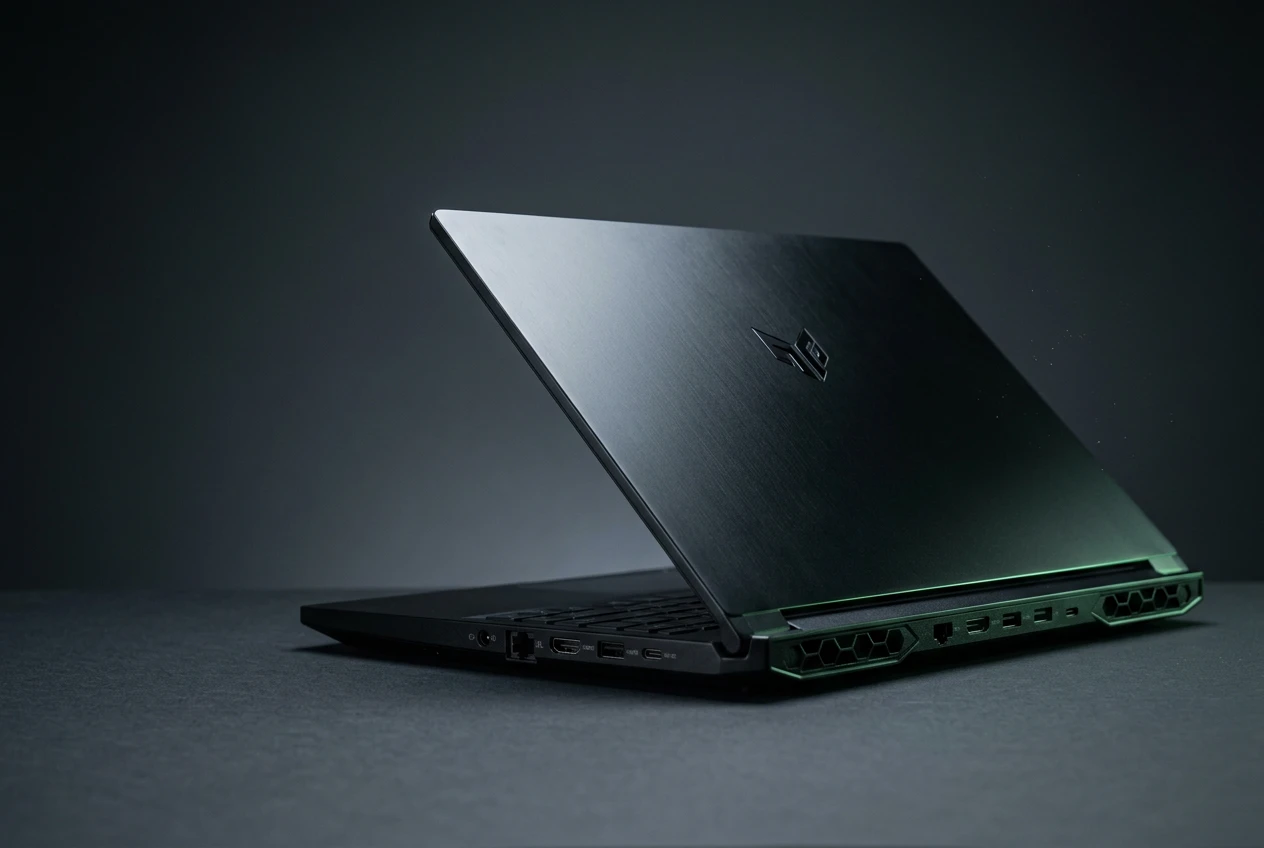
Where the TUF Gaming 16 spends its engineering effort is cooling and ergonomics, and those upgrades are genuine. The system uses three heat pipes paired with dual 80-blade fans, and ASUS says the setup holds fan noise to under 40 decibels in Turbo Mode at full load, with quieter output in the default Performance mode. For a long session in a shared room, that acoustic ceiling matters more than a benchmark chart.
The cooling design also routes some airflow across the motherboard to chill surface-mounted components, and adds dust filters to keep the intake clean over years of use. Build quality follows the TUF script: an all-black finish, an anti-fingerprint coating on the keyboard deck, a 180-degree display hinge, and testing to MIL-STD-810H durability standards for drops, vibration, and temperature swings.
The connector layout is the other quiet win.
- Rear-mounted ports: the RJ45 Ethernet jack, power input, and HDMI sit at the back, keeping cables clear of the mousing hand for both left and right-handed players.
- Side ports: three USB Type-A connectors plus one USB Type-C with DisplayPort 2.1 and Power Delivery (PD, charging over the USB-C cable) handle peripherals, a second screen, and on-the-go top-ups without the brick.
- Memory and storage access: dual RAM and dual SSD slots that owners can reach and upgrade themselves.
Where the TUF Gaming 16 Sits in the 2026 Lineup
ASUS now runs three sibling 16-inch TUF machines for 2026, and they are easy to confuse by name alone. The plain TUF Gaming 16 is the value anchor; the F16 and A16 climb the ladder on CPU and display. The split below shows why the entry model leans on older silicon.
| Model | Top CPU | Top GPU | Panel |
|---|---|---|---|
| TUF Gaming 16 (2026) | Intel Core i7-14650HX (14th gen) | RTX 5070 Laptop, 85W | 16-inch IPS-level 2.5K 165Hz |
| TUF Gaming F16 (2026) | Intel Core Ultra 9 290HX | RTX 5070 Laptop | 16-inch OLED 2.5K 165Hz |
| TUF Gaming A16 (2026) | AMD Ryzen 9 | RTX 5070 / 5070 Ti | 16-inch FHD+ 165Hz |
The pattern is clear once you line them up. Step up to the TUF Gaming F16 2026 tech specs and you get a current Core Ultra 9 chip and an OLED panel; the A16 swaps in AMD’s Ryzen and reaches a faster RTX 5070 Ti. The base TUF Gaming 16 trades those for a lower entry cost, which is exactly the buyer it is chasing. ASUS has not published a price for it yet, though the A16 has carried a sticker around $1,349 for reference.
Who the Value Build Fits
This laptop is built for a specific buyer, and being honest about who that is saves disappointment later. The full picture sits in the 2026 TUF Gaming launch announcement, but the buying logic comes down to a short list.
- Good fit: esports and competitive players who want high frame rates at 1080p, a quiet machine for shared spaces, and a rugged chassis that survives a backpack commute.
- Fine for now: students and first-time gaming-laptop buyers who value an upgrade path, with up to 64GB of DDR5 memory and up to 2TB of PCIe 4.0 storage across user-accessible slots.
- Look elsewhere: anyone who wants the newest Intel features, top sustained GPU output, or an OLED screen, since the F16 and A16 cover those for more money.
The upgrade story is the underrated part. Because both RAM and SSD slots open up, a buyer can start cheap and add memory or storage later, stretching the machine’s useful life well past the day the CPU stops looking current. If you are still deciding whether a gaming laptop is even the right platform, a primer on PC gaming as a platform is a sensible first stop, and value-minded shoppers tracking the wider budget hardware wave have also been watching Acer’s budget Snapdragon laptop push.
Frequently Asked Questions
Is the Intel Core i7-14650HX in the TUF Gaming 16 a new chip?
No. The 14th-gen i7 launched at CES in early 2024 under Intel’s Raptor Lake Refresh line, so by the time this 2026 laptop ships the processor is roughly two and a half years old. It remains capable for gaming, but it sits two Intel generations behind the Core Ultra parts in ASUS’s pricier TUF models.
How powerful is the RTX 5070 at 85 watts?
It is a solid 1080p performer and handles many 1440p games, especially with DLSS 4 Multi-Frame Generation enabled. The 85-watt power ceiling is lower than the same GPU runs in larger, costlier laptops, so two machines both labeled RTX 5070 can perform noticeably differently depending on their wattage.
Can I upgrade the RAM and storage myself?
Yes. The TUF Gaming 16 ships with dual RAM slots and dual SSD slots that ASUS describes as user-upgradeable, supporting up to 64GB of DDR5 memory and up to 2TB of PCIe 4.0 storage. That makes it easy to buy a lower configuration now and expand later.
How loud is the cooling system?
ASUS rates fan noise at below 40 decibels in Turbo Mode under full load, using three heat pipes and dual 80-blade fans, with quieter output in the out-of-the-box Performance mode. Dust filters help keep that cooling consistent over the long term.
What is the difference between the TUF Gaming 16, F16, and A16?
The plain TUF Gaming 16 is the value model with a 14th-gen Intel CPU and an IPS-level screen. The F16 steps up to a current Core Ultra 9 chip and an OLED panel, while the A16 uses AMD Ryzen silicon and can reach an RTX 5070 Ti GPU. All three are 16-inch machines aimed at different budgets.
Has ASUS announced a price and release date?
Not at announcement. ASUS revealed the TUF Gaming 16 on June 2, 2026, but left pricing and availability for closer to launch. As a rough guide, the related TUF Gaming A16 has sold around $1,349.
ASUS has not set a price or shipping date for the TUF Gaming 16, and both are expected closer to launch. Until they arrive, the spec sheet is the whole pitch, and the buyer who reads it carefully will judge the laptop on the gap between a current Blackwell GPU and the older CPU sitting right above it.
 Simple Wave Chases Range as Ather Konarc Cuts Price
  Adobe Bets on Experience Cloud’s Anil Chakravarthy as CEO
  The Quiet Architect Behind Akshay Oberoi’s Karjat Home
  PaperCut Rushes a Third Patch as Print Servers Fall
  Apple’s Foldable iPhone Hinges on Samsung Display Supply
  Farah Calls the Evoluto F355 Restomod a Costly Triumph