
 Ishan Crawford
 Leaked renders and specs for the Poco F9 Ultra and F9 Pro put a 6.9-inch 185Hz AMOLED, Snapdragon 8 Elite Gen 5 and 200MP main camera on European shelves at starting prices of €999 and €799, yet both phones carry smaller batteries than the Redmi K100 twins just launched in China.
The phones are rebranded versions of those China-only models, according to a detailed WinFuture report. Global buyers get the same silicon and camera cores but lose capacity and pay more once memory costs and regional tuning finish the job.
Leaked Renders Put Two Sizes on the Table
WinFuture published the first official-looking images and a near-complete specification sheet. The F9 Pro is the smaller phone. The Ultra stretches the same design language across a larger canvas and adds hardware.
| Feature | Poco F9 Pro | Poco F9 Ultra | Redmi K100 Pro Max (China) |
|---|---|---|---|
| Display | 6.59-inch AMOLED, ~1156×2510, 185Hz, 4500 nits peak | 6.85-6.9-inch AMOLED, 1200×2608, 185Hz, 4500 nits | 6.9-inch AMOLED, 1200×2608, 185Hz, 4500 nits |
| Chipset | Snapdragon 8 Elite Gen 5 | Snapdragon 8 Elite Gen 5 | Snapdragon 8 Elite Gen 5 |
| RAM / Storage | 12/16 GB, 256/512 GB | 12/16 GB, 256/512 GB | 12/16 GB, 256/512 GB+ |
| Main camera | 200 MP OIS | 200 MP OIS | 200 MP OIS f/1.7 |
| Telephoto | 50 MP, 2.5-3× optical | 50 MP 5× periscope | 50 MP 5× periscope |
| Ultrawide | 8 MP | 50 MP | 50 MP |
| Battery | 6,330 mAh | 8,050 mAh | 9,070 mAh |
| Charging | 100 W wired | 100 W wired | 100 W wired + 50 W wireless |
| Weight | ~206 g | ~235 g | 238 g |
| Starting price | €799 (12/256) | €999 (16/512) | CNY 4,199 (~€540-620) |
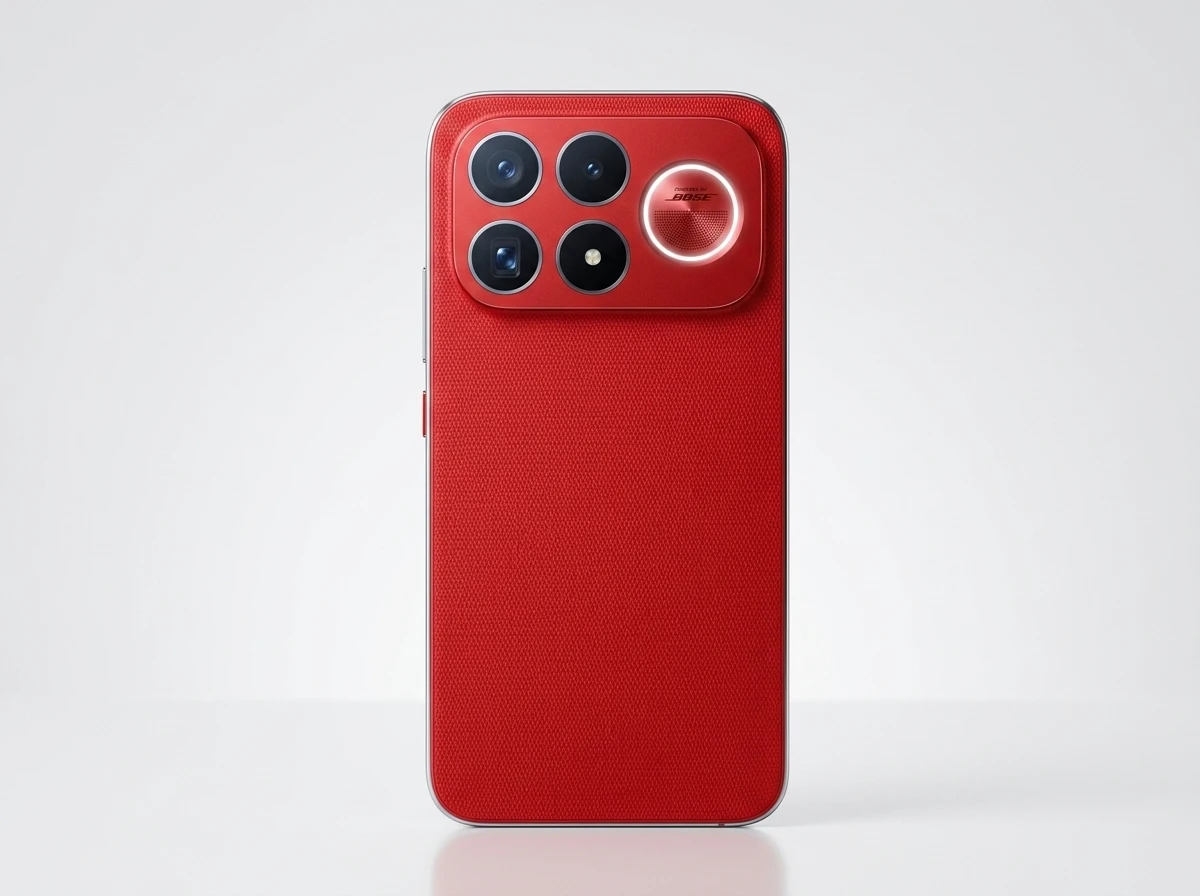
Both Poco models use Gorilla Glass 7i on the front, a metal frame and a fiberglass-reinforced plastic back. They carry IP69 dust and water resistance and a Bose-tuned speaker system. The Ultra alone adds a rear LED notification ring.
The displays come from TCL CSOT with Xiaomi material input. Peak brightness hits 4,500 nits on both. Selfie cameras are 32 MP across the board.
Shared chassis choices keep the pair visually close. The Pro trims diagonal size and secondary camera ambition. The Ultra pushes closer to the China Pro Max outline while still shedding some cell mass against that twin.
Europe Gets Less Cell Than China
The clearest split sits in the battery bay. China Redmi K100 Pro and Pro Max launched on 11 August 2026 with 8,580 mAh and 9,070 mAh silicon-carbon cells. The global Poco versions drop to 6,330 mAh and 8,050 mAh.
| Model | Battery | Wired charge | Wireless | Weight |
|---|---|---|---|---|
| Poco F9 Pro (global) | 6,330 mAh | 100 W | Not confirmed | ~206 g |
| Poco F9 Ultra (global) | 8,050 mAh | 100 W | Not confirmed | ~235 g |
| Redmi K100 Pro (China) | 8,580 mAh | 100 W | 50 W + reverse | – |
| Redmi K100 Pro Max (China) | 9,070 mAh | 100 W | 50 W + reverse | 238 g |
WinFuture notes the European packs still support 100 W wired charging with USB Power Delivery. The lighter weights (206 g and 235 g) follow the smaller cells. China units keep wireless charging at 50 W plus reverse options; the leak is quieter on wireless for the Poco pair.
Comment threads and early posts on X repeatedly call the capacity cut disappointing. Buyers who track both markets see the same board and cameras but lose multi-day endurance that the China models advertise. The phones already exceed older European energy limits, so the shrink looks like a deliberate regional SKU decision rather than pure regulation.
The Pro takes the sharper hit relative to its China sibling. The Ultra lands nearer the China Pro Max on paper yet still gives up roughly a full thousand milliamp-hours and the confirmed wireless suite. Weight savings track those cuts almost one for one on the Ultra side.
€799 and €999 Stickers Land Higher
WinFuture states the F9 Pro should start at least at €799 for the 12 GB/256 GB configuration. The Ultra is expected at least at €999 for 16 GB/512 GB. Those figures sit above the Poco F8 Ultra’s earlier European launch pricing, which hovered near €700-830 depending on the retailer and configuration.
The high prices show that even Xiaomi is no longer willing or able to swallow the enormous rise in memory costs just to move a few more units.
That line comes directly from the WinFuture exclusive images and full specs report. China pricing for the K100 Pro Max opens at CNY 4,199 (roughly €540-620 at recent rates) for 12/256 and climbs to CNY 5,999 for higher storage. Global buyers therefore face a steeper euro entry for a phone with less battery.
Colors for Europe are expected in black, white, green and red. Exact launch timing remains unconfirmed, though the China debut makes a near-term global window likely.
Retailers may still shave the openers after stock lands, as they did on the F8 Ultra. Even so, the leaked floors already place the new pair a clear step above that earlier European band before any promotion math begins.
Memory Costs Squeeze the Old Formula
Poco built its reputation on flagship-adjacent silicon at mid-range money. The memory market has changed that math. AI data-center demand for high-bandwidth memory has pulled wafer capacity away from the LPDDR and NAND used in phones.
An IDC analysis of 2026 memory shortage projects smartphone average selling prices could rise 3-5 % in a moderate case or 6-8 % in a tougher one. Thin-margin Android brands feel the pressure first. Xiaomi, which owns both Redmi and Poco, sits in that group.
- DRAM and NAND contract prices kept climbing through mid-2026 even as the rate of increase cooled from earlier 50-60 % quarterly jumps.
- Memory can make up 10-20 % of a phone’s bill of materials, higher on mid-range models.
- OEMs face the choice of raising street prices, cutting RAM or storage options, or accepting thinner margins.
- Longer replacement cycles become more likely once handsets jump a price tier.
The F9 pricing is the visible result. What used to look like a flagship killer now sits closer to conventional premium Android territory once the euro conversion and battery cut are factored in.
Keeping 12/16 GB RAM and 256/512 GB storage options intact means the bill of materials still carries a heavy memory line. Xiaomi appears to have chosen higher street prices over a cut-down configuration sheet for Europe.
200MP Main and the Zoom Split
Both phones share a 200 MP main sensor with optical image stabilization and an f/1.68-1.7 aperture. Video reaches 8K30 and 4K60. The Ultra matches the China Pro Max camera stack more closely.
- Ultra: 50 MP ultrawide plus 50 MP 5× periscope telephoto (around 115-120 mm equivalent) with OIS.
- Pro: 8 MP ultrawide and 50 MP telephoto at 2.5-3× optical (around 60 mm) with OIS.
- Both: 32 MP front camera, color spectrum sensor, LED flash.
The Pro’s more modest secondary cameras keep the price and size down. The Ultra targets users who want the full zoom range without moving to a full Xiaomi or Samsung ultra flagship. Earlier Redmi leaks, including the Redmi Note 17 series battery and camera tips, show Xiaomi continues to push high-resolution sensors and large cells across price bands, though the Note line stays further down the stack.
On stills and video the shared main sensor does the heavy lifting for both. The secondary gap is where the Ultra earns its higher sticker and where the Pro leaves headroom for buyers who rarely leave the wide and short-tele range.
Bose Speakers Meet an LED Ring
Audio is a consistent highlight. Both models integrate a Bose-tuned speaker layout that includes a larger rear-facing unit. The Ultra adds the LED notification ring around the camera island, a visual feature that has appeared on select prior Xiaomi designs.
Under the hood sits the same Snapdragon 8 Elite Gen 5 platform details that powers the China K100 series. Peak CPU clocks reach approximately 4.6 GHz on the prime cores. Storage is UFS with no microSD expansion. HyperOS on a recent Android base is expected.
The Redmi K100 Pro Max full specifications page confirms the China counterpart’s 9070 mAh cell, IP68/IP69 rating, ultrasonic fingerprint, infrared blaster and full wireless charging suite. Global Poco units keep most of that list except the battery size and, apparently, some wireless features.
What European Buyers Keep and Surrender
Strip away branding and the two markets still share a long common list. The gaps cluster in endurance, wireless power and entry price rather than in day-to-day compute or the main camera.
- Kept: Snapdragon 8 Elite Gen 5, 200 MP main with OIS, 185 Hz AMOLED peak at 4,500 nits, Gorilla Glass 7i, IP69, Bose-tuned speakers, 100 W wired charging, 32 MP front camera, UFS storage, HyperOS.
- Trimmed on both Poco models: total cell capacity versus the matching China twin, confirmed 50 W wireless and reverse charging.
- Trimmed mainly on the Pro: ultrawide resolution and telephoto reach versus the Ultra and the China Pro Max.
- Added cost: euro starting prices well above the CNY 4,199 to 5,999 China band once converted.
The lighter global shells follow directly from the smaller packs. At roughly 206 g and 235 g the Poco pair undercuts or matches the 238 g China Pro Max while giving up the multi-day cell story those China units advertise.
For buyers who charge nightly and value pocket weight, the trade may feel rational. For buyers who chose prior Poco flagships for endurance at a discount, the new math is harder to ignore.
How the Timeline Points to a Near Window
Public milestones already on the record sketch a compressed path from China reveal to a likely European push.
- 11 August 2026 – Redmi K100 Pro and Pro Max launch in China with the 8,580 mAh and 9,070 mAh cells, full wireless suite and local CNY pricing from 4,199 upward.
- Post-launch leak window – WinFuture publishes official-looking renders and a near-complete F9 Pro and F9 Ultra specification sheet aimed at Europe, including the €799 and €999 openers.
- Near-term global window – Unconfirmed in the leak, yet treated as likely once the China debut and the finished global SKU sheet are both in hand.
Nothing in the report locks a store date. The pattern still favors a short gap between the two regional waves rather than a long hold-back of the global pair.
Colors in black, white, green and red are the expected European set. Final RAM and storage mixes at retail could still shift slightly from the 12/16 GB and 256/512 GB grid in the leak, though those are the configurations tied to the stated starting prices.
The F8 Ultra Path Looks Costlier Now
Last year’s F8 Ultra brought a 6.9-inch panel, the same generation Snapdragon and a 6500 mAh battery to global markets. Street prices settled lower than launch after promotions. The F9 Ultra improves refresh rate to 185 Hz, jumps the main camera to 200 MP, lifts battery to 8050 mAh and adds the LED ring, yet the leaked starting tag climbs.
That pattern matches the broader market shift. An earlier Redmi Note 17 chipset leak already showed Xiaomi balancing high-capacity batteries against more modest processors on lower lines. On the F series the silicon stays top-tier, so the price has to absorb the memory inflation.
Year on year the Ultra story is still an upgrade on paper. Refresh rate, main sensor resolution and cell size all move forward from the F8 Ultra’s 6500 mAh baseline. The euro floor moves forward with them, and the China comparison now makes the remaining capacity gap visible in a way last year’s lineup did not.
China customers who can buy the K100 Pro Max keep the largest cells and the lower local currency entry. Global Poco shoppers receive nearly identical cameras and performance in a lighter shell, then pay the euro premium and accept the capacity trim. The winner-loser split is geographic and contractual rather than a pure performance gap.
Launch dates and final European configurations are still open. Once the phones reach retail, the real test will be whether the 185 Hz display, 200 MP detail and Bose audio outweigh the higher asking price and the missing milliamps for buyers who once counted on Poco to undercut the flagships by a wide margin.
 Scotland Reader Photos Capture Eclipse Week Beyond the Sky
  Scotland’s Rare World Cup Win Over Haiti Still Echoes
  Scottish Morning Roll Campaign Echoes Baguette Path to Unesco
  Samsung Passport Fold8 Turns Apple Fans Into Switchers
  Android’s Quiet Shift to Ambient AI Hardware This Week
  Scotland Bluetongue Cases Spark UK Vaccine Scramble