
 Ishan Crawford
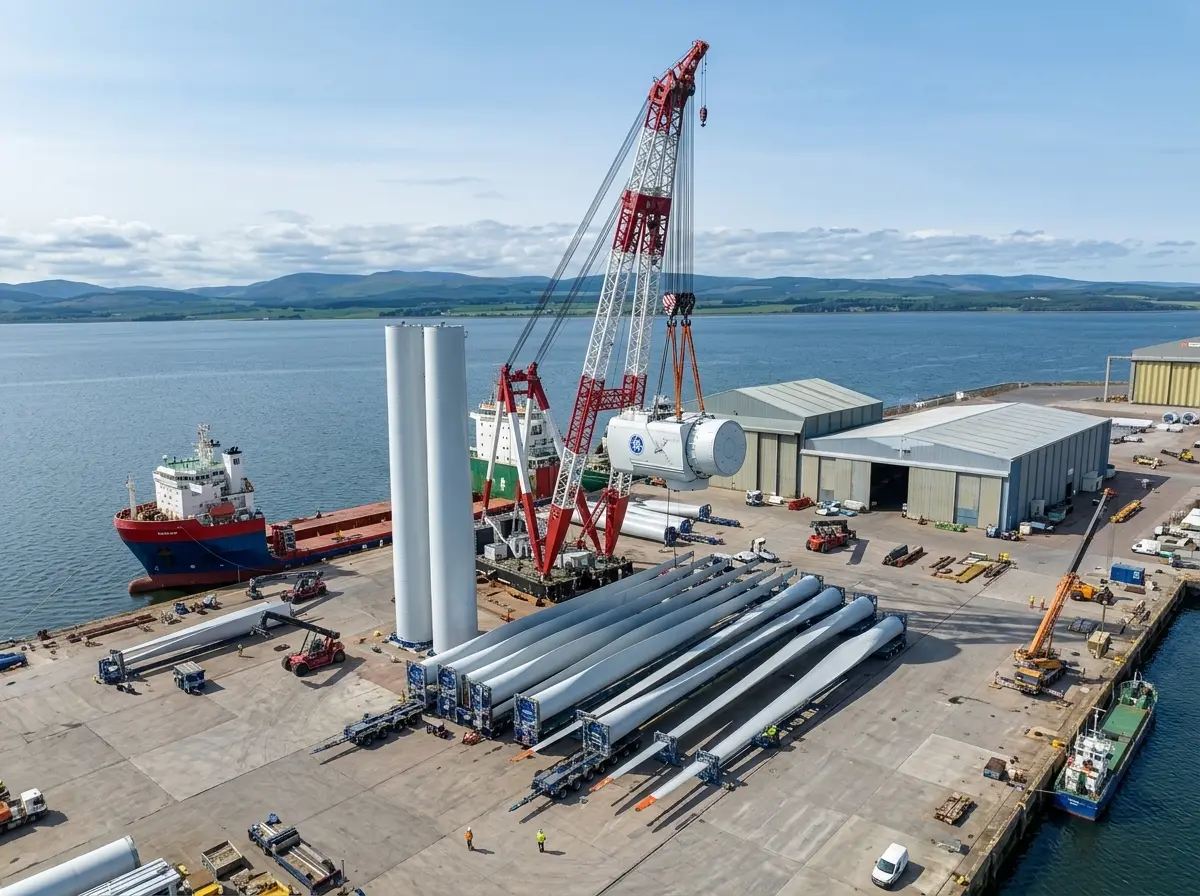
 Up to 180 skilled jobs are being created at Maraen Port of Nigg near Inverness to marshal turbine components for Dogger Bank B and C, the later phases of the 3.6 GW North Sea project. Recruitment is already under way and the roles run through the farm’s expected mid-2028 completion.
Scottish Energy Minister Stephen Gethins MSP visited the deepwater Green Freeport site as the announcement landed. The posts cover project managers, port operators and mechanical and electrical technicians for pre-assembly of GE Vernova’s 13 MW and 14 MW Haliade-X machines.
What the Nigg Roles Cover
The positions sit inside the marshalling harbour contract for Dogger Bank B and C. Turbine components arrive at the Cromarty Firth quay, get prepared on site, then load onto installation vessels for the North Sea sites more than 130 km off north-east England.
- Project managers coordinating logistics and schedules
- Port operators running heavy-lift and laydown operations
- Mechanical and electrical technicians handling pre-assembly of nacelles, blades and towers
Dogger Bank Wind Farm’s own statement confirmed the up to 180 new skilled roles at Nigg. SSE Renewables leads construction of the £9 billion joint venture (SSE 40 %, Equinor 40 %, Vårgrønn 20 %). Yoshihiro Hayakawa, CEO and Managing Director at Maraen, said the work builds directly on earlier campaigns for Beatrice and Seagreen.
Steve Wilson, Offshore Wind Director at SSE Renewables, called the jobs proof that the project keeps delivering economic benefits for Scotland and the wider UK supply chain.
Dogger Bank’s Three Phases Reach Critical Mass
Dogger Bank is the world’s largest offshore wind farm under construction. It will total 277 GE Vernova Haliade-X turbines across three 1.2 GW phases and is projected to meet roughly 6 % of current UK electricity demand once fully online, based on 17.3 TWh annual output against 289 TWh recorded demand in 2024.
| Phase | Capacity | Turbines | Status mid-2026 |
|---|---|---|---|
| Dogger Bank A | 1.2 GW | 95 × 13 MW | Turbine campaign complete early 2026 |
| Dogger Bank B | 1.2 GW | 95 × 13 MW | Installation ongoing |
| Dogger Bank C | 1.2 GW | 87 × 14 MW | Offshore works start 2027 |
Foundations for all 277 monopiles finished in late 2025. Nigg’s work focuses on B and C components after the May 2026 marshalling award from GE Vernova. Phase A already feeds power into the grid. Full project completion targets mid-2028.
From Oil Yard Peak to Renewables Superhub
The port’s path explains why Dogger Bank landed here. Established in 1972 as a Highland Fabricators yard, Nigg employed around 5,000 people at the oil-and-gas peak and delivered more than 30 major platforms. It then fell quiet for nearly a decade after 2000.
- 2011-2013: Global Energy Group acquisition with Mitsui backing; skills academy opens; dry dock returns to service.
- 2015: South Quay completed, opening the door to renewables.
- 2018-2020: Beatrice (588 MW) WTG pre-assembly and Moray East jacket and WTG marshalling.
- 2021-2023: East Quay built; Seagreen (1.1 GW) jackets and WTGs handled; Green Freeport status awarded; Moray West transition pieces and turbines supported.
- 2025: Full acquisition by Mitsui & Co. Europe and Mitsui O.S.K. Lines; rebrand and integration under Maraen; customs site designation.
Maraen’s own record shows more than 3.5 GW of offshore wind already handled. The site now offers over 1,200 metres of deep-water quay, 50 t/m² ground loading and more than 450,000 m² of laydown. Hard seabed conditions take the largest jack-up vessels.
The sustained investment in the port has created infrastructure that is critical to Scotland’s and the UK’s energy transition.
Hayakawa made that point as he welcomed the minister and confirmed the 180 roles.
Green Freeport Status and Japanese Capital Change the Odds
Nigg sits inside the Inverness and Cromarty Firth Green Freeport, awarded in 2023. The wider zone projects 11,300 long-term jobs projected across the Freeport and £6.5 billion in planned investments over 25 years across 520 hectares of industrial land. Tax and customs incentives, plus Authorised Economic Operator status, lower the friction for heavy manufacturing and logistics.
Maraen’s Japanese owners have already committed fresh capital. A linked £30 million Eastern Inner Dock Quay expansion adds heavy-duty Ro-Ro capacity and roughly 16,000 m² of new working area, partly backed by a Highlands and Islands Enterprise grant. The quay will also serve the adjacent Sumitomo Electric high-voltage cable factory due online in 2026, letting cable reels load straight onto installation vessels.
That combination of Freeport rules, deep water, heavy ground bearing and foreign balance-sheet strength is what turns one marshalling contract into a lasting hub bid for ScotWind, INTOG and Celtic Sea work.
The Wider Economic Numbers Behind One Port Contract
An independent BVG Associates study published in November 2025 found Dogger Bank is expected to deliver a £6.1 billion UK GDP contribution over its lifetime. Peak UK full-time equivalent jobs supported hit an estimated 3,600 in 2025, with 1,500 of those in the North-East of England and North Yorkshire. Operational life of at least 35 years is projected to sustain an average 1,400 FTE roles, mostly highly skilled.
Direct spend already exceeds £3 billion in the North-East and adjoining counties. The project has also committed £26 million to local STEM education and community schemes. Earlier, 2021 contracts with Aberdeen-based North Star Group for service operation vessels supported around 170 UK jobs.
The Nigg intake therefore sits inside a larger Scottish footprint that includes vessel work, fabrication and now turbine pre-assembly. On X, some replies to the BBC Scotland post immediately weighed the 180 roles against recent fossil-fuel job losses at sites such as Grangemouth. The transition is delivering new skilled posts in the Highlands while older energy employment contracts. Skills transfer and apprenticeship pipelines will decide whether the net local gain holds.
Pre-Assembly Work That Scales With Turbine Size
Haliade-X machines stand among the largest offshore turbines in serial production. Pre-assembly at a sheltered deepwater port cuts expensive offshore weather windows and vessel days. Nigg’s laydown, covered fabrication halls and paint shops let teams stage complete strings of components so installation vessels can load and sail with minimal delay.
The same infrastructure that handled Beatrice, Seagreen and Moray West now absorbs the larger 13 MW and 14 MW units for Dogger Bank. Once B and C finish, the port’s upgraded quays and Freeport status keep it ready for the next round of fixed and floating projects. Maraen has listed five growth enablers: land development, rolled steel tubulars, offshore wind fabrication, floating assembly and O&M.
Gethins framed the visit in those terms: Scotland’s ports sit well placed for the energy transition, and Nigg shows how regional opportunity and supply-chain businesses rise together.
The 180 jobs are real and time-bound to mid-2028. The deeper shift is that a former oil yard under Japanese ownership inside a Green Freeport has become the practical UK default for marshalling the next generation of giant turbines. That capacity will outlast any single farm.
 Scotland Reader Photos Capture Eclipse Week Beyond the Sky
  Scotland’s Rare World Cup Win Over Haiti Still Echoes
  Scottish Morning Roll Campaign Echoes Baguette Path to Unesco
  Samsung Passport Fold8 Turns Apple Fans Into Switchers
  Android’s Quiet Shift to Ambient AI Hardware This Week
  Poco F9 Leak Hands Global Buyers Less Battery for More Money