
 Ishan Crawford
 South Korea’s KOSPI jumped 16.5% to 6,513.45 by early Friday trade, reclaiming nearly all of a three-session collapse that had driven the index as low as 5,262.77. Samsung Electronics rose more than 21% and SK Hynix more than 26% after Microsoft’s cloud results restored faith in AI infrastructure returns.
The rebound tracked a sharp Wall Street recovery and turned a week of panic over Chinese memory rivals into a violent reset of valuations.
Friday’s Rebound Hit Circuit Safeguards
In early Asian hours the KOSPI advanced as much as 16.8% to 6,531.71 before settling near the Investing.com print of 6,513. The move recovered almost the entire near-17% drop suffered across the prior three sessions.
Samsung shares climbed over 21% (some prints showed 22.5-23%). SK Hynix advanced more than 26% (prints reached 27-28%). The Korea Exchange’s sidecar mechanism briefly suspended program trading after the index surged past 17% intraday.
Tokyo’s Nikkei 225 also rose 5.2%. SoftBank Group jumped 15% and Tokyo Electron 10%. Oil eased, with Brent near $86.
- KOSPI: +16.5% to 6,513.45 after weekly trough near 5,263
- Samsung Electronics: +21% to +23%
- SK Hynix: +26% to +28%
- Prior three sessions: nearly -17% on the benchmark
U.S. futures edged higher as the Asian open absorbed Thursday’s S&P 500 gain of 1.7%, Nasdaq rise of 2.8% and Dow advance of 1.2%.
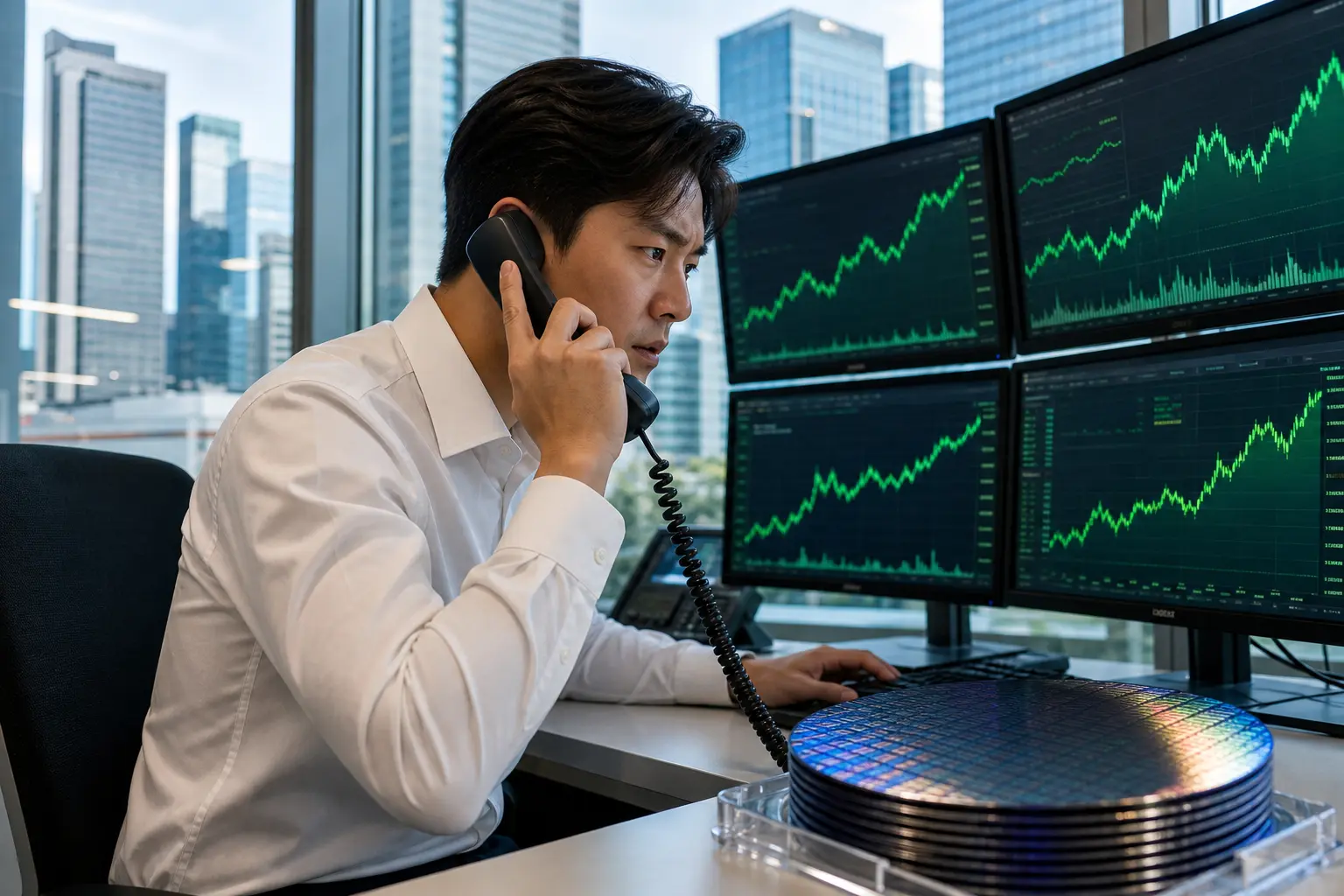
Microsoft Azure Numbers Flipped the Script
Thursday’s Wall Street surge was led by technology after Microsoft reported fiscal fourth-quarter results that beat expectations on cloud growth. Revenue reached $90.0 billion, up 18%. Operating income hit $40.6 billion, also up 18%. Net income rose 31% on a GAAP basis to $35.8 billion.
Azure and other cloud services revenue increased 43%, topping analyst estimates near 40%. Microsoft Cloud revenue climbed 27% to $59.3 billion. Commercial remaining performance obligation jumped 84% to $678 billion.
We are advancing the frontier on the cost-to-outcome curve, ensuring every customer can turn tokens into business results. This year, Azure revenue surpassed $100 billion for the first time.
Satya Nadella, Microsoft chairman and CEO, said the figures reflected customer confidence in the company’s AI platform. CFO Amy Hood highlighted the cloud strength that closed the fiscal year. The results eased fears that heavy AI capital spending was failing to generate returns. Microsoft shares rose more than 15% in the session that spilled into Asia.
That single data point reopened the bid for the memory suppliers that feed AI servers.
Record Earnings Both Chipmakers Posted This Week
Samsung and SK Hynix had already delivered strong second-quarter numbers. Investors initially sold the news, locking in profits after a massive AI-driven rally and questioning whether valuations matched future growth. Friday’s buyers treated the same numbers as confirmation.
| Company | Q2 Revenue | Q2 Operating Profit | Key Margin / Note |
|---|---|---|---|
| Samsung Electronics | KRW 171.5 trillion | operating profit of 89.5 trillion won | DS Division 89.2T; memory record |
| SK Hynix | 79.3 trillion won in quarterly revenue | KRW 60.5 trillion | 76% operating margin; net 93.9T |
Samsung’s Device Solutions division drove the bulk of profit. Memory posted another record on server demand and rising prices. The company said it expects the market to remain undersupplied in the second half despite some moderation in mobile and PC demand. It highlighted HBM4 sales, the industry’s first HBM4E samples, and long-term customer contracts. Samsung sees supply constraints tightening further into 2027 and potentially 2028 as AI token generation expands.
SK Hynix reported revenue up 257% year-on-year and operating profit up 557%. Cash and cash equivalents reached 88 trillion won. Net cash stood at 69.4 trillion. The firm has finalized long-term agreements with around 10 key customers and continues talks with others. HBM4 mass shipments began in the quarter. Management pointed to structural demand from agentic AI and expanding conventional memory needs alongside high-bandwidth products.
SK Hynix’s profit still missed the loftiest forecasts, partly on delayed advanced shipments, which had added to mid-week pressure.
China Competition Lit the Fuse for the Rout
The prior selloff was no ordinary correction. Concerns over rising competition from Chinese memory chipmakers, amplified by CXMT’s record Shanghai trading debut, collided with profit-taking after the AI rally and doubts about infrastructure returns.
On Tuesday the KOSPI closed down 10.84% at 6,023.66, its biggest one-day loss since early March. It triggered a circuit breaker for the eighth time in 2026. Samsung fell roughly 13%, SK Hynix nearly 15%. The two names account for a large share of the index, so their moves dominate the benchmark. A further drop Wednesday extended the damage; the three-session slide approached 17% and left the index below 5,600 at one point.
Analysts noted that CXMT’s listing forced portfolio rebalancing and raised oversupply risks for DRAM pricing. The earlier China-driven chip stock crash had already shown how quickly regional memory names can reprice when Chinese capacity enters the narrative. This week simply scaled that fear across an entire national market.
- CXMT IPO debut added weight to China competition narrative
- Profit-taking after multi-month AI-fueled gains in Samsung and SK Hynix
- Questions over AI capex returns ahead of big U.S. tech earnings
- High concentration: two chipmakers drive roughly 40-50% of KOSPI moves
- Leveraged funds forced to liquidate into the decline
Crowd observations on X captured the speed of the reverse: one tracked whale position in SK Hynix flipped from multi-million loss to more than $6 million unrealized profit on the Friday bounce alone. That leverage cut both ways.
Two Names Still Swing the Whole Index
Samsung and SK Hynix together form the structural core of the KOSPI. When they fall double digits the benchmark follows; when they rebound 20%+ the index can post historic single-day gains. The first half of 2026 had already shown the upside of that concentration. The index more than doubled at one stage and briefly crossed 9,000 in June on HBM optimism.
July’s reverse erased a large slice of those gains in days and put the month on track for one of the worst calendar performances on record. Circuit breakers fired repeatedly. The Friday recovery, while dramatic, still leaves the index well below its mid-year peaks. The same concentration that delivered the bounce keeps the market exposed to any fresh disappointment on HBM pricing, Chinese capacity, or U.S. tech capex guidance.
Long-Term Contracts Now Look More Durable
The second-order effect sits in the customer agreements and the shortage outlook. Both Korean makers stressed multi-year supply deals with major data-center operators. Samsung explicitly forecast a favorable supply-demand balance for memory through at least 2027 and pointed to growing long-term contracts. SK Hynix has roughly ten LTAs locked and is expanding discussions while ramping HBM4 and preparing further capacity at Yongin and other sites under capital discipline.
Microsoft’s Azure acceleration supplied the missing proof that the AI infrastructure spending is converting into revenue. That closed the loop for memory buyers. Demand from servers, HBM, and emerging agentic workloads continues to outrun supply additions. Prices for high-value DRAM and NAND rose sharply in the quarter. Cash generation at both firms is now enormous, giving them balance-sheet flexibility most rivals lack.
None of this erases Chinese progress. CXMT’s public market debut and capacity plans remain a medium-term pricing risk. Yet the immediate reaction treated the Korean makers’ technological edge in HBM, their existing customer lock-ins, and the still-tight supply picture as more decisive than the new competitor’s listing.
Friday’s session restored most of the week’s lost ground. The deeper shift is that multi-year memory tightness and the contracts supporting it have been stress-tested and, for now, reaffirmed.
Frequently Asked Questions
What exact second-quarter figures did Samsung Electronics report?
Samsung posted consolidated revenue of KRW 171.5 trillion and operating profit of KRW 89.5 trillion, both all-time quarterly highs. The Device Solutions division alone contributed KRW 127.5 trillion in revenue and KRW 89.2 trillion in operating profit, driven almost entirely by the memory business.
How profitable was SK Hynix in the April-June quarter?
SK Hynix recorded revenue of 79.3187 trillion won, operating profit of 60.5426 trillion won for a 76% operating margin, and net profit of 93.9226 trillion won. First-half revenue crossed 100 trillion won for the first time in company history.
What Azure growth rate did Microsoft deliver that sparked the rebound?
Azure and other cloud services revenue grew 43% year-over-year in Microsoft’s fiscal fourth quarter, beating consensus estimates near 40%. Full Microsoft Cloud revenue rose 27% to $59.3 billion and remaining performance obligation reached $678 billion.
How much of the KOSPI do Samsung and SK Hynix represent?
The two chipmakers together account for a dominant share of the index, commonly cited in the 40-50% range of market capitalization and an even larger portion of daily moves. Their double-digit swings routinely dictate whether the benchmark hits circuit-breaker levels.
How long does Samsung expect memory supply constraints to last?
Samsung stated that supply constraints are expected to continue and to tighten further in 2027, with the possibility of extending into 2028 as AI-related demand, including token generation, expands faster than capacity additions.
Disclaimer: This article is for informational purposes only and does not constitute investment advice. Markets are volatile; past performance is not indicative of future results.
 GTA Online Summer Heist Event Doubles Classic Finales Cash
  Samsung Galaxy F70 Pro Tease Locks Flipkart While M47 Holds Amazon
  Meta AI Glasses Turn Delhi Protests Into Walking Cameras
  India’s Net Neutrality Review Follows Airtel Slicing Gap
  Galaxy Z Fold 8 Preorders Race Past S26 Benchmarks
  Maruti Hansalpur Plant D Lifts Capacity Toward Four Million