
 Ishan Crawford
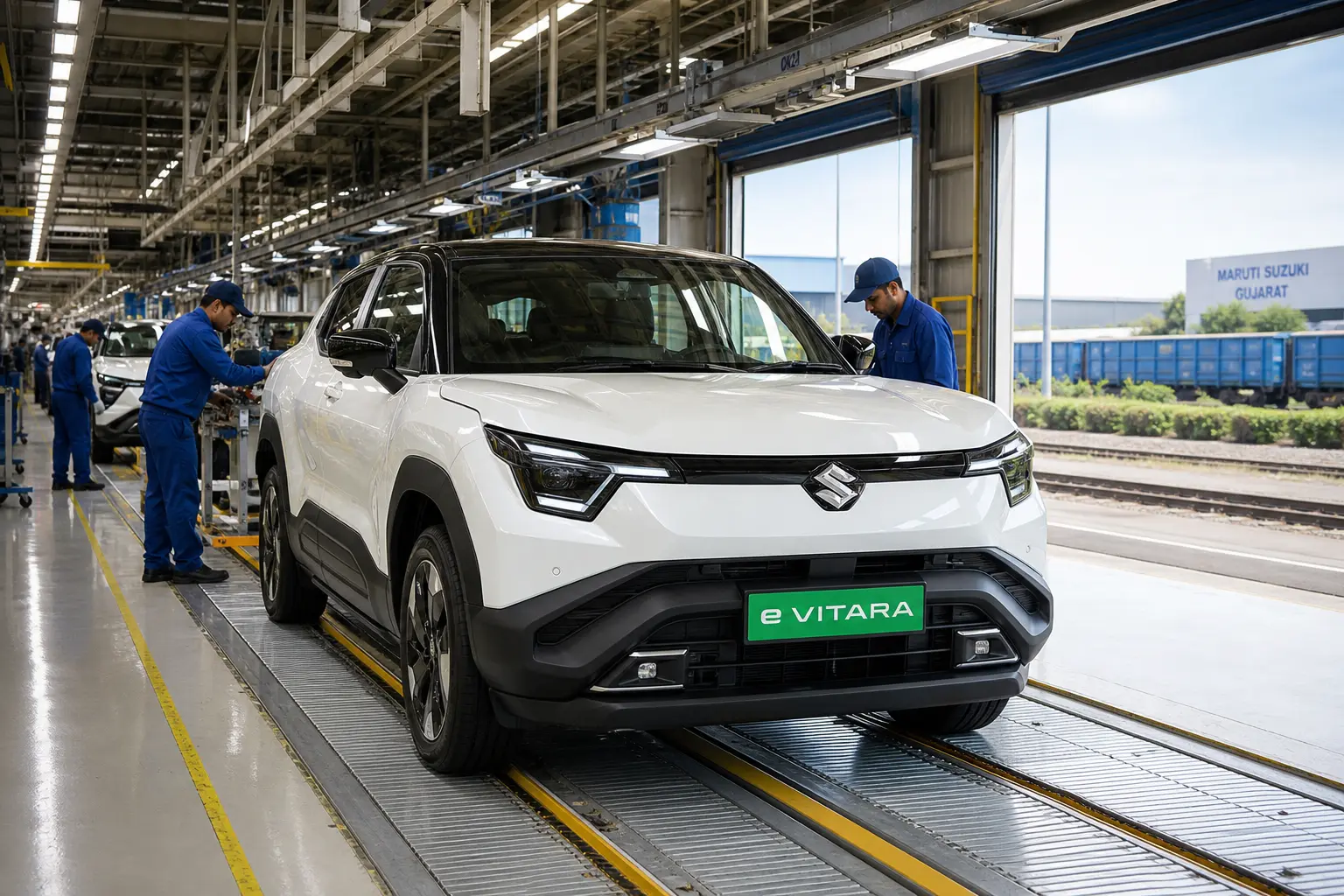
 Maruti Suzuki India began commercial production on 30 July 2026 at Plant D, the fourth line at its Hansalpur complex in Gujarat. The move lifts the company’s total annual capacity in India to 2.9 million units and makes Hansalpur Suzuki’s first site anywhere to reach one million vehicles a year.
The new line is dedicated first to the e VITARA battery-electric SUV. It arrives as Maruti already leads passenger-vehicle sales by a wide margin and is racing to convert that lead into EV volume and global exports.
What Plant D Adds
Plant D carries an annual capacity of 250,000 units. That single addition takes the Hansalpur facility from 750,000 to 1 million vehicles a year and turns the 640-acre site into India’s largest passenger-vehicle complex at one location.
Cumulative investment at Hansalpur now stands at ₹25,288.7 crore. The fourth plant alone accounts for an estimated ₹3,900 crore. Managing Director and CEO Hisashi Takeuchi said the line will strengthen supply for both Indian customers and overseas markets under the “Make in India, Make for the World” banner.
Current models at the complex include:
- Baleno
- Fronx
- Swift
- e VITARA
Hansalpur already handled nearly 47 percent of Maruti’s overseas shipments in FY26. The new line gives the company more room to grow that share without starving domestic demand.
Gujarat’s Role Keeps Growing
Hansalpur opened with Plant A in February 2017. Plant B followed in January 2019 and Plant C in April 2021. Each added 250,000 units. The pattern has been steady, deliberate expansion rather than sudden leaps.
Suzuki now runs four Indian manufacturing hubs: Gurugram, Manesar, Hansalpur and Kharkhoda. With Plant D live, the split sits at 10 lakh units at Hansalpur, 9 lakh at Manesar, and 5 lakh each at Gurugram and Kharkhoda.
A second Gujarat greenfield site at Sanand is already under basic agreement with the state government. It is scheduled to start with 250,000 units by 2029 and is expected to grow further. Takeuchi has repeatedly linked Hansalpur and Sanand as the twin engines for the company’s longer-term 4-million-unit India target.
The state has become Maruti’s preferred expansion ground because of infrastructure, logistics and policy support. That concentration also deepens the company’s exposure to one region’s labour and power dynamics, a trade-off the firm appears willing to accept.
The e VITARA Gets Its Own Line
Plant D’s first job is the e VITARA, Maruti’s flagship BEV and Suzuki’s global strategic electric model. Earlier production constraints limited domestic allocation; the dedicated capacity removes that bottleneck.
Industry trackers showed the e VITARA climbing the EV sales charts within months of deliveries starting, briefly pushing Maruti into the top four electric passenger-vehicle makers even with a single model. Global production for more than 100 markets is centred on the Indian plant, so every extra unit at Hansalpur supports both home sales and exports.
- 250,000 units annual capacity on Plant D
- 1 million total Hansalpur capacity, first for any Suzuki site
- 2.9 million company-wide India capacity after the start
- ₹3,900 crore estimated spend on the fourth plant
Pricing for the e VITARA uses a battery-as-a-service option that starts around ₹10.99 lakh plus per-km EMI in introductory form. The new line should improve availability of both the entry and higher-range battery packs once ramp-up stabilises.
Rail Tracks Turn Logistics into an Advantage
Capacity alone does not move cars. Hansalpur hosts India’s first in-plant automobile railway siding under the PM GatiShakti programme. Since March 2023 the company has dispatched more than 7.5 lakh vehicles by rail from the site.
In February 2026 the project was registered as the world’s first modal shift transportation project under Verra’s Verified Carbon Standard. Independent calculations point to roughly 1.7 lakh tonnes of CO2e emissions cut over a ten-year period, generating an equivalent volume of carbon credits.
By transitioning vehicle movement from road to rail, the project demonstrates how scale, operational efficiency and environmental responsibility can go hand in hand.
Hisashi Takeuchi made that point when the Verra registration was announced. The same approach has been extended to Manesar, which now holds India’s largest in-plant automobile rail siding. In calendar 2025 Maruti moved a record more than 580,000 vehicles by rail across its network.
Crowd reaction on X treated the combination of million-unit capacity and carbon-credit rail as proof that Indian plants can serve as clean global export bases, not merely low-cost sheds. That perception matters when European and other buyers weigh supply-chain emissions.
How the Four Plants Line Up
Official figures from Suzuki lay out the Hansalpur progression clearly.
| Plant | Start of Production | Annual Capacity | Initial / Current Focus |
|---|---|---|---|
| Plant A | February 2017 | 250,000 | Baleno |
| Plant B | January 2019 | 250,000 | Swift / Fronx |
| Plant C | April 2021 | 250,000 | Fronx / e VITARA |
| Plant D | July 2026 | 250,000 | e VITARA |
The table shows a consistent 250,000-unit module repeated four times. That modular approach let Suzuki hit the one-million mark at a single site faster than any other facility in its global network. Cumulative production milestones at Hansalpur (1 million, 2 million, 3 million, 4 million vehicles) were each reached in record time for the company.
FY26 manufacturing totalled about 2.31 million vehicles across all sites, with domestic sales near 1.82 million and exports around 444,000. Capacity utilisation therefore still leaves headroom even after the latest addition.
The Runway to Four Million Units
Suzuki’s mid-term plan and repeated statements from Takeuchi set a clear destination: 4 million units of annual capacity in India during the 2030s. The company also wants to hold roughly 50 percent passenger-vehicle market share and lead in BEV production, exports and sales.
Plant D is one concrete step. Kharkhoda is still expanding in phases. Sanand is the next major greenfield. Together they close the gap between today’s 2.9 million and the longer target without requiring a sudden multi-million leap at one location.
- 2017-2021, Three successive 250,000-unit plants open at Hansalpur.
- March 2023, In-plant rail siding begins operations.
- 2025, Kharkhoda starts; early e VITARA production and exports begin.
- July 2026, Plant D commercial production; total capacity 2.9 million.
- By 2029, Sanand targeted to start at 250,000 units.
- 2030s, Company aims for 4 million units India-wide capacity.
Rivals are not standing still. Tata Motors and Mahindra have posted strong growth rates and are expanding their own EV and SUV capacity. Hyundai and Toyota continue to add products. Yet none currently matches Maruti’s absolute volume base or its single-site scale at Hansalpur. The new line therefore widens the absolute gap even if relative market-share pressure remains.
Partnership dynamics also matter. Toyota and Suzuki’s shared India SUV plans mean some future models may draw on the same manufacturing ecosystem. That collaboration can stretch capacity further while spreading development cost.
Pricing and tax changes continue to shape demand. Recent Maruti pricing moves on the Brezza show how the company uses product and tax adjustments to defend volume in the core ICE segments while the EV lines ramp. The two strategies run in parallel rather than in sequence.
Plant D’s Plant D annual capacity of 250,000 units is therefore more than an incremental shed. It is the first dedicated high-volume EV line inside a million-unit complex that already exports nearly half its output and moves most of those cars by rail with certified carbon savings. The arithmetic points to Maruti converting its traditional volume advantage into the capacity and logistics base needed for the next decade’s EV and export fight.
Whether the 4-million target arrives on the early or late side of the 2030s will depend on demand, battery supply and execution at Sanand. The physical runway, however, is now visibly longer than it was a week ago.
 ONGC licence frees Venezuela cash and operatorship talks
  Anthropic Hits $65 Billion Run Rate and Flips the AI Cash Test
  Supreme Court grounds the fare free-for-all with three-week clock
  Gold Nears $4400 as Soft Data Meets Oil Inflation Risk
  Nifty Slips as Zaggle Circuits and Dhoot Debuts Big
  Diesel Crack Tops $100 as Iran Rhetoric Lifts Crude