
 Ishan Crawford
 South Korea’s KOSPI plunged as much as 10% on Tuesday, tripping a sidecar and a circuit breaker before lunch, as fresh alarm over artificial intelligence financing and Chinese chip competition slammed Samsung Electronics and SK Hynix. Japan’s Nikkei 225 fell as much as 4.4% to its lowest close since May 22. One trading day earlier, the same forces had powered the best single session in Chinese chipmaking history.
NVIDIA’s more than $750 billion in AI financing commitments and a Chinese breakthrough in chipmaking machinery are pulling the same trade in opposite directions. One side is crushing the Korean and Japanese companies that built the last decade of chip dominance. The other is lifting the Chinese rivals that dominance was meant to hold back.
A Sidecar and a Circuit Breaker Before Lunch
Wall Street had already set a nervous tone. Tech-heavy Nasdaq 100 futures fell 1% and S&P 500 futures slipped 0.3%, after the overnight cash session closed mixed and erased most of its earlier gains.
Seoul’s exchange pulled two separate brakes before midday. The Korea Exchange activated a sell-side sidecar at 10:23 a.m. local time, suspending program sell orders for five minutes to slow the automated selling. It wasn’t enough. Once the index cracked its 8% intraday trigger, a circuit breaker froze all trading for 20 minutes.
By the time the session found its footing, the KOSPI had fallen as much as 10%, its lowest level since mid-April. It was the eighth circuit-breaker halt on the Korean exchange this year. Local market data show close to 30 sidecar activations and five circuit-breaker halts by late June alone, a pace already ahead of the 26 sidecars recorded in all of 2008, the last time Korean markets saw comparable stress.
Japan fared only slightly better. The Nikkei 225 fell as much as 4.4% to its weakest close since May 22, and the broader TOPIX slipped 2.7%. Samsung, which spent the summer racing to keep a 25% US tariff off its shipbuilding and chip exports, watched roughly 12% of its market value disappear in a single session.
The Stocks Absorbing the Selloff
The declines split along one clear line. Whoever builds the tools or supplies the memory behind NVIDIA’s AI boom took the worst of it.
| Company | Market | Approximate Move | What It Makes |
|---|---|---|---|
| SK Hynix | Seoul | Down as much as 13% | AI memory chips, NVIDIA’s key HBM supplier |
| Samsung Electronics | Seoul | Down as much as 12% | Memory chips and contract chip manufacturing |
| Kioxia Holdings | Tokyo | Down as much as 18% | NAND flash memory |
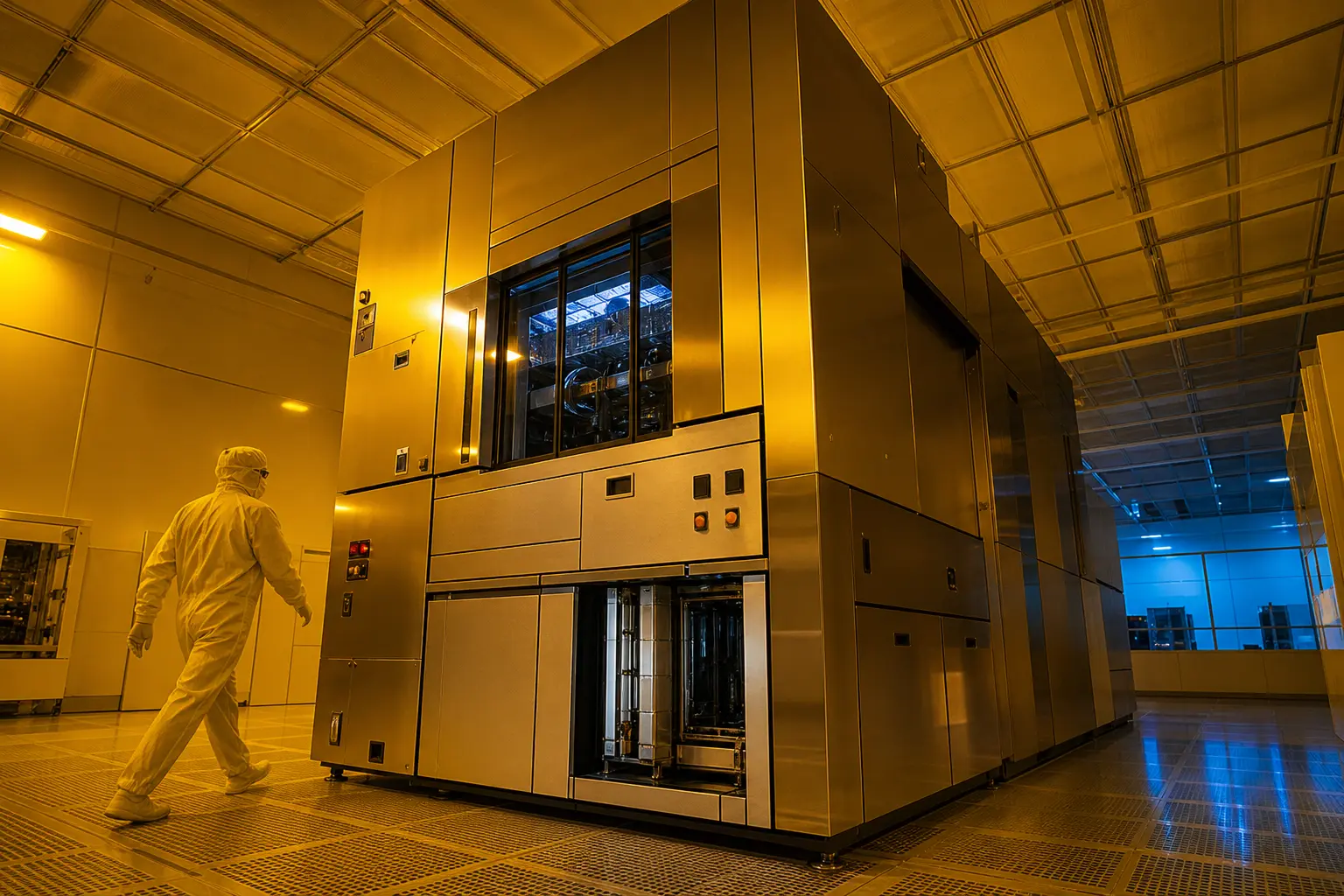
| Tokyo Electron | Tokyo | Down more than 9% | Chipmaking equipment |
| Disco Corp | Tokyo | Down more than 9% | Wafer dicing and grinding tools |
| Nikon | Tokyo | Down more than 9% | Lithography equipment |
| Murata Manufacturing | Tokyo | Down more than 9% | Electronic components |
| ASML Holding | Amsterdam | Down more than 8% (Monday) | Lithography machines, EUV monopoly holder |
Every name on that list depends on one assumption: that global demand for chipmaking equipment keeps climbing without a hiccup. Tuesday’s session tested that assumption from two directions inside the same 24 hours.
NVIDIA’s $750 Billion Circular Question
Behind the selloff sits a number that has been building for months. NVIDIA is now pursuing more than $750 billion in new and potential AI agreements, according to Bloomberg’s reporting this week.
The SK Group Bet
The largest single piece is a partnership with South Korea’s SK Group, expected to generate more than $500 billion of business between the two companies across AI data centers and next-generation memory. NVIDIA and SK hynix said they will codevelop next-generation high-bandwidth memory for AI factories, while SK Telecom is building a 2-gigawatt AI factory on NVIDIA’s Vera Rubin platform, with the first facility due online in 2027.
The OpenAI Exposure
Layer in NVIDIA’s exposure to OpenAI, reported at a $250 billion guarantee for data-center lease payments plus another $350 billion in financing for GPU purchases, and the total explains why analysts keep reaching for the word circular. OpenAI and other NVIDIA-backed customers use that financing to buy NVIDIA’s own chips, which critics say inflates demand and concentrates debt and bridge loans across NVIDIA, SoftBank Group and SK Group at once. NVIDIA chief executive Jensen Huang has pushed back on the circular label, arguing the company’s own investments cover only a small slice of what its customers ultimately need to raise.
Is a Chinese Machine Cracking ASML’s Chip Moat?
Not entirely, and not yet. A state-backed Shanghai manufacturer has begun mass-producing China’s first homegrown immersion deep ultraviolet (DUV) lithography machines, The Information reported, with roughly five units due this year for SMIC, Hua Hong and CXMT. The tools trail ASML’s newest systems by a generation. They are still real, still shipping, and they rattled ASML’s stock the same week.
The manufacturer drew its engineering teams from several domestic firms, including the state-backed startup Shanghai Yuliangsheng Technology. SMIC, China’s largest contract chipmaker, has been testing one of Yuliangsheng’s immersion tools since September 2025, and roughly 20 more units are planned for 2027. ASML still holds a near-total monopoly on the extreme ultraviolet (EUV) machines that print the most advanced chips. Tuesday’s threat sits one rung down, in the deep ultraviolet tools that print the mature-node memory and logic chips SMIC and CXMT actually sell today. ASML shares had already slid more than 8% in Monday trading, their lowest close since early June.
- What we know: a Shanghai state-backed manufacturer is shipping immersion DUV tools this year, SMIC has tested one since September 2025, and ASML shares fell more than 8% on the report.
- What we know: roughly five machines are due in 2026, with about 20 more planned for 2027.
- What’s unconfirmed: whether the tools can match ASML’s throughput, overlay precision and reliability at real production volumes.
- What’s unconfirmed: how much of the hardware is genuinely domestic, since some critical components still arrive from Japanese suppliers, and whether the delays that slowed 2026 output carry into next year’s ramp.
CXMT’s Shanghai Debut Rewrites China’s Chip Rankings
One day before that report, ChangXin Memory Technologies delivered the number that gave Beijing’s self-sufficiency push its loudest exclamation point yet. CXMT shares surged 466% on their trading debut on Shanghai’s STAR Market Monday, the largest initial public offering in mainland Chinese semiconductor history.
The Hefei-based DRAM maker raised 57.92 billion yuan, or roughly $8.6 billion, pricing shares at 8.66 yuan before they closed at 49 yuan. That left CXMT worth about 3.3 trillion yuan, or roughly $488 billion, more than the Industrial and Commercial Bank of China and enough to make it the single most valuable company listed on the mainland.
CXMT still trails the field by a wide margin. It held just 7.67% of the global DRAM market in the fourth quarter of last year, ranking fourth behind Samsung, SK Hynix and Micron Technology.
The global DRAM market has long been dominated by Samsung, SK Hynix and Micron, with CXMT accounting for only about 10% of capacity. But fresh capital from its listing could allow it to capture a larger share of the market.
Charlie Pullan, a global markets analyst at the financial insights platform Finimize, said Tuesday.
Hong Kong and mainland shares told a similar story outside the chip sector itself. Hong Kong’s Hang Seng traded flat, the Shanghai Composite fell 1.2%, and the CSI 300, which tracks large caps across Shanghai and Shenzhen, dropped 2.6% on broader market weakness. Individual technology names moved the other way.
- NetEase gained more than 3%
- JD.com rose nearly 3%
- Xiaomi, Alibaba, Meituan and Tencent each advanced between 0.5% and 1.2%
- SMIC fell about 3% anyway, even as an early customer for the new lithography tools
Elsewhere in the region, Australia’s S&P/ASX 200 reversed early losses to close up 0.5%. Singapore’s Straits Times Index slipped 0.3%. India’s Nifty 50 barely moved. The selling stayed concentrated in the two markets most exposed to memory chips and chipmaking equipment.
Oil Retreats Just as the Fed, BOJ and Earnings Land
Crude oil offered the one piece of relief for inflation watchers. Prices extended Monday’s sharp decline after President Donald Trump said there was a “good chance” of reaching a deal with Iran, with Washington pausing its daily strikes while diplomatic talks continue. It’s a similar pattern to an earlier US-Iran framework deal that briefly sent oil down 2.3% and lifted Asian stocks to records.
Cheaper crude eases one input into this week’s Federal Reserve meeting, even if it does nothing to offset a technology-led selloff that has nothing to do with energy prices. The Fed’s decision lands alongside policy meetings at the Bank of Japan and the Bank of England. Microsoft, Meta Platforms, Apple and Amazon all report quarterly earnings the same week, and each of the four ranks among NVIDIA’s largest AI infrastructure customers.
 ONGC licence frees Venezuela cash and operatorship talks
  Anthropic Hits $65 Billion Run Rate and Flips the AI Cash Test
  Supreme Court grounds the fare free-for-all with three-week clock
  Gold Nears $4400 as Soft Data Meets Oil Inflation Risk
  Nifty Slips as Zaggle Circuits and Dhoot Debuts Big
  Diesel Crack Tops $100 as Iran Rhetoric Lifts Crude