
 Ishan Crawford
 Videos from the Cockroach Janta Party protests at Delhi’s Jantar Mantar in mid-July showed a police officer wearing Meta Ray-Ban AI smart glasses while monitoring student demonstrators. The discreet frames can photograph and record on voice command, turning an ordinary pair of sunglasses into a point-of-view camera that few notice until it is too late.
That single sighting, confirmed across multiple outlets and social clips, plugs consumer hardware into one of India’s densest AI surveillance grids and raises a sharper problem than simple secret filming: real-time identification that can follow protesters home.
What the Cameras Caught at Jantar Mantar
The Cockroach Janta Party, or CJP, began as a satirical Gen Z response to a judicial remark comparing unemployed youth to cockroaches. By July it had drawn thousands of mostly student protesters to the historic observatory site over NEET paper-leak grievances. Education Minister Dharmendra Pradhan later resigned.
Protesters and rights groups alleged continuous filming from a permanent observation tower, phones, camcorders and body-worn cameras. Visuals also captured officers in Meta smart glasses. A Public Interest Litigation filed by former JNUSU president Aishe Ghosh claimed the recording covered eating, resting and medical care, and that officers threatened to send images to parents and colleges. Women caught in rain were still filmed, the plea said.
- Continuous photography and videography alleged since 20 June
- Threats to share footage with families and institutions
- Meta glasses spotted alongside fixed and mobile AI systems
- Ten FIRs registered after clashes, with AI footage used for identification
Solicitor General Tushar Mehta told the Delhi High Court the recording was routine law-and-order work, not surveillance, and called the petition “luxury litigation.” The court asked whether any standard operating procedure governs protest-site policing and listed the matter for further hearing. Delhi Police has not publicly detailed how the glasses were used.
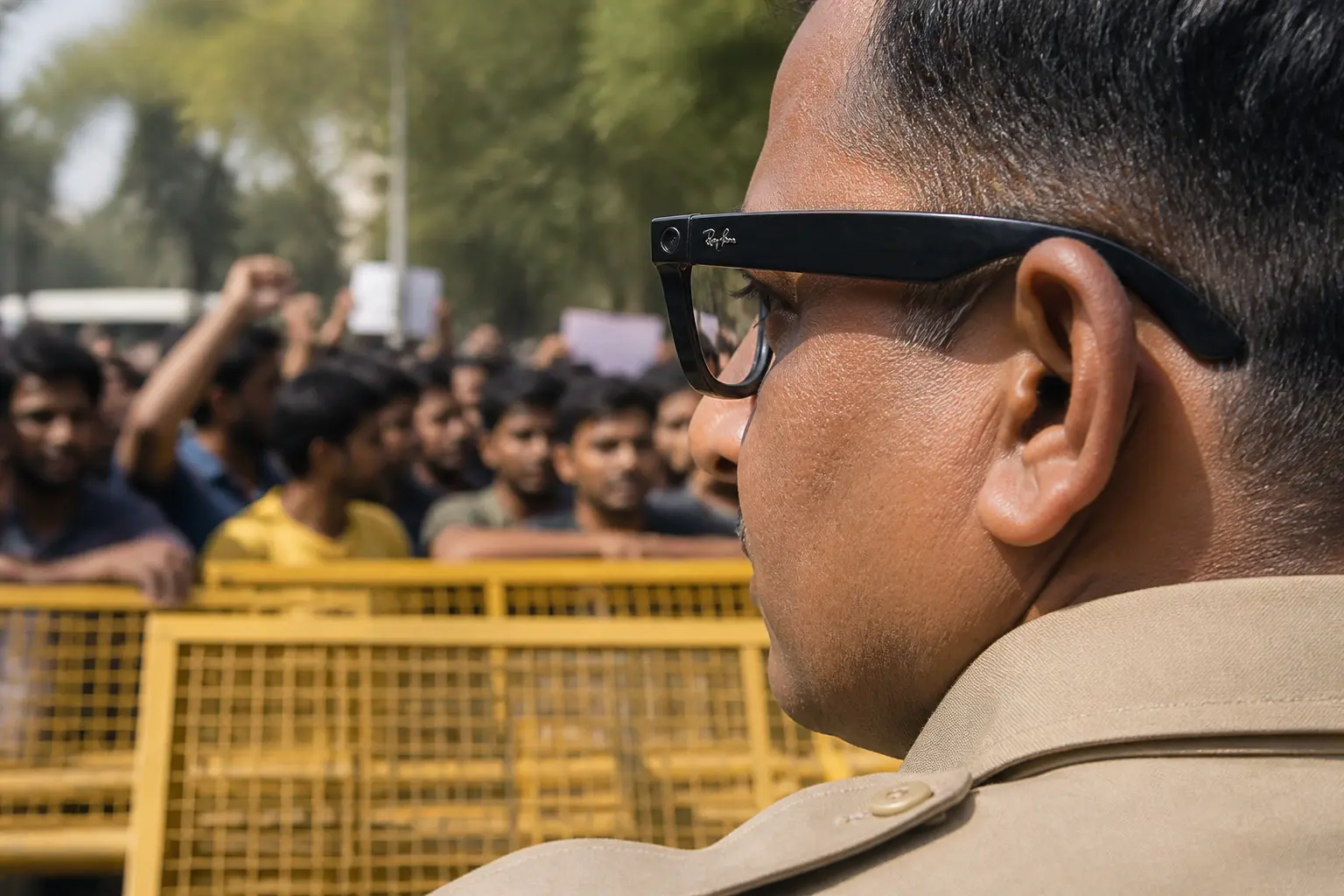
How Meta’s Glasses Capture and Signal
Ray-Ban Meta AI glasses, the second-generation collaboration between Meta and EssilorLuxottica, pack a camera, microphones, speakers and an on-device AI assistant into ordinary-looking frames. The wearer can say “Hey Meta, take a photo” or “record a video” and the device complies. Live streaming is also supported on some models.
Meta’s own privacy page stresses a white capture LED that blinks during recording. Covering or disabling that light automatically turns the camera off. A July 2026 software update goes further: if the device detects the LED has been physically tampered with or destroyed, the camera shuts down. The company says the light has no off switch and is one of several built-in safeguards.
| Feature | Meta Ray-Ban AI Glasses | Typical Fixed CCTV |
|---|---|---|
| Form factor | Wearable eyewear, eye-level POV | Pole or building mount |
| Recording cue | Blinking white LED (cover disables cam) | Usually none or distant IR |
| Activation | Voice command or touch | Always-on or motion |
| Mobility | Moves with wearer through crowd | Fixed field of view |
| AI integration | On-device assistant, gallery sync, optional live | Central analytics (FRT, ANPR) |
Critics note the LED can be hard to spot in bright daylight and that modders have offered paid “stealth” services to remove it. Meta counters that Meta built privacy into AI glasses from the ground up and urges wearers to respect preferences, power off in private spaces and obey the law. Photos and videos stay private unless the user imports or shares them. For AI features the company says it removes key identifiable information.
The Citywide Net These Glasses Plug Into
Delhi Police already runs one of India’s largest AI public-surveillance systems. The Internet Freedom Foundation puts the integrated camera count near 25,000, drawing from the Safe City Project, Delhi Metro, Railways and police feeds. An Integrated Command, Control, Communication and Computer Centre (C4I) at headquarters links district and station command posts.
The latest phase, inaugurated by Home Minister Amit Shah in February 2026, added 2,100 AI-enabled cameras with plans for thousands more. Analytics cover facial detection and recognition, automatic number-plate recognition, hand-gesture recognition and crowd-density monitoring. One mobile unit deployed at protests is the Ikshana van, equipped with eight cameras for 360-degree coverage and live facial-recognition matching.
Stats snapshot of the network:
- ~25,000 cameras already integrated
- 2,100 new AI cameras in the latest phase
- 80% similarity score treated as a positive facial match (per 2022 RTI)
- Database size estimates ranging from 20,000 known criminals to roughly 350,000 records
After CJP clashes, police said AI footage would be cross-checked against criminal databases before arrests. Earlier reporting has described multiple datasets, including one built from protest images of “rabble-rousers.” No fixed data-retention rules have been publicly confirmed; officers have said footage may be kept if needed for investigations.
Legal Vacuum Meets a Constitutional Test
India has no dedicated statute regulating facial recognition or wearable cameras in public spaces. The Digital Personal Data Protection Act, 2023 supplies a general framework but contains broad exemptions for government processing in the interests of sovereignty, integrity or security. The Ministry of Home Affairs has told Parliament that Delhi Police’s FRT programme rests on a June 2022 internal order authorising use against “suspected individuals or known criminals.”
The principal check remains the Supreme Court’s 2017 ruling that recognised Puttaswamy privacy as fundamental right under Article 21. Any restriction must rest on law, pursue a legitimate aim and meet proportionality, using the least restrictive means. An earlier ruling in Malak Singh barred arbitrary police surveillance that targets people outside recognised categories or suppresses fundamental freedoms.
Digital rights groups, including the Internet Freedom Foundation, say Delhi Police introduced FRT without a Privacy Impact Assessment and that none has been done for the Safe City Project. Responses to RTI requests back that claim. By contrast the EU AI Act live facial recognition ban generally prohibits real-time biometric identification by law enforcement in public places, with narrow exceptions for missing persons or imminent terrorist threats.
Students Feel the Deterrence First
The second-order effect appears in how young protesters behave. Students told reporters they covered their faces and worried about future competitive exams or government jobs. Some feared footage would reach families or colleges. Continuous eye-level recording from a moving officer removes the last pockets of informal space that fixed towers leave open.
A separate incident earlier in the protest cycle involved a content creator using Meta glasses to film a transgender protester; the clip went viral, spawned memes and harassment, and later prompted the person to speak of wanting to sue Meta. That civilian misuse previewed the same hardware now seen on police.
On X, reactions split sharply. One widely shared post asked why Parliament summoned Meta over a PM video takedown while remaining silent on “pervert glasses” used to “scan, identify and hunt student protesters.” Another celebrated the glasses as walking, streaming CCTV that left “zero blind spots,” warning that “the cockroaches do not know what’s coming.” The cultural shorthand “pervert glasses” itself spread as a meme of distrust.
- 20 June 2026 onward, continuous surveillance alleged at Jantar Mantar
- Mid-July, Meta glasses and AI vans filmed at site; clashes and 10 FIRs
- 23 July, News Minute and others detail PIL and network scale
- Late July, High Court hears arguments; education minister resigns; protests wind down
- 31 July, The Hindu explainer brings the glasses privacy question to wider readers
Apar Gupta of the Internet Freedom Foundation described CJP itself as a “content-first movement” built by influencers rather than traditional committees. That same digital fluency now collides with hardware that can harvest faces at walking pace.
Meta’s Stance and the Broader Wearable Race
Meta maintains the glasses empower users, including people with disabilities, and that privacy controls sit with the wearer. The company has not commented specifically on police deployments in Delhi. Its guidance simply tells civilians to stop if someone objects and to power off in sensitive places.
The same consumer devices sit inside a larger AI hardware push. While Apple leaning on Google AI races for on-device intelligence in phones, Meta is betting that always-available eyewear will normalise continuous capture. Browser makers, meanwhile, keep adding tools such as native containers for browser privacy that try to limit tracking on the open web. Wearable cameras reverse the power dynamic: the tracker is now mobile and human-scale.
No evidence yet shows the Delhi glasses ran live facial recognition themselves. The chilling power lies in the combination: an unnoticed POV feed that can be fed into the existing 80-percent-match pipeline whenever an officer chooses. Fixed cameras already map the streets. Glasses map the faces that look back at the police.
Until courts force a clear SOP, a Privacy Impact Assessment or statutory limits, every student who turns up at Jantar Mantar or the next flashpoint will know the officer’s eyes may be recording, matching and storing. That knowledge alone changes who shows up and how loudly they speak.
 ONGC licence frees Venezuela cash and operatorship talks
  Anthropic Hits $65 Billion Run Rate and Flips the AI Cash Test
  Supreme Court grounds the fare free-for-all with three-week clock
  Gold Nears $4400 as Soft Data Meets Oil Inflation Risk
  Nifty Slips as Zaggle Circuits and Dhoot Debuts Big
  Diesel Crack Tops $100 as Iran Rhetoric Lifts Crude