
 Ishan Crawford
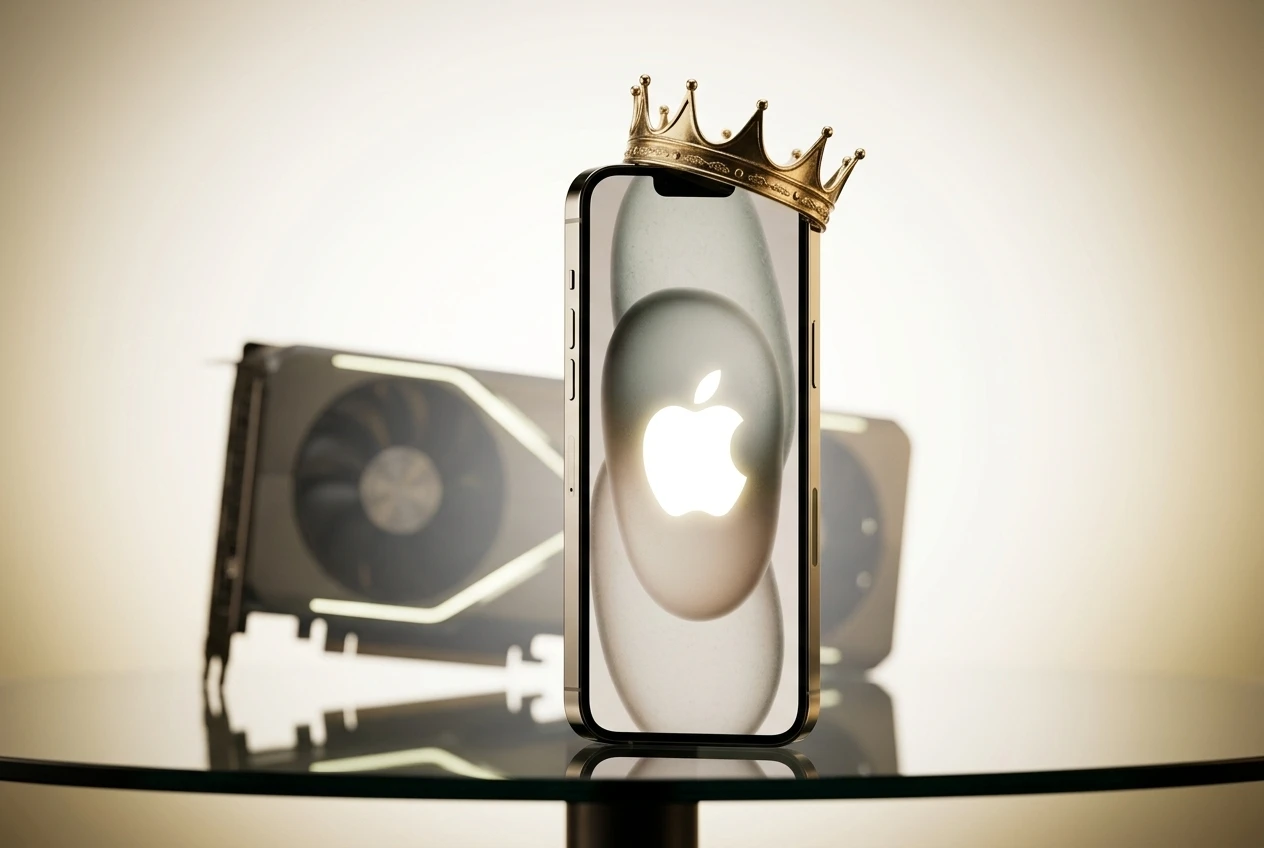
 Apple closed trading on Friday, July 17, worth $4.88 trillion, edging past Nvidia’s $4.86 trillion after a 3.5% drop in the chipmaker’s shares, Al Jazeera first reported. It is Apple’s first day back atop the world’s most valuable company rankings in more than a year.
Apple got there without building a foundation AI model of its own. Its rebuilt Siri leans on Google’s Gemini everywhere outside China, and on Baidu’s and Alibaba’s models inside it. Investors are rewarding that choice six weeks before a hardware engineer takes over as chief executive.
Apple Closes the Gap Nvidia Opened in October
Nvidia became the first company in history to reach a $5 trillion valuation in October 2025, riding demand for the chips that train and run AI models. The gap that opened between the two companies has closed, and reversed, inside nine months.
Apple heads into the moment on the back of its best March quarter on record, revenue of $111.2 billion, up 17% from a year earlier, with Services revenue reaching an all time high of $30.98 billion. Apple’s own executives told investors in that same report to expect 14% to 17% sales growth this quarter.
| Metric | Apple | Nvidia |
|---|---|---|
| Market value (July 17) | $4.88 trillion | $4.86 trillion |
| 2026 stock move | Up roughly 20% | Up about 13%, down 16% from its May 14 high |
| AI approach | Licenses Google’s Gemini; Baidu and Alibaba in China | Builds and sells the GPUs powering rival AI systems |
| Next scheduled catalyst | Fiscal Q3 earnings, July 30 | Vera Rubin platform rollout; Japan AI push |
Both stocks were worth roughly the same amount six weeks ago. The distance between them has been closing since Apple’s shares bottomed out in late June.
The AI Apple Didn’t Have to Build
Apple’s rally did not start with a chip order or a data center groundbreaking. It started with a public beta.
Apple opened access to a beta version of the new Siri AI in July, alongside iOS 27, macOS 27 and updates across its other platforms. The assistant now understands the personal context behind a user’s question, pulls real time information from the web, and handles more complex tasks without hand holding, changes the company detailed when it introduced the software last month.
The new Siri does not run on an Apple built foundation model at all. Apple skipped the data center buildout that has consumed hundreds of billions of dollars industry wide, and instead pays Google for access to its Gemini models to power the assistant and the broader Apple Intelligence suite. In China, that job goes to models from Baidu and Alibaba.
- Google’s Gemini powers the rebuilt Siri and Apple Intelligence features across iOS, macOS, iPadOS and Apple’s other platforms everywhere outside mainland China.
- Baidu’s models take that role for iPhone owners inside China, cleared by the country’s Cyberspace Administration this month.
- Alibaba’s models sit alongside Baidu’s in the Chinese rollout, together standing in for the foundation model Apple chose not to build.
Michael Monaghan, founder of the investment firm Founder ETFs, said the market has moved through distinct phases in how it prices the AI trade.
Market sentiment has shifted from rewarding model makers, then to semis, and now on to those companies that can turn compute into experiences and outcomes the customer will pay for, thus driving corporate earnings.
Monaghan offered that read in comments to Al Jazeera. Apple investors, he added, first questioned the company’s lower AI spending and now treat it as an edge, since Apple can chase consumer AI without paying for cloud infrastructure at scale. He linked the approach to Apple co-founder Steve Jobs’ old habit of starting with the customer experience and working backward toward the technology needed to deliver it.
Why Is Nvidia’s Slide Bigger Than One Bad Friday?
Nvidia’s Friday drop was not an isolated event. The company has shed close to $1 trillion in market value since mid May as investors rotate out of GPU heavy bets and into memory chip suppliers, a shift that has pushed Nvidia further from its own sector than at any point in over a decade.
Nvidia shares are up about 13% for 2026 but have shed nearly $1 trillion in value since touching an all time high on May 14, even as the broader semiconductor index has climbed 74% this year, its best run since 2003.
Micron, a maker of memory chips used to train and run AI systems, is up 229% in 2026 and now leads that index. Nvidia, once its biggest driver, ranks third from the bottom among its 30 members, and its own correlation to the chip index it used to lead has fallen to its lowest level since 2014.
Friday’s session fit the pattern. Nvidia fell alongside Western Digital, Applied Materials, Marvell, Micron and AMD after Samsung’s preliminary results came in weaker than hoped, a reminder that one disappointing memory supplier can now drag down the whole group Nvidia used to lead alone.
South Korea’s SK Hynix priced a $28 billion US listing this month that was oversubscribed several times over. Micron crossed a $1 trillion valuation of its own in May, Al Jazeera reported, deepening the list of chipmakers pulling investor attention away from Nvidia specifically. Benjamin Hall, vice president of alpha research at Segal Marco Advisors, told Reuters that “the new entrants to the market could spread out the focus away from the pure Magnificent Seven names into a wider number of names.”
A Hardware Chief Inherits an Unfinished AI Bet
Cook keeps a foothold at the company. Apple announced in April that Cook will become executive chairman of its board on September 1, 2026, while John Ternus, senior vice president of hardware engineering, becomes chief executive the same day. The board approved the move unanimously after what Apple called a long term succession process.
Ternus joined Apple in 2001 and has run hardware engineering since 2021, overseeing product development across the iPad, iPhone and the Mac’s shift to Apple’s own chips. Speculation about him as heir apparent grew after Apple’s chief operating officer, Jeff Williams, stepped back from operational duties in July 2025, according to reporting on the succession race that cited Bloomberg’s Mark Gurman.
Apple also elevated Johny Srouji, the executive who has led its chip design work, to chief hardware officer, absorbing the hardware engineering group Ternus is leaving behind. The reshuffle touches three senior roles at once, not just the top job.
Analysts have started folding the transition into their bull case for the stock, framing Cook’s move to chairman and Ternus’s shift to chief executive as a way to keep Cook’s experience with tariffs, regulators and supply chains in the building while an engineer takes the wheel on product.
- April 21, 2026: Apple names John Ternus as Tim Cook’s successor, effective that September.
- May 14, 2026: Nvidia shares close at their high for the year, the peak from which the slide began.
- June 25, 2026: Apple raises prices on Mac, iPad and Home devices, triggering its worst single day stock drop in more than a year.
- July 17, 2026: Apple’s market value passes Nvidia’s, $4.88 trillion to $4.86 trillion.
- July 30, 2026: Apple reports fiscal third quarter results.
- September 1, 2026: Cook becomes executive chairman and Ternus becomes CEO.
The next two items on that list, the earnings report and the handover, arrive within six weeks of each other.
Apple’s Earnings Test Arrives July 30
Wall Street has already priced in a lot. Apple now trades at roughly 34 times forward earnings, the richest multiple among Magnificent Seven names other than Tesla and well above its own decade long average of about 23 times.
Citi raised its price target to $365 from $315 this month, and JPMorgan’s sits at $345. The consensus estimate for the quarter calls for earnings per share of $1.88, up 20% from a year earlier, resting partly on record Services revenue and a foldable iPhone that Apple has reportedly told suppliers to build in quantities near 10 million units this year, up from a prior forecast of seven to eight million.
That foldable device is expected to land alongside the rest of Apple’s iPhone 18 lineup, which is set for a staggered rollout across two waves, with the Pro model tipped to arrive on September 8, a week before Ternus formally becomes CEO.
The memory chip problem that triggered Apple’s worst trading day of the year remains unresolved. The same price surge lifting Micron and SK Hynix is raising Apple’s own component costs, which is why the company raised prices on Mac, iPad and Home devices in June. Apple’s iPhone lineup was spared that round, though the company has hinted more increases could follow.
That guidance, issued alongside the March quarter results, will be tested against real numbers in less than two weeks.
Frequently Asked Questions
Why Did Apple Overtake Nvidia in Market Value?
Nvidia’s shares fell 3.5% on Friday while Apple’s held steady, widening what had been a narrow gap into a lead. The final tally left Apple worth $4.88 trillion against Nvidia’s $4.86 trillion, a difference of roughly $20 billion, thin enough that it could flip again within days depending on how each stock trades.
When Does Tim Cook Officially Stop Being Apple’s CEO?
Cook hands the CEO title to John Ternus on September 1, 2026, per Apple’s own announcement. He stays on the board as executive chairman, a role in which Apple said he will help with tasks such as engaging with policymakers around the world, while Ternus runs day to day operations.
Who Is John Ternus?
Ternus is Apple’s senior vice president of hardware engineering, a role he has held since 2021 after joining the company in 2001 with a mechanical engineering degree from the University of Pennsylvania. He has called Tim Cook a mentor and has credited Steve Jobs as an early influence on his career at Apple.
Does Apple Build Its Own AI Models?
No. Apple’s Siri and Apple Intelligence features run on Google’s Gemini models outside China, and on models from Baidu and Alibaba inside China, where regulators require domestically cleared AI systems before public release. Apple has not announced a competing foundation model of its own.
What Could Send Nvidia Back to the Top?
Nvidia remains the dominant supplier of data center AI chips and has been promoting its next generation Vera Rubin computing platform to customers building AI infrastructure. Nvidia chief executive Jensen Huang has also pointed to Japan’s AI buildout as a growth avenue, though investors have so far met new product announcements with less enthusiasm than in past years.
 ONGC licence frees Venezuela cash and operatorship talks
  Anthropic Hits $65 Billion Run Rate and Flips the AI Cash Test
  Supreme Court grounds the fare free-for-all with three-week clock
  Gold Nears $4400 as Soft Data Meets Oil Inflation Risk
  Nifty Slips as Zaggle Circuits and Dhoot Debuts Big
  Diesel Crack Tops $100 as Iran Rhetoric Lifts Crude