
 Ishan Crawford
 Samsung’s Galaxy Watch9 and Galaxy Watch Ultra 2 leaked in full hours before Samsung unveils them today at its Unpacked event in London. Both watches, the leak confirms, run on Qualcomm’s Snapdragon Wear Elite chip rather than anything built by Samsung’s own chip division.
It marks the first time every model in a Galaxy Watch generation ships without a single Samsung-made processor inside. That switch lands as Samsung’s chip business keeps losing money elsewhere in its own lineup.
The Leak Locks Down Every Spec and Sensor
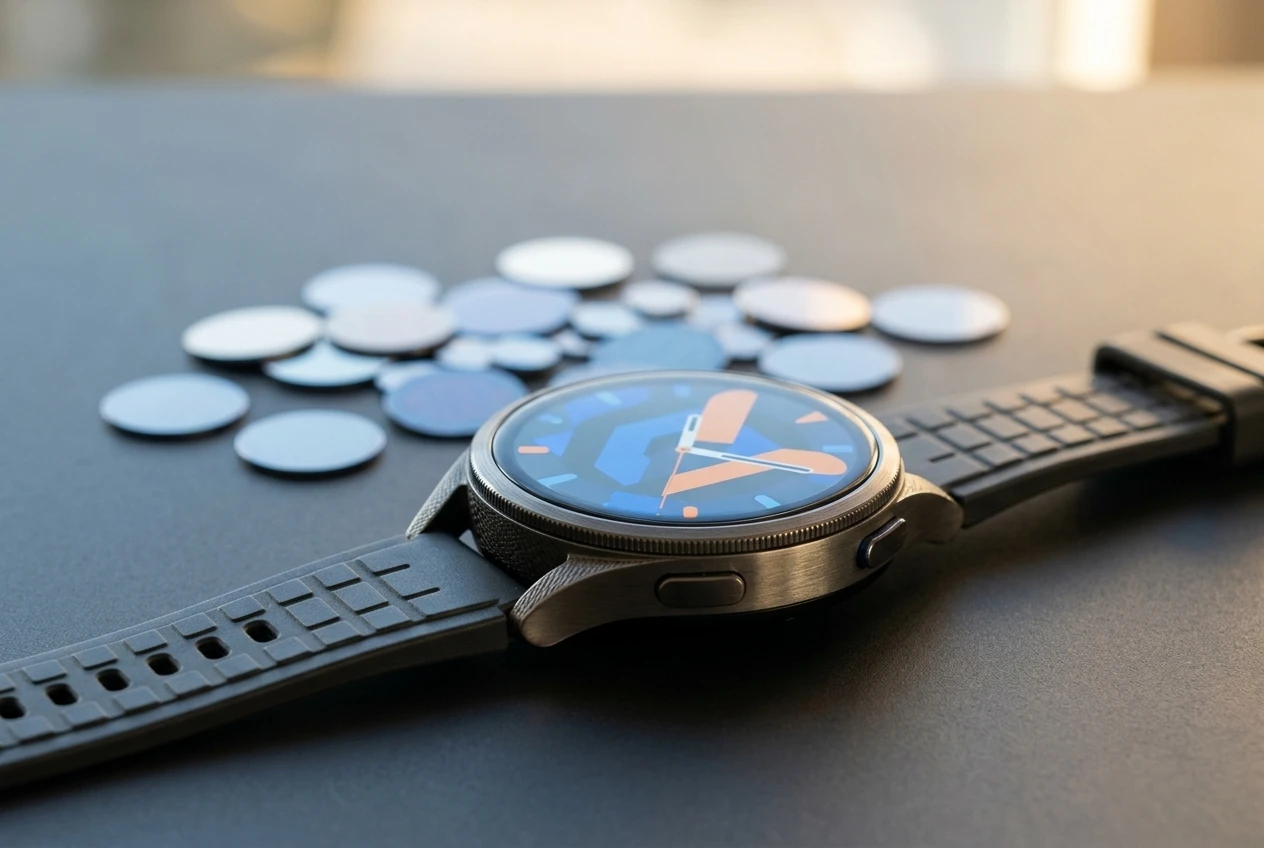
The leak, credited to frequent Samsung tipster Evan Blass and detailed first by GSMArena, lays out five separate configurations. The Galaxy Watch9 comes in 40mm and 44mm cases, with 1.34 inch and 1.47 inch AMOLED screens respectively, both reaching up to 3,000 nits of peak brightness. The Galaxy Watch Ultra 2 gets a larger 1.52 inch AMOLED panel rated for up to 5,000 nits, with sapphire crystal protection shared across both watches.
Storage splits by tier: 32GB on the Watch9, 64GB on the Ultra 2, both paired with 2GB of RAM. Battery capacity follows a similar pattern. The 40mm Watch9 packs 390mAh, the 44mm model 445mAh, and the Ultra 2 jumps to 800mAh, a gain the outlet Gagadget pegged at roughly 35 percent over the original Ultra’s 590mAh cell. All three sizes add WPC-based fast wireless charging.
- Samsung BioActive sensor for heart rate, ECG and body composition, unchanged across both watches
- Temperature, barometer and geomagnetic sensors carried over from the outgoing generation
- Bluetooth 6.0, dual-band Wi-Fi, NFC and GPS across the entire lineup
- Wear OS 7 with One UI 9 Watch running on both the Watch9 and Ultra 2
Water resistance splits along familiar lines too. The Watch9 carries IP68 and 5ATM ratings, while the Ultra 2 steps up to IP69K and 10ATM or higher. None of the design is a surprise at this point; Galaxy Watch Ultra 2 press renders leaked ahead of Unpacked weeks earlier, showing the same titanium case the specs now confirm.
Samsung Retires Its In-House Watch Chip
Every Galaxy Watch since the line switched to Wear OS in 2021 has run on a Samsung-designed Exynos chip. The Galaxy Watch7 used the Exynos W1000, a 3nm processor Samsung announced days ahead of its July 2024 Unpacked event, built around a single Cortex-A78 core and four Cortex-A55 cores. Samsung called the W1000 its first wearable processor with a big core, promising major performance gains over the previous chip.
That run ends with the Watch9 and Ultra 2. Qualcomm confirmed the switch itself back in March, when it unveiled the Snapdragon Wear Elite platform at Mobile World Congress in Barcelona.
By integrating the new Snapdragon Wear Elite platform, the next-generation Galaxy Watch will be an even more holistic wellness companion. This marks an important step in our ongoing efforts to deliver more efficient and personalized experiences, right from your wrist.
InKang Song, an executive vice president who leads mobile technology strategy at Samsung Electronics, said that the day Qualcomm announced the chip, months before any Watch9 leak surfaced. Samsung watchers had already spotted signs of Samsung abandoning Exynos for Snapdragon earlier in the leak cycle, though reports as recently as June guessed the swap might apply only to the Ultra 2, with the base Watch9 keeping its Exynos W1000. Wednesday’s full leak settles that question. Both watches list the same Snapdragon Wear Elite chip.
Droid Life, which covered Qualcomm’s announcement as it happened, called the move a sign that “Qualcomm built a better chip this time around.” It is a blunt way of putting what Samsung itself has only described in marketing language.
A Chip Business Still Losing Money
Samsung’s chip design and foundry operations have had a rough stretch. The foundry business alone posted more than 2 trillion won, or about $1.4 billion, in operating losses in the fourth quarter of 2024, according to KED Global. Yield problems at Samsung’s own fabs were serious enough that the Exynos 2500 processor never made it into the Galaxy S25 at all. Qualcomm’s Snapdragon 8 Elite covered the entire flagship lineup instead, SamMobile reported.
The losses have not let up. Samsung told trade outlet Digitimes in June that its system-on-chip business would push the wider System LSI division into another loss for 2026. Samsung president Park Yong-in said the unit’s problems are “difficult to convert into a surplus in the short term,” even after what he called a record quarter elsewhere in the company, according to Sammy Fans. Park added that Samsung “will strive to improve the business body and improve profitability.”
There is a partial rebound underway too. Samsung’s foundry business narrowed its losses through 2025 after landing contract manufacturing orders from Tesla for its AI5 and AI6 chips, the Korea Herald reported. That recovery is coming from outside customers winning new business, not from Samsung’s own device divisions choosing to stay.
Qualcomm’s Win Reaches Beyond One Watch
The Galaxy Watch9 is not the only recent Samsung product where an outside chipmaker took over. Google went through its own version of the same exit earlier this year, when the Tensor G6 finished Google’s break from Samsung chips in its flagship Pixel phone.
For Qualcomm, the Snapdragon Wear Elite deal secures an entry point into Samsung’s watch line it had lacked for years. Neowin noted that Samsung’s recent Galaxy Watch models had not used Qualcomm’s Snapdragon Wear platforms before, relying mostly on Samsung’s own Exynos wearable chips instead. Qualcomm frames the new platform as bigger than watches. Its own announcement describes hardware built to power Personal AI at the edge across wearables, including pins and pendants, not just wrists, with a dedicated processor built for running AI models on the device itself.
The chip’s specs back up that pitch. Qualcomm claims a 5x jump in single-core CPU performance and a 7x gain in graphics output over the outgoing Snapdragon W5+ Gen 2, along with a 50 percent charge in 10 minutes and up to 30 percent longer battery life. Google, Motorola and Samsung are all listed as launch partners.
Five Watches, One Bigger Bill
Samsung is charging more for all of it. Every configuration costs more than its predecessor, with confirmed increases of €30 to €50 depending on the model, according to Notebookcheck’s reporting on the leaked European price list.
| Model | Connectivity | Price (EUR) | Battery |
|---|---|---|---|
| Galaxy Watch9 40mm | Bluetooth | €409 | 390mAh |
| Galaxy Watch9 40mm | Bluetooth + LTE | €459 | 390mAh |
| Galaxy Watch9 44mm | Bluetooth | €439 | 445mAh |
| Galaxy Watch9 44mm | Bluetooth + LTE | €489 | 445mAh |
| Galaxy Watch Ultra 2 | LTE only | €749 | 800mAh |
The 44mm LTE Watch9 rises €30 over last year’s price, and the Ultra 2 rises €50, per Notebookcheck’s breakdown of the same leak. Samsung’s US pricing, reported separately by BigGo Finance, starts the Watch9 at $349 and holds the Ultra 2 at $699, matching its predecessor there even as Europe pays more across the board.
Is Any of This Confirmed Yet?
Samsung has not confirmed the leaked figures directly, but it already confirmed the chip switch itself back in March, and Wednesday’s Unpacked event in London is expected to make the rest official within hours, alongside new foldables and a first real look at Samsung’s smart glasses.
- Confirmed by Samsung in March: an executive vice president said on the record that the next Galaxy Watch would use Snapdragon Wear Elite
- Confirmed by Wednesday’s leak: full pricing, storage, battery and display figures for all five watch configurations
- Not yet confirmed: whether a Galaxy Watch9 Classic joins the two standard sizes, as some outlets have speculated
- Not yet confirmed: final UK and US colorways, along with any region pricing beyond Europe
Samsung’s London event starts this afternoon local time. Pre-orders are expected to open the same day, with retail stock reaching shelves around August 6.
Frequently Asked Questions
Will the Galaxy Watch9 work with an iPhone?
No. Like every Galaxy Watch before it, the Watch9 and Watch Ultra 2 need an Android phone for setup and full functionality, so iPhone owners cannot pair one, according to smartwatch tracking site Smartwatch Insight.
What colors will the Galaxy Watch9 and Watch Ultra 2 come in?
Leaked details point to Cream and Graphite for at least one Galaxy Watch9 configuration, sourced from leaker Billbil-kun, while the Watch Ultra 2’s titanium case is expected in Titanium Gray and Titanium Silver, according to Sammy Fans.
When can I actually buy the Galaxy Watch9 and Watch Ultra 2?
Pre-orders are expected to open the same day as Wednesday’s Unpacked event, with retail stock reaching stores around August 6, 2026, based on Samsung’s usual gap of two to three weeks between announcement and sale.
Is Samsung finished with Exynos chips for good?
Not necessarily. Samsung is still developing the Exynos 2700 for future Galaxy phones and has discussed moving Exynos chip design out of its System LSI unit and into its mobile division, so a return to wearables in a later generation is not ruled out.
 One UI 9’s Privacy Display Fix Reaches Just One Galaxy Phone
  Marathon’s Vault Breaker Arrives as Bungie’s Bigger Bet Keeps Faltering
  Sony’s PlayStation Disc Cutoff Erases the Last Proof of Ownership
  Tesla’s Summer Update Hands Grok the Keys, and Musk’s Empire More Reach
  Apple’s $634 Million Masimo Payment Is Final After Appeal Denial
  Nestle India’s 48% Profit Jump Also Swells Its Payout to Switzerland