
 Ishan Crawford
 Google has locked in August 12, 2026 for its next Pixel launch, and the smallest detail in the leak pile matters more than the stage date. The chip inside the coming Pixel 11 series, Tensor G6, appears to finish something Google started only one generation ago: a full break from Samsung’s silicon business, covering both the factory that builds the chip and the modem that connects it.
That split should help fix years of complaints about Tensor overheating and battery drain. It is also landing right as the manufacturing process Google just switched to has turned scarce and expensive, which helps explain why Pixel 11 prices look set to climb in both India and the United States.
Google Sets August 12 and Leaves the Rest to Leakers
Google has sent out official invites for a Made by Google event in New York City on August 12, 2026. The invite line reads, “the night the next generation of Pixel arrives,” and it points to four devices: the Pixel 11, Pixel 11 Pro, Pixel 11 Pro XL, and the Pixel 11 Pro Fold.
The date sits roughly a week earlier than last year’s Pixel 10 reveal, part of a pattern where Google keeps pulling its launch forward to get ahead of Apple’s iPhone event and Samsung’s Unpacked showcase.
Everything past the date, including pricing, colors, and internal hardware, is coming from leakers, retailer listings, and chip-tracking publications rather than Google itself.
Four Straight Chips Came from Samsung, Until One Didn’t
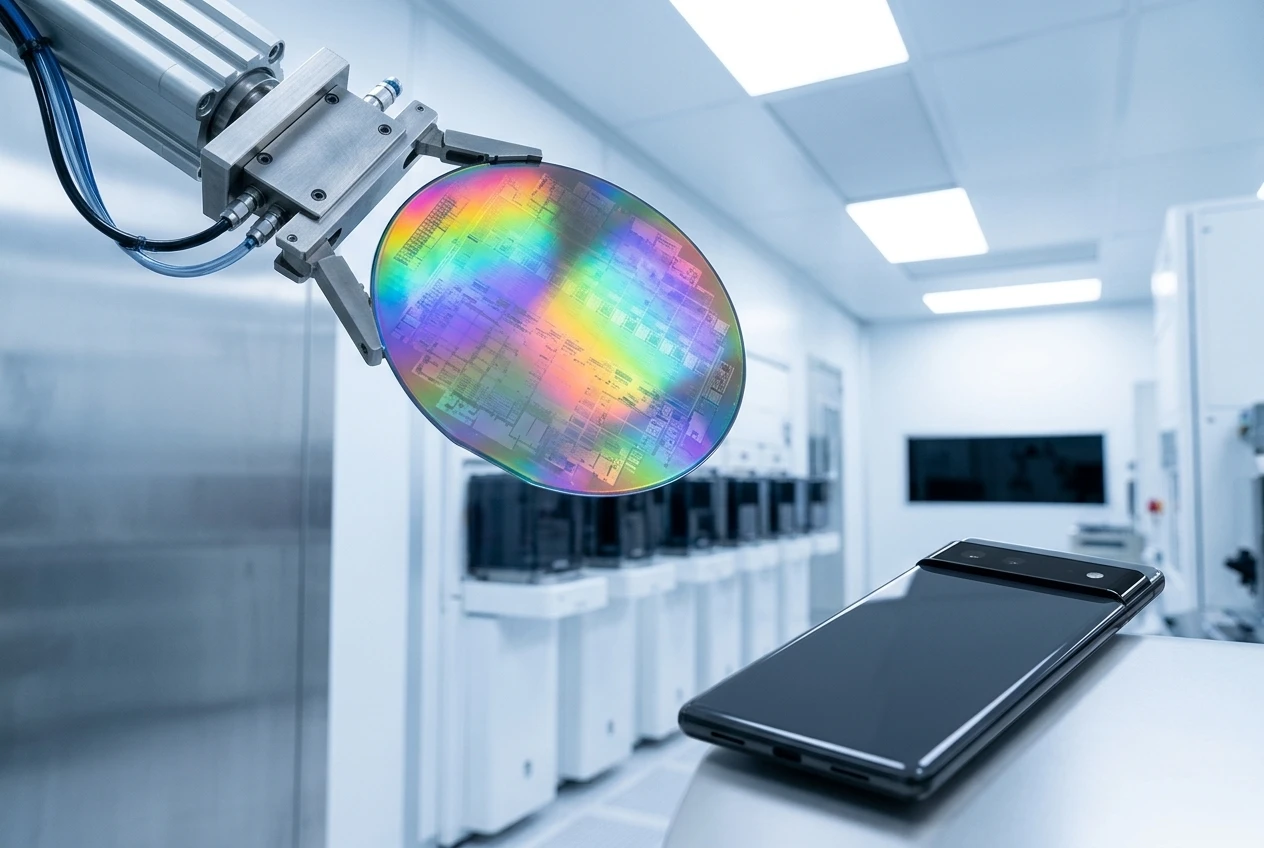
Every Tensor chip from the Pixel 6 through the Pixel 9 came out of Samsung Foundry, built on a customized Exynos base. That changed with the Pixel 10’s Tensor G5, codenamed Laguna, which Google shifted to TSMC (Taiwan Semiconductor Manufacturing Company) and its 3-nanometer N3E process.
The switch reportedly caught Samsung off guard. The Korean financial outlet The Bell described Google’s move as a shock to Samsung and a wake-up call for its foundry business, in a report relayed by 9to5Google. Samsung’s own 3-nanometer yields were reportedly stuck somewhere between 20 and 50 percent at the time, against roughly 90 percent for TSMC, numbers that made the decision look less like a snub and more like simple math.
The timeline shows how fast the relationship unwound:
- 2021: Tensor G1 debuts in the Pixel 6, built by Samsung Foundry on a customized Exynos base.
- 2024 to 2025: Google signs a multi-year manufacturing deal with TSMC; Tensor G5, codenamed Laguna, tapes out on TSMC’s 3-nanometer N3E process.
- August 2025: The Pixel 10 ships with Tensor G5, the first Tensor chip Samsung Foundry never touched.
- October 2025: Leaks reveal Google testing a MediaTek M90 modem for Tensor G6, aiming to drop Samsung’s modem business too.
- August 12, 2026: The Pixel 11 series is expected to arrive with Tensor G6 on TSMC’s 2-nanometer node, alongside a MediaTek modem in place of Samsung’s.
The Modem Is the Next Piece Samsung Loses
Tensor G6, codenamed Malibu, is expected to move to TSMC’s 2-nanometer (N2) process using Gate-All-Around (GAA) transistors, a design that wraps the control gate around all four sides of the switch instead of three, cutting wasted power and heat. Google is reportedly targeting 15 to 20 percent better efficiency over Tensor G5.
The bigger change may be the modem. Google is reportedly replacing Samsung’s Exynos modem with MediaTek’s M90, after testing the same swap for the Pixel 10 and ultimately sticking with Samsung’s Exynos 5400i that generation, according to 9to5Google’s October 2025 report. Leaked internal Google documents reportedly named Tensor overheating as the top reason customers returned Pixel phones, giving Google a direct incentive to move on from Samsung’s radio hardware too.
MediaTek’s own launch material for the M90 lays out what Google is reportedly buying into:
- 12Gbps peak downlink, a speed MediaTek’s announcement puts at the modem’s fastest tier to date, using wide carrier aggregation across sub-6GHz and mmWave bands
- 20 percent faster uplink, enabled by 3GPP Release 17 2T-2T Uplink TX switching
- Up to 18 percent lower average power draw through MediaTek’s UltraSave technology, compared with the prior-generation modem
- Dual 5G SIM dual-active support, letting both SIM slots stay connected to live 5G networks at once
The same pairing is already showing up a rung down the lineup. Leaks around Google reversing its Pixel 10a chip shortcut describe the Pixel 11a carrying the same Tensor G6 and MediaTek M90 combination, suggesting the modem swap runs across the whole 2026 Pixel family rather than just the flagship.
The Leaked Spec Sheet for Pixel 11, Pro, and Pro XL
Render leaks from tipster OnLeaks, a source known for accurate pre-launch phone designs, published via Android Headlines, show the Pixel 11 keeping Google’s familiar silhouette with two visible changes: thinner screen bezels and a fully black camera bar, replacing the two-tone finish that used to ring the LED flash.
Physical size barely moves. The Pixel 11 is expected to measure roughly 152.8 x 72 x 8.5mm, just 0.1mm thinner than the Pixel 10. A new ambient lighting feature nicknamed Pixel Glow, believed to be a notification lighting system, has also turned up in Android 17 beta code.
Here is how the three confirmed models compare on paper, based on the current leak set:
| Specification | Pixel 11 | Pixel 11 Pro / Pro XL |
|---|---|---|
| Display | 6.3-inch OLED, 120Hz, up to 3,100 nits peak brightness | Same 6.3-inch panel size across both Pro variants |
| Chipset | Tensor G6 (2nm, TSMC) | Tensor G6 (2nm, TSMC) |
| RAM | 8GB or 12GB | 12GB and up, higher storage tiers expected |
| Battery | 4,840mAh | Larger capacity expected, exact figure unconfirmed |
| Rear camera | 50MP main, 48MP ultra-wide, 12MP telephoto | 50MP main, 50MP ultra-wide, 48MP periscope telephoto |
| Front camera | 10.5MP or 16MP (some leaks suggest 50MP) | 42MP |
| Software | Android 17 out of the box | Android 17 out of the box |
Take the camera and battery figures with caution. Google has not confirmed any of this, and megapixel counts in particular have shifted across different leak rounds.
A 2-Nanometer Chip Comes with a Bigger Price Tag
Indian pricing leaks have been unusually consistent. Multiple outlets converge on around Rs 84,999 (about $960) for the base Pixel 11 with 12GB of RAM and 256GB of storage, with the Pixel 11 Pro estimated between Rs 1,03,999 and Rs 1,11,999, and the Pixel 11 Pro XL reaching up to Rs 1,19,999. In the US, base pricing is rumored to start at $900, a $100 jump over the Pixel 10, though that reportedly comes with double the base storage, up from 128GB to 256GB.
Storage is only part of the story. TSMC’s 2-nanometer wafers are reportedly priced as high as $30,000 each, a 50 percent jump over 3-nanometer wafers, according to TrendForce, a Taiwan-based chip market research firm. Apple has locked up more than half of TSMC’s initial 2-nanometer output for 2026, according to a Dataconomy report, leaving Qualcomm, MediaTek, and now Google to compete for what remains.
That does not guarantee Google is passing wafer costs straight to buyers. But a scarcer, pricier node gives the Pixel 11’s higher price a second explanation beyond extra storage, one that could test Pixel’s multi-year sales growth in India just as Google asks buyers to pay more.
Samsung Loses Twice
Zoom out and the numbers explain why Samsung was reportedly rattled by the Tensor G5 switch. TSMC’s foundry business posted $35.86 billion in revenue in the first quarter of 2026, a 72.3 percent global market share, according to TrendForce data. Samsung Foundry, a distant second, brought in $3.2 billion and 6.5 percent share, down from 7.7 percent a year earlier even as its own revenue ticked up slightly.
| Foundry | Q1 2025 Share | Q1 2026 Share | Q1 2026 Revenue |
|---|---|---|---|
| TSMC | 67.6% | 72.3% | $35.86 billion |
| Samsung Foundry | 7.7% | 6.5% | $3.2 billion |
TSMC’s foundry revenue now runs roughly eleven times Samsung’s, by that measure. Samsung Electronics still has to sell Galaxy phones against a Pixel line that no longer depends on Samsung’s own chip and modem technology, competing in the same India showrooms where both brands chase premium buyers.
When India Actually Gets the Pixel 11
Google has spent the last few years closing the gap between its US and India launches. The Pixel 10 series reached India within days of its global reveal, selling through the Google Store, Flipkart, and Amazon. Expect the same pattern this year, with an India reveal alongside or shortly after the August 12 New York event, and retail availability following in about two to three weeks.
Wait for August 12, or Buy the Discounted Pixel 10 Now
If your current phone still works fine, waiting three to four weeks for confirmed pricing and independent reviews is the safer move. The jump to a 2-nanometer chip with GAA transistors is a real architectural change, not a marketing refresh, and it should show up in battery life and thermal performance once reviewers get their hands on it.
If you need a phone now, the Pixel 10 is already discounted on Amazon and remains a capable flagship, with the Tensor G5 chip, a 120Hz OLED display, and Google’s seven-year software update promise.
Frequently Asked Questions
Is Google completely replacing Samsung inside the Pixel 11?
Not entirely. Leaks point to Samsung Foundry losing chip manufacturing and Samsung’s Exynos modem being replaced by MediaTek’s M90, but those leaks focus specifically on the chip and modem. Google has not said whether other Samsung-made components carry over.
Did the Pixel 10 already use a MediaTek modem?
No. Google reportedly tested a MediaTek modem during Pixel 10 development but stuck with Samsung’s Exynos 5400i for that generation, according to 9to5Google’s October 2025 report. The switch to MediaTek’s M90 is expected to start with the Pixel 11.
How much better will the M90 modem’s battery life actually be?
MediaTek’s own figures put the M90’s power savings at up to 18 percent over its previous modem generation. Independent battery testing will not be possible until review units ship after the August 12 event, so treat that number as a manufacturer claim for now.
Does a 2-nanometer chip guarantee better battery life?
Not automatically. A smaller, Gate-All-Around process raises the ceiling for efficiency, but Google still has to tune its own software and camera processing on top of it. Past Tensor chips have lagged rivals on real-world battery life despite similar node advantages, so reviews after launch will matter more than the spec sheet.
Will the Pixel 11 Pro Fold get the same Tensor G6 chip?
Yes, based on current leaks. All four expected models, including the Pixel 11 Pro Fold, are tied to the Tensor G6 platform, though foldable-specific details like battery capacity and hinge changes have not surfaced in leaks yet.
 One UI 9’s Privacy Display Fix Reaches Just One Galaxy Phone
  Samsung Drops Its Own Exynos Chip for the Galaxy Watch9 and Ultra 2
  Marathon’s Vault Breaker Arrives as Bungie’s Bigger Bet Keeps Faltering
  Sony’s PlayStation Disc Cutoff Erases the Last Proof of Ownership
  Tesla’s Summer Update Hands Grok the Keys, and Musk’s Empire More Reach
  Apple’s $634 Million Masimo Payment Is Final After Appeal Denial