
 Ishan Crawford
 The trade setup for June 2 hangs on a single round number. With weekly index options settling in the same session, the question filling every chart is whether the NIFTY50 can hold its 23,000 support on expiry day. For most retail traders, the honest answer is that the level matters far less than the odds stacked against the seat they are sitting in.
Those odds are not a market opinion. They are printed in the risk disclosure that every Indian broker is forced to publish at the bottom of its own page, and almost nobody reading the day’s support and resistance call ever scrolls down to it.
The 23,000 Question Driving the June 2 Setup
The NIFTY50 is the National Stock Exchange’s benchmark, a basket of 50 large-cap stocks that the wider market treats as shorthand for Indian equities. When traders ask whether it can defend 23,000, they are watching a round number that tends to attract heavy option positioning on both sides.
Round figures behave like magnets near settlement. Large blocks of open interest (OI, the count of outstanding option contracts) cluster at strikes ending in triple zeros, and that clustering can pin the index toward the strike where the most option buyers lose, a tendency traders nickname max pain.
So the setup is really two scenarios. A hold above the level keeps call buyers hopeful and lets dip-buyers defend the zone into the close. A clean break below opens the door to a faster slide, because the stops sitting under a famous round number tend to fire together. Neither path is knowable in advance, which is precisely the problem with treating the June 2 session as a coin that can be called.
Why Expiry Day Concentrates the Risk
Expiry is not just another trading day with a deadline attached. It is the one session where the mechanics of options work fastest against the person holding them, and where a correct directional view can still end in a loss.
- Time decay runs hardest. Theta, the daily erosion of an option’s value, accelerates into the final hours, so an out-of-the-money option can lose most of its premium even if the index barely moves.
- Gamma swings widen. Small moves in the index produce outsized swings in option prices near expiry, turning a calm tape into violent intraday reversals.
- Premiums collapse to zero. Options that finish out of the money expire worthless, handing the entire stake to the seller on the other side.
- Liquidity thins at the wings. Far strikes trade with wide spreads late in the day, so exiting a losing position costs more than the screen suggests.
- Volume spikes invite overtrading. The crowd that only shows up on settlement day tends to chase moves, add positions, and rack up costs in a few frantic hours.
What SEBI’s Own Numbers Say About the Odds
Step back from the candlesticks and the picture changes. The Securities and Exchange Board of India (SEBI, the country’s market regulator) requires brokers to print a blunt warning, and the warning is the real headline of any expiry-day setup.
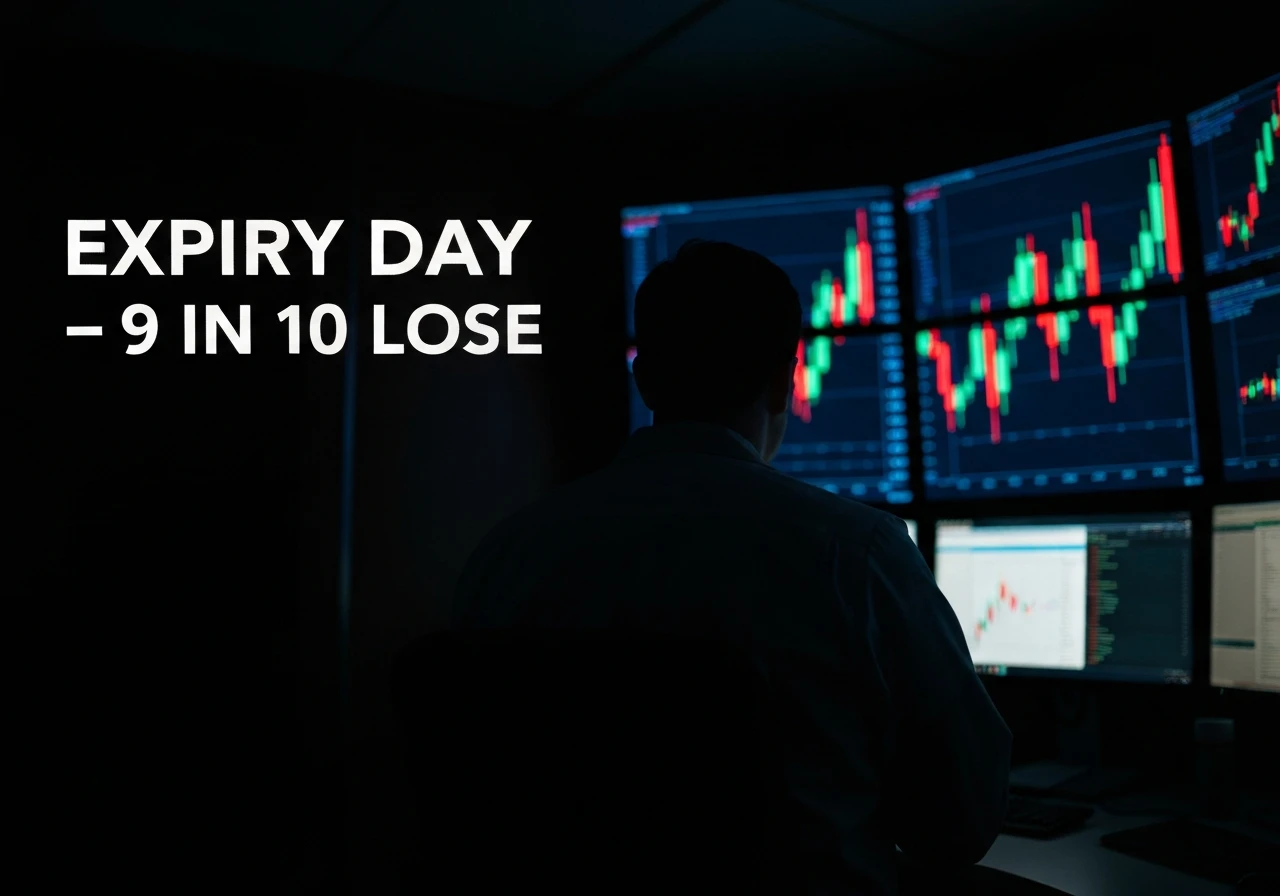
9 out of 10 individual traders in equity Futures and Options Segment, incurred net losses.
That line, mandated across every broking page in the country, is the figure that should sit beside the 23,000 call rather than beneath it.
The Headline Loss Rate
The disclosure is not a soft caution. Roughly nine out of ten individuals trading equity Futures and Options (F&O, contracts that derive their value from an underlying stock or index) walked away with net losses. That is a structural outcome, not a run of bad luck, and it holds across bull phases and bear phases alike. You can read the regulator’s published research on derivatives participation through SEBI’s research on individual F&O traders.
Where the Average Trade Lands
Among those losing, the average net trading loss came in close to ₹50,000 (roughly $600) per person. For a segment marketed on the dream of fast compounding, the typical lived result is a five-figure hole, before the costs of getting there are even counted.
The Transaction-Cost Trap Behind Expiry Trades
The losses are only half the story. The frictions of trading, brokerage, exchange charges, taxes and the like, take a second bite that grows precisely when activity spikes, which is what expiry day delivers.
SEBI’s disclosure puts hard figures on that bite. Loss makers spent an additional 28% of their net losses on transaction costs, and even the small group who finished ahead surrendered between 15% and 50% of their profits to the same costs. The more you churn, the larger the slice the system keeps regardless of your direction.
| Measure | Loss-making traders | Profit-making traders |
|---|---|---|
| Share of individual F&O traders | About 9 in 10 | About 1 in 10 |
| Typical net trading outcome | Net loss near ₹50,000 | Net profit |
| Cost on top of result | +28% of losses spent on costs | 15% to 50% of profits eaten by costs |
Read across that table and the expiry-day appeal starts to look like a poor wager dressed as a thrilling one, since high-frequency settlement trading maximises the very cost line that already drags on results across the NSE derivatives segment.
How Disciplined Traders Read an Expiry Session
None of this means the 23,000 zone is meaningless. It means the level is a reference point, not a prediction, and the difference shows up in how a careful trader handles the June 2 session versus how the crowd handles it.
The disciplined version starts with position size. A defined-risk structure, where the most you can lose is fixed before you enter, removes the worst expiry-day surprise, the position that runs away in the final hour. Round numbers above and below the spot become bands to react to, not targets to bet the account on.
The crowd version does the opposite. It buys cheap far-out options because they look like lottery tickets, adds to losers as premiums bleed, and confuses a busy screen for an edge. The first approach treats expiry as a day to protect capital; the second treats it as a day to find action, and SEBI’s data is mostly a portrait of the second group. Investors who feel pushed toward unsolicited tips can escalate through SEBI’s online dispute resolution portal.
If the NIFTY50 holds its footing into the close, the bulls keep the narrative and the dip-buyers look smart for a day. If it breaks and the stops cascade, the same setup that promised a clean bounce becomes the trap that proves the disclosure right one more time. Either way, the level decides the headline, and the structure decides the account.
Frequently Asked Questions
What does it mean for the NIFTY50 to hold 23,000 on expiry day?
It means the benchmark stays at or above the 23,000 mark through the settlement session. Because heavy option open interest clusters at round strikes, a hold tends to favour call buyers and dip-buyers, while a break below can trigger stacked stop-loss orders and a faster decline.
Why do most F&O traders lose money?
SEBI’s mandated disclosure states that nine out of ten individual traders in the equity F&O segment incur net losses. The combination of time decay on options, high transaction costs, leverage, and overtrading turns the segment into a structural loss-maker for the majority, not a matter of occasional bad luck.
What makes expiry day riskier than other sessions?
On expiry day, option time decay accelerates, price swings per index point widen, and out-of-the-money options can expire worthless. The surge in volume also tempts traders to chase moves, which raises costs in a few hours and amplifies losses.
How much do transaction costs eat into trading results?
According to SEBI, loss-making traders spent an additional 28% of their net losses on transaction costs, and even profitable traders gave up between 15% and 50% of their profits to those costs. Heavy expiry-day churn inflates this drag further.
Is trading the June 2 expiry a sensible idea for beginners?
For most beginners it is among the hardest places to start, given the documented loss rate and cost burden. A defined-risk approach, small position sizes, and treating round-number levels as references rather than guaranteed turning points lower the odds of a costly first lesson.
Disclaimer: This article is for informational purposes only and is not investment advice or a recommendation to trade in securities, futures, or options. Trading in equity derivatives carries a high risk of loss, and the figures cited reflect SEBI risk disclosures accurate as of publication. Consult a SEBI-registered investment adviser before acting, and read all related risk documents carefully. Investments in the securities market are subject to market risks.
 Scotland Reader Photos Capture Eclipse Week Beyond the Sky
  Scotland’s Rare World Cup Win Over Haiti Still Echoes
  Scottish Morning Roll Campaign Echoes Baguette Path to Unesco
  Samsung Passport Fold8 Turns Apple Fans Into Switchers
  Android’s Quiet Shift to Ambient AI Hardware This Week
  Poco F9 Leak Hands Global Buyers Less Battery for More Money