
 Ishan Crawford
 Volkswagen India has secured global approval for a sub-4-metre SUV based on the Skoda Kylaq, a project budgeted at roughly 25 million euros or Rs 275 crore. The move hands the brand a ticket back into a segment that moves about 1.1 lakh units every month and accounts for roughly 30 percent of all passenger-vehicle sales.
The car will share the Kylaq’s MQB-A0-IN bones and 1.0-litre TSI petrol engine yet carry distinct Volkswagen styling, features and positioning. Exact launch timing and the final name remain open, though the Brazilian Tera offers the closest global clue.
Global Green Light for a Low-Cost Twin
Autocar India first flagged the project six months earlier. The formal go-ahead now clears local engineering and tooling work at the group’s Chakan facility. Because the model is essentially badge-engineered, development cost stays modest and time-to-market short compared with a clean-sheet design.
Volkswagen last sold cars under four metres when it offered the Polo hatchback and Ameo sedan. Both left the range years ago, leaving the brand parked above the volume zone with only the Taigun and Virtus. The new SUV drops the entry point and opens a far larger customer pool.
Expected pricing sits between Rs 8 lakh and Rs 13 lakh ex-showroom, overlapping the upper half of the Kylaq range and the heart of the Fronx-Nexon-Punch battle.
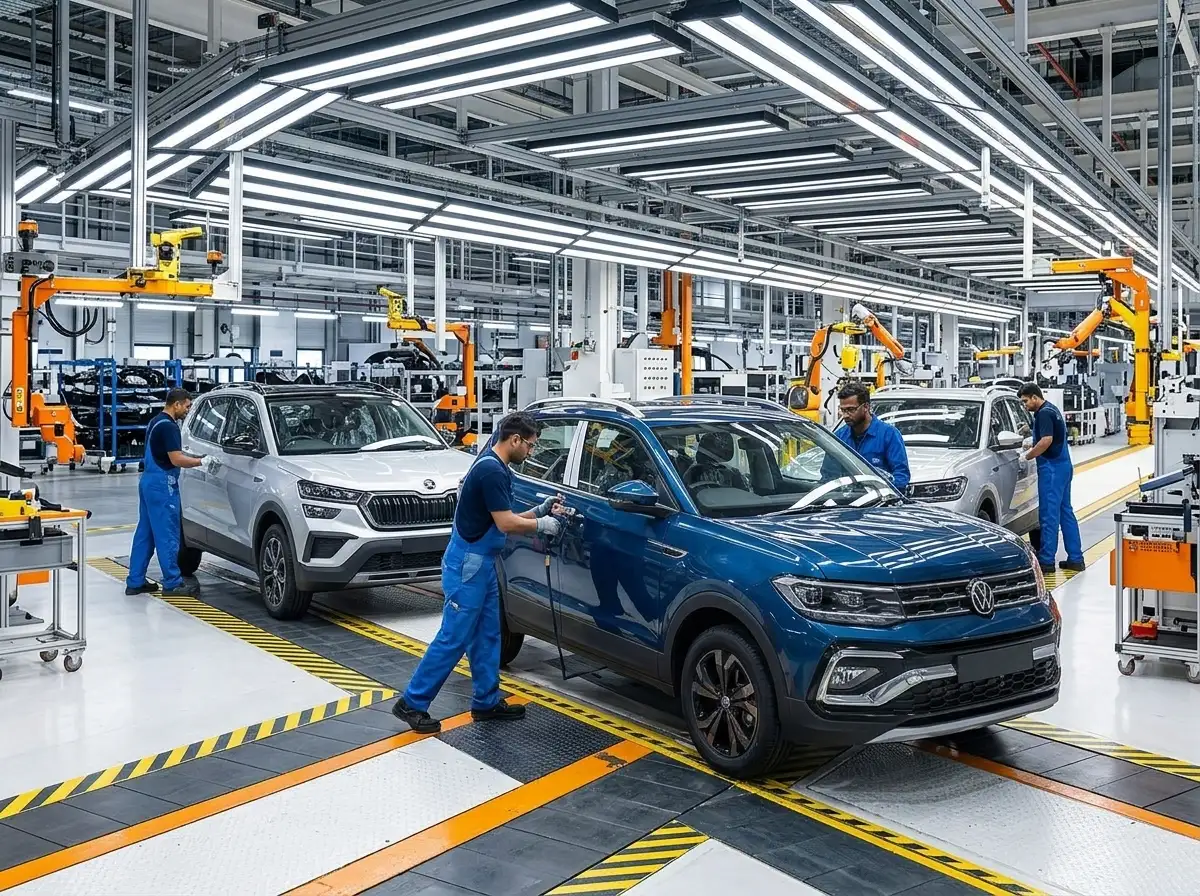
Same Engine, Fresh Face and an 8-Speed Box
Power comes from the familiar 1.0-litre three-cylinder TSI that makes 116 PS and 178 Nm. Buyers get a six-speed manual or, from day one, an eight-speed automatic. The Kylaq still uses a six-speed torque-converter unit; it is slated to gain the eight-speeder in a later update.
- Engine: 999 cc TSI petrol, 116 PS / 178 Nm
- Gearboxes: 6-speed manual plus 8-speed automatic at launch
- Platform: MQB-A0-IN shared with Kylaq, Kushaq and Taigun
- Expected length: under 4,000 mm to keep the lower GST slab
Exterior and cabin will receive substantial visual changes so the Volkswagen does not look like a rebadged Skoda. Feature lists should mirror the Kylaq’s 10.1-inch touchscreen, wireless Apple CarPlay and Android Auto, electric sunroof, ventilated front seats and six-way power front seats on higher trims.
Stats snapshot
- Project outlay: ~€25 million (Rs 275 crore)
- Target price band: Rs 8-13 lakh ex-showroom
- Segment monthly volume: ~1.1 lakh units
- Kylaq share of Skoda sales: roughly 60 percent
The Segment That Moves 1.1 Lakh Cars a Month
India’s sub-4-metre SUV category has become the industry’s volume engine. Hatchback buyers keep trading up, GST on qualifying cars fell from 28 percent to 18 percent, and almost every major brand now fields at least one model. In May 2026 the segment cleared 1.17 lakh units.
| Model | May 2026 sales | Segment share | YoY change |
|---|---|---|---|
| Maruti Fronx | 20,686 | 17.5% | +52% |
| Tata Punch | 20,208 | 17.1% | +54% |
| Tata Nexon | 19,100 | 16.2% | +46% |
| Hyundai Venue | ~10-11k range | ~9% | strong |
| Skoda Kylaq | 3,443 | ~3% | down |
Tata and Maruti together control roughly half the market. Skoda’s Kylaq, launched the previous year, already ranks inside the top ten and supplies 60 percent of the brand’s monthly total. That success proved the platform works; Volkswagen simply wants its own badge on the same metal.
Upcoming rivals include a VinFast electric, Mahindra’s Vision X concepts, a new Hyundai EV, a Honda compact SUV and the Renault Bridger. Space remains, but the fight grows fiercer every quarter.
Chakan Has Room and Needs the Units
Škoda Auto Volkswagen India’s Pune plant lists Pune plant capacity of 225,000-plus cars a year. A second site at Shendra adds another 60,000. Both factories have run below full utilisation for long stretches. Additional Kylaq-platform volume improves the numbers and spreads fixed costs across more units of Taigun, Virtus, Kushaq, Slavia and the new twin.
Group executives have repeatedly stressed the “Made in India for India and the World” line. The same Chakan lines already build cars for export. Higher throughput lowers the per-car burden of R&D, tooling and overhead, which helps every model that shares the plant. That second-order gain matters as much as the new nameplate’s own sales.
Recent years also saw voluntary early-exit offers for workers as the company restructured. Filling the lines with a high-volume product is the cleaner long-term answer.
Safety Kit Travels Straight Across
The Kylaq earned five stars at Bharat NCAP, posting 5-star Bharat NCAP scores of 30.88 and 45 for adult and child occupant protection. That made it the strongest ICE performer in the sub-4-metre SUV class. Six airbags, electronic stability control, multi-collision braking, hill-hold, tyre-pressure monitoring and roll-over protection all come standard from the base trim.
Safety is intrinsic to the Škoda DNA and since 2008 every Škoda car has been crash-tested globally, and in India, with a 5-star safety rating.
Petr Janeba, then Brand Director at Škoda Auto India, made that point at the NCAP announcement. The Volkswagen version is expected to carry the same hardware and the same hot-stamped steel structure. Buyers who want European crash performance at this price will have two badges to choose from. Full details sit on the official Bharat NCAP fact sheet for Kylaq.
- Six airbags standard
- Electronic stability control and multi-collision brake
- Hill-hold control and tyre-pressure monitoring
- Roll-over protection and electronic differential lock
- Hot-stamped steel body structure
Feature parity should also cover the 10.1-inch touchscreen, 8-inch digital cluster, wireless phone charger and automatic climate control already familiar from the Kylaq.
Timing, Name and the Noise Around Reliability
No firm launch window has been published. Industry chatter points to mid-to-late 2027, which would put the car on sale roughly two years after the Kylaq’s arrival. Some voices on X already call the entry late. One detailed owner post described a brand-new Kylaq stopping twice within an hour of delivery in late July 2026 and still awaiting a clear root-cause explanation weeks later. That single anecdote does not define the model, yet it underlines how aftersales and early reliability will shape reception of the Volkswagen twin.
What we know
- Global project approval secured at ~Rs 275 crore
- Shared 1.0 TSI and MQB-A0-IN platform
- 8-speed automatic from launch
- Target price Rs 8-13 lakh
What’s still unconfirmed
- Final India name (Tera is used in Brazil)
- Exact exterior and interior design changes
- Precise launch month and first-year volume target
- Whether any unique Volkswagen safety or tech extras appear
The Brazilian Tera measures just over 4.1 metres in some reports and uses related powertrains. India will almost certainly keep the car under four metres to protect the tax advantage that still draws buyers, even as CAFE-III rules that squeeze small petrol cars tighten fleet averages and the extra fuel cost from India’s E20 ethanol push continues to bite real-world economy.
Group Stakes Run Deeper Than One Nameplate
For Volkswagen the new SUV is more than another product slot. It restores a volume foothold the brand abandoned, gives dealers a lower-priced conversation starter, and supplies the missing piece beneath the Taigun. For the joint Skoda-Volkswagen operation the bigger arithmetic is plant loading and parts commonality. Every extra thousand units of the twin improves the economics of the engines, gearboxes and body parts already flowing through Chakan.
Skoda must manage the internal competition carefully. The Kylaq already delivers the bulk of its sales. A near-identical Volkswagen model priced in the same band could steal some of those buyers, or it could simply expand the pie by pulling in customers who prefer the VW badge. Either way the group captures the margin.
Success will be measured less by how many Tera-or-whatever badges leave the line in year one and more by whether total MQB-A0-IN output climbs enough to make the entire India 2.0 family cheaper and more profitable. That is the quieter calculation behind the Rs 275 crore green light.
 ONGC licence frees Venezuela cash and operatorship talks
  Anthropic Hits $65 Billion Run Rate and Flips the AI Cash Test
  Supreme Court grounds the fare free-for-all with three-week clock
  Gold Nears $4400 as Soft Data Meets Oil Inflation Risk
  Nifty Slips as Zaggle Circuits and Dhoot Debuts Big
  Diesel Crack Tops $100 as Iran Rhetoric Lifts Crude