
 Ishan Crawford
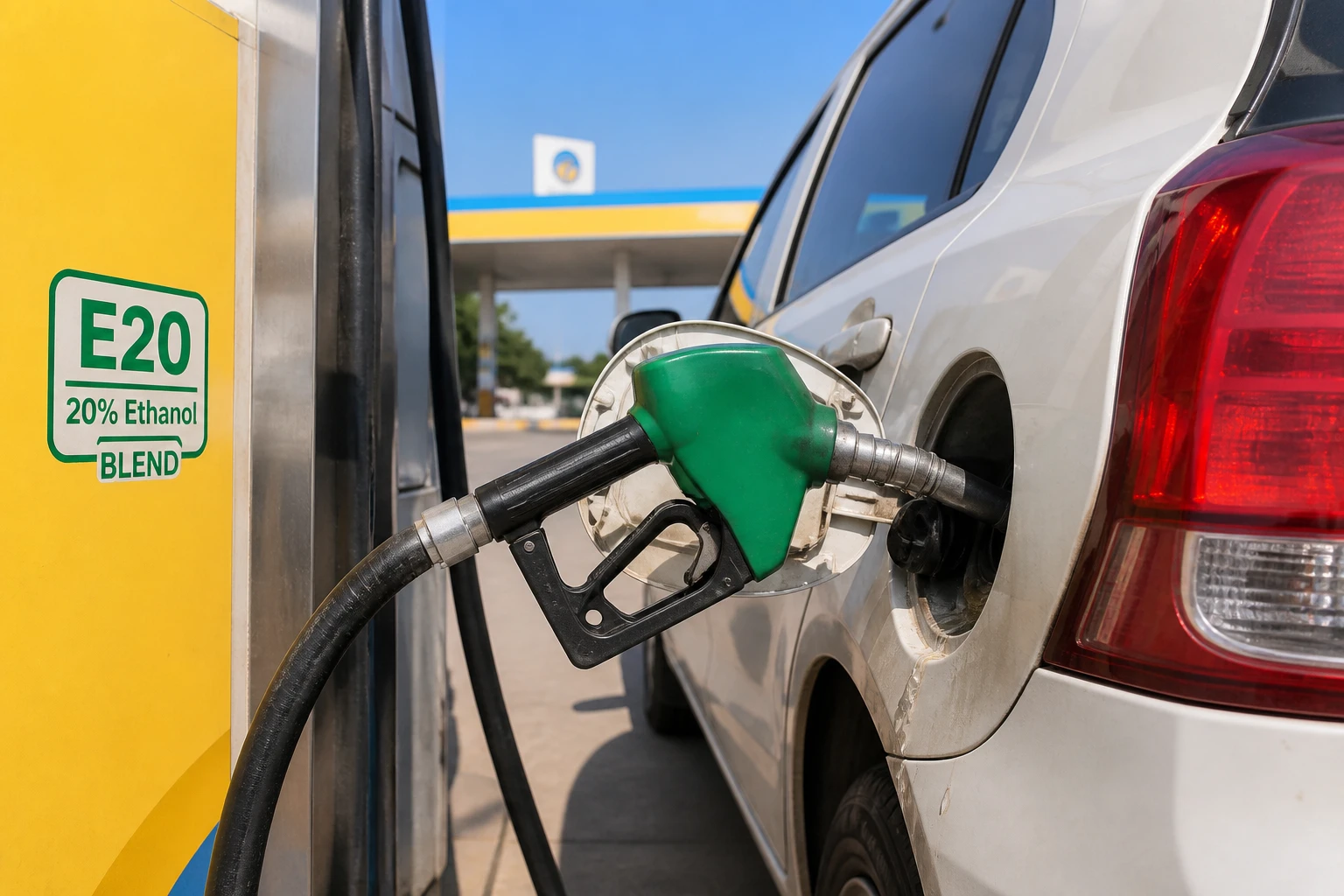
 Indian motorists spent an estimated Rs 88,234 crore more on fuel between 1 April 2023 and 31 March 2026 because ethanol-blended petrol delivers less energy per litre than pure petrol. The figure comes from a calorific-value analysis by The Reporters’ Collective using government motor-spirit data. Union Petroleum Minister Hardeep Singh Puri had called stories of lower efficiency and engine harm “a load of BS.”
The same maths that produced the bill also shows why the cost keeps recurring. Ethanol carries roughly one-third less energy than petrol. At 20 percent blend the shortfall lands near 6.7 percent. Drivers simply buy more litres for the same kilometres, and the pump price of blended fuel has not been cut to offset it.
The Extra Bill From Lower Energy Density
In FY 2025-26 India burned 42.6 million metric tonnes of motor spirit at nearly 20 percent ethanol. Pure petrol would have required only 39.76 million tonnes for the same energy. The difference: 2.83 million tonnes of extra fuel purchased that year alone, valued at Rs 37,843 crore at prevailing Delhi blended prices.
Across the three fiscal years as blending rose from about 11.8 percent toward 20 percent, total excess consumption reached 6.57 million tonnes. Priced conservatively at blended rates rather than the far higher pure-petrol tariff, that excess equals Rs 88,234 crore.
| Period | Excess fuel (MMT) | Estimated extra cost (Rs crore) |
|---|---|---|
| FY 2025-26 | 2.83 | 37,843 |
| Three years total (FY24-FY26) | 6.57 | 88,234 |
The Collective notes the calculation tilts conservative. It assumes drivers could have bought unblended fuel at the same price as E20. In reality pure petrol in Delhi sits near Rs 167-170 a litre while blended fuel is about Rs 102, a gap of Rs 66-68. Using the true pure-petrol price would push the consumer bill far higher.
Ministers have not released their own full quantification of the mileage cost. Questions to the Petroleum and Transport ministries went unanswered at publication.
What the 2021 Roadmap Already Spelled Out
The government’s own expert committee saw the efficiency hit coming. The June 2021 NITI Aayog-MoPNG 6-7% fuel efficiency loss for four-wheelers designed for E0 and calibrated for E10. Two-wheelers faced a 3-4 percent drop. Vehicles already designed for E10 and tuned for E20 were projected at 1-2 percent.
- Calorific value of ethanol is around two-thirds that of gasoline, so more volume is needed for the same power.
- The report recommended tax incentives or lower retail prices on E10 and E20 “to compensate the consumers for a drop in efficiency.”
- It also flagged the need for material-compatible and engine-tuned vehicles phased in from 2023 and 2025.
- Foreword and summary projected roughly Rs 30,000 crore annual oil-import savings once E20 was reached.
Those price offsets never arrived at the pump. Blended petrol has stayed at parity with the old petrol price structure even as the energy content fell. The import-bill saving materialised for the exchequer; the mileage debit stayed with drivers.
All the stories you hear about biofuels being harmful for engines, there’s a load of BS, B capital, S capital.. (in them)
Puri made that remark to an energy conference after the 20 percent milestone. He listed congestion in Delhi or Gurugram as a likelier culprit for higher fuel use than the blend itself.
Blending Raced From E10 Toward E20
Ethanol blending began as a small programme in 2003 and stayed under 2 percent for years. After the 2018 National Policy on Biofuels and the later decision to advance the 20 percent target from 2030 to 2025, volumes climbed fast.
- ESY 2020-21: about 8.1 percent average blend
- ESY 2021-22: 10.0 percent
- ESY 2022-23: 12.1 percent
- ESY 2023-24: 14.60 percent
- ESY 2024-25: 19.20 percent
- ESY 2025-26 (Nov-June): 20 percent
The official blending rates by ethanol supply year appear in the Petroleum Ministry’s July 2026 Q&A. India hit the 20 percent mark in 2025, five years early. For FY 2025-26 the Collective’s PPAC-based average sat near 19.9 percent.
Road Transport Minister Nitin Gadkari has long championed the programme. In a July 2026 interview he called any mileage loss minor in city traffic and more noticeable only at high speed. The same month Puri told Parliament that laboratory studies and field trials showed no significant performance variation or abnormal wear. The underlying trial reports were not released publicly.
Owner Surveys Sit Above the Official Band
Government statements now concede a possible 3-5 percent economy reduction in some vehicles while stressing higher octane, cleaner combustion and lower particulates. Real-world owner data land higher.
A June 2026 LocalCircles survey of more than 44,000 pre-2023 petrol vehicle owners across 305 districts found 66% of pre-2023 owners reporting over 10% drop in mileage since early 2025. That share had been 45 percent only a month earlier. Breakdown among those who answered: 23 percent saw more than 20 percent loss, 23 percent saw 15-20 percent, 20 percent saw 10-15 percent.
- 66 percent reported mileage drop exceeding 10 percent (up from 45 percent in May)
- 55 percent reported unusual wear and tear or extra repairs (up from 29 percent)
- 23 percent of mileage respondents put the drop above 20 percent
On X, drivers posted personal logs: one Unicorn CB160 owner went from 55 kmpl to 41.5 kmpl. Others described the 88,234 crore figure as the bill for an experiment they never chose. Official accounts framed criticism as opposition to farmer income and energy security. Maruti Suzuki’s service data for 2.84 crore vehicles, including 1.5 crore older ones, found no E20-linked corrosion or abnormal wear, according to ministry statements. The gap between lab/field claims and owner-reported economy remains the live argument.
The Collective also compared motor-spirit growth with estimated vehicle parc growth drawn from CEEW ownership work. In the years blending accelerated, fuel use outpaced the rise in vehicles on the road, consistent with a mileage penalty though congestion and longer trips also play roles.
Pure Petrol Exists, at a Steep Premium
Gadkari has said people who do not want ethanol-blended fuel can buy 100 percent petrol and pay more. In practice the option is narrow and expensive. Premium ethanol-free grades such as XP100 retail near Rs 167-170 in Delhi against roughly Rs 102 for E20. Availability is limited to selected outlets.
The logistics argument in the ministry Q&A is that stocking pure petrol, E10 and E20 nationwide across more than one lakh retail outlets would multiply handling cost and complexity. The result is that the only widely available fuel is the one with the energy shortfall, while the energy-equivalent alternative carries a 60 percent price premium. Most households have no practical exit.
In the United States, the world’s largest ethanol producer, blended fuel is typically priced below unblended grades. India has not followed that model. The NITI roadmap’s suggestion of retail tax relief to compensate for lower calorific value was not adopted.
Farmers, Forex and the Other Side of the Ledger
The programme’s defenders point to concrete gains. Domestic ethanol replaces imported crude. Ministry and BJP figures cite large foreign-exchange savings, reduced CO2, and faster cane-dues clearance for sugar mills because oil companies pay for ethanol on shorter cycles than sugar buyers. Maize growers gained a new large-scale buyer. Public-sector banks financed roughly Rs 1 lakh crore a year into distilleries and related infrastructure on the strength of the blending mandate.
Those wins are real for the exchequer, for surplus cane and grain regions, and for the ethanol value chain. The 2021 roadmap itself projected Rs 30,000 crore annual import savings at full E20. The Collective’s analysis does not deny the foreign-exchange or farm-income effects. It quantifies the parallel cost that has sat on household fuel budgets: Rs 88,234 crore over three years, with the annual charge continuing at current blend levels and rising if blends go higher.
Ethanol from sugarcane is also water-intensive. The same NITI document noted that one litre of sugarcane-route ethanol can embed thousands of litres of irrigation water and urged a shift toward less thirsty feedstocks and second-generation sources. That pressure remains part of the longer ledger.
The net transfer is therefore clear in direction even if every rupee of import saving and farm income is counted. Drivers as a class have paid a large, recurring surcharge for lower energy density. The industries and regions that supply the ethanol, and the government that reduced its crude bill, have received the corresponding benefit. Price signals at the pump never equalised the two sides.
Frequently Asked Questions
Why does ethanol-blended petrol give lower mileage than pure petrol?
Ethanol’s calorific value is roughly two-thirds that of petrol, so a litre of E20 contains about 6-7 percent less chemical energy than a litre of pure petrol. Engines therefore need more volume of the blend to produce the same work, which shows up as reduced kilometres per litre unless the engine is specifically optimised for the higher octane and different combustion properties of the blend.
What exactly did the 2021 NITI Aayog roadmap say about the efficiency penalty?
It estimated a 6-7 percent fuel-efficiency loss for four-wheelers designed for E0 and calibrated for E10, 3-4 percent for two-wheelers in the same category, and 1-2 percent for four-wheelers designed for E10 and calibrated for E20. It also recommended tax incentives or lower retail prices on blended fuel to offset that drop for consumers.
How much more does pure petrol cost than E20 in Delhi?
At recent rates cited in reporting, E20 sells near Rs 102 a litre while ethanol-free premium grades retail around Rs 167-170, a gap of roughly Rs 65-68 per litre. That premium turns the pure-petrol option into a luxury rather than a routine choice for most owners.
How was the Rs 88,234 crore figure calculated?
Analysts converted the ethanol share of motor spirit into an energy-equivalent shortfall (approximately 33 percent less energy per litre of ethanol), applied that shortfall to actual motor-spirit consumption volumes as blending rose, derived the extra tonnes of fuel required, and valued those tonnes at blended Delhi petrol prices rather than the higher pure-petrol price. The three-year excess volume was 6.57 million tonnes.
When did India reach 20 percent ethanol blending?
Average blending hit 20 percent in the 2025-26 ethanol supply year after climbing from roughly 8 percent in 2020-21 through 10 percent, 12.1 percent, 14.6 percent and 19.2 percent in successive years. The original 2030 target had been advanced to 2025.
 ONGC licence frees Venezuela cash and operatorship talks
  Anthropic Hits $65 Billion Run Rate and Flips the AI Cash Test
  Supreme Court grounds the fare free-for-all with three-week clock
  Gold Nears $4400 as Soft Data Meets Oil Inflation Risk
  Nifty Slips as Zaggle Circuits and Dhoot Debuts Big
  Diesel Crack Tops $100 as Iran Rhetoric Lifts Crude