
 Ishan Crawford
 The Isle of Ulva, a 5,000-acre speck off the west coast of Scotland with just 16 permanent residents, will close its only ferry every Sunday this summer. Behind the decision sits a television show. Since Banjo and Ro’s Grand Island Hotel aired on BBC Scotland in January 2026, visitor numbers have climbed so sharply that the Ulva Ferry company says it can no longer keep the boat running seven days a week.
What reads like a quirky island footnote is the sharp end of a much larger pattern. Scotland’s screen-tourism trade pulled £787 million from visitors in 2023, and the places now feeling the strain are often the smallest and least equipped to handle a crowd.
Ulva Pulls the Plug on Sunday Sailings
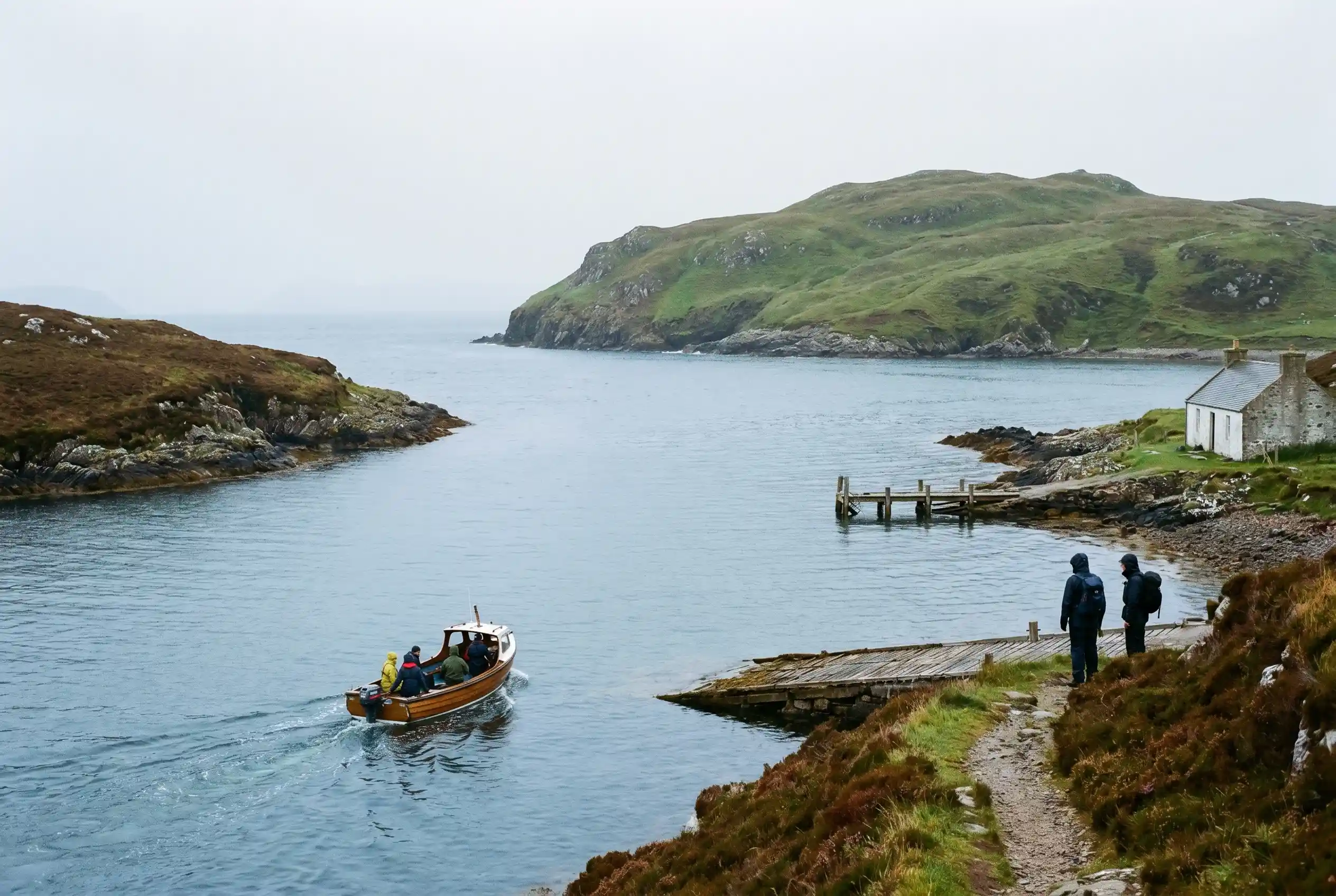
The Ulva Ferry runs a foot-passenger boat across a narrow strait between the Isle of Mull and Ulva, a crossing that takes about five minutes. From June through August the service will not run on Sundays, giving islanders and the island’s restaurant a single day to reset before the working week begins again.
The operator framed the move as a reluctant one, and was blunt about being caught off guard by the demand.
None of us could have predicted how significant the increase in the numbers of visitors would be, so to give ourselves, the Boathouse and fellow islanders the chance to recharge and prepare for the week ahead, we have made the difficult decision not to open Sundays this summer.
Anyone who had already booked a stay and is due to arrive or leave on a Sunday in June, July or August can still be helped across, the operator said. The Boathouse seafood restaurant on Ulva, which sits where the ferry lands, has become the island’s busiest pinch point.
Sixteen Residents Against a Summer Tide
The arithmetic is unforgiving. Ulva is home to 16 people, several of them children, and in a busy season the island can draw thousands of visitors arriving from as far away as Canada and Australia, all funnelling through one jetty and a single restaurant. The numbers tell the story on their own.
- 16 permanent residents, several of them children
- 4,000 visitors in a busy summer
- 800 people lived on Ulva at its 19th-century peak
- 5 minutes to cross from Mull on a foot-passenger ferry
Andy Primrose, who runs a small hostel on the island, said the bumper year had been good for trade, even if it had its limits. From his vantage point near the ferry slipway, the crowds had lifted the handful of small businesses rather than overwhelmed them.
The ceiling, he argued, is physical rather than commercial.
“It all comes down to capacity,” he told BBC Scotland News. “All these businesses are based on individuals and there’s only 16 folk here, and some of them are children. There is a natural limit to what you can do.” He added that the spending had spread across the island’s operators, which is why the surge had not felt overbearing on the ground.
From Six Islanders to a Boutique-Hotel Dream
The 2018 Community Buyout
Ulva’s story almost ended a decade ago. By the time the island changed hands, the resident population had slipped to about six, the rented houses were rotting, and work had drained away to the mainland over decades of under-investment.
In 2018 the North West Mull Community Woodland Company (NWMCWC, a community body set up to manage local land), bought the island for £4.65 million, the bulk of it (£4.4 million) from the Scottish Government’s Land Fund. The stated aim was social and economic development for the community, both now and for future generations. More than 350 people later registered an interest in moving there.
The House Banjo Wanted to Save
The centrepiece of that revival is a derelict Regency villa tied to Lachlan Macquarie, the early-19th-century colonial governor of New South Wales who was born on the island. The house had sat empty for eight years, with no electricity and no running water, slowly decaying within sight of the ferry route.
Then came Banjo Beale, the interior designer who won the BBC’s Interior Design Masters and now fronts Scotland’s Home of the Year, and his husband Ro Christopher. Their attempt to turn the crumbling mansion into a boutique hotel became the six-part series that changed the island’s fortunes. The studio behind the project sits on interior designer Banjo Beale’s own studio page.
“Maybe it will have some people come and stay, hopefully,” Beale told the BBC when he took on the restoration. That modest wish landed far harder than he expected.
Scotland’s £787 Million Set-Jetting Boom
Ulva is not the first Scottish location reshaped by a camera crew, and it will not be the last. Set-jetting, the habit of picking a holiday because of a film or television series, has become a measurable force in the national economy rather than a marketing footnote.
According to VisitScotland, 19% of leisure visitors in 2023 said film, TV or literature helped inspire their trip, a share that climbed to 37% among long-haul travellers. Those screen tourists spent £787 million in total that year, of which £161.4 million went directly on screen-related activities, and the agency counted 1.14 million overnight screen tourists across the period. The detail sits in Scotland’s film and TV tourism research and in Screen Scotland’s economic value reporting.
The pattern repeats across the map, with productions pushing visitors toward places that were quiet before the cameras arrived.
| Production | Location | Documented visitor effect |
|---|---|---|
| Outlander | Doune Castle, Stirling | Annual visitor numbers up about 6% |
| Outlander | Culross Palace, Fife | Up about 14% |
| Outlander | Newhailes House, Musselburgh | Up about 30% |
| Banjo and Ro’s Grand Island Hotel | Isle of Ulva | Ferry now closed on Sundays after “unprecedented” demand |
The flagship case remains Outlander, the time-travel drama that has driven double-digit visitor growth at several National Trust for Scotland properties since it first aired in 2014. Ulva is simply the newest, and by some distance the smallest, name on that list.
Skye Can Absorb Visitors, Ulva Cannot
Scale is the whole problem. The Isle of Skye, the poster child for Scottish overtourism, has a population of just over 10,000 and a road network that, however strained, actually exists. Skye still groans under cruise ships that can land up to 2,000 passengers in a single weekend, yet it has the infrastructure to take them.
Ulva has none of that, and the constraints stack up quickly. There are no roads, so people get around on foot or by quad bike, and the ferry carries foot passengers only. Every business is run by an individual or a couple, which means a single busy day lands on the same few pairs of hands.
- No roads and no car ferry, so visitors arrive and move around on foot
- One restaurant and a handful of small operators absorbing every arrival
- A resident workforce too small to draw on extra cover at short notice
- A five-minute crossing that turns into a bottleneck the moment a coach party books Mull
That is why the answer here was a closed day rather than a bigger boat. For a community this size, rest is the one lever it fully controls. On Sundays this summer the ferry will sit idle at the slipway, the narrow strait between Mull and Ulva quiet once more, while the island catches its breath before Monday.
Frequently Asked Questions
Is the Isle of Ulva still open to visitors?
Yes. Ulva remains open to day visitors and overnight guests six days a week. Only the Sunday ferry service is being paused, and only across June, July and August. The rest of the week runs as normal.
When can you not get the ferry to Ulva?
On Sundays throughout June, July and August 2026. The Ulva Ferry will not run that day so islanders and local businesses can take a break, though guests who had already booked a Sunday arrival or departure can arrange a crossing.
What TV show made Ulva so popular?
Banjo and Ro’s Grand Island Hotel, a six-part BBC Scotland series that aired from January 2026. It followed interior designer Banjo Beale and his husband Ro Christopher as they tried to convert a derelict Regency mansion into a boutique hotel.
How do you get to the Isle of Ulva?
By a foot-passenger ferry from the Isle of Mull. The crossing over the narrow strait takes about five minutes. There is no car ferry, and Ulva has no roads, so visitors travel on foot once they arrive.
How many people live on Ulva?
Just 16 people live there permanently, some of them children. The island once supported around 800 residents in the 19th century before depopulation reduced it to a handful.
 Scotland’s Bench Bet Pays Off Again in 33-17 Win Over Fiji
  PV Sindhu Turns a Ranking Comeback Into a Japan Open Final
  Kid Safe Phones Are Booming as Age Verification Laws Stall
  iPhone 18 Pro Camera Confirmed by a Tata Electronics Ransomware Hack
  EU Orders Google to Open Android and Share Search Data With Rivals
  Pixel’s Growth Streak Faces Its Biggest Test at the Pixel 11 Launch