
 Ishan Crawford
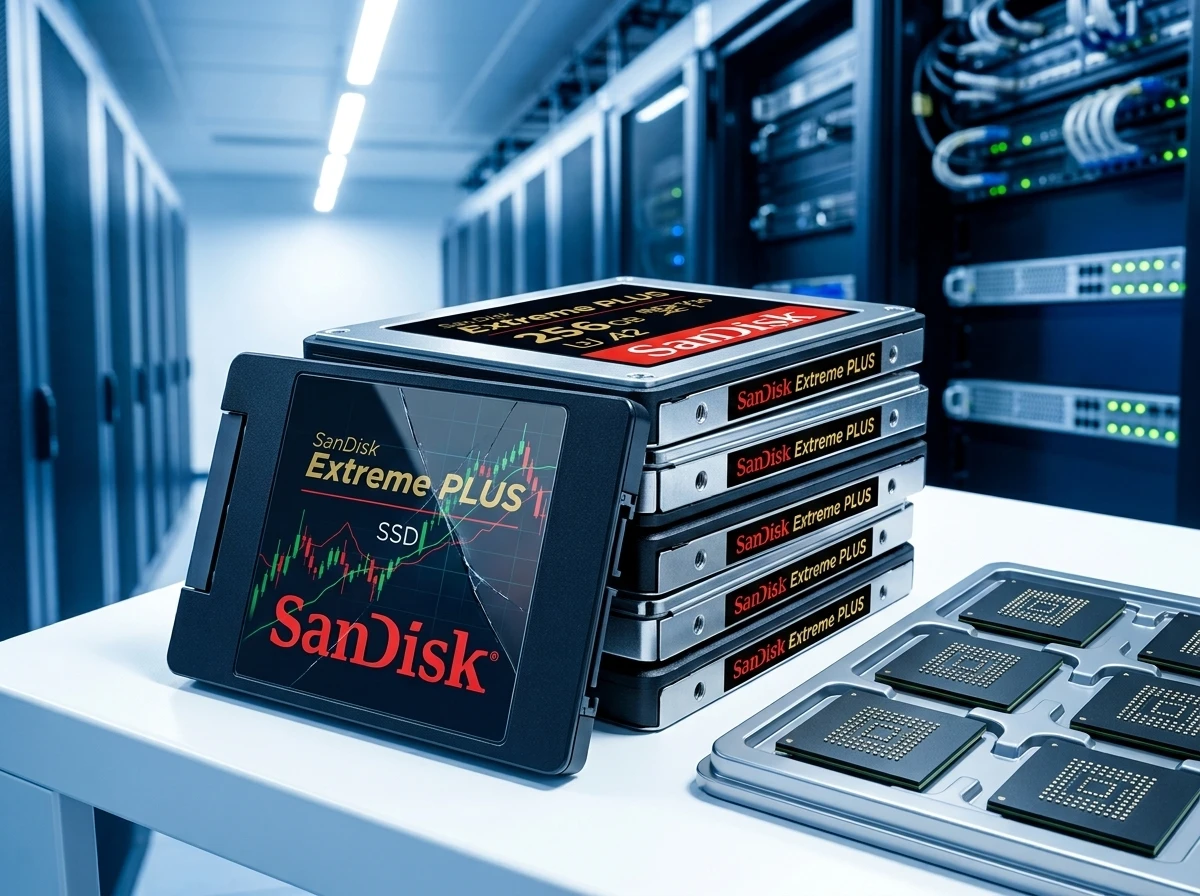
 Sandisk reported fiscal fourth-quarter adjusted earnings of $39.25 per share on revenue of $8.97 billion, crushing FactSet estimates of $34.96 and $8.48 billion, yet shares fell more than 5 percent after first-quarter revenue guidance of $10.3 billion to $10.8 billion landed below the $10.8 billion Wall Street target.
The memory maker’s stock has soared 469 percent this year and more than 3,100 percent over the past twelve months. That rally left little margin for anything short of perfection.
The gap between the print and the reaction is the story. Results cleared every major estimate. Guidance cleared every prior quarter. It still failed to clear the bar the rally itself had raised. Momentum that large turns ordinary sequential growth into a disappointment by default.
Record Quarter Still Met a Wall
Sequential revenue jumped 51 percent. Year-over-year growth hit 372 percent from the year-ago $1.9 billion. Non-GAAP gross margin reached 84.6 percent, up 6.2 points from the prior quarter and more than 58 points from a year earlier.
GAAP net income came in at $6.90 billion, or $43.97 per diluted share. For the full fiscal year 2026, revenue hit $20.25 billion, up 175 percent, with non-GAAP diluted EPS of $70.88 and GAAP net income of $11.43 billion.
| Metric | Q4 2026 | Q3 2026 | Change |
|---|---|---|---|
| Revenue | $8.97B | $5.95B | +51% |
| Non-GAAP EPS | $39.25 | $23.41 | +68% |
| Gross Margin | 84.6% | 78.4% | +6.2 ppt |
| Datacenter Revenue | $2.98B | $1.47B | +103% |
About one-third of the sequential gain came from higher volumes and two-thirds from higher pricing. Edge revenue was $5.43 billion, up 48 percent sequentially. Consumer slipped to $556 million.
That mix matters. Pricing supplied the larger share of the lift, which is why margins moved so far so fast. Volume still contributed a solid third, so the gain was not pure price alone. Edge held the bigger absolute dollars even as datacenter posted the faster percentage climb. Consumer’s slip shows the old end markets no longer set the pace.
Full-year revenue of $20.25 billion and non-GAAP diluted EPS of $70.88 turn a single strong quarter into a year-long reset. GAAP net income of $11.43 billion for the year underscores how much cash the cycle threw off once prices and mix both moved in Sandisk’s favor.
Guidance That Fell Short of the Hype
For the fiscal first quarter of 2027 Sandisk guided revenue to $10.30 billion to $10.80 billion and non-GAAP diluted EPS to $44.00 to $46.00. The revenue midpoint sits below the FactSet consensus near $10.8 billion. EPS guidance brackets the $44.72 consensus.
- Revenue midpoint roughly $10.55 billion versus Street $10.8 billion
- Gross margin guide 83.0 percent to 85.0 percent non-GAAP, a slight step down from 84.6 percent just posted
- Diluted shares expected around 155 million
Investors who rode a multi-thousand-percent climb wanted another blowout raise. They got solid sequential growth instead. Shares closed at $1,350.50, down 5.4 percent, and traded lower after hours.
The midpoint implies roughly 18 percent sequential growth after a 51 percent surge. That is still expansion. It is simply not the same rate. The gross margin range of 83.0 percent to 85.0 percent brackets the just-reported 84.6 percent and allows a slight step down. EPS guidance that brackets consensus while revenue guidance undershoots it tells the market the company expects to hold profitability even if top-line acceleration cools.
Diluted shares expected around 155 million keep the per-share math clean after the heavy buyback activity. The package is coherent. It is also conservative relative to the stock’s recent trajectory, and that is what the tape punished.
Datacenter Becomes the Growth Pillar
Datacenter revenue reached $2.98 billion in the quarter, ahead of the $2.74 billion estimate, and $5.15 billion for the full year, up 437 percent. CEO David Goeckeler said the company “established datacenter as a key growth pillar” and deepened customer partnerships.
Since announcing five New Business Model agreements in April, Sandisk signed five more, including three with new customers. Earlier three contracts alone carried roughly $42 billion in minimum contractual revenue as remaining performance obligations. These multi-year deals feature volume commitments, mixed pricing, and financial guarantees that lock supply for hyperscalers and revenue visibility for Sandisk.
The shift aims to reduce pure cyclicality. Customers get assured bits for AI clusters. Sandisk gets more predictable free cash flow. Momentum traders still prefer the old explosive pricing swings.
Full-year datacenter revenue of $5.15 billion already shows how fast the pillar scaled once the contracts began to convert. Beating the $2.74 billion quarterly estimate by a clear margin confirms demand is not purely a pricing story. The ten total New Business Model agreements now on the books spread that demand across a wider customer set, including three new names added after the first wave.
Volume commitments and financial guarantees change the negotiating dynamic. Hyperscalers secure supply for AI buildouts. Sandisk secures a floor under future revenue. Mixed pricing still leaves room for upside when the spot market runs hot, yet the minimums limit how far results can fall when it cools.
Buybacks Meet a Parabolic Run
The board approved an additional $14 billion share repurchase authorization, lifting remaining capacity to $15.5 billion. The company bought back $4.52 billion of stock in the quarter alone.
That capital return arrives after Sandisk completed its separation from Western Digital in February 2025 and began trading as an independent company under the SNDK ticker. Western Digital itself announced the planned separation of the company’s Flash business that same month.
The independent flash pure-play has ridden the AI memory shortage hard. Cloud builders at Amazon, Meta and Alphabet continue to pour capital into data centers. NAND supply remains tight. Prices and margins have soared. The stock’s valuation now prices continued perfection.
A $4.52 billion repurchase in a single quarter is aggressive by any standard. Layering another $14 billion of authorization on top signals management’s confidence that free cash flow can support both technology spending and large-scale capital return at the same time. Remaining capacity of $15.5 billion gives the company room to keep buying through whatever near-term volatility the guidance reaction produces.
The February 2025 separation created the pure-play vehicle that could run this strategy without the old conglomerate constraints. Trading as SNDK, Sandisk now stands or falls on flash alone. That clarity attracted the capital that drove the 469 percent year-to-date and more than 3,100 percent twelve-month gains. It also concentrated the expectations that made a solid guide look light.
Selling Spills Across Asia
The guidance reaction did not stay in the United States. Japanese and Korean memory names sold off hard in the next session. Kioxia slid more than 8 percent. SK Hynix dropped around 10 percent. Samsung Electronics lost more than 6 percent. Equipment names such as Tokyo Electron also fell.
That move echoes earlier pressure on regional chip shares when Chinese capacity headlines hit. Readers tracking those swings can see the parallel pattern in coverage of South Korea and Japan chip stocks.
Traders on X immediately framed the miss as a cycle signal. One widely viewed post called the guidance a “shock” that hit Asian memory hard. Others noted that peers such as Micron and Western Digital had delivered stronger forward looks, making Sandisk’s more conservative stance stand out.
We closed fiscal 2026 with a leading technology portfolio, established datacenter as a key growth pillar, and deepened our customer partnerships. Our technology and products are well positioned to create value for our customers and generate growing and durable free cash flow.
Goeckeler made that case on the release. Crowd reaction split between those calling the drop overdone given the backlog and buybacks, and those arguing high valuations leave no room for even modest margin compression.
The breadth of the Asian move shows how tightly regional memory names now trade on any signal from a major flash supplier. A guide that undershoots in the United States becomes a same-session or next-session reset in Tokyo and Seoul. Equipment names such as Tokyo Electron move with the memory producers because their order books depend on the same spending cycle.
Comparison to Micron and Western Digital sharpened the critique. When peers post stronger forward looks, a conservative stance reads as caution about pricing power rather than simple prudence. Social posts that labeled the guide a “shock” amplified that reading even though the absolute numbers still pointed to growth.
What the Contracts Change and What They Do Not
The New Business Model locks multi-year volumes and some pricing. It should produce steadier cash flow and lower earnings volatility than the old spot-heavy flash cycle. Full-year datacenter growth of 437 percent shows the AI pull is real.
Yet sequential revenue growth is now guided nearer 18 percent at the midpoint after a 51 percent surge. Gross margin is expected flat to slightly lower. That combination looks like early peaking of pricing power to some investors who bought the stock for unlimited upside.
- February 2025, Sandisk separates from Western Digital and lists as SNDK
- April 2026, First five NBM deals announced, including $42 billion minimums from three contracts
- August 5, 2026, Q4 results and ten total NBM agreements disclosed; $14 billion buyback added
- August 13, 2026, Investor Day scheduled for longer-term targets and product roadmap
The company still expects durable free cash flow. Cash generation has been strong enough to fund both the large buyback and ongoing technology investment. High Bandwidth Flash standardization work with SK hynix continues.
Short-term holders who chased the parabolic move now face the ironic cost of that success: expectations that treat a 50 percent sequential rise and mid-80s margins as the new baseline rather than a peak. Longer-term holders see contracted AI demand, a cleaner balance sheet and aggressive capital return as the foundation that survives any near-term pricing digest.
Margin Power Meets a Tougher Tape
Non-GAAP gross margin of 84.6 percent sits more than 58 points above the year-earlier level. That expansion is the clearest single measure of how tight NAND supply and AI-driven demand have rewritten Sandisk’s economics. The guide for 83.0 percent to 85.0 percent keeps the company inside that elevated band even if the exact peak has passed.
Two-thirds of the sequential revenue gain came from price. That ratio explains both the margin surge and the market’s sensitivity to any hint of pricing digestion. When price has done most of the recent work, investors watch the next guide for signs the lever is losing force.
- Price contribution supplied roughly two-thirds of the sequential revenue lift
- Volume contribution supplied the remaining one-third
- Margin guide holds the mid-80s even while allowing a slight step down
- EPS range still brackets the $44.72 Street number
Holding mid-80s margins while growing revenue at a still-solid sequential pace would have been celebrated in any prior cycle. After a 3,100 percent twelve-month run it registers as a pause. The distinction is about starting valuation, not about the quality of the underlying business.
Cash generation that already funded a $4.52 billion quarterly buyback and supports a $15.5 billion remaining authorization gives management tools to cushion the share count while the market digests the new growth rate. Technology investment continues alongside that return of capital, including the High Bandwidth Flash work with SK hynix.
Investor Day Will Test the Longer View
The August 13 Investor Day arrives days after the guidance reaction. Management will present longer-term targets and the product roadmap against a tape that has just reminded everyone how little room high valuations leave. The ten New Business Model agreements and the $42 billion in minimums from the earlier three contracts form the factual backbone of any durability argument.
Goeckeler’s statement on the release already framed the case: a leading technology portfolio, datacenter as a growth pillar, deeper partnerships, and growing durable free cash flow. The Investor Day is the forum where those themes turn into multi-year numbers the market can underwrite or reject.
Short-term holders and longer-term holders will hear the same slides differently. One group wants evidence that 50 percent sequential jumps can reappear. The other wants evidence that contracted volumes, mix improvement, and capital return can compound even when pricing power stabilizes. Both groups will parse the same backlog and margin framework for opposite conclusions.
The separation from Western Digital, the build-out of the New Business Model, and the scale of the buyback authorization are already complete. What remains is whether the market accepts steadier compounding as enough after a parabolic re-rating, or whether it continues to demand perfection every quarter.
Sandisk posts fiscal fourth quarter revenue of $8.97 billion and the accompanying tables as the hard record of the quarter just closed. The market’s verdict arrived in the same session: the numbers were excellent, the bar was higher, and the stock paid the difference.
 Scotland’s Facial Recognition Push Sparks Mask Ban Call
  Galaxy Z Flip 8 Hits $799 Only If Your Trade-In Qualifies
  If England Had Kept Water Public Like Scotland
  Samsung Smart Switch Now Moves Passwords and eSIM From iPhone
  Old Firm Spend Pulls Clear as Premiership Rivals Patch Squads
  Chinese Studios Quietly Seize the Gamescom Stage