
 Ishan Crawford
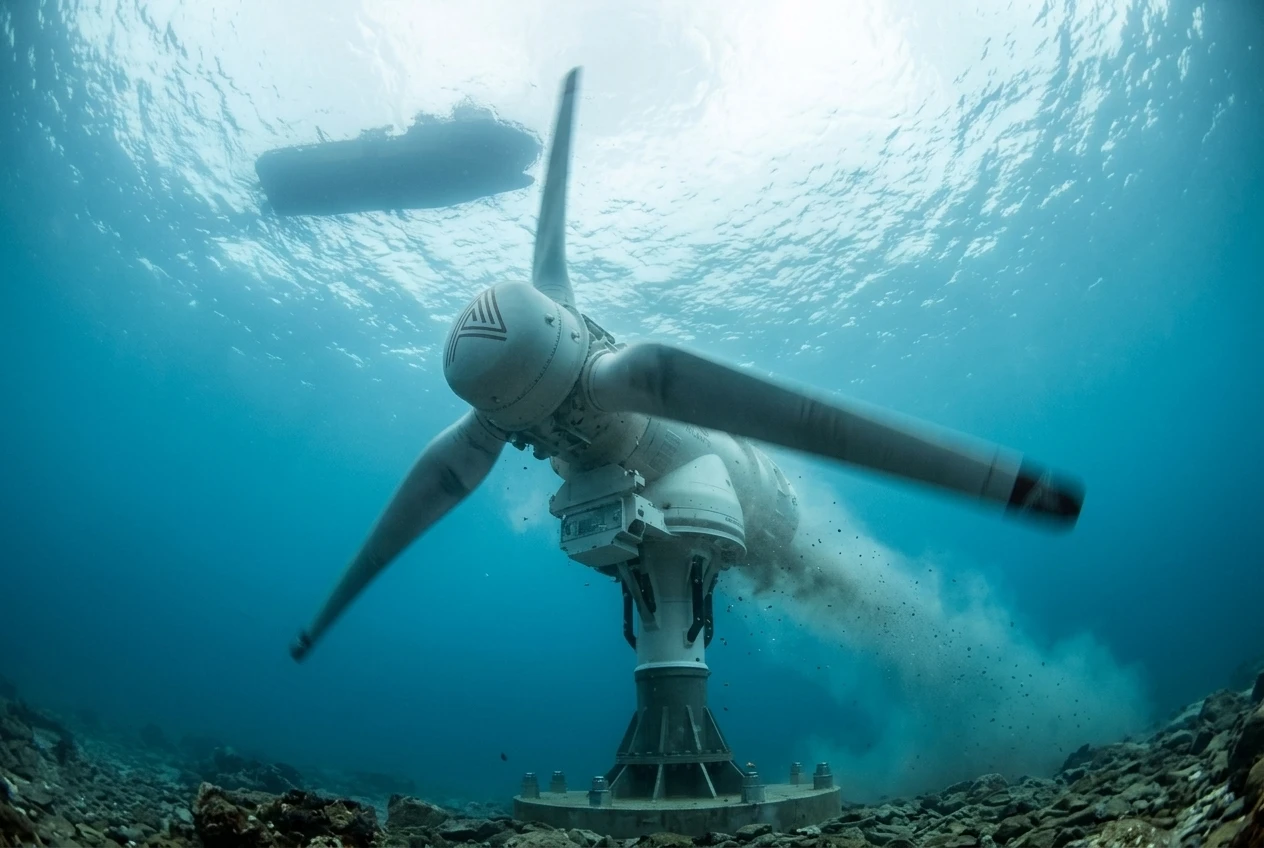
 A tidal turbine bolted to the seabed of Scotland’s Pentland Firth has now run six and a half years without a single unplanned repair, a mark its operators call a world record for the industry. The machine sits inside the MeyGen tidal array, wedged in the narrow channel between the Scottish mainland and the island of Stroma, spinning through some of the fastest flowing water in Europe.
That quiet endurance matters because almost everywhere else, the bet on tidal power has gone bust. Ventures in Canada’s Bay of Fundy have folded one after another, and a Scottish firm once had to pull a $12.9 million ocean energy device out of the water almost as soon as it went in. MeyGen staying upright and generating is the clearest evidence yet that a decade of UK public money aimed at an unproven technology is starting to pay off.
Six and a Half Years, No Repairs
The milestone was announced in July 2025 by SKF, the Swedish bearings manufacturer, working with Proteus Marine Renewables, which supplies power systems to the MeyGen project. Engineers confirmed the bearings and seals on one of the site’s four 1.5 megawatt turbines had passed the six and a half year mark without needing unplanned or disruptive maintenance.
Rémi Gruet, chief executive of Ocean Energy Europe, the Brussels based industry body for the sector, called it a very significant milestone for the future of tidal energy. He did not pretend it settled everything.
It’s a title we wish we didn’t have. We want more, we want others.
Gruet said that, adding that others in the sector are having difficulty matching what MeyGen has managed. Andrea Copping, a marine energy expert at the University of Washington, offered a similar mix of caution and credit, noting there are still a lot of challenges but that this project has shown long term operation is possible. Continuous generation in real ocean conditions, she said, is still rare; most tidal projects have amounted to tests and demonstrations.
Fraser Johnson, MeyGen’s operations and maintenance manager, put the engineering problem plainly: it is very hard to take what is essentially a wind turbine and put it underwater. The record setting machine should keep running for at least another year, he said, before it needs to come out of the water for scheduled maintenance. The Associated Press has reported that the turbine’s long operational stretch demonstrates improved durability for tidal technology in conditions that chew through steel and seals alike.
The Graveyard Tidal Power Left Behind
Since the first UK tidal stream tests in the mid 2000s, the wider industry has lurched from hype to collapse and back again. The casualties are not obscure footnotes. They are recent, and they are expensive.
- OpenHydro, partnered with Nova Scotia’s Emera Inc., went out of business in 2018 and left a 1,300 tonne tidal turbine stranded on the bottom of the Bay of Fundy.
- Sustainable Marine Energy, a UK based developer, failed with estimated losses of more than $30 million.
- Occurrent, formerly BigMoon Power, filed for bankruptcy in Nova Scotia, the latest in a string of Bay of Fundy collapses that has left fishing groups worried about equipment abandoned on the seafloor.
- A Scottish firm’s $12.9 million wave and tidal sea snake device was pulled from the water almost immediately after it was deployed in 2009.
Tory Rushton, Nova Scotia’s natural resources minister, responded to Occurrent’s collapse by insisting the province was not giving up. “We’re willing partners here,” he said. “If we can harness it and make power at an affordable rate, then we’re certainly going to do that.”
A review of 58 tidal stream deployments between 2003 and 2020, published in the journal Renewable and Sustainable Energy Reviews, found that just over half performed well, 18 percent failed outright, 14 percent were withdrawn from service and another 14 percent generated less power than planned. Blade failure was the most common cause, usually traced to engineers underestimating the loads the sea would throw at their machines. The same review found the failure rate has been falling steadily, closing in on numbers the wind industry would recognize.
Westminster’s Quiet, Expensive Wager
MeyGen survived that graveyard because the UK government decided, repeatedly, to keep paying for tidal power even when the market would not. Contracts for Difference, the mechanism that guarantees renewable generators a fixed price for their electricity, gave tidal stream nothing in its first three allocation rounds. There was no dedicated budget, and tidal could not compete on price with mature technologies. It secured zero capacity in AR1, AR2 and AR3.
Ministers then carved out a ringfenced pot reserved for marine energy. That single policy choice drove 121.86 megawatts of contracted tidal stream capacity by the sixth allocation round, including 38.02 megawatts in Wales. AR6 alone, decided in September 2024, secured 28 megawatts across six projects at five sites, clearing at £172 per megawatt hour. Parliament’s own record of the seventh round shows four more tidal projects secured a further 20.9 megawatts, pushing total CfD backed tidal stream capacity to 140 megawatts and keeping, in the government’s words, around half the world’s operational tidal stream deployment in UK waters.
The full breakdown of who won what sits in the Department for Energy Security and Net Zero’s AR7 results filing, published alongside the wider 14.7 gigawatt package of onshore wind, solar and offshore wind that made this the largest CfD round the UK has ever run.
| Allocation Round | When | Tidal Stream Capacity | Detail |
|---|---|---|---|
| AR1 to AR3 | 2014 to 2019 | 0 MW | No ringfenced budget, tidal secured nothing |
| AR6 | September 2024 | 28 MW | Six projects, five sites, cleared at £172/MWh |
| AR7 | January to February 2026 | +20.9 MW | Four new projects, cumulative total reaches 140 MW |
| AR7a | February 2026 | Budget squeezed | Ringfenced pot cut roughly 30% in real terms |
The Marine Energy Council, the industry’s own trade body, has pushed for something firmer than round by round announcements. In its response to the government’s consultation, it asked ministers to set a clear target of 1 gigawatt of tidal stream deployment by 2035, arguing the sector cannot plan supply chains around a ringfence that gets decided anew each year.
Why Does Tidal Power Cost So Much More Than Wind or Solar?
Tidal stream remains far pricier than its onshore rivals because it is still a small, young industry without the manufacturing scale that made wind and solar cheap. The clearing price for tidal projects in the UK’s most recent completed round was more than double what onshore wind fetched, and the government’s own reference ceiling price for tidal has kept climbing even as wind and solar prices fall.
- £172 per megawatt hour: tidal stream’s clearing price in AR6, September 2024
- £72 per megawatt hour: onshore wind’s clearing price in AR7
- £65 per megawatt hour: solar’s clearing price in AR7, itself 6.5% below the prior round
- £371 per megawatt hour: tidal’s administrative ceiling price set for AR7a, in 2024 adjusted terms
Context helps here. The average UK wholesale power price in 2025 ran above £80 per megawatt hour, and new gas fired generation is estimated to cost around £147 per megawatt hour to run. Tidal is expensive against wind and solar, but it is being asked to prove itself in a market where fossil generation is not cheap either.
MeyGen Aims for Fifty-Nine Megawatts by 2029
MeyGen is owned today by Ampeak Energy, the developer formerly known as SAE Renewables and, before that, SIMEC Atlantis Energy and Atlantis Resources. The company holds consent for 86 megawatts at the Inner Sound site, far beyond the 6 megawatts currently installed. Its own project page for MeyGen describes the site as the largest planned tidal stream project in the world, sitting on a Crown Estate lease that allows for up to 398 megawatts if every phase is eventually built.
Phase 2 aims to grow the array to 59 megawatts between 2027 and 2029, a jump developers describe as creating the world’s first commercial scale tidal array rather than a demonstration site. Separately, Proteus Marine Renewables and SKF plan to roll out new 3 megawatt AR3000 turbines from 2026, with 30 units planned across sites in Scotland, France and Japan, each capable of powering around 3,000 homes. A 12 month Marine Energy Taskforce, backed by the Crown Estate and Crown Estate Scotland, is meanwhile drawing up a roadmap to speed up wave and tidal deployment while keeping supply chain work in the UK.
Scotland’s wider renewables pipeline dwarfs any of this. Elsewhere in Scottish waters, developers are sitting on two gigawatts of offshore wind still awaiting seabird approval, a reminder of how modest MeyGen’s megawatts look next to the country’s main renewable bet. Tidal’s pitch has never been scale. It is the fact that its output can be forecast years ahead, tied to the predictable pull of the moon and sun rather than the weather.
The Next Auction Could Undercut the Bet
The AR7a outcome is where the vindication gets complicated. The tidal ringfence that used to be reserved for marine energy alone has been folded into a shared £15 million Pot 2 budget now contested by six competing technologies. The government’s own AR7a results notice confirms the reshuffled pot, and industry analysts have calculated that even if tidal stream captured the entire budget, the sector would still face a real terms cut of around 30 percent compared with what the AR6 ringfence was worth.
Geothermal power looks best placed to eat into that shared pot. Its administrative strike price sits at £219 per megawatt hour, well below tidal’s £371, giving geothermal developers far more room to bid low and win. Developers who have spent years building tidal project pipelines, securing planning consent and lining up supply chains now face a funding round that could hand most of the available money to a different technology entirely.
The turbine off Stroma will keep spinning regardless of what regulators decide next. Its repair free run already happened. Whether fifty nine more megawatts get built beside it now depends on an allocation round still being fought over in Whitehall.
Frequently Asked Questions
How Much of Britain’s Electricity Could Tidal Stream Power Actually Supply?
Research from ORE Catapult and Imperial College London puts tidal energy’s potential at 11.5 gigawatts, enough to cover about 11 percent of UK electricity demand, and estimates tidal stream projects could add up to £17 billion to the economy by 2050 if that potential is built out.
What Is the Difference Between Tidal Stream and a Tidal Barrage?
Tidal stream turbines like MeyGen’s stand freely on the seabed and spin in open flowing water, needing no dam. A tidal barrage, by contrast, blocks an estuary so water is forced through turbines as the tide rises and falls, requiring far larger civil works and a bigger footprint on the surrounding environment.
Do Tidal Turbines Harm Marine Life?
A 2025 review published in the journal Ecological Solutions and Evidence found that fears about tidal power’s ecological effects have often outpaced the actual evidence. Environmental impact assessments remain a mandatory part of consenting any new tidal site in UK waters regardless.
How Many Homes Can MeyGen Power Right Now?
At its current 6 megawatt capacity, MeyGen’s four turbines generate enough electricity for up to 7,000 homes a year. The Scottish government estimated back in 2013 that the fully consented 86 megawatt first phase could eventually power around 42,000 homes, equivalent to 40 percent of homes across the Highlands.
How Often Do Tidal Turbines Need to Come Out of the Water for Repairs?
MeyGen’s record setting turbine is expected to keep running for at least another year before it needs scheduled recovery, according to operations and maintenance manager Fraser Johnson. Recovery work uses specialist vessels for turbine retrieval and subsea cable work, similar to the offshore construction vessel deployed for MeyGen’s scheduled December works.
 ONGC licence frees Venezuela cash and operatorship talks
  Anthropic Hits $65 Billion Run Rate and Flips the AI Cash Test
  Supreme Court grounds the fare free-for-all with three-week clock
  Gold Nears $4400 as Soft Data Meets Oil Inflation Risk
  Nifty Slips as Zaggle Circuits and Dhoot Debuts Big
  Diesel Crack Tops $100 as Iran Rhetoric Lifts Crude