
 Ishan Crawford
 Lava has pushed its Virat V1 and Virat V1 5G launch from July 21 to July 24, confirming full specs with launch partner Flipkart. Both phones will sell under 25,000 rupees (roughly $300), exclusively on Flipkart, with no ads or bloatware out of the box.
The timing is awkward. Counterpoint Research just reported that India’s smartphone shipments fell 10% year over year in the second quarter, the steepest June-quarter slide in six years, driven almost entirely by a memory-chip price shock hitting cheap phones hardest. Lava is walking straight into that segment with a homegrown brand it has spent four years trying to rebuild.
Same Body, Two Very Different Engines
The two phones share a screen size and a design language but split hard on internals. The Virat V1 5G runs on the Unisoc T8200 chipset with 4GB of RAM and 64GB of storage, boots on Android 16 with no bloatware, and packs a 6,000 mAh battery behind a 6.75 inch HD+ display running at 120Hz. It carries a 13MP dual rear camera, a 5MP front camera, an IP64 rating for dust and splash resistance, and ships in Arya Blue or Sonar Gold.
The standard Virat V1 swaps in Unisoc’s older SC9863A chip and ships with Android 15 Go Edition, a lighter build of Android aimed at entry-level hardware, while keeping the same 4GB and 64GB memory setup. Its battery drops to 5,000 mAh, and it is not yet confirmed whether its display supports the same 120Hz refresh rate. It does get a confirmed side-mounted fingerprint scanner, a feature Lava has not yet confirmed for the 5G variant, and comes in Nilgiri Blue or Himalayan Silver.
| Spec | Lava Virat V1 | Lava Virat V1 5G |
|---|---|---|
| Chipset | Unisoc SC9863A | Unisoc T8200 |
| RAM / Storage | 4GB / 64GB | 4GB / 64GB |
| Display | 6.75 inch HD+, 120Hz unconfirmed | 6.75 inch HD+, 120Hz |
| Battery | 5,000 mAh | 6,000 mAh |
| Rear camera | 13MP dual setup | 13MP dual setup |
| Front camera | 5MP | 5MP |
| Software | Android 15 Go Edition | Android 16 |
| Build rating | IP64 | IP64 |
| Fingerprint scanner | Side mounted, confirmed | Not yet confirmed |
| Colors | Nilgiri Blue, Himalayan Silver | Arya Blue, Sonar Gold |
Neither phone has a confirmed price yet. Lava has only said the Virat series will stay under 25,000 rupees, and it plans to sell both models exclusively on Flipkart with its free at-home service program included.
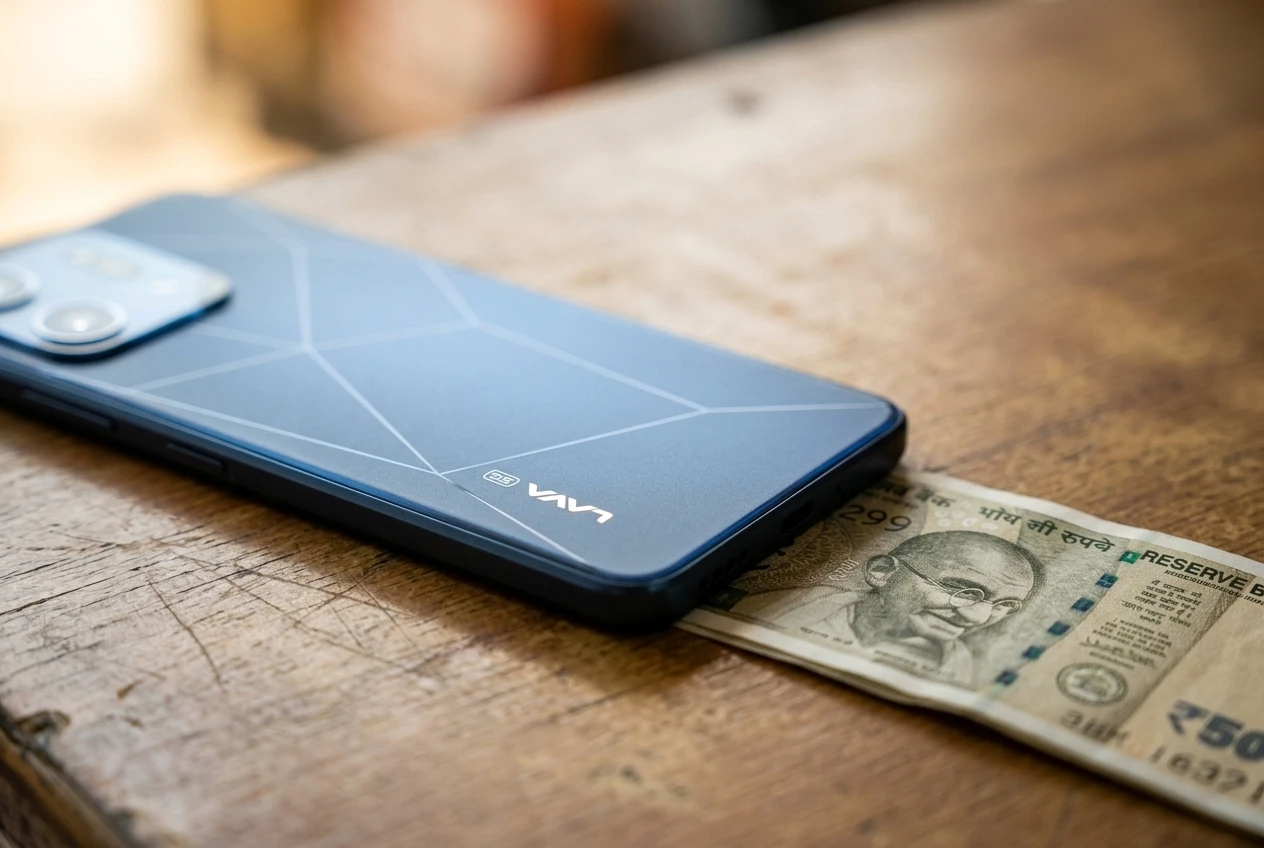
India’s Cheapest Phones Are Getting Sharply Pricier
Lava is launching into a market that just had its worst quarter in years. India’s smartphone shipments fell 10% year over year in the April to June quarter, the biggest June-quarter decline in six years, and the damage was not evenly spread. The segment under 15,000 rupees, exactly where the Virat V1 sits, saw shipments collapse 45% year over year, as memory chips alone jumped from under a fifth of a phone’s component cost to more than 45% in that price band.
Prachir Singh, a senior analyst at Counterpoint Research, said the pressure ran in both directions at once.
India’s smartphone market remained under pressure during the quarter, as both demand and supply were adversely affected.
Singh made the comment describing the broader Q2 slowdown. Counterpoint’s research director, Tarun Pathak, has said the firm expects the full-year market to shrink 13%, with memory prices already up close to fourfold since September 2025 and still climbing. Chinese brands, the same companies that built their scale in India on cheap 4G phones, saw their combined market share drop to its lowest point for a second calendar quarter since 2020, according to the same tracker. That is the exact gap Lava is trying to step into with a domestically made alternative.
Why Did Lava Choose Flipkart Over Amazon?
Lava built its recent smartphone comeback largely through Amazon, and the Virat series breaks that pattern entirely. The new lineup sells only on Flipkart, a shift multiple outlets covering the launch have flagged as unusual for a brand that has typically used Amazon as its main online storefront for phone launches.
Lava frames the deal as bigger than a distribution contract. Flipkart gets a homegrown brand to market as proof of its support for Indian manufacturing, and Lava gets access to a platform whose reach is credited with helping other budget and mid-range brands grow fast in India. The company says its own online sales grew 74% in 2025, part of a year in which its overall smartphone business grew 63% and its offline retail footprint passed 100,000 outlets. Flipkart’s vice president for mobiles, Kanchan Mishra, said the company sees the partnership as central to its broader push.
“At Flipkart, we are committed to bringing the best of India’s smartphone innovation to consumers across the country,” Mishra said, describing the Virat series as an extension of that goal.
Buyers in that Tier 2 and Tier 3 audience are the ones caught in the middle of this shift. They are the same value-conscious shoppers Counterpoint says are stretching out upgrade cycles as prices climb, and they are exactly who Lava and Flipkart say the Virat series was designed around from the start rather than adapted from an existing offline model.
The Brand That Paused Smartphones for Five Years
Lava’s push into online-first phones did not happen in a vacuum. The company, founded in 2009 and headquartered in Noida, spent years building its name in feature phones before smartphones became the priority again.
- 2017: A rough stretch across the industry forced Lava to shelve its smartphone plans. “After 2017, it was a difficult phase for all Indian smartphone makers,” Sunil Raina, Lava International’s managing director, said of that period.
- 2021: Lava launched the Agni 5G in November, marketed as India’s first India-made 5G smartphone at the time.
- 2022: The company restarted its smartphone push, beginning a run of 40 to 50% annual growth in the category that has continued since.
- 2024: The Agni 3 5G arrived in October with a rear AMOLED display, one of several design-first bets Lava made as it rebuilt its lineup.
- 2025: Lava’s smartphone portfolio grew 63% year over year, with online sales up 74% and retail expanding past 100,000 outlets nationwide.
- June 2026: Raina told reporters in Kolkata that Lava was targeting 10% of India’s sub-30,000 rupee segment by 2030, up from a base under 2%, while also preparing an Agni launch in the United Kingdom.
- July 9, 2026: Lava and Flipkart announced the Virat series partnership publicly for the first time.
- July 24, 2026: The Virat V1 and Virat V1 5G are set to launch, four days later than first planned.
Lava’s Noida factory is rated to build more than 42 million handsets a year, and the company still runs Agni, Storm, Blaze and Yuva as its offline-heavy lines. Virat does not replace any of them. It sits alongside them as Lava’s first lineup engineered specifically for online buyers rather than ported over from an existing offline design.
The Math Behind a Ten Percent Target
Raina’s own numbers show how far Lava has to climb. India’s smartphone industry ships around 150 million units a year, and the sub-30,000 rupee band he is chasing already makes up 70 to 75% of all of it. Getting to 10% of that band by 2030 means out-growing a market that Counterpoint expects to shrink for the rest of this year.
The brands Lava has to pass are not standing still either, even as the overall pie shrinks.
- vivo led Q2 2026 with 17.8% of shipments, though that was down from 19.2% a year earlier.
- Samsung climbed to 17.6%, up from 15.5%, the only major brand among the top five to grow shipments during the quarter.
- OPPO held 13.6%, up from 13.2%.
- Xiaomi reached 9.4%, up from 8%.
- Apple sat at 7% despite a 3% shipment decline tied to supply constraints.
- Lava remains under 2%, the gap Raina wants to close nearly sixfold within four years.
That gap is why the Flipkart deal matters more to Lava than a typical retail tie-up. A 40 to 50% compound growth rate sounds dramatic, but it is being measured off a tiny base, and Counterpoint’s own data shows the segment Lava depends on most is the one taking the hardest hit from rising component costs. Pricing for both Virat phones arrives on July 24, the same day Lava finds out how many buyers are willing to test that bet.
Frequently Asked Questions
Why hasn’t Lava announced Virat V1 pricing yet?
Lava typically confirms final pricing at the launch event itself rather than in pre-launch teasers. For comparison, its Agni 5G launched in 2021 at 17,999 rupees, giving a rough sense of what an affordable Lava 5G phone has cost in the past, though the Virat V1 5G uses far more basic hardware than that flagship-style launch did.
What does the Virat series’ IP64 rating actually cover?
An IP64 rating means a device is fully sealed against dust and can handle water splashes from any direction, but it is not built to survive submersion. It is a common protection level for budget phones rather than a swim-proof guarantee.
What is Android Go Edition, and why does only the Virat V1 use it?
Android Go Edition is a stripped-down version of Android built for phones with limited RAM and storage, trading some features for smoother performance on cheaper hardware. Lava is using it on the Virat V1 because its older Unisoc SC9863A chipset and lower memory ceiling suit the lighter software better than the 5G model’s newer chip does.
Does the Virat series replace Lava’s Agni, Blaze, or Yuva lines?
No. Lava is keeping Agni, Storm, Blaze and Yuva as its existing multichannel lineup sold both offline and online, while Virat is positioned as a separate, Flipkart-exclusive family built specifically for online-first buyers.
Why is Lava launching Virat on Flipkart instead of Amazon?
Lava has generally used Amazon as its primary online partner for past smartphone launches, so the Virat series marks a deliberate switch. Lava and Flipkart have both described the deal as going beyond distribution, with Flipkart’s consumer data feeding directly into how the Virat lineup was designed.
 ONGC licence frees Venezuela cash and operatorship talks
  Anthropic Hits $65 Billion Run Rate and Flips the AI Cash Test
  Supreme Court grounds the fare free-for-all with three-week clock
  Gold Nears $4400 as Soft Data Meets Oil Inflation Risk
  Nifty Slips as Zaggle Circuits and Dhoot Debuts Big
  Diesel Crack Tops $100 as Iran Rhetoric Lifts Crude