
 Ishan Crawford
 For the first time in 44 months, India’s manufacturers are spending more to make things than they can recoup at the loading dock. The Wholesale Price Index (WPI, the measure of factory-gate prices) input-output ratio crossed 1.0 in April 2026, landing at 1.02, after input costs jumped 6.2 percent on the month while output prices barely moved at 0.7 percent.
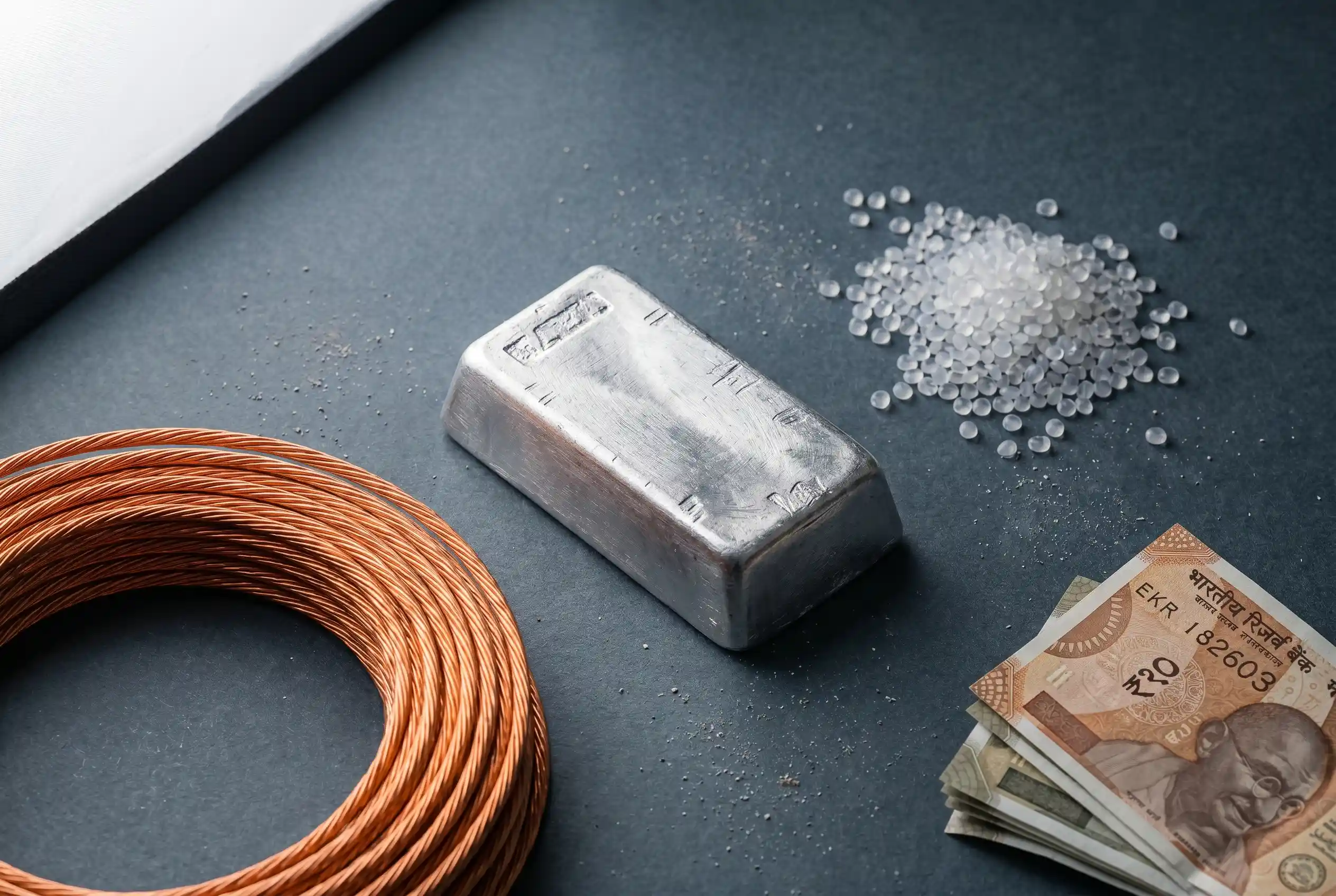
The latest Quickonomics note from rating agency Crisil ties the inversion directly to the closure of the Strait of Hormuz, the shipping chokepoint that carries roughly a fifth of the world’s oil and most of its liquefied natural gas (LNG) in peacetime. Pressure has spread well past fuel into copper, aluminium, plastics, and packaging, the inputs sitting inside nearly every shelf in an Indian retail store.
The 44-Month Streak Has Broken
The input-output ratio is the simplest gauge of whether Indian factories are eating their costs or passing them through. Below 1.0, output prices are keeping pace with or running ahead of input prices, and manufacturer margins are intact. Above 1.0, the inputs are racing ahead of what the factory can charge.
For 44 consecutive months ending in March, the reading stayed below the line. April broke it.
A 1.02 print is not large in absolute terms. The directional shift is what matters. Input prices climbed 6.2 percent in a single month while output prices moved 0.7 percent. Headline WPI inflation climbed to 8.3 percent from 3.9 percent the prior month; non-food WPI more than doubled, to 10.9 percent from 4.7 percent.
| WPI Indicator | April Reading | Context |
|---|---|---|
| Input-output ratio | 1.02 | First print above 1.0 in 44 months |
| Headline WPI inflation | 8.3% | Up from 3.9% the prior month |
| Non-food WPI inflation | 10.9% | Up from 4.7% the prior month |
| Input prices, month-on-month | +6.2% | Highest in nearly four years |
| Output prices, month-on-month | +0.7% | Pass-through still capped |
The 5.5 percentage points sitting between what factories pay and what they charge represent the margin cushion that has not yet snapped. The rating agency’s read is that it will, because the underlying inputs are not normalising on any near-term horizon the model can resolve.
Why the Strait of Hormuz Sits Behind Every Invoice
The trigger is geographic. The Strait of Hormuz, the 21-mile waterway separating Iran from Oman, became impassable to most commercial traffic after Iranian forces shut it in late February following strikes on Tehran. International Energy Agency (IEA) chief Fatih Birol has called the resulting shipping freeze the largest supply disruption in the history of the global oil market.
For India, which buys roughly two-thirds of its crude oil and a substantial slice of its LNG from suppliers that route through the strait, the closure has translated into a cascade of price shocks across feedstocks rather than a single fuel-price spike.
What the chokepoint carries in a normal month, per UN Trade and Development data on Hormuz trade flows:
- Roughly 20 percent of global oil flows and a comparable share of LNG cargoes
- About 40 percent of China’s crude oil imports and 70 percent of Japan’s Middle Eastern crude
- 12 to 14 percent of Europe’s LNG supply, almost all of it sourced from Qatar
- More than 1,550 commercial vessels and roughly 22,500 mariners trapped in or around the strait as of May 8
State-owned Shipping Corporation of India has been cleared by the Indian Navy to resume Persian Gulf voyages in the coming weeks, the first planned return of Indian-flagged tankers to the route since February. Even that limited reopening, however, comes with insurance premiums and freight rates that the World Economic Forum analysis of nine commodities affected by Hormuz describes as structurally embedded in input costs for at least two more quarters.
Copper, Aluminium, and the Bill for India’s Factories
The headline shock is fuel. The underlying shock is metals.
- +49.3% crude oil-related inputs, month-on-month in April
- +20.6% aluminium
- +19.1% gas-related inputs
- +17.3% copper
Copper and aluminium sit inside almost every category of industrial output Indian factories ship. Power cabling, electric-vehicle motors, transformer windings, smartphone components, air-conditioner coils, beverage cans, foil packaging, automotive body panels, rooftop solar inverters. A 17 percent monthly jump in copper and a 20 percent jump in aluminium are unusual enough that even sectors with no direct fuel exposure are facing rebuilt cost sheets.
The metals story is partly independent of the strait. Disruptions at Emirates Global Aluminium and Aluminium Bahrain (Alba), two of the largest Gulf smelters, have constrained physical supply for months. London Metal Exchange copper rallied 22 percent from below USD 11,000 a tonne at the close of November to a record USD 13,387 on January 6, well before the chokepoint shut. The Hormuz event sat on top of a structurally tight metals market and turned it into a panic.
Indian aluminium prices have moved roughly Rs 35 to Rs 45 per kg since late February, settling near Rs 358.7 per kg, a four-year high. High-density polyethylene (HDPE, the resin behind most flexible packaging) jumped about 42 percent in March alone, according to packaging-sector data. Plastics, the cheap input that has historically absorbed the worst of oil shocks for FMCG players, has lost its buffer status.
The pain map is wide. Automobiles use copper for wiring harnesses, aluminium for engine blocks, plastics for trim. Consumer durables, electronics, construction, packaging, pharmaceuticals, and textiles all draw on the same input pool. None of these sectors can pre-source a six-month buffer for a closure whose end date no one can model.
How Hindustan Unilever, Nestle, and Auto Makers Are Buying Time
Selective Price Hikes and Shrinkflation
Hindustan Unilever, India’s largest packaged consumer goods company, is absorbing an 8 to 10 percent surge in raw-material costs by raising selling prices 2 to 5 percent and trimming the grammage on small sachets, the format that drives most of its rural volumes. The company is defending an EBITDA (earnings before interest, taxes, depreciation, and amortisation) margin band of 22.5 to 23.5 percent. Operating margin already slipped to 23.5 percent in the latest reported quarter.
Packaged foods major Nestle India has taken a different bet, holding shelf prices to chase volume growth and absorbing the input pressure for now. Dabur, the herbal-and-ayurveda firm, has signalled selective price increases of up to 4 percent against an internal inflation rate of roughly 10 percent, using shrinkflation on the lowest-ticket packs.
Auto Margins Are Bending
The automotive sector tells the same story in heavier numbers. SML Mahindra reported that Q4 FY26 operating margin took a 130-basis-point hit from input inflation in its latest results call. Electric two-wheeler manufacturers are entering the new quarter with depleted aluminium inventories after a record sales month in March, knowing full pass-through is hard in a price-sensitive segment dominated by first-time buyers.
In the domestic market, with demand holding up so far, there is room to pass on the costs to consumers and support margins.
That line, from the Crisil note, is the operative sentence for the next two quarters. Manufacturers have absorbed roughly half the input shock through margin compression. The other half is queued for the price tag.
Why the Cushion Runs Out
The pattern across consumer-facing categories is consistent. Companies are eating part of the input shock, raising prices selectively on premium SKUs (stock-keeping units), shrinking pack sizes on entry-level ones, and hoping the chokepoint reopens before the next price-review cycle. The note’s view is that even a reopened route will not undo the input run-up, because metals tightness predates Hormuz and oil contango is still pricing in months of risk premium. Quarterly results from the FMCG cohort due in late July will mark the first hard read on how much absorption capacity is left.
Why the Pass-Through Window Opens This Quarter
The Crisil note makes one observation that should worry inflation watchers. Indian consumer demand has held up better than most of Asia despite the global commodity shock. Rural wages are running ahead of inflation, urban wage growth has slowed but stays positive, and the post-festive replenishment cycle has so far moved volumes.
That resilience is the door through which price hikes walk. Companies cannot raise tickets into a soft market, but they can raise them into one where the customer is still showing up. The note states this directly: there is room to pass on costs to consumers and protect margins.
Pass-through historically lags the input shock by one to two quarters. The factory-gate reading from April is the leading indicator. The July to September shopping cycle, which includes back-to-school buying, the early Onam and Janmashtami festive run-up, and the pre-Diwali inventory build, is when the marked-up packs hit the shelves. Households that have not yet noticed the rupee impact of the West Asia crisis at the petrol pump will begin noticing it at the kirana counter.
Fuel has already moved. Indian state-owned oil marketing companies raised petrol Rs 2.61 and diesel Rs 2.71 per litre in a single revision earlier this month, bringing the May increases to roughly Rs 7.5 per litre across both fuels, the fourth hike in under two weeks. Delhi petrol now sits at Rs 102.12 per litre, the highest level since May 2022. The fuel pinch alone shaves household discretionary spending. The packaged-goods pinch arrives next.
What the RBI’s FY27 Math Now Has to Account For
The Reserve Bank of India (RBI, the country’s central bank) projected fiscal year ending March 2027 (FY27) headline Consumer Price Index (CPI) inflation at 4.6 percent in its most recent monetary policy statement, against a flexible inflation target of 4 percent within a tolerance band. That number was anchored before Hormuz shut.
The OECD has since revised its FY27 forecast for India upward to 5.1 percent. India’s own Economic Survey for FY26 acknowledged that core inflation, the measure that strips out volatile food and fuel components, will need closer monitoring as global base-metal prices stay elevated and monetary easing carries through. The US Congressional Research Service primer on Iran conflict and Hormuz commodity flows tracks the same metals-channel risk through a different lens.
For the central bank, the bind is familiar. Factory-gate inflation flagged in the latest WPI print will start arriving in CPI readings from June onward. The Monetary Policy Committee (MPC) has been on an easing bias since late 2025. A core-inflation reacceleration into the second half of the calendar year would force a pause at minimum, possibly a reversal.
That, in turn, lands on equity valuations, bond yields, and the broader credit cycle the government has been counting on to support household consumption through the second half. The number to watch is not the headline CPI print, which food prices still dominate, but core CPI. Three consecutive months above 5 percent on the core gauge and the assumption that the inflation impulse is temporary fails the test of its own framework. The RBI’s published inflation-projection history shows how rarely the committee revises mid-cycle once it commits to a path.
If the chokepoint reopens within weeks and global metals retrace, India sees a brief factory-gate spike that the consumer-goods and auto sectors absorb without a full retail pass-through. If it stays shut into the festive quarter, the input-output ratio will not be the only 44-month streak that breaks.
 Leeds Botox Botulism Cases Reopen Britain’s Cosmetic Jab Gap
  Pragg Beats Carlsen at Norway Chess as Firouzja Holds Three-Point Lead
  Vivo X300 Ultra vs iPhone 17 Pro: The Camera Hardware Gap Is Real
  McCullum Bets Refined Bazball Can Survive a Home Summer Reckoning
  India 0, Jamaica 2: 24-Year English Wait Ends in a Familiar Loss
  India NCD Deaths Hit 60% as Heart Disease Drives One in Three