
 Ishan Crawford
 Leaks from Galaxy Club put the Galaxy S27 Pro at a 5,087mAh rated battery (likely advertised near 5,200mAh) and the S27 Ultra at 5,534mAh rated (around 5,700mAh typical). Silicon-carbon anode tech, already shipping in the Galaxy Z Fold 8 series, is the enabler after the Ultra line sat at 5,000mAh since 2020.
That capacity jump is real. So is the quieter trade-off already printed on the foldables’ regulatory labels.
The Numbers Finally Clear 5,000mAh
SamMobile and Galaxy Club report the first concrete figures for the two top S27 models. The Pro cell is rated 5,087mAh and expected to be sold as about 5,200mAh typical. The Ultra cell is rated 5,534mAh and expected to land between 5,700mAh and 5,800mAh in marketing.
Those gains land on phones still expected in a January or February 2027 Unpacked window, with retail shortly after. For context, every Galaxy S Ultra from the S20 Ultra onward carried a 5,000mAh pack. This would be the first true capacity step in six years for Samsung’s top slab phone.
| Model | Rated (mAh) | Typical / advertised (mAh) | Notes |
|---|---|---|---|
| Galaxy S26 Ultra | – | 5,000 | Long-standing ceiling |
| Galaxy S27 Pro (leak) | 5,087 | ~5,200 | Silicon-carbon expected |
| Galaxy S27 Ultra (leak) | 5,534 | ~5,700-5,800 | ~15% over S26 Ultra |
Galaxy Club notes the jump itself indirectly confirms silicon-carbon chemistry. Standard graphite anodes simply do not pack that much extra energy into the same chassis volume.
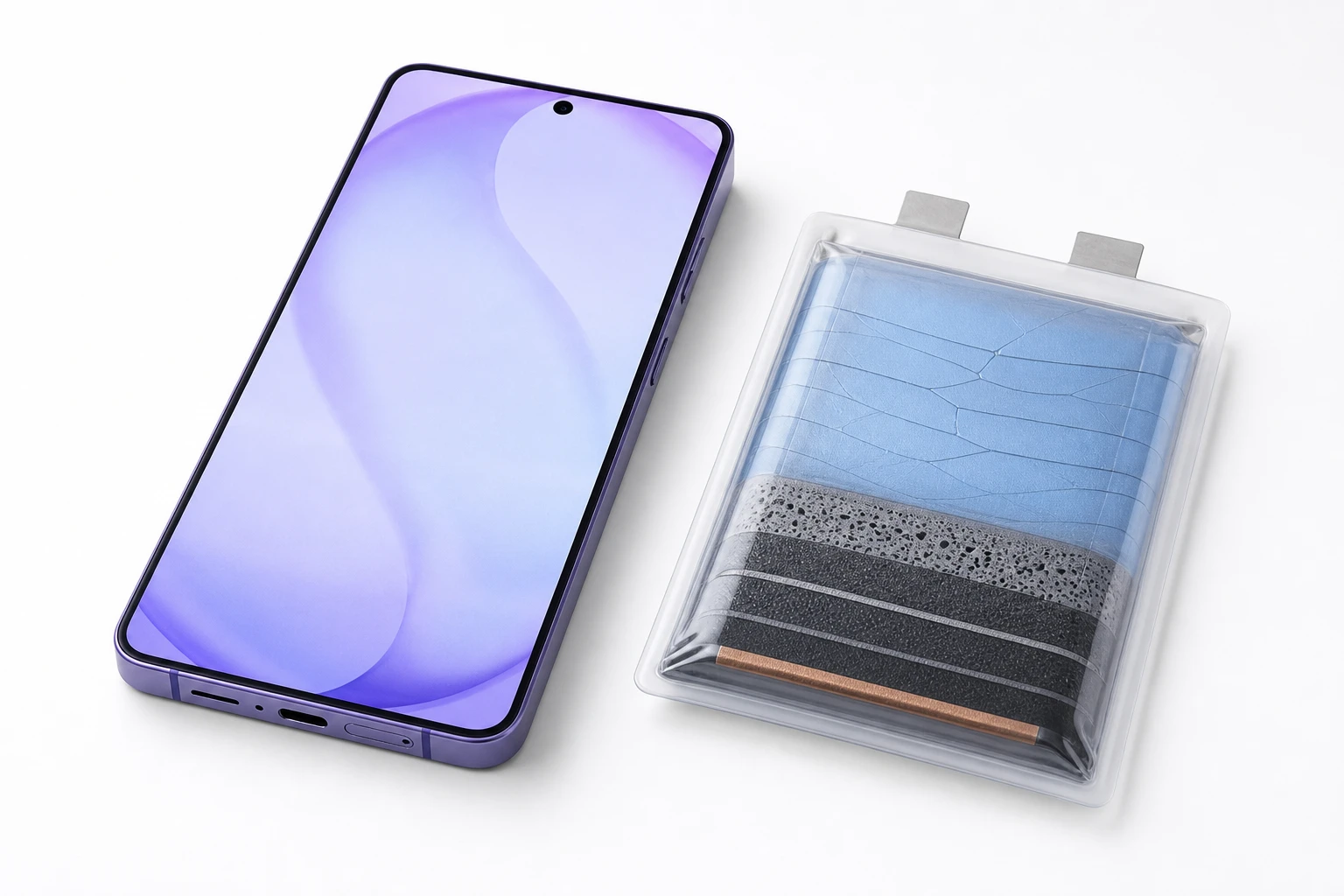
What Silicon-Carbon Changes
Silicon-carbon batteries remain lithium-ion cells. The anode mixes silicon with carbon instead of relying on pure graphite. Silicon holds far more lithium ions, so energy density rises and capacity climbs without a thicker phone.
The physics penalty is expansion. Silicon can swell up to 300% as it takes on lithium. Repeated swelling risks cracking the anode and shortening calendar life. Engineers limit the silicon percentage, add buffering structures, and accept a lower official cycle rating to keep swelling under control.
- Higher density: more mAh in the same footprint
- Expansion risk: silicon swells far more than graphite
- Managed trade-off: lower guaranteed cycles in exchange for day-one capacity
Samsung already shipped the chemistry in the Z Fold 8, Fold 8 Ultra and Flip 8. Real-world endurance tests on those devices showed clear gains over the prior generation, even with the new materials.
1,200 Cycles Replace the Old 2,000 Guarantee
EU energy labels for the new foldables list a minimum of roughly 1,200 full charge cycles before the pack is expected to hold 80% of original capacity. Last year’s Fold 7 and many prior Samsung flagships carried a 2,000-cycle figure. That is a 40% cut in the published endurance guarantee.
The drop tracks the chemistry change. Samsung still clears the bar set by most rivals.
Cycle snapshot
- 1,200 cycles: Fold 8 series silicon-carbon rating to 80%
- 2,000 cycles: prior Samsung flagship standard
- 1,000 cycles: Apple’s published target for iPhone 15 and later
A user who charges once a day reaches 1,200 cycles in a little over three years. That window matches or exceeds the typical flagship upgrade cycle for many buyers. Owners who keep phones four or five years will notice the difference sooner than annual upgraders.
Crowd chatter on X treats the number as largely academic for people who trade every two or three years. The bigger daily-use win is the extra capacity itself.
Apple Still Lists a Lower Official Target
Apple’s support documentation states that batteries in iPhone 15 models and later are designed to retain 80 percent after 1,000 cycles under ideal conditions. Earlier iPhones sat at 500 cycles for the same 80% mark.
Samsung’s new 1,200-cycle silicon-carbon rating therefore still sits above Apple’s published figure even after the drop from 2,000. The Korean company can market both more day-one capacity and a longevity number that beats the main rival’s disclosure.
Whether Apple follows with silicon-carbon on a future iPhone Air or Pro remains open. The pressure increases once Galaxy S27 units ship with multi-hour endurance advantages that reviewers can measure. Forbes noted that remaining the last major maker on older anode chemistry could become a hard sell once the capacity numbers hit store shelves.
The Quiet Win for the New Pro Model
Samsung confirmed a four-model S27 lineup earlier via GSMA filings that include a distinct Pro SKU between the Plus and Ultra. The leaked Pro battery already jumps past the old Ultra figure.
That matters for buyers who want strong cameras and performance without the largest screen or price. A ~5,200mAh pack in a more compact body would give the Pro a genuine all-day edge that previous mid-tier flagships lacked.
- Ultra keeps the largest cell and the highest camera ceiling
- Pro inherits near-Ultra capacity in a smaller chassis
- Base and Plus models still lack confirmed figures and may trail on cost grounds
- Foldables already proved the chemistry at Unpacked
The same Unpacked cycle that introduced silicon-carbon on foldables now sets up the S series. Samsung’s recent Unpacked push on foldables served as the live test bed before the higher-volume S27 launch.
Who Feels the Trade-Off and Who Does Not
Buyers who refresh every 24-36 months will mostly experience longer screen-on time and fewer mid-afternoon charges. The cycle rating cut lands outside their ownership window. Heavy users who keep a phone past four years, or who buy used two-year-old units, will hit the 80% threshold earlier than on older graphite packs.
Resale values could reflect that reality once the first wave of S27s ages. Early Fold 8 owners already live with the 1,200-cycle label; the market will price the difference once volume data arrives.
No official S27 battery or release confirmation exists yet. The figures rest on Galaxy Club reporting of internal specs and the pattern already visible on the foldables. Capacities for the base S27 and S27+ remain unconfirmed, and some tipsters have floated cost limits that could keep silicon-carbon on the top two models only.
If the numbers hold, the Ultra will ship with its first real capacity increase in half a decade and a chemistry that still clears Apple’s published battery targets. The irony is baked into the cell: the material that finally delivers the mAh everyone asked for also shortens the official guarantee that almost no one used to full length.
Samsung is betting most people will take the extra hours of daily runtime and move on before the cycle counter becomes the story.
 Scotland’s Facial Recognition Push Sparks Mask Ban Call
  Galaxy Z Flip 8 Hits $799 Only If Your Trade-In Qualifies
  If England Had Kept Water Public Like Scotland
  Samsung Smart Switch Now Moves Passwords and eSIM From iPhone
  Old Firm Spend Pulls Clear as Premiership Rivals Patch Squads
  Chinese Studios Quietly Seize the Gamescom Stage