
 Ishan Crawford
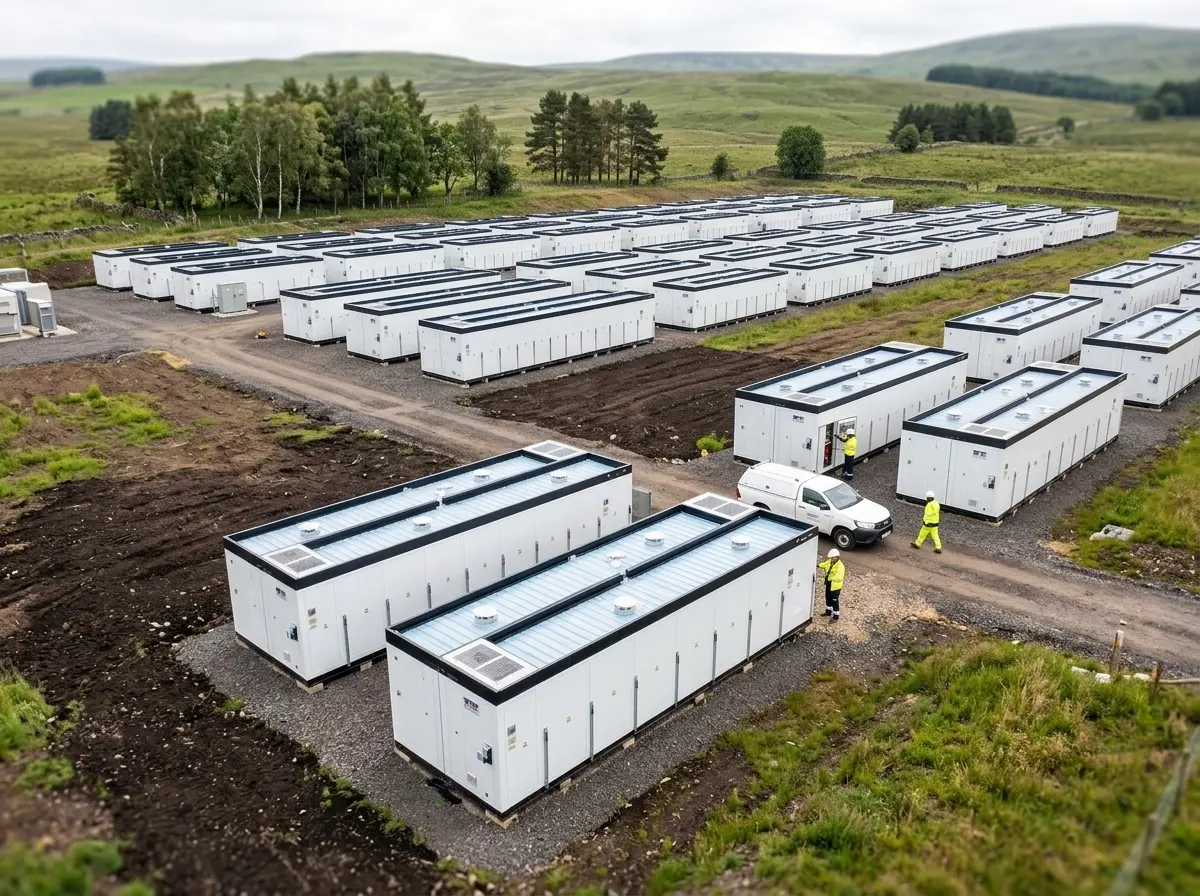
 The 500 MW/1 GWh Coalburn 1 battery energy storage system entered commercial operations this week on a former coal mining site in South Lanarkshire, Scotland, and is now the largest operational BESS in Europe.
Developed by Copenhagen Infrastructure Partners through its CI IV fund with local partner Alcemi, the two-hour lithium-ion project sits near Glasgow and marks the first of three transmission-connected Scottish assets to go live.
What Exactly Came Online at Coalburn
Coalburn 1 delivers 500 MW of power and 1 GWh of energy storage. Construction started in November 2023. Canadian Solar’s e-STORAGE unit supplied the hardware under a contract covering 1,170 MWh DC of SolBank LFP systems plus full integration, commissioning and long-term services.
The containers use lithium-iron-phosphate chemistry with liquid cooling and multi-level fire safety systems. CIP sold a 50% stake to AXA IM Alts in April 2025. RES signed an agreement to manage the 500 MW Coalburn facility in July 2025, adding it to a global services book of more than 43 GW.
- 500 MW power output, two-hour duration
- 1 GWh AC energy capacity (1,170 MWh DC nameplate)
- ~1.6 million metric tons of CO2 averted over 14 years per e-STORAGE estimates
- Transmission-connected, first of three CIP Scottish projects
Nischal Agarwal, partner at CIP, called delivery an important milestone for the firm’s European storage push.
Scotland’s Wind Bottlenecks Made the Site Logical
Scotland hosts heavy onshore and offshore wind yet faces north-south transmission limits. On windy days generators are often paid to curtail output so lines do not overload. Batteries sited at the constraint can soak up surplus power and release it later when the grid can move it or when demand rises.
That location logic underpins the entire CIP-Alcemi effort. The projects store excess Scottish generation that would otherwise be wasted, then inject it to ease stress events or serve peak load farther south. Crowd discussion on X this week sharpened the same point: assets like Coalburn cut the bills that flow to generators simply to stop producing.
UK operational grid-scale BESS capacity has climbed past 7 GW and roughly 12.9 GWh. Statera’s 300 MW/600 MWh Thurrock site in Essex held the UK size lead after August 2025. Coalburn 1 now tops both the UK and Europe lists for operational systems.
The Revenue Stack That Makes 500 MW Bankable
Coalburn 1 does not rely on merchant trading alone. Its contracts blend fixed and variable income.
| Revenue Stream | Duration / Volume | Counterparty / Notes |
|---|---|---|
| Optimisation agreement | 10 years | SSE Energy Markets (covers Scottish trio) |
| Capacity Market | 15 years / 300 MW | Fixed availability payment |
| Capacity Market | 7 years / 75 MW | Additional contracted volume |
| Merchant / balancing | Ongoing | Intraday, balancing mechanism, curtailment capture |
The capacity market slices lock in payments for being available. SSE’s optimisation agreement runs the trading. Together they de-risk a project whose capital outlay exceeded GBP 400 million at FID. That structure turns a large battery into something closer to infrastructure than pure merchant risk.
Three Scottish Sites and a 4.3 GW UK Pipeline
Coalburn 1 is the first of three 1 GWh-class transmission assets. Coalburn 2 will add another 500 MW at the same site. Devilla, near Fife, is the third. CIP has already partially divested Devilla stakes. Combined, the trio will deliver 1.5 GW of power and 3 GWh of storage once complete. Construction on the later two is due to ramp in 2027 after January 2026 FIDs.
Beyond Scotland, CIP and Alcemi are advancing a broader UK book of seven grid-scale BESS projects totaling 4.3 GW. The portfolio sits at strategic nodes chosen to ease network constraints and provide ancillary services. Progress here also feeds CIP’s storage experience in the US, continental Europe and Australia.
- Coalburn 1, 500 MW / 1 GWh, commercial operations August 2026
- Coalburn 2, 500 MW / 1 GWh, same site, construction ahead
- Devilla, 500 MW / 1 GWh class, Fife, partial stake sale completed
That scale matters. Smaller batteries struggle to justify transmission connections and deep offtake packages. A 500 MW unit can.
From Coal Spoil to LFP Containers
The site itself carries history. Coalburn sits in a former mining community. The same ground that once powered thermal plant now hosts containers that help integrate the wind that replaced much of that coal. e-STORAGE’s SolBank units are purpose-built for utility duty: LFP cells, active balancing, liquid cooling and layered fire management. Colin Parkin, president of e-STORAGE, said the firm was delivering nearly 2 GWh DC of storage to the UK market alone through this and related work.
Safety remains a live debate around large BESS. Lithium systems have recorded thermal events elsewhere. The LFP chemistry and multi-level protections are the industry’s standard answer for utility projects. Monitoring and control systems add another layer.
Project timeline in brief:
- November 2023, Construction begins at Coalburn 1
- December 2023, e-STORAGE awarded 1,170 MWh DC supply and integration contract
- April 2025, CIP divests 50% stake to AXA IM Alts
- July 2025, RES appointed as asset manager
- August 2026, Commercial operations declared, Europe’s largest operational BESS
What the Size Record Unlocks
The headline is Europe’s biggest battery. The second-order result is proof that large, transmission-connected BESS can be financed, built and contracted at scale in the UK market. CIP’s Agarwal put it directly:
As Europe’s largest operational battery energy storage system, Coalburn 1 will enhance the flexibility and resilience of the UK electricity system, support the integration of more renewable power, and contribute to lowering costs for consumers. Alongside Coalburn 2 and Devilla this project demonstrates CIP’s industrial capabilities in developing, commercializing and delivering energy infrastructure at scale.
That capability now has a live reference asset. It arrives against a backdrop of Scotland’s wider construction and skills pressures that have slowed other infrastructure. Battery projects that clear grid and offtake hurdles can still move.
The same storage build-out sits inside Europe’s push for diversified clean-tech supply chains. Canadian Solar’s e-STORAGE role shows Asian manufacturing remaining central even as policy favors resilience. The UK still needs tens of gigawatts more storage by 2030 under Clean Power targets. Coalburn 1 is one large brick in that wall, and the contracts that surround it show how the next bricks can be laid without pure merchant exposure.
Scotland’s wind will keep blowing harder than the wires can always carry. The battery now sitting on the old coal ground is built to catch what used to be spilled.
Frequently Asked Questions
How does Coalburn 1 compare in size to earlier European batteries?
At 500 MW / 1 GWh it exceeds the previous UK operational leaders such as Statera’s 300 MW / 600 MWh Thurrock site and Zenobē’s Blackhillock phases. Multiple industry outlets and CIP itself state it is now the largest operational BESS across Europe; no larger live counter-example has been reported in the coverage.
What battery chemistry and safety features does the project use?
It uses lithium-iron-phosphate (LFP) SolBank containers from e-STORAGE with liquid cooling, active cell balancing, multi-level fire safety management and continuous monitoring. LFP is chosen in part for its thermal stability relative to other lithium chemistries in utility applications.
Who owns and operates Coalburn 1 today?
CIP’s funds retain a 50% stake after the April 2025 sale of the other half to AXA IM Alts. RES manages day-to-day operations under a 2025 agreement. SSE Energy Markets holds the 10-year optimisation mandate covering the Scottish projects.
What fixed revenues support the investment case?
A 15-year Capacity Market contract covers 300 MW and a separate seven-year contract covers 75 MW, providing availability payments. These sit alongside the SSE optimisation deal and open-market trading of residual capacity.
How large is CIP’s overall UK battery portfolio?
Including Coalburn 1 the Alcemi partnership covers seven grid-scale projects with a combined 4.3 GW of power capacity. The three Scottish transmission assets alone total 1.5 GW / 3 GWh when complete.
 ONGC licence frees Venezuela cash and operatorship talks
  Anthropic Hits $65 Billion Run Rate and Flips the AI Cash Test
  Supreme Court grounds the fare free-for-all with three-week clock
  Gold Nears $4400 as Soft Data Meets Oil Inflation Risk
  Nifty Slips as Zaggle Circuits and Dhoot Debuts Big
  Diesel Crack Tops $100 as Iran Rhetoric Lifts Crude