
 Ishan Crawford
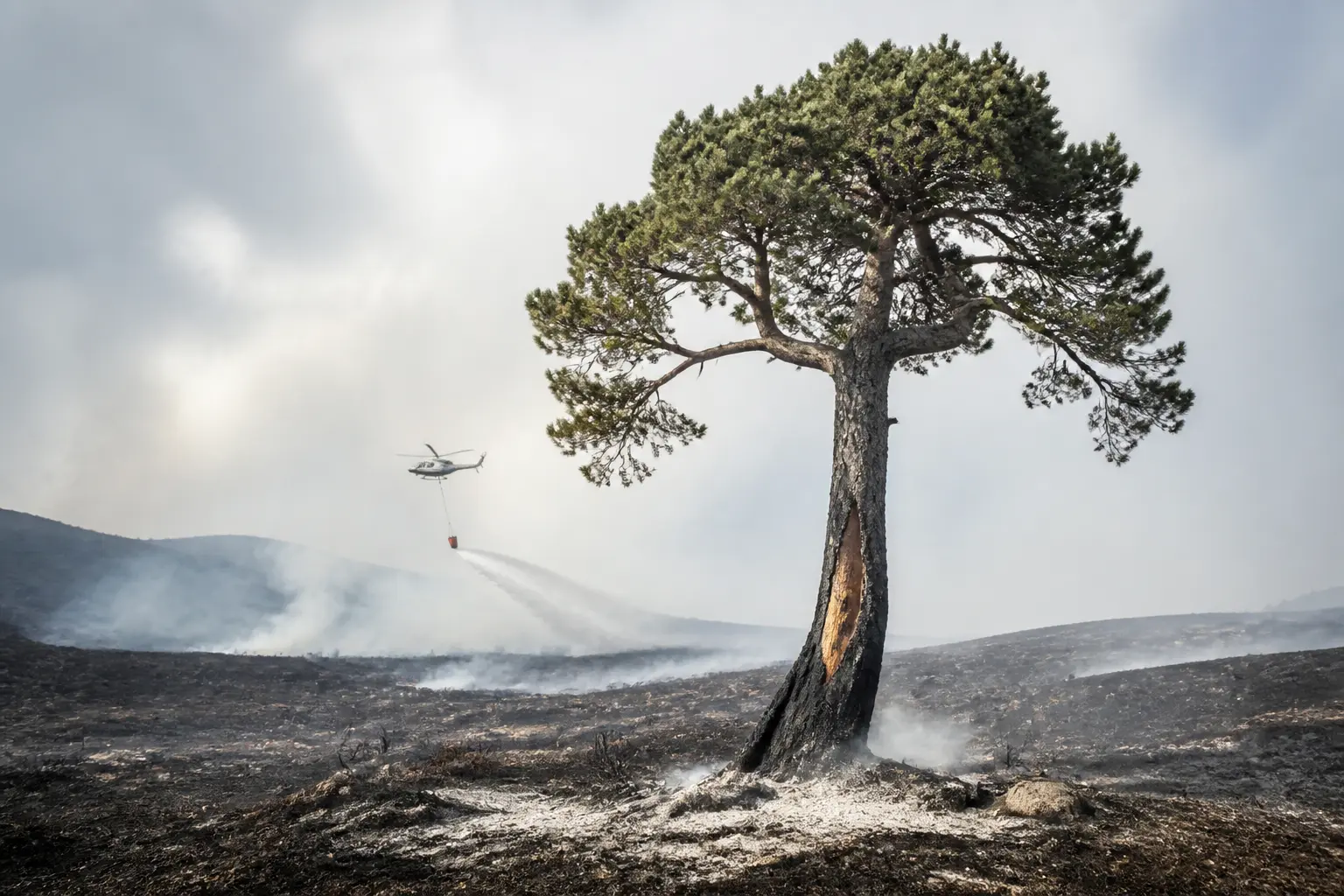
 Smoke still rises over the Cairngorms National Park, twelve days after a wildfire tore through it. The blaze has scorched roughly 2,500 hectares of moorland and ancient pinewood, and officials call it the worst fire the park has ever recorded. Firefighters remain on the hills. Rain has slowed the flames but has not put them out.
This is Scotland’s third supposed wildfire record in four years. The dedicated aerial firefighting fleet that locals demanded after the first two still does not exist.
2,500 Hectares of Ash
Grant Moir, chief executive of the Cairngorms National Park, calls it the worst fire the park has ever seen. It struck, he said, “right in the centre of the Cairngorms, in the actual Cairngorm mountains and Abernethy,” a place he considers precious beyond most others.
Police Scotland stopped classing the fire a major incident on Saturday night. That is a public safety label. Firefighting crews are still on the hill.
More than 75 firefighters were still on the hills on Sunday. A count of around 70 firefighters and nine fire engines remained days later, backed by specialist Wildfire Tactical Advisors. Visible flames have dropped, though pockets of ground fire still smoulder.
The response has pulled in nearly every public body with a stake in the Highlands.
- Forestry and Land Scotland – bulldozed the emergency firebreaks that saved most of the old pinewood
- Police Scotland – declared the major incident that triggered Friday’s evacuation, then stood it down a day later
- RSPB Scotland, the Scottish arm of the Royal Society for the Protection of Birds – manages the Abernethy reserve where much of the fire has burned
- Highland Council – helped coordinate the evacuation and the return of residents
Officials warn it could take weeks, if not months, before the fire is fully extinguished. Repairing the damage, they say, will take decades.
Three Centuries of Pine Lost in Days
The fire has clawed through parts of the Caledonian pinewood, a forest holding Scots pines up to 300 years old. Bulldozed firebreaks, cut in the fire’s earliest days, saved most of the ancient trees.
Ian Allsopp, Forestry and Land Scotland’s planning manager for the north region, put it plainly: “For rare habitat loss, it really is a challenge.” Deer and other large animals likely escaped, he said, but smaller mammals, lizards, insects and ground nesting birds would not have.
Among the pinewood’s residents is one of Scotland’s last strongholds of the capercaillie, a bird whose population has been sliding toward extinction for decades. Fire in this specific pocket of forest lands harder than almost anywhere else it could have struck.
Nethy Bridge Empties, Then Comes Home
Strong winds fanned the flames on Friday, prompting the evacuation of Nethy Bridge village. Residents have since been told they can return.
Inside the village community centre, now a makeshift base for emergency crews, a long table sags under donated food. Firefighters, police officers and volunteers move around it. Many look exhausted.
“It’s absolutely heartbreaking,” said Sandy McCook, a retired press photographer who lives in the village. “The flames on Friday were cataclysmic.”
McCook is angry too. He showed the Guardian a photograph he had taken of the fire when it was still only the size of a tennis court, long before it grew into the blaze that emptied his village.
What sparked the fire is still unknown. Most UK wildfires trace back to human causes, anything from a discarded cigarette to an abandoned glass bottle. A national park bylaw introduced in April already bans campfires and barbecues through the summer, part of an effort to cut ignition points.
How Many “Worst Ever” Fires Can Scotland Have?
At least three times since 2019, depending on how the record is measured. The yardstick keeps changing, an annual UK total one year, a single blaze the next, a national park’s own history this time. The pattern repeats anyway. A fire burns bigger than anything recorded before it, and no permanent aerial defence follows.
The 2026 Cairngorms fire holds a narrower record: worst in the national park’s own history, smaller by raw hectares than two previous fires elsewhere in the Highlands.
| Year | Event | Area Burned | Record Claimed |
|---|---|---|---|
| 2019 | UK wide wildfire season | 28,754 hectares | Highest annual UK total at the time |
| 2023 | Cannich wildfire, Highlands | More than 6,000 hectares | Believed the largest single UK blaze on record |
| 2025 | Dava wildfire and UK wildfire season | 47,879 hectares across the year | New highest annual UK total |
| 2026 | Cairngorms wildfire | Roughly 2,500 hectares so far | Worst fire in the national park’s own history |
Embers from the 2025 season kept burning long after the flames looked beaten, with hotspots persisting a year after Scotland’s previous record blaze. The Cairngorms fire is younger than that one, but it is already following a familiar arc.
The Highlands Are Losing Their Fire Immunity
The Scottish Highlands used to be considered too cool and wet to burn like this. That immunity is eroding.
Climate change is bringing warmer, drier spells in spring and early summer, drying out vegetation that would once have stayed damp through the season. Reduced grazing, rural depopulation and declining land management have let fuel loads build up across the hills, raising wildfire risk across traditionally cool, wet terrain.
- 30% to 50% – projected rise in Scottish wildfire risk by 2080, compared with the 1980s
- Eight – wildfires recorded in Scotland lasting more than five days since 2010, every one of them since 2018
- 47,879 hectares – UK area burned by wildfire in 2025, itself a modern record
Bigger fuel loads make for bigger, hotter, longer fires. That is the mechanism behind each of the records above.
Three Rented Helicopters, One National Gap
Three privately contracted helicopters have flown for days over the Cairngorms, dropping an estimated 750,000 litres of water a day onto hotspots. Allsopp called it “so lucky” that operators were available at all to water bomb what he described as an “inferno.”
Much of the terrain works against firefighters on foot. Allsopp calls the Cairngorms “an extremely challenging landscape” of steep mountains and forest, where “access is so difficult, you just can’t get people up here.” That is precisely why the helicopters matter.
McCook wants something more permanent: a model built like the Scottish air ambulance, with a helicopter and crew on standby, able to scramble the moment a fire is reported.
Had we had a helicopter there on government contract to deal with such incidents, that fire could have been dealt with within two hours of it being reported.
McCook is not the only one making that case. By Monday, the Scottish Greens were pressing for a publicly funded firefighting aircraft to run through the wildfire season. The party said Scotland has instead relied on a patchwork of private operators and borrowed resources.
The UK government offered military support on Sunday. It had no access to the specialist firefighting helicopters the Scottish government had actually requested, part of a day-long wait for helicopters Scotland does not own earlier in the fire’s course.
More Dry Weather Is Already on the Way
The Scottish government’s own review of the helicopter call off process includes a full cost and benefit analysis. No public timeline has been set for its conclusions.
Light rain has slowed the fire and eased the smoke over recent days. Allsopp is not celebrating yet.
“Wet weather is not enough to put out the fire on its own,” he said. Full containment, he said, still needs helicopter water bombing “for days and days and days.”
More dry weather is forecast across the Highlands in the coming days. Firefighters are staying on the hills to meet it.
Allsopp described the whole response as feeling like “a war strategy,” with staff from every part of his organisation, accountants included, sent out to fetch water and sun cream for crews on the hill.
 ONGC licence frees Venezuela cash and operatorship talks
  Anthropic Hits $65 Billion Run Rate and Flips the AI Cash Test
  Supreme Court grounds the fare free-for-all with three-week clock
  Gold Nears $4400 as Soft Data Meets Oil Inflation Risk
  Nifty Slips as Zaggle Circuits and Dhoot Debuts Big
  Diesel Crack Tops $100 as Iran Rhetoric Lifts Crude