
 Ishan Crawford
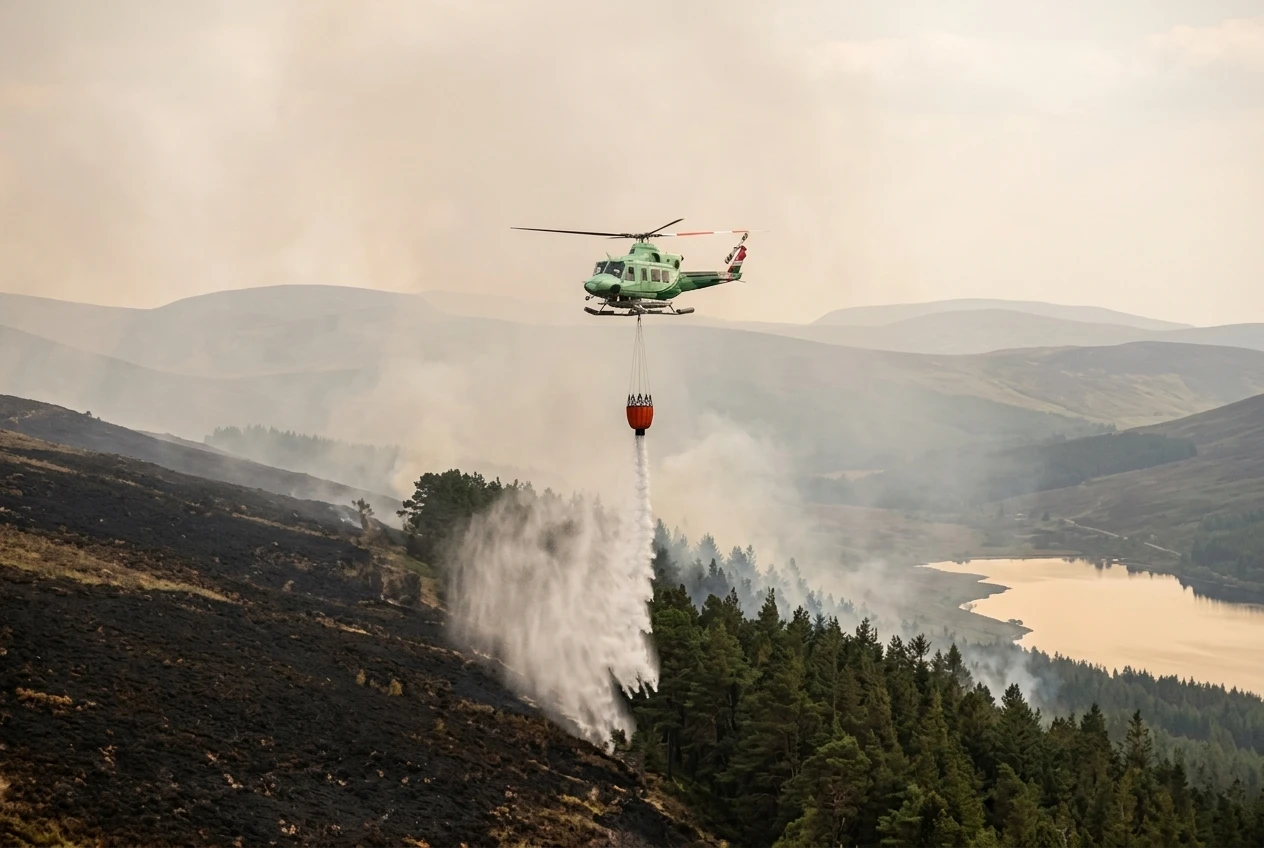
 Two helicopters spent Friday dropping water on a Cairngorms wildfire that has burned for three days, but the aircraft themselves took longer to arrive than the fire took to spread past two miles wide. Crews asked for a helicopter on Wednesday, the day the blaze broke out near Ryvoan Bothy south of Nethy Bridge. None were available. The first one did not reach the fire ground until Thursday night.
Scotland does not keep a single aircraft on standby anywhere in the country built specifically to fight wildfires. Every helicopter now working the Cairngorms fire was hired, borrowed or diverted from another job, a gap that a Highland councillor, a community council chairman and the Scottish Government’s own strategy have all pointed to this week.
A Request Wednesday, an Aircraft Thursday Night
The fire was reported just before noon on Wednesday, July 15, after smoke was spotted near Ryvoan Bothy on RSPB Scotland’s Loch Garten reserve, close to Forestry and Land Scotland’s Glenmore holdings. By Wednesday night it stretched roughly two kilometres wide. RSPB Scotland, the conservation charity that owns the reserve, sent all 27 of its on duty staff and volunteers to the fire line with quad bikes, backpack hoses and shovels.
A spokesperson for the charity said at the time that no aircraft were free because every helicopter appeared to be tied up fighting wildfires in England and Wales. Two aircraft eventually reached the fire ground on Thursday night, more than a day after that first request, and the Cairngorms National Park Authority confirmed Friday afternoon they were still flying water bombing runs.
Lynne Gow, an SFRS area commander, said the aircraft gave crews an operational lift in ground the trucks could not reach. Aerial support, she said, complements the ground effort and helps limit the fire’s spread where conditions allow. More than 50 firefighters, nine fire appliances and two specialist wildfire units remained on scene through the weekend.
Was the Fire Ever Really ‘Contained’?
Not by most accounts on the ground. Neil Gray, Scotland’s justice secretary, called the blaze “currently contained” on Thursday afternoon, crediting the “exceptional work of firefighters.” Land managers and gamekeepers battling the flames pushed back within hours, and a wildfire prevention specialist dismissed the word outright.
- Neil Gray, justice secretary: said the fire was “currently contained” thanks to firefighters’ work, and that his government would keep reviewing the situation.
- Calum Kippen, co-founder of Bright Spark Burning Techniques, a wildfire prevention firm: rejected the term, saying “the only way to describe the fire as being contained is that it’s maybe contained between the Atlantic and the North Sea.”
- Land managers and gamekeepers on the fire line: told reporters the wording did not match what they were seeing, though the SFRS said the phrase was not intended to alarm and that live incidents can change fast.
By Friday the fire had burned an estimated four square kilometres, about 1.5 square miles, up from the roughly 300 hectares RSPB Scotland had logged a day earlier as the blaze kept moving through Caledonian pinewood and open moor.
Campsites, a Ski Resort and a Reindeer Herd Go Quiet
The closures stack up fast once a fire this size sits on top of a national park built on tourism. Glenmore Forest Park and the area around Loch Morlich have been under a strict cordon since Wednesday night, with no public access while crews work.
- Campsites and the ski resort inside Glenmore Forest Park, closed as a precaution
- The Loch Garten Nature Centre, run by RSPB Scotland on the reserve where the fire started
- A stretch of the A9 closed after smoke drifted across the carriageway and cut visibility for drivers
- The C7, known locally as the Ski Road, closed at Coylumbridge
- A visitor centre running guided trips to see the area’s free ranging reindeer herd, which evacuated staff and suspended trips
- Homes and properties near Nethy Bridge, evacuated as a precaution rather than in response to direct danger
Aviemore, the gateway town whose economy has shifted from a skiing base to a year round tourism draw over five decades, sits just down the glen from the cordon. There have been no reports of any casualties throughout the incident.
Scotland Fights Wildfires Without Owning a Single Aircraft
The gap goes deeper than one late helicopter. Scotland and the rest of the UK have no permanent, government owned fleet of firefighting aircraft. Official wildfire operational guidance published by the Scottish Government says UK fire services are, with very few exceptions, unable to rely on any aerial support of their own, and instead lean on local arrangements with companies whose main business is not firefighting at all.
Firms such as Skyhook Helicopters, a private operator that can drop 1,000 litres of water on a fire roughly every three to four minutes once on task, fill that role under contract when a fire service calls. It is a system built on availability rather than guarantee, and this week that showed. Two more wildfires, at Fauldhouse Moor in West Lothian and Tentsmuir Forest in Fife, were burning at the same time, pulling engines and attention toward other parts of the country.
Sandy McCook, chairman of Nethy Bridge Community Council, put it bluntly: there is still no firefighting helicopter capability in Scotland, civilian or military. Bill Lobban, a Highland councillor who lives in Aviemore, said the impacts of global warming have never been clearer and argued the country must rethink how it handles wildfires. Duncan Ferguson, a Glenmore resident evacuated this week, said his community asked for a local fire plan five years ago and got nothing.
| Aircraft Type | Typical Water Capacity |
|---|---|
| Small single engine airtanker | About 3,000 litres (800 gallons) per drop |
| Large fixed wing airtanker | 35,000 plus litres (9,400 plus gallons) per drop |
| Contracted helicopter with bambi bucket | Roughly 1,000 litres per drop, refillable every 3 to 4 minutes |
None of those aircraft are owned by the Scottish Government or the SFRS. Every one is chartered, borrowed from the military, or contracted from private operators as the need arises.
The Plan That Already Flagged the Gap
Scotland published a Strategic Action Plan on wildfires in March, four months before this fire, after 2025 became the country’s worst wildfire season on record. Among its listed actions was a promise of reviewing helicopter access protocols and identifying ways to strengthen aerial support during peak wildfire risk periods.
That review is still open. A Scottish Government spokesperson said this week that the SFRS, public bodies and Scottish Wildfire Forum partners are already working with the government to review the helicopter call off process and identify every opportunity for improvement, including a full cost and benefit analysis, adding that the work is well underway and recommendations will follow in due course. The same spokesperson said the Cairngorms incident had been appropriately and proportionately resourced throughout.
Scotland had already launched that wildfire strategy naming the Cairngorms National Park directly as a potential trial site for a mountain rescue style volunteer network. It was not finished in time for Wednesday.
Last Year’s Fire Was the Biggest Britain Had Ever Seen
This is not the first time Scotland has watched a wildfire outrun its response. Between June 28 and July 2, 2025, wildfires around Carrbridge and Dava Moor, not far from this week’s fire, became the largest ever recorded in the UK. They burned close to 10,000 hectares of moorland, peatland and woodland, with flames reaching 20 metres in length.
Scotland’s government has called 2025 its most severe wildfire season on record, logging 241 wildfire incidents that year, with 109 of them in April alone. The SFRS issued 14 separate wildfire warnings across 2025, the last one landing in October, well outside what used to count as the season. A five-year tracking study from the James Hutton Institute, a Scottish research body, found wildfire activity spread across 442 square kilometres of the country’s moorland, almost all of it outside the controlled burns land managers use to cut fuel loads.
The fire that grew past two miles wide near Ryvoan Bothy this week was already testing that strategy within its first 24 hours, months before any trial volunteer network or byelaw was due to begin.
A Warmer, Drier Scotland Is the New Backdrop
This is not happening against a stable climate. The Met Office’s latest State of the UK Climate report found 2025 was Britain’s warmest year on record, the sixth time that record has been broken so far this century. Mike Kendon, the report’s lead author, said plainly that what used to count as extreme weather is increasingly becoming normal. The most recent decade measured 1.33C warmer than the 1961 to 1990 baseline, and the number of days above 30C has quadrupled in parts of Greater London.
Michael Byrne, a climate scientist at St Andrews University, said Scotland is seeing more rainfall in winter and milder temperatures, ideal conditions for vegetation to grow thick before it dies and dries into fuel. Warmer air pulls more moisture out of that dead vegetation, he said, making it far more flammable once summer turns dry. Christopher Blanchett, senior weather presenter at BBC Scotland, said the west Highlands crossed the heatwave threshold earlier this week and the Cairngorms had gone seven days without meaningful rain, with none expected in the days ahead.
The SFRS wildfire warning covering the central Highlands, southern and eastern Scotland runs until Monday, July 20. Fire crews remain at the Cairngorms scene, and there have still been no reports of any casualties.
Frequently Asked Questions
What is a bambi bucket?
A bambi bucket is the collapsible container helicopters use to fight wildfires from above. It hangs beneath the aircraft on a cable, gets filled from hydrants, fire engines or open water such as Loch Morlich, and releases through a valve the crew controls to drop water precisely where it is needed.
What is the Scottish Wildfire Forum?
It is a joint body bringing together the SFRS, land managers, public agencies and other stakeholders to reduce the risks wildfires pose to people, wildlife and property. The group is behind this week’s wildfire warnings, and it is due to gather the wider wildfire community at a UK conference in Leeds this November.
Why are conservationists worried about capercaillie near the Cairngorms fire?
Capercaillie are large, ground nesting woodland grouse that had already gone extinct in Britain once, in the mid-18th century, before being reintroduced in Perthshire in 1837. Breeding males had risen by roughly 50 percent since 2020 after habitat loss, egg predation and deer fence collisions cut numbers, and the National Park and NatureScot launched an emergency plan this year to build on that recovery, only for birds recently seen near Ryvoan to end up in the fire’s path.
Are the free ranging reindeer near Glenmore safe?
Yes. The visitor centre that runs guided reindeer trips confirmed on Thursday that its herd was safe on the hills away from the flames, though staff were evacuated as a precaution and trips remain suspended until further notice.
 ONGC licence frees Venezuela cash and operatorship talks
  Anthropic Hits $65 Billion Run Rate and Flips the AI Cash Test
  Supreme Court grounds the fare free-for-all with three-week clock
  Gold Nears $4400 as Soft Data Meets Oil Inflation Risk
  Nifty Slips as Zaggle Circuits and Dhoot Debuts Big
  Diesel Crack Tops $100 as Iran Rhetoric Lifts Crude