
 Ishan Crawford
 Andrew Taylor finished his final Burryman circuit through South Queensferry on 7 August 2026 after roughly fifteen years inside the burrs. Next August the costume passes to 30-year-old Cameron Forrester, the longtime bell-ringer born in the town.
While the Edinburgh Fringe fills headlines ten miles away, the Ferry Fair’s oldest surviving rite continues on local terms alone.
Andrew Taylor’s Last Circuit Under the Burrs
The second Friday of August is fixed for the procession. This year it fell on 7 August, inside a Ferry Fair week that marked the fair’s 90th crowning and ran from 1 to 8 August.
Taylor left the Staghead Hotel around 8.45am after the dressing. He returned exhausted near 6pm. Police escorted the party. Overcast skies eased the heat that has felled earlier holders.
- Route length: seven to nine miles through the town
- Duration: nine hours or more
- Stops: roughly twenty to thirty, every pub plus houses
- Taylor’s span: first year 2012, final outing 2026
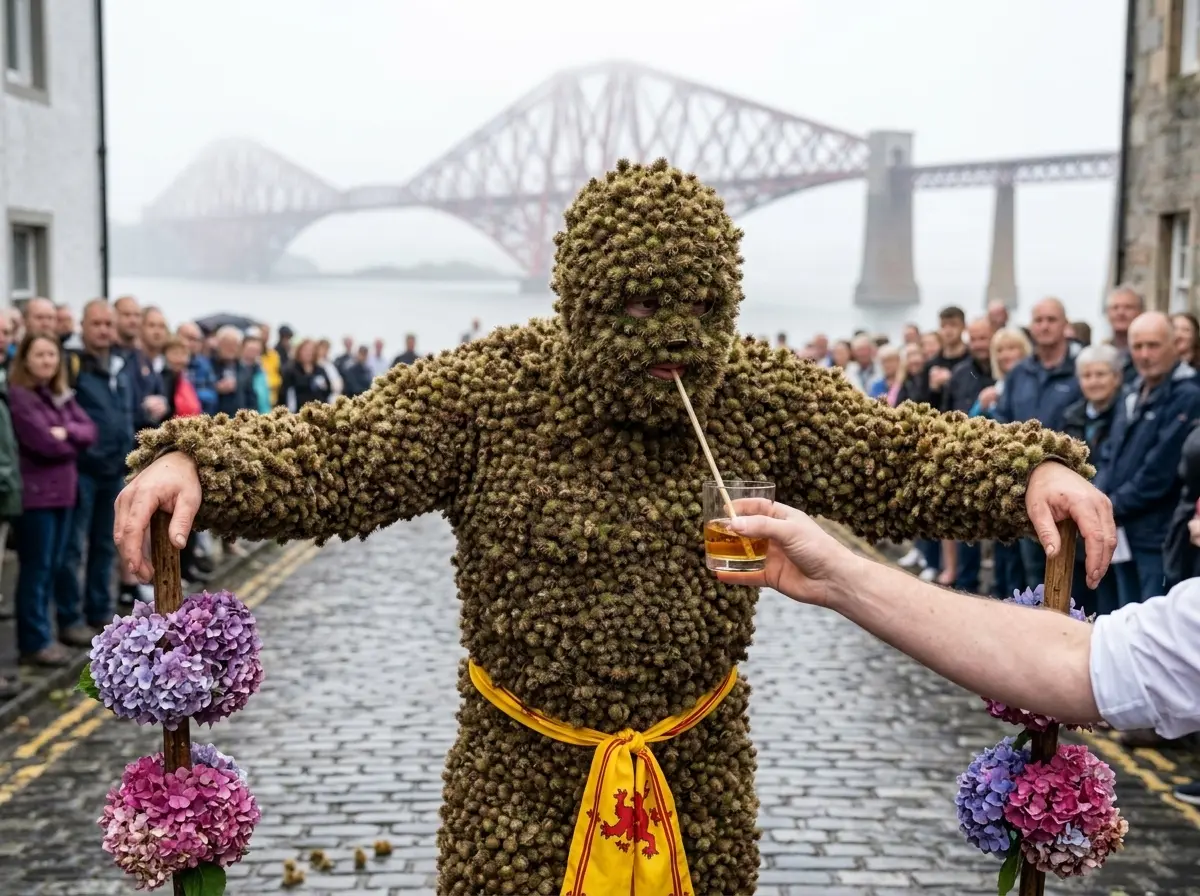
Money collected in the tins goes to local charities. Householders and publicans offer whisky. The Burryman accepts through a straw because the burrs lock his arms and leave only a small mouth hole.
The day is built from repetition rather than spectacle. Each stop repeats the same exchange: coins in the tin, a dram through the straw, a single burr handed back as luck. The pattern holds from the first pub to the last house.
On X, one widely shared clip from Iain Cameron called the day “a bizarre 400-year-old Scottish ritual” and drew nearly 90,000 views. Another viewer simply wrote that it was “truly the weirdest thing I’ve ever seen.” The clips sell the spectacle. Locals treat the scratched finish as ordinary civic work.
Thousands of Hooks Make the Suit
Burdock seedheads from Arctium lappa and A. minus supply the covering. Gatherers collect approximately 11,000 burrs the night before. Helpers mesh them into about 25 flat A3-sized panels that stick like natural Velcro.
The panels wrap over several protective layers and a balaclava. Only boots, hands and two eye holes stay free. A flower-covered bowler or garland tops the head. Two flowered staves support the arms held stiffly outward. A sash, sometimes cut from the Royal Standard of Scotland with its red lion on yellow, once wrapped the waist; recent holders have preferred a plainer look.
- Boots remain free for the long walk
- Hands stay clear to grip the staves
- Two eye holes give the only forward view
- A small mouth opening admits the whisky straw
The costume forces an awkward gait, legs apart. Two attendants guide the Burryman and steady the poles. By evening the wearer is scratched, often bloodied, and triumphant. Doc Rowe, the folklorist who has attended for nearly fifty years and sometimes serves as dresser, notes the physical toll never deters the next volunteer.
The whisky stops are non-negotiable once offered. Earlier accounts warned that weakly candidates faint under the heat and fatigue of the dressing itself. Taylor has said the arms are the worst part.
Only Men Born in the Town May Wear It
The rule is absolute: the Burryman must be born in South Queensferry. The office usually stays with one man for years. That continuity is the point of the handoff.
| Burryman | Approximate tenure | Notes |
|---|---|---|
| Alan Reid | 25 years, until 1999 | Long modern run |
| John Nicol | Until 2011 | Succeeded Reid |
| Andrew Taylor | 2012-2026 | Final walk 7 Aug 2026 |
| Cameron Forrester | From 2027 | Bell-ringer for a decade |
Other past names include John “Jacko” Hart, Sam Corson and Arne Fredricksen. A child known as the Wee Burry Man appeared in 1948. Taylor himself was born in the Staghead Hotel, the procession’s traditional start point, and works for Edinburgh Council. He has said remaining too long can discourage younger locals from stepping forward. That is why he steps aside now.
Forrester has carried collecting tins since he was nine. This year he rang the bell for the last time, calling “Hip, Hip, Hooray, it’s the Burryman’s Day!” The cry brings householders out with coins and a dram. In return they receive a single burr as a luck token, a practice that became essential only in the last thirty years.
The birth rule keeps the role inside the same small pool of men. Long tenures then deepen the knowledge of every door and every pub. When a holder steps down, the next man is already known to the route because he has walked it in support for years.
Origins Stay Lost While the Walk Continues
No one owns a definitive start date. The right to hold the Ferry Fair was granted in 1687, yet the Burryman custom is widely held to be older. An old extract preserved in the official Ferry Fair history of the Burryman traces an unaltered observance back at least to the generation that remembered the 1746 Battle of Falkirk. Sir Walter Scott’s antiquarian efforts already failed to pin it down.
- 1687: Ferry Fair right granted; the Burryman custom already treated as older
- 1746: Living memory of Falkirk still tied to an unaltered observance
- 1948: A child known as the Wee Burry Man appears in the record
- 1999-2026: Modern handoffs from Reid to Nicol to Taylor to Forrester
Theories multiply. Some see a pagan survival or Green Man figure of rebirth and fertility. Others call him a scapegoat who draws evil away from the town. Parallel “burry man” figures once walked in other Scottish fishing ports such as Buckie and Fraserburgh to “raise the herring.” Those died out. South Queensferry’s version is the last in Scotland. Loose English cousins include the Whittlesea Straw Bear and Castleton Garland King.
Scotland’s intangible cultural heritage record simply states that the meaning and origins are now unclear. The town no longer depends on the herring catch the rite once served. What remains is the walk itself and the belief that stopping it would bring bad luck.
A detailed account of costume and route lists the same core facts year after year: local man, burrs, staves, whisky, charity, good fortune if the custom continues.
The Town, Not the Tourists, Keeps It Alive
Doc Rowe has watched six Burrymen. In his Country Diary he stresses that the figure’s value today lies not in pagan speculation but as a living community event. Tourists appear, yet the procession runs on local labour and local donations. The Fringe can have the stages. Queensferry keeps the burrs.
It is a reminder that the Burryman is more than a figure in a curious costume: he is a living link between generations. This is one tradition that is in safe hands.
Rowe wrote those lines after watching Forrester prepare to inherit the role. The same observation surfaces whenever a long holder steps down. Alan Reid’s quarter-century and John Nicol’s run both ended the same way: a younger local-born man already inside the team moved forward.
The whisky itself is ordinary Scottish spirit offered without measure. It pairs naturally with other stories of how whisky country’s own water puzzles shape the drink’s future. The ritual simply puts a straw in the glass and keeps the man moving.
Labour stays local because the rule demands it. Donations stay local because the tins fund town charities. That closed loop is what separates the walk from festival programming ten miles away.
Cameron Forrester Moves From Bell to Full Suit
Forrester’s decade as bell-ringer ends with the 2026 walk. He already knows every stop and every house that opens its door. The physical demands stay the same: no sitting, no bending the arms, nine hours upright, scratches guaranteed. Overcast weather helped Taylor this year. Future Julys and Augusts will not always be kind.
The handover is deliberate. Taylor has acknowledged that a single long tenure can quietly close the door on the next cohort. By leaving after fifteen seasons he reopens it. Forrester inherits both the honour and the expectation that he too will one day judge when to pass the panels onward.
South Queensferry sits on the Firth of Forth under the bridges, a short hop from the capital’s festival crush. Visitors already seek quieter Scottish routes drawing visitors away from overloaded hotspots. The Burryman offers something those routes cannot manufacture: a rite that still requires a man born on the spot and a town willing to feed him whisky all day.
Next August the same shout will rise. The panels will stick. The staves will take the weight. Another Queensferry man will finish bloodied and upright, and the chain will have lengthened by one more year.
Other Ports Dropped the Walk Long Ago
Buckie and Fraserburgh once sent their own burry figures out to “raise the herring.” Those processions ended. South Queensferry’s version is now the last in Scotland. The town no longer lives by the catch the rite once served, yet the walk continues on the same second Friday.
Loose English cousins still appear elsewhere. The Whittlesea Straw Bear and the Castleton Garland King share the broad idea of a costumed figure moving through a community for luck or season. None of them uses burdock panels or the South Queensferry birth rule.
- Buckie and Fraserburgh: former Scottish fishing-port burry figures, now gone
- Whittlesea Straw Bear: English parallel built on straw rather than burrs
- Castleton Garland King: English seasonal counterpart with a different covering
- South Queensferry: sole surviving Scottish burry walk
Survival here rests on the absolute birth rule and on long tenures that still end in time. When holders step aside, a younger local already inside the team is ready. That pattern, repeated from Reid through Nicol to Taylor and now Forrester, keeps the panels in use.
The Suit Turns Charity Into Endurance
Nine hours upright with arms locked outward turns every donated dram into a physical test. The wearer cannot sit, cannot bend the arms, and cannot refuse a glass once it is offered. Attendants steady the staves; the man inside supplies the will.
Heat has felled earlier holders. Overcast skies eased Taylor’s final circuit, yet the scratches and the bloodied finish remain ordinary outcomes. Doc Rowe, present for nearly fifty years, records that the toll never stops the next volunteer from coming forward.
Charity tins and luck tokens give the ordeal a civic frame. Money goes to local causes. Each householder receives a single burr in return. The spectacle that draws nearly 90,000 views online is, on the ground, a full working day for a man born in the town and dressed by his neighbours.
Forrester already knows the route from a decade of bell-ringing. The suit will change the day from call-and-response to silent endurance. The shout stays the same. The body inside the panels will learn what Taylor learned about the arms.
Frequently Asked Questions
What is the Burryman of South Queensferry?
The Burryman is a local man covered head to ankle in thousands of sticky burdock burrs who walks a multi-mile route through the town on the second Friday of August, collecting charity donations and accepting whisky through a straw to bring good luck.
Who is allowed to become the Burryman?
Only men born in South Queensferry may hold the role. The same person often serves for many consecutive years before handing the costume to a younger local already active in the supporting team.
How many burrs cover the Burryman?
Gatherers collect roughly 11,000 burdock seedheads the night before. They are formed into about 25 flat panels that wrap the body like Velcro over protective clothing and a balaclava.
Why does the Burryman drink whisky through a straw?
The dense burr covering locks the arms outward and leaves only a small mouth opening, so every offered dram at pubs and houses must be taken through a straw; tradition requires acceptance of any drink offered.
When does the Burryman procession take place?
It is held every year on the second Friday of August as part of the wider Ferry Fair week in South Queensferry, starting at the Staghead Hotel in the morning and lasting nine hours or longer.
Are the origins of the Burryman known?
No definitive origin survives. The custom is older than the 1687 fair charter, with theories ranging from pagan fertility figures and scapegoats to fishing-luck rites, yet the town continues it as a living community practice rather than a solved historical puzzle.
 ONGC licence frees Venezuela cash and operatorship talks
  Anthropic Hits $65 Billion Run Rate and Flips the AI Cash Test
  Supreme Court grounds the fare free-for-all with three-week clock
  Gold Nears $4400 as Soft Data Meets Oil Inflation Risk
  Nifty Slips as Zaggle Circuits and Dhoot Debuts Big
  Diesel Crack Tops $100 as Iran Rhetoric Lifts Crude