
 Ishan Crawford
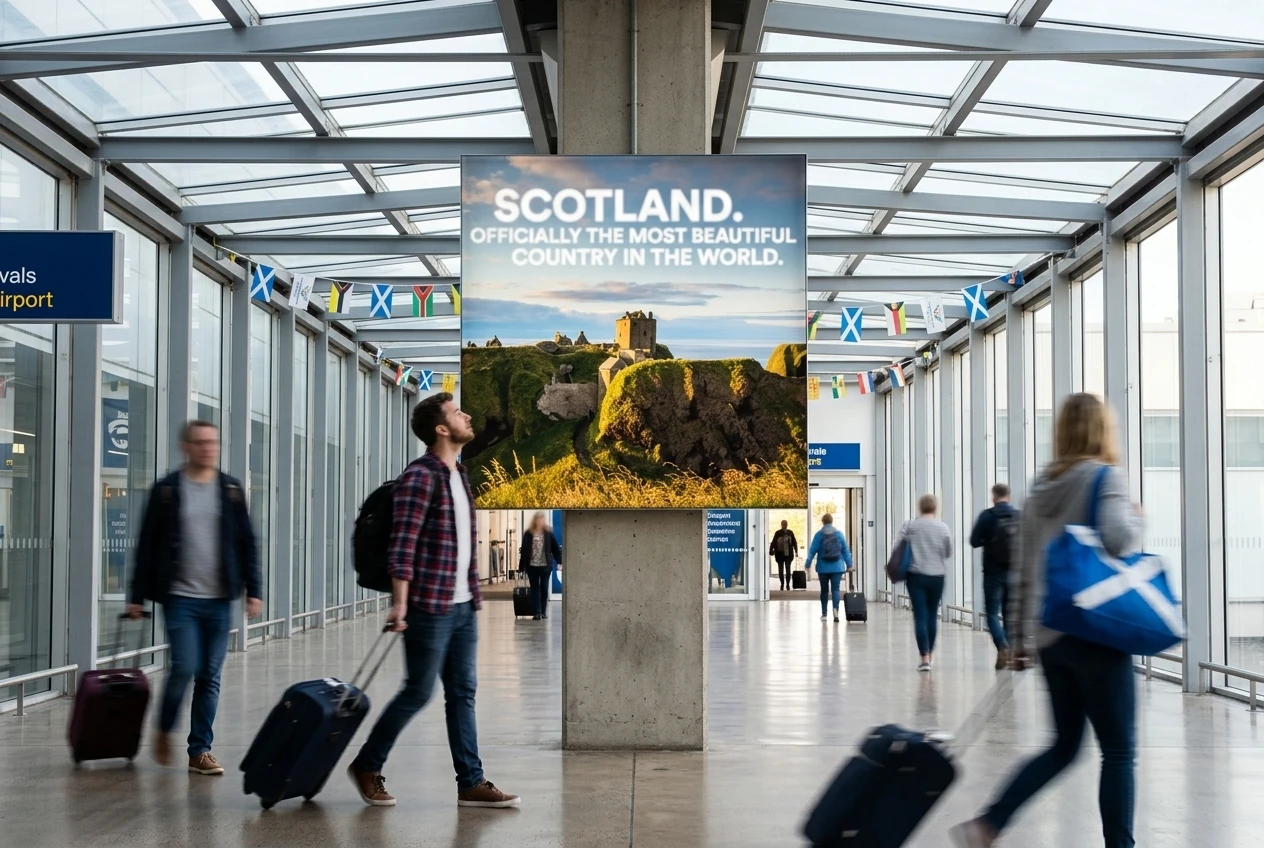
 Brand Scotland launched a new welcome campaign this week, one day before 3,000 athletes from 74 nations and territories touch down in Glasgow for the Commonwealth Games, which open on July 23. Created by the Edinburgh agency Leith, the campaign is called Feel It All and pairs bold photography with lines built around Scotland’s head, heart and spirit.
It is a warm, confident pitch. It is also running on top of a Games that exists only because another country walked away from the bill. Glasgow is hosting a scaled down, four venue event after Victoria, Australia pulled out in 2023 over runaway costs. The campaign’s ads do not mention that.
Feel It All Sells Scotland’s Head, Heart and Spirit
The creative features eight executions that pair striking photography with bold, short lines of copy. Each one links the excellence and energy of the Games to Scotland’s case as a place to live, work, study, visit and do business.
The eight executions will run across Glasgow and Edinburgh Airports, Glasgow Central Station, and city and roadside sites around both cities, meeting travelers the moment they land.
We wanted the work to feel open, warm and full of momentum. The Games bring a huge sense of energy into Scotland, and the campaign reflects that. Every execution is built to show the country as a place to live, work, study, invest and explore, and to do it in a way that feels true to Scotland today.
Richard Thomson of Leith said that, describing the brief behind the work. The agency calls the strategy an attempt to build lasting affinity rather than a two week tourist bump, encouraging visitors toward deeper, long term connections with the country.
Why Is Glasgow Hosting Instead of Australia?
Glasgow is hosting because the Australian state of Victoria withdrew in July 2023, after its own cost estimate for the Games more than doubled, from roughly 2.6 billion Australian dollars to more than 6 billion. Victoria paid a compensation fee to keep the event alive, and Glasgow, which still had the venues from 2014, stepped in as the fallback host.
Victoria Premier Daniel Andrews framed the walkout bluntly at the time. “That does not represent value for money,” Andrews said, arguing a ballooning budget for a short event could not be justified against health and education spending.
Glasgow’s bid was confirmed in October 2024, and it comes with a much smaller footprint than the city delivered twelve years ago. For readers who want the full schedule, sports and venue list, there is a complete rundown of Glasgow 2026’s events covering the fortnight in detail.
| Detail | Glasgow 2014 | Glasgow 2026 |
|---|---|---|
| Sports on the program | 17 | 10 |
| Main venues | Multiple sites, including Hampden Park | 4 (Scotstoun, Tollcross, Emirates Arena, SEC) |
| Reported cost | About £543 million | About £150 million |
| Athlete housing | Purpose built athletes’ village | Hotel accommodation |
The gap between those two rows explains most of what makes this Games different. Fewer sports, fewer venues, no village, and a budget cut to a fraction of what Glasgow spent last time.
Badminton, Cricket and Six Other Sports Got Cut
Ten sports remain: athletics, swimming, artistic gymnastics, track cycling, netball, weightlifting, boxing, judo, bowls and 3×3 basketball, each with a para equivalent. Ten more were dropped to fit the smaller budget and the compressed planning window.
- Badminton
- Cricket
- Hockey
- Rugby sevens
- Diving
- Beach volleyball
- Mountain biking
- Rhythmic gymnastics
- Squash
- Table tennis
Scale shows up in the venues too. Scotstoun Stadium holds around 9,700 spectators for athletics, against the 44,000 who filled Hampden Park for track and field in 2014.
Boxing survived the cuts, which carries extra weight in Scotland this year. The country recently mourned Commonwealth Games boxing legend Dick McTaggart, whose passing landed just weeks before the sport he won gold in returns to a Glasgow ring.
Victoria’s Exit Fee Bankrolls the Games
Victoria agreed to pay 380 million Australian dollars, about 243 million US dollars, to the Commonwealth Games Federation after abandoning its hosting rights, Reuters reported at the time. That single payment did more to keep the Games alive than any pitch from a rival city.
ESPN has reported that around 200 million of those US dollars were earmarked to help cover Scotland’s hosting costs specifically. Separately, the Commonwealth Games Federation committed £100 million of its own funds toward Glasgow’s core delivery budget, according to organizers.
- AU$380 million – compensation Victoria agreed to pay the Commonwealth Games Federation after its 2023 withdrawal
- £100 million – the Federation’s own investment underwriting Glasgow’s delivery budget
- $200 million – the portion of Victoria’s payment reportedly directed toward Scotland’s hosting costs
- £150 million – the total projected cost of Glasgow 2026, per organizers
Organizers are careful to draw a line around that money. Glasgow 2026’s own finance FAQ states the delivery does not require public funding from Glasgow City Council, the Scottish Government or the UK Government. That claim is accurate as far as the core budget goes. It says nothing about where the Federation’s own capital came from in the first place.
Feel It All Doubles as a Recruitment Pitch
Every Feel It All execution ends on the same list: live, work, study, invest, explore. That is not incidental copywriting. It is the exact mission Brand Scotland was built to sell.
Brand Scotland launched in 2018 as Scotland Is Now, a joint push by the Scottish Government, VisitScotland, Scottish Development International and Universities Scotland, backed by an initial combined spend of around £6 million. The lineup has since grown to include Scottish Enterprise, Highlands and Islands Enterprise, Scotland Food and Drink and Creative Scotland.
The strategy has produced measurable results before. In 2020, Scotland was ranked among the top five most admired place brands in the world by the Anholt-Ipsos City Nation Place Survey, alongside New York, New Zealand, Amsterdam and London. Brand Scotland’s own events page frames this summer as welcoming the world to Glasgow for a second time, tying the sporting fortnight directly to its pitch on studying, working and investing in the country.
Seen that way, the athletes are almost a backdrop. The real audience is anyone watching from abroad who might one day enroll in a Scottish university, relocate a business unit or book a return trip once the medals are handed out.
Ministers Still Wrote Cheques for a Privately Funded Games
First Minister John Swinney has leaned into the branding logic himself. He called the Games “an exciting opportunity to build on our global brand and show the world what a fantastic place Scotland is to live, work, study” in, speaking ahead of the King’s Baton Relay this month.
Public money is still moving around the event, even if it never touches the core delivery budget. The Scottish Government is providing £20 million for free and low cost sporting activities for young people this summer, plus £245,000 to support more than 50 free events during the Scottish leg of the baton relay and £150,000 toward a Scotland House hub at the Corinthian in Glasgow.
Health Secretary Neil Gray has pointed to the payoff those sums are meant to unlock. Officials expect more than £150 million of economic benefit for local businesses and jobs, a figure the government has repeated often enough that it now functions as the Games’ unofficial price tag. The Scottish Government has separately promoted the Games’ wider benefits for the economy beyond that single number.
Glasgow’s Games run July 23 to August 2. Ahmedabad, India is already confirmed as the next host, in 2030, with this stripped down Glasgow edition serving as the bridge that kept the Commonwealth Games alive long enough to get there.
 ONGC licence frees Venezuela cash and operatorship talks
  Anthropic Hits $65 Billion Run Rate and Flips the AI Cash Test
  Supreme Court grounds the fare free-for-all with three-week clock
  Gold Nears $4400 as Soft Data Meets Oil Inflation Risk
  Nifty Slips as Zaggle Circuits and Dhoot Debuts Big
  Diesel Crack Tops $100 as Iran Rhetoric Lifts Crude