
 Ishan Crawford
 ASUS unveiled the Asus Pad (T3201) on June 2, 2026, a 12.2-inch Android 16 tablet built around a dual-layer OLED display, a MediaTek Dimensity 8300 processor, 8GB of memory, and a 9,000mAh battery. The launch in Taipei marks the company’s return to the mainstream tablet shelf after a long stretch spent on laptops and gaming hardware.
The feature ASUS put first is that stacked-screen panel, the same class of display technology Apple loaded into its most expensive iPad Pro two years ago. ASUS tuned the panel for longevity and battery life instead of the searing peak brightness Apple chased, and that one decision says more about who the Pad is for than any other line on the box.
ASUS Returns to Tablets With a 12.2-Inch Pad
The slate measures 12.2 inches at 2,800 by 1,840 pixels, a 2.8K resolution in a 3:2 shape that suits documents, web pages, and split-screen work better than a movie-first 16:10 ratio. ASUS quotes a 92 percent screen-to-body ratio and a TÜV Rheinland certification (the German testing body) for reduced blue light and flicker-free output.
Physically it is a thin, light machine. The chassis runs 6.5mm thick and 523g, made from a magnalium frame with a fiberglass back cover. A protective case ships in the box, ASUS Pen 2.0 and a Bluetooth keyboard are sold separately, and a microSD slot pushes storage as far as 1TB beyond the built-in capacity.
| Specification | Asus Pad (T3201) |
|---|---|
| Display | 12.2-inch dual-layer OLED, 2,800 x 1,840, 144Hz |
| Brightness / color | 600 nits typical, 100% DCI-P3 |
| Processor | MediaTek Dimensity 8300 (4nm) |
| Memory / storage | 8GB LPDDR5x, 128GB or 256GB UFS 3.1 |
| Battery / charging | 9,000mAh, 45W USB-C |
| Cameras | 13MP rear, 5MP front |
| Audio | Quad speakers, Dolby Atmos |
| Software | Android 16 |
| Weight / thickness | 523g / 6.5mm |
The complete kit is laid out in the full Asus Pad specification sheet, and most of it reads like a sensible mid-tier productivity tablet. The exception is the screen.
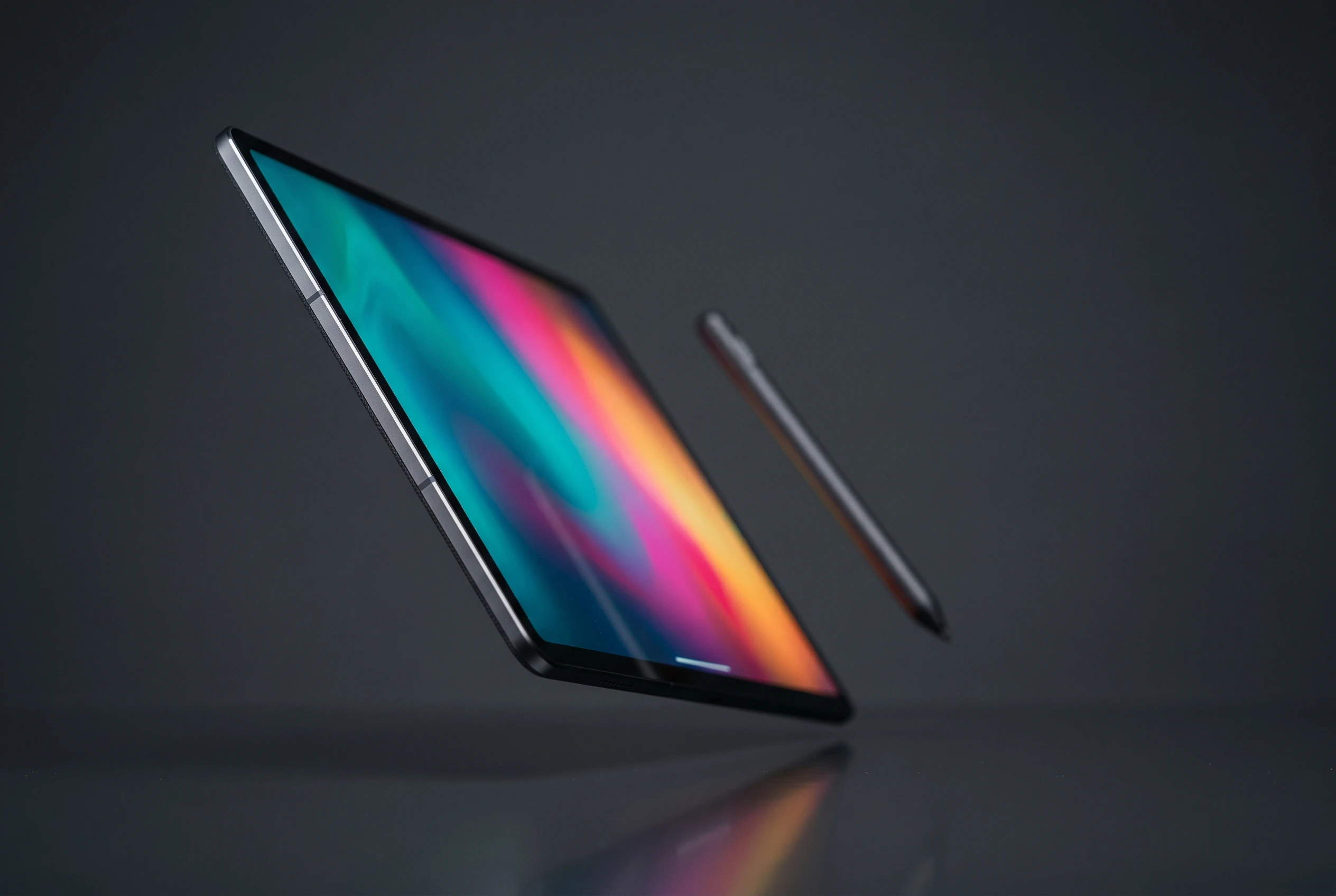
How Dual-Layer OLED Stacks Up
A standard OLED (organic light-emitting diode) screen uses a single layer of light-emitting material. A dual-layer panel stacks two of those emission layers on top of each other and combines their output, an approach the industry also calls tandem OLED.
The payoff is not just a brighter picture. Spreading the workload across two layers means each one runs cooler and less hard for the same on-screen result, which is why the dual-layer OLED panel here is pitched on efficiency and lifespan as much as image quality. ASUS leans on three benefits in particular:
- Lower power draw per layer at a given brightness, which helps a tablet stretch its battery through long sessions.
- Slower panel ageing and reduced burn-in risk, because neither layer is pushed to its limit.
- Steadier color and brightness uniformity across a large 12.2-inch surface.
Apple was the first to bring the technique to a tablet, and it sat behind a premium price. ASUS putting the same idea into a far more ordinary device is the part worth noticing.
Why 600 Nits Marks the Compromise
Here is where the Pad and the tablet that pioneered the format split. Apple’s tandem OLED iPad Pro display uses the stacked structure to hit roughly 1,000 nits of full-screen brightness in standard dynamic range (SDR) and 1,600 nits for high dynamic range (HDR) highlights. The Asus Pad quotes 600 nits typical, well short of that ceiling.
That is not a flaw so much as a different goal. ASUS spent the dual-layer advantage on lower power and longer panel life rather than peak luminance, the same kind of trade visible in a recent flagship phone that swapped a camera for a brighter, longer-lasting screen. The result is a tablet that should stay comfortable indoors and last for years, but one that will struggle against bright sunlight more than the device it borrows its panel idea from.
| Attribute | Asus Pad (T3201) | Apple iPad Pro 13-inch (M4) |
|---|---|---|
| Panel | 12.2-inch dual-layer OLED | 13-inch tandem OLED |
| Brightness | 600 nits typical | ~1,000 nits SDR, 1,600 nits HDR |
| Refresh rate | 144Hz | 120Hz ProMotion |
| Processor | MediaTek Dimensity 8300 | Apple M4 |
| Storage interface | UFS 3.1 | NVMe |
| Starting price | Not announced | About $1,299 |
The Dimensity 8300 Sits a Tier Below the Panel
The screen punches above the rest of the hardware, and the chip is where that shows. The Dimensity 8300 chipset specifications describe a 4nm part with four Arm Cortex-A715 performance cores, four Cortex-A510 efficiency cores, and a Mali-G615 graphics block. It is a capable upper-mid-range processor, not a flagship one.
There is even headroom ASUS left on the table. MediaTek’s own listing says the Dimensity 8300 can drive displays at up to 180Hz Full HD or 120Hz at WQHD, and pairs with UFS 4.0 (Universal Flash Storage) memory. The Pad runs its panel at 144Hz and ships with the older, slower UFS 3.1 instead. Those are cost calls that keep the tablet affordable while the premium screen does the marketing.
Battery, Audio, and the Stylus Hooks
Around the display, ASUS built a stack of features aimed at people who want a tablet to do real work, not just stream video. A quad-speaker array carries Dolby Atmos spatial audio, ASUS GlideX handles screen sharing and file transfers with a PC, and Google Gemini, Circle to Search, and Face Login round out the software.
- 9,000mAh battery with 45W USB-C charging, reaching about 50 percent in 30 minutes.
- 4 speakers rated at 8 ohm and 1 watt each, tuned for Dolby Atmos playback.
- 523g in a 6.5mm body, with WiFi 6E and Bluetooth 5.3 for wireless.
- 1TB microSD expansion ceiling on top of 128GB or 256GB of onboard storage.
ASUS Pen 2.0 covers handwriting and sketching, while the optional Bluetooth keyboard turns the slate into a light laptop stand-in. The USB-C port carries DisplayPort 1.4 video out and Power Delivery 3.0, so a single cable handles an external monitor and charging.
Where the Pad Fits a Crowded Android Field
Android tablets in this size class are not short on competition. Samsung’s Galaxy Tab S series, Lenovo’s Tab lineup, Xiaomi’s Pad family, and OnePlus all sell 12-inch slates aimed at the same buyer, and most undercut Apple by a wide margin. ASUS is wagering that a stacked OLED screen is the spec that makes shoppers stop and compare.
The bigger pattern is the one ASUS is quietly riding. Stacked-panel technology that launched as an iPad Pro exclusive is now arriving on devices built for the middle of the market, much as budget silicon keeps reaching cheaper machines, from Acer’s first budget Snapdragon laptop on down. When premium display tech trickles down this fast, the buyer wins even if the brand selling it stays in the second tier.
The catch is that ASUS announced no price and no release date. Until those land, the Asus Pad (T3201) is a strong spec sheet with an interesting screen and an open question over whether the number on the price tag matches the panel inside.
Frequently Asked Questions
What Is the Asus Pad (T3201)?
It is a 12.2-inch Android 16 tablet ASUS announced on June 2, 2026, featuring a 2.8K dual-layer OLED screen at 144Hz, a MediaTek Dimensity 8300 chip, 8GB of memory, and a 9,000mAh battery. It is ASUS’s return to the mainstream tablet category.
What Does Dual-Layer OLED Mean on the Asus Pad?
Dual-layer OLED, also called tandem OLED, stacks two light-emitting layers and combines their output. The design lowers power draw per layer, slows panel ageing, and improves brightness uniformity across the large 12.2-inch surface.
How Much Does the Asus Pad (T3201) Cost?
ASUS did not announce a price or regional availability at launch. The company detailed the full specification list but left pricing and release timing for a later date.
What Processor Powers the Asus Pad?
The tablet uses MediaTek’s Dimensity 8300, a 4nm chip with four Cortex-A715 cores, four Cortex-A510 cores, and Mali-G615 graphics. It is an upper-mid-range processor rather than a flagship one.
Does the Asus Pad Support a Stylus and Keyboard?
Yes. It works with ASUS Pen 2.0 for handwriting and sketching and supports a Bluetooth keyboard, both sold separately. A protective case is included in the box.
How Big Is the Battery and How Fast Does It Charge?
The Asus Pad carries a 9,000mAh battery with 45W USB-C fast charging, which reaches roughly 50 percent capacity in about 30 minutes.
 ONGC licence frees Venezuela cash and operatorship talks
  Anthropic Hits $65 Billion Run Rate and Flips the AI Cash Test
  Supreme Court grounds the fare free-for-all with three-week clock
  Gold Nears $4400 as Soft Data Meets Oil Inflation Risk
  Nifty Slips as Zaggle Circuits and Dhoot Debuts Big
  Diesel Crack Tops $100 as Iran Rhetoric Lifts Crude