
 Ishan Crawford
 The Bank of Japan left its short-term policy rate at 1.00% on July 31 in an 8-1 vote, matching market expectations after the June hike. USD/JPY rose 0.78% to 160.80 as the board flagged upside risks to prices from the weak yen and AI-linked demand.
Board member Hajime Takata alone pushed for 1.25%, arguing conditions had entered a new phase. The decision keeps financial conditions accommodative even as the Outlook shows underlying inflation approaching the 2% target and risks skewed higher.
The 8-1 Hold and Takata’s Lone Call
Policy Board members decided by an 8-1 majority vote statement to encourage the uncollateralized overnight call rate to remain around 1.0%. Voting for the hold were Governor Kazuo Ueda and seven colleagues. Takata dissented.
Takata considered that the situation had shifted to a new phase requiring a nimble approach to upside risks to prices from overseas demand shocks and changes in overseas financial conditions. He proposed setting the guideline at around 1.25%. The proposal was defeated.
- Underlying inflation approaching 2%, financial conditions still accommodative.
- Board will continue raising rates if economic and price developments warrant it.
- Particular attention to Middle East impact on FX markets, economy and prices.
- Recent yen falls likely to lift prices mainly of durable goods.
- Output gap slightly positive; wage and price pressures stronger than the gap alone suggests.
Firms’ active wage- and price-setting behavior is expected to continue. Inflation expectations should keep rising moderately. Japan’s economy is seen growing moderately, though at a slower pace, with exports and output increasing moderately.
The majority’s choice to hold rather than follow Takata leaves the policy rate at its highest level since September 1995, yet still leaves real rates negative in key zones. That gap between the headline stance and the real-rate backdrop is what keeps conditions described as accommodative even after the June move.
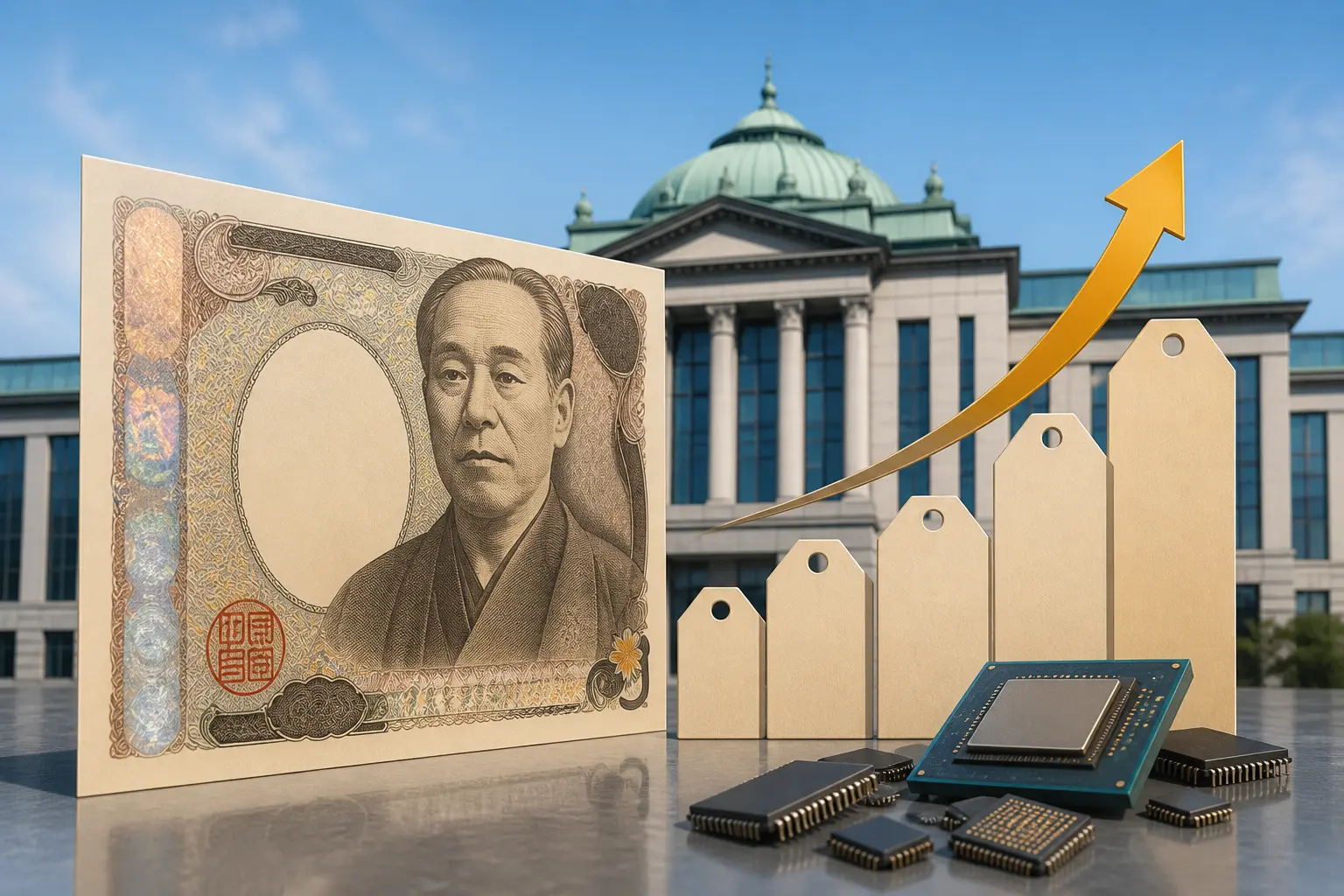
What the New Outlook Numbers Show
The July 2026 Outlook Report medians lifted growth slightly while adjusting inflation for government energy relief.
| Fiscal Year | Real GDP Median | Core CPI Median (less fresh food) | Prior April Median (GDP / CPI) |
|---|---|---|---|
| 2026 | +0.6% | +2.5% | +0.5% / +2.8% |
| 2027 | +0.8% | +2.4% | +0.7% / +2.3% |
| 2028 | +0.8% | +2.0% | +0.8% / +2.0% |
Core CPI for fiscal 2026 was cut mainly because of subsidies on electricity and gas charges. The wage-price interaction mechanism is judged intact. Medium- to long-term inflation expectations are projected to rise. Underlying inflation is likely to reach a level consistent with the 2% target between the second half of fiscal 2026 and fiscal 2027.
Risks to prices remain skewed to the upside. The board noted that significant downside risks to activity and significant upside risks to prices have both decreased, yet pass-through from high crude oil prices is progressing quickly in business-to-business deals.
Read side by side, the revisions show a board slightly more constructive on growth and still convinced the wage-price loop will carry underlying inflation to target, even after the energy-subsidy cut to the near-term CPI path. The fiscal 2027 core CPI median ticked up, not down, which keeps the medium-term inflation story intact.
Yen Intervention Sets the Stage
One day earlier, USD/JPY tumbled from above 163.00 to below 158.00 in minutes. Traders and analysts widely attributed the move to Japanese authorities buying yen. Officials have not confirmed the action. The pair later recovered some ground.
After the rate decision, the yen attracted sellers again and USD/JPY traded at 160.80. The sequence fits a familiar pattern: verbal warnings, suspected intervention, temporary rebound, then renewed pressure when rate support stays limited.
- April-May 2026: Ministry of Finance deploys a record ¥11.73 trillion in interventions after USD/JPY breaches 160.
- June 2026: BoJ delivers a 25-basis-point hike, lifting the policy rate to 1.00%.
- July 30: USD/JPY drops from above 163.00 to below 158.00 in minutes on suspected yen buying; the Federal Reserve holds the same day.
- July 31: BoJ holds at 1.00% by an 8-1 vote; USD/JPY climbs 0.78% to 160.80.
Earlier in 2026 the Ministry of Finance deployed a record ¥11.73 trillion earlier interventions across April and May after the pair breached 160. Those operations bought time rather than lasting direction. The same dynamic appears in play now, especially with AI-related demand and Middle East oil effects still feeding import costs. Related coverage of the earlier yen defense and AI trade pressures showed how quickly the pair can retest intervention levels when policy remains gradual.
Stats snapshot
- USD/JPY move July 30: above 163 to below 158 in minutes
- Post-decision level: 160.80, +0.78% on the day
- Prior 2026 intervention scale: ¥11.73 trillion (April-May)
- Rate since June hike: highest since September 1995
Upside Risks Feed Straight Back Into Prices
The board was explicit that recent yen depreciation, higher semiconductor prices tied to global AI demand, and elevated crude oil are already pushing up durable goods. Import prices have risen substantially. That rise is expected to lift a wide range of items.
There is a risk of underlying CPI inflation deviating upward to a level above the price stability target of 2%.
The statement and Outlook both stress the need to keep that upside risk from materializing and hurting the economy later. Output gap improvements and stronger-than-gap wage-price pressures reinforce the concern. Firms continue to set wages and prices actively. The second-order channel is clear: a soft yen raises import and input costs, those costs pass through faster under tight labor markets, and the resulting inflation reading then pressures the board either to hike sooner or to tolerate another round of FX action.
Middle East developments remain a live variable for both oil and financial markets. The board said it will examine the likelihood of the baseline scenario and the risks while watching those impacts.
Because the output gap is only slightly positive, the stronger wage and price pressures the board already flags cannot be explained by slack alone. That residual pressure is what makes yen-driven import costs more dangerous now than in earlier cycles: firms are already in an active setting mode, so cost shocks land on receptive ground.
Who Feels the Still-Accommodative Stance
Financial conditions remain accommodative even after the June move to 1%. Real rates stay negative in key zones. Corporate funding costs are low relative to profitability. That supports business fixed investment, especially AI-related and labor-saving projects, and helps exporters who benefit from a weaker yen.
Households face the other side. Energy and durable-goods prices rise first when the yen softens and oil stays elevated. Government subsidies blunt some of the energy hit in fiscal 2026, yet the board still sees core inflation accelerating above 2% in the second half of the year before easing later. Wage growth is solid but must outrun those costs for real incomes to improve.
Carry-trade investors and yen shorts also sit in the middle. The hold removes an immediate squeeze. The intervention shows authorities will still act on disorderly moves. History of post-intervention rebounds suggests the pressure can rebuild quickly if rate differentials stay wide.
- Exporters and equity investors: short-term support from loose conditions and yen levels
- Importers and consumers: higher durable-goods and energy pass-through
- BoJ itself: tighter trade-off between gradualism and the upside inflation risk it just highlighted
The split is mechanical. Loose real funding conditions and a soft yen cushion the corporate and export side first. The same soft yen and elevated oil lift the prices households meet in energy and durables before wages fully catch up. Subsidies only delay part of that household hit into later fiscal years.
Markets Already Price the Next Decision
Investors still expect at least one more 25-basis-point increase before year-end. October and December remain the leading candidates. A hawkish tilt from Governor Ueda at the press conference could pull odds toward October. A cautious tone on consumption or global demand could push them later.
On X, reactions split along familiar lines. Some posts framed the hold as market-friendly and even a near-term equity boost. Others, including investor Peter Schiff, argued that keeping the rate at 1% with only a possible quarter-point move by year-end “ensures a weaker yen, rising inflation, and higher long-term interest rates, ultimately forcing the BoJ to hike much more in the future.” That view tracks the second-order loop the board itself described.
Technical levels reinforce the stakes. USD/JPY sits near the 100-day moving average around 160. Support clusters near 158 and the 200-day average. A sustained break higher reopens the path toward the recent cycle highs above 163 and invites fresh intervention talk. A break lower would need clearer rate-path confirmation from the BoJ to stick.
The Federal Reserve’s own hold the day before left the dollar softer, which can amplify any yen response to Japanese signals. Rate differentials remain the structural driver. Intervention can blunt the speed of moves. It does not close the gap on its own.
Intervention Buys Time While Differentials Persist
The July 30 plunge and the next-day rebound to 160.80 illustrate the limit of FX operations when the policy rate stays at 1.00%. Authorities can force a sharp move lower in USD/JPY within minutes. They cannot rewrite the rate gap that keeps drawing capital toward the dollar side once the immediate shock fades.
April and May’s ¥11.73 trillion already showed the same pattern at larger scale: heavy buying slowed the rise, then the pair returned toward prior pressure zones while policy stayed gradual. The post-decision climb back above 160 fits that script again.
- Intervention changes the speed of yen moves, not the structural pull from rate differentials.
- A Fed hold can soften the dollar briefly, yet the Japanese side still sets how wide the gap remains.
- Each temporary rebound that fades raises the odds that markets will retest the levels that triggered the last bout of buying.
That is why the board’s own language on upside price risks from the weak yen matters for the next meeting. If depreciation keeps feeding durables and import costs, the case for waiting narrows even if growth stays only moderate.
The Next Hike Window Stays Open
With underlying inflation still projected to meet the 2% target between the second half of fiscal 2026 and fiscal 2027, and with risks skewed higher, the hold functions as a pause for data rather than a signal that the tightening cycle is complete. Investors already treat October and December as live dates for another 25-basis-point step.
Takata’s call for 1.25% puts a marker on the table: at least one member judges that overseas demand shocks and financial conditions already justify a nimble step. The majority disagreed on timing, not on the direction of travel implied by an intact wage-price mechanism and rising inflation expectations.
For markets, the practical test is whether the yen stabilizes near current levels or again pushes toward the zone above 163 that brought suspected intervention. Stability would give the board room to wait. A fresh run higher would tighten the link between FX and the inflation path the Outlook just reaffirmed.
Frequently Asked Questions
What was the exact vote on the Bank of Japan’s July 2026 rate decision?
The Policy Board voted 8-1 to keep the uncollateralized overnight call rate around 1.0%. Hajime Takata cast the sole dissenting vote and proposed 1.25% instead; that proposal was defeated by majority vote.
How did the BoJ change its GDP and core CPI forecasts in July 2026?
Median real GDP forecasts rose to +0.6% for fiscal 2026 (from +0.5%) and +0.8% for fiscal 2027 (from +0.7%), with fiscal 2028 unchanged at +0.8%. Core CPI (all items less fresh food) median for fiscal 2026 was lowered to +2.5% from +2.8% on energy subsidies, while fiscal 2027 rose to +2.4% from +2.3% and fiscal 2028 stayed at +2.0%.
Why did board member Hajime Takata dissent?
Takata argued the situation had shifted to a new phase in which the Bank needs a nimble approach to upside risks to prices caused by demand shocks from overseas developments and changes in overseas financial conditions, leading him to propose a 1.25% target.
When does the BoJ expect underlying inflation to reach its 2% target?
Underlying CPI inflation is projected to reach a level generally consistent with the price stability target between the second half of fiscal 2026 and fiscal 2027 and to remain around that level thereafter, supported by the wage-price cycle and rising inflation expectations.
What level is the Japanese policy rate at historically after this decision?
The 1.00% short-term rate is the highest since September 1995, following the 25-basis-point increase delivered in June 2026.
The hold buys assessment time after June. The upside risks the board itself listed keep the next decision live and the yen feedback channel open.
 ONGC licence frees Venezuela cash and operatorship talks
  Anthropic Hits $65 Billion Run Rate and Flips the AI Cash Test
  Supreme Court grounds the fare free-for-all with three-week clock
  Gold Nears $4400 as Soft Data Meets Oil Inflation Risk
  Nifty Slips as Zaggle Circuits and Dhoot Debuts Big
  Diesel Crack Tops $100 as Iran Rhetoric Lifts Crude