
 Ishan Crawford
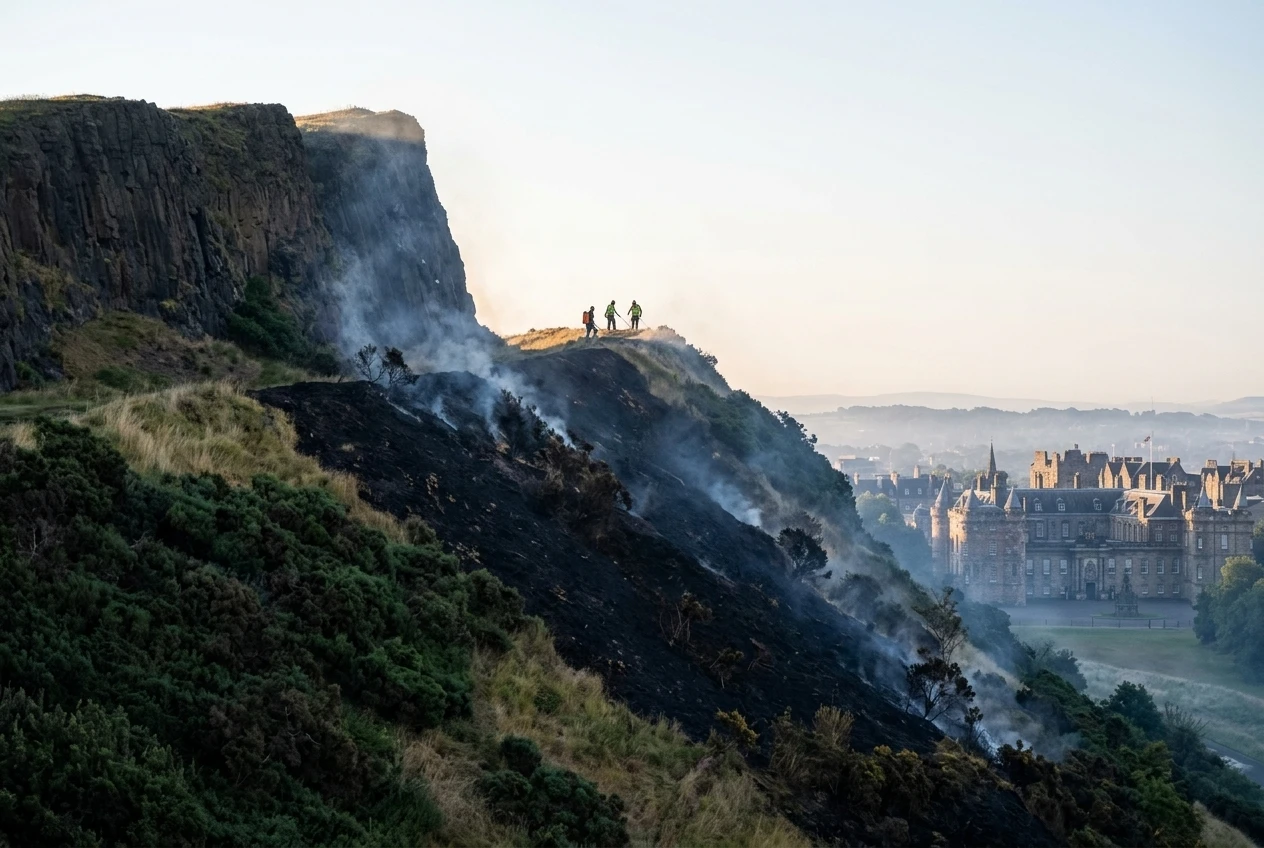
 A wildfire that firefighters believed they had beaten flared back up on Arthur’s Seat in Edinburgh, turning what looked like a one night blaze into the hillside’s third wildfire in twelve months. Six fire engines and specialist crews worked through Sunday night and into a second day after the Scottish Fire and Rescue Service (SFRS) was alerted at 6:38 p.m. on July 19. No injuries have been reported, but the road beneath the hill stayed shut, and nearby residents were told to keep their windows closed.
Last year’s fire on the same slope did its worst damage after the flames went out, when bare, burned ground triggered rockfall that shut a road for months. This week’s blaze, not fully extinguished as crews kept working the hillside, is testing whether that pattern repeats.
Flames Return Hours After Crews Call It Contained
Firefighters had the blaze largely knocked down by Monday afternoon. Then it reignited, forcing crews back onto the hillside to stop it spreading further, according to Edinburgh News.
“Operations Control mobilized six fire appliances and specialist resources to the scene where firefighters are working to extinguish a fire affecting an area of grass,” an SFRS spokesperson said in a statement. “Our crews remain on scene this morning, having worked tirelessly throughout the night fighting the fire.”
Jon Henderson, an SFRS assistant chief officer, told BBC Radio Scotland Breakfast that crews scaled up again once conditions allowed. “We had crews at Arthur’s Seat on Sunday evening and then overnight,” he said. “At first light, we stepped up that response again when the conditions were favorable for that.” He put the active fire at about 0.01 square kilometers, roughly a hectare, and said crews expected to be there “for a couple of days, continuing to tackle it and dampen out hotspots.”
Police Scotland confirmed Queens Drive, the road that rings the hill, remains closed. “Emergency services remain in attendance, and the public should avoid the area,” a spokesperson said, adding that residents nearby should keep windows and doors shut.
Two days in, parts of the picture are still moving.
What we know:
- The fire was first reported at 6:38 p.m. on July 19, prompting four engines that grew to six by Monday morning
- No injuries have been reported by SFRS or Police Scotland
- Queens Drive remains closed, and residents are being asked to keep windows and doors shut because of smoke
- The blaze reignited after appearing largely under control on Monday afternoon
What’s unconfirmed:
- The fire’s exact cause. Henderson said open blazes on this terrain are hard to trace to a single starting point, and some happen naturally
- The total area burned this time, beyond Henderson’s early estimate of about 0.01 square kilometers
- Whether the scorched ground will trigger the kind of rockfall that closed a road here after last year’s fire
Three Blazes Inside Twelve Months
This week’s fire is the second at Arthur’s Seat in three months and the third in under a year, according to Edinburgh News reporting. In May, a fire broke out near the ruins of St Anthony’s Chapel on the same hillside, and Police Scotland opened an investigation into its cause, Local Area Commander Alison MacDonald said at the time.
A year earlier, in August, a gorse fire spread across the hill and kept crews on scene for six days straight, with the fire service posting updates through a sixth day of firefighting. Firefighters have also responded to blazes on the same hill in 2019, 2020 and 2022, CNN reported, citing the fire service’s own tally.
Historic Environment Scotland (HES), which runs the park for the Scottish Ministers, said this week it was “incredibly saddened” that Holyrood Park had “once again been affected by a wildfire.” A spokesperson pointed to a pattern beyond just this one hillside: “We know many people will be upset to see the impact on Arthur’s Seat and the surrounding landscape, particularly given the increasing frequency of wildfires during periods of hot, dry weather.”
| Year | Month | What Happened |
|---|---|---|
| 2019 | February | Overnight gorse blaze, dozens of firefighters called in |
| 2020 | Not specified | Blaze recorded in the fire service’s own multi year tally |
| 2022 | Not specified | Blaze recorded in the fire service’s own multi year tally |
| 2025 | August | Six day gorse fire, cause later ruled neither deliberate nor accidental, followed by months of rockfall inspections |
| 2026 | May | Fire near St Anthony’s Chapel, Police Scotland investigation opened |
| 2026 | July | Current fire, reignited after appearing contained, third blaze in twelve months |
Why Arthur’s Seat Keeps Catching
The blaze broke out under a “very high risk” wildfire warning covering the Central Highlands and southern and eastern Scotland, in place through Monday, according to fire service statements cited by CNN.
It also broke out while separate crews spent a fifth straight day on a wildfire in the Cairngorms National Park, one that waited a day for helicopters Scotland doesn’t own before it later spread past two miles and forced evacuations.
Fire scientists point to a simple mix behind hillside blazes like this one: crowds and dry ground. After last year’s fire, Rory Hadden, a fire science researcher in the University of Edinburgh’s engineering department, told Euronews that conditions on the hill are almost built for ignition. “The large number of people visiting and the very dry conditions are therefore a good mix for a wildfire to start and to spread,” he said.
The pattern reaches well past one hill. Scotland recorded 241 wildfires in 2025, its worst season on record, with crews spending more than 100 days on wildfire response that year alone. Across the wider UK this year, 65 fires larger than 30 hectares had burned a combined 18,601 hectares by mid July, under continent wide tracking through the European Forest Fire Information System.
SFRS’s own wildfire prevention guidance asks the public to:
- Avoid barbecues, campfires or any open flame on grass or gorse during dry spells
- Call 999 immediately on spotting any unattended outdoor fire
- Take rubbish home, since discarded glass and litter can help ignite dry ground
None of that guidance is new. It has followed nearly every wildfire warning Scotland has issued for years.
Rockfall Risk Outlived Last Year’s Flames
The clearest sign of what a hillside fire leaves behind showed up after last August’s blaze, not during it.
“There has been an increase in rockfalls impacting the High Road in Holyrood Park due to the recent wildfire burning away the gorse that provided protection from these events,” an HES spokesperson said in the weeks that followed. Independent engineering geologists inspected the rock faces above the road and ran a trajectory analysis of the slopes, the spokesperson said, with results expected that October to guide what came next.
The road stayed shut for months while that assessment played out, long after the fire itself had been extinguished and largely forgotten by the rest of the city. Burned gorse had done the work of holding loose rock in place. Once it was gone, the hillside kept shedding stone onto the road below it.
A Royal Neighbor and a Closed Road
Arthur’s Seat rises inside Holyrood Park, roughly 650 acres of hills, lochs and crags that have been crown land since James V enclosed the ground in 1541. The park is owned by the Scottish Ministers and run day to day by Historic Environment Scotland, the same body that has now watched this hillside burn three times in a year.
It borders the Scottish Parliament and the Palace of Holyroodhouse, King Charles’s official residence in the city. Queens Drive, the road ringing the hill, has stayed closed through both this week’s fire and last year’s rockfall inspections, cutting off a route used daily by commuters, tourists and hillwalkers alike.
The hillside’s fame as a backdrop in the 2011 film One Day and its 2024 Netflix follow up has driven plenty of this week’s coverage. Rangers and geologists are focused on a longer running question: what the burned slope does next, once the cameras and the fire engines both leave.
Every Past Investigation Ended the Same Way
Henderson said a full investigation would only start once the current fire is fully out. “The difficulty we have with open fires is that they can be difficult to assess where they started because of the scale, and sometimes these do happen naturally,” he said.
That difficulty has a track record. After last August’s fire, group commander Niall MacLennan said he could be “pretty much certain” human behavior was involved, since it was “very rare for any natural wildfires to start in this country.” The investigation that followed found no evidence the fire was started deliberately or by accident. SFRS listed the cause as unknown.
Scotland’s wildfire strategic action plan, drawn up with SFRS after the record 2025 season, sets out coordinated work on prevention, preparedness and response heading into future fire seasons. It does not change what happens on this particular hill once the ground dries out again.
For now, SFRS says its focus is the same as it was Sunday night: put the fire out, then try to work out how it started, if that is even possible this time.
Frequently Asked Questions
Is Arthur’s Seat open to visitors right now?
No. Queens Drive remains closed and Police Scotland has told the public to avoid the area entirely while crews dampen hotspots, a process officials expect to take a couple of days at minimum beyond containment.
Was the Arthur’s Seat fire started deliberately?
Investigators have not said. After last year’s fire on the same hill, officials suspected human involvement but later found no evidence it was started deliberately or by accident, listing the cause as unknown, a pattern this year’s investigation has not yet resolved.
How big is Holyrood Park?
The park covers roughly 650 acres of hills, crags and lochs and has been royal ground since James V had it enclosed by a stone wall in 1541, long before Arthur’s Seat became a filming location or a hiking draw.
How many wildfires has Scotland recorded in 2026?
Scotland’s fires sit within a wider UK total of 65 blazes larger than 30 hectares and 18,601 hectares burned as of mid July, part of a season building on 2025’s record 241 Scottish wildfires.
 ONGC licence frees Venezuela cash and operatorship talks
  Anthropic Hits $65 Billion Run Rate and Flips the AI Cash Test
  Supreme Court grounds the fare free-for-all with three-week clock
  Gold Nears $4400 as Soft Data Meets Oil Inflation Risk
  Nifty Slips as Zaggle Circuits and Dhoot Debuts Big
  Diesel Crack Tops $100 as Iran Rhetoric Lifts Crude