
 Ishan Crawford
 India’s Akasa Air is targeting 30 per cent capacity growth in FY27, with the airline’s long-term expansion plan unchanged despite the West Asia conflict and higher fuel costs, Chief Financial Officer Ankur Goel said on Tuesday. The carrier, which has been flying for nearly four years, currently operates a fleet of 39 Boeing 737 MAX planes. Capacity growth in the current financial year would reach 30 per cent, with the next four to five years expected to bring 30 to 40 per cent annual increases, Goel told reporters in New Delhi.
The growth path runs against the rest of India’s airline industry, where Air India, Air India Express and IndiGo have together pulled roughly 250 daily flights from their June-through-August schedules as aviation turbine fuel costs spike. Akasa sits at roughly 5 per cent of domestic seats, the smallest of the three growing carriers and the only third-entrant still expanding. Goel said the focus remained on staying well capitalised through the current squeeze, and that the long-term plans had not been rethought. The 30 per cent FY27 target is the airline’s stated commitment, which arrives while the rest of the industry trims.
Akasa Air Pitches 30% Capacity Growth in FY27
The FY27 capacity target translates into more than 30 per cent growth in Available Seat Kilometres (ASKs), the standard industry measure of capacity, year-on-year, Goel said. Beyond FY27, Akasa is targeting annual capacity growth of 30 per cent over the next five years, with a fleet expansion plan that takes the carrier to 226 aircraft by 2032. The current fleet has nearly six times to grow inside the next six years to hit that number.
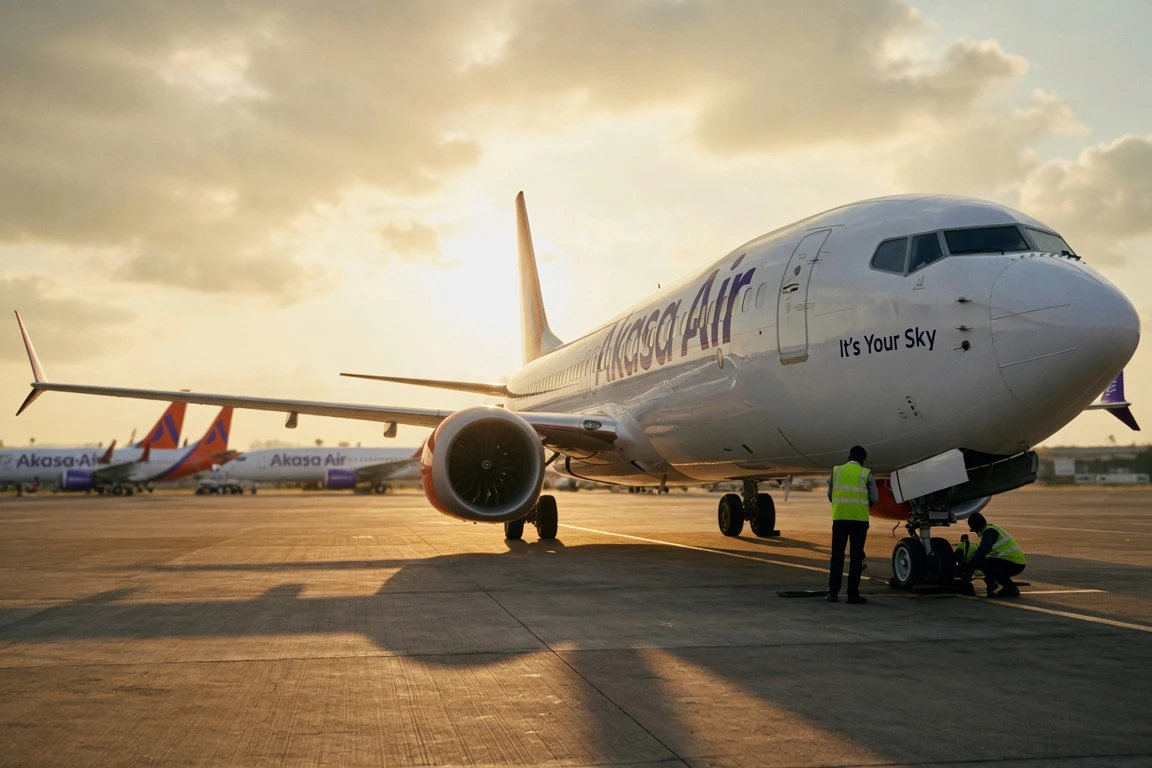
Akasa’s order book underwrites the run. The carrier has placed a single order for 226 Boeing 737 MAX aircraft with 187 still to be delivered over the next six years, per an airline release on its 39th aircraft. The 39th plane, a Boeing 737 MAX 8-200 registered VT-YBP, arrived at Kempegowda International Airport in Bengaluru on Monday after a delivery flight from Seattle via Reykjavik and Cairo. Eight aircraft have joined the fleet in 2026 alone, an induction pace that puts the airline on track for its annual growth target.
Long term plans have not gone through any rethink.. plans remain on firm footing.
Akasa Air Chief Financial Officer Ankur Goel said this at a briefing in New Delhi on Tuesday, when asked whether geopolitical uncertainty had shifted the carrier’s growth trajectory. The order book continues to deliver through the period of cost pressure. The 30 per cent FY27 target is the first annual checkpoint on the longer 30 to 40 per cent commitment.
FY26’s 37% Revenue Jump Sets the Bar
Akasa’s growth target follows a strong fiscal just ended. In the 2025-26 fiscal, the airline’s operating revenue rose 37 per cent and capacity measured by Available Seat Kilometres grew 30 per cent, Goel said. The two figures are reported together in Akasa’s briefing. The FY27 target is in line with the prior year’s 30 per cent ASK growth.
Akasa has been flying for nearly four years, a short operating history for an Indian carrier committing to a 30 per cent growth target in two consecutive years. Goel declined to specify a profit target for FY27, but said the focus was on remaining well capitalised. The airline has ‘enough cushion to tide through the current situation’, he said, on the cost pressure hitting the industry. The annual induction pace, with eight aircraft added in 2026 so far, is now a hard data point. The next test is the FY27 capacity print, expected to land over the course of the financial year.
Rivals Pull Flights as Fuel Costs Spike
The West Asia conflict and the resulting fuel-price shock have redrawn the near-term map for Indian carriers. Some airlines have temporarily cut flights as operating costs climb.
Air India, Air India Express and IndiGo have together pulled roughly 250 daily flights from their June-through-August schedules, a coordinated trim from carriers that move nine of every ten domestic passengers. The cuts land as aviation turbine fuel (ATF) prices for domestic routes have climbed about 25 per cent since the West Asia escalation, with international ATF close to double. Akasa sits at roughly 5 per cent of domestic seats, the only growing third entrant in a near-duopoly. The trim from larger peers leaves the smaller carrier with room to keep adding capacity into the same squeeze.
- Air India: 22% domestic schedule trim between June and July, removing roughly 110 daily departures
- IndiGo: 5% domestic capacity cut, stripping about 110 flights from each day’s roster
- Air India Express: 10% domestic trim, removing roughly 34 flights daily from a 340-flight base
- Combined: roughly 250 daily flights removed from the June-through-August schedule
Akasa’s answer to the cost shock is the balance sheet, not the schedule. ‘The focus is to remain well capitalised’, Goel said, and the airline has ‘enough cushion to tide through’ the cost squeeze. The carrier has not announced any capacity cuts tied to fuel.
Indian carriers are flying longer fuel-thirstier reroutes around closed Middle Eastern airspace, paying for dollar-priced kerosene against a softer rupee, and now retreating from lean-season domestic miles that no longer cover the cost stack. Carriers that move nine of every ten Indian domestic passengers have trimmed 250 daily flights from their summer schedules, a coordinated cut from three airlines. Air India, Air India Express and IndiGo are pulling capacity as aviation turbine fuel costs spike. Akasa has announced no fuel-related capacity cuts. The carrier is holding the long-term plan and continuing the deliveries at the eight-per-year pace set in 2026, with another 187 still to come on the 226-plane order.
Boeing 737 MAX Order Book Backs the Run
The 39th aircraft arrived in Bengaluru on Monday, a Boeing 737 MAX 8-200 bearing registration VT-YBP, completing a Seattle-Reykjavik-Cairo-Bengaluru delivery flight. Akasa has added eight aircraft to its fleet in 2026 so far, the most recent of which arrived in mid-June. The latest induction lines up with the carrier’s stated growth plan for the financial year.
Akasa’s order book is built around a single aircraft type. The carrier has placed an order for 226 Boeing 737 MAX aircraft and 187 planes remain to be delivered over the next six years. The all-737-MAX fleet is unusually simple for a low-cost carrier, allowing the airline to standardise on pilot training, maintenance and spare parts. The aircraft in service are Boeing 737 MAX 8-200 variants, identical in type to the 187 still to come. Adding the same aircraft type at a steady pace is how the carrier plans to hit the FY27 capacity target and the 30 to 40 per cent range beyond that.
The arrival of the 39th plane on Monday was the latest data point on the order book. Akasa has added eight aircraft in 2026 so far, an average of more than one per month, with another 187 still to come over six years. ‘Our growth plan remains intact, and we continue taking delivery of aircraft’, Goel said at a briefing that laid out the 30 per cent run through FY31.
Akasa’s Domestic and International Footprint
Akasa currently connects 27 domestic destinations and 7 international ones, for a network of 34 cities in total. Around 25 per cent of its capacity is deployed on international routes, with the rest in domestic flying. The airline has been flying for nearly four years and runs the 34 routes from a single fleet type. Akasa has been adding international destinations more quickly than domestic ones in 2026 so far, with the foreign share now at 25 per cent of capacity. The single-type fleet means the same pilots, mechanics and spares work every plane on the route map.
Akasa’s network split tracks its growth arc and the macro context. Indian domestic capacity is being trimmed by the larger carriers, which gives Akasa more room to add domestic frequencies. International flying has its own fuel-cost exposure, but the dollar-revenue profile of routes to West Asia, Southeast Asia and the Gulf is structurally different from domestic. Akasa’s 25 per cent international capacity share puts the carrier in a different cost-currency mix than its domestic-heavy peers.
| Segment | Destinations | Capacity share |
|---|---|---|
| Domestic | 27 | Not disclosed |
| International | 7 | Around 25% |
Why the Capital Cushion Matters
The capital cushion is the centre of Akasa’s bet on continued growth. Goel said the focus is to remain well capitalised through the current situation, and the airline has ‘enough cushion to tide through’ the cost squeeze. The carrier has not disclosed a specific cash position, but the message is that the balance sheet can absorb the fuel shock without cutting capacity. The cushion is what the airline is leaning on to hold the 30 per cent FY27 growth target and the 30 to 40 per cent range for the years after.
Akasa sits at the smallest end of India’s three growing carriers. SpiceJet has been shrinking near 4 per cent, and regional carriers combined hold under 2 per cent of seats, leaving Akasa as the only third-entrant still expanding.
The order book is the second leg of the bet. Akasa’s 226-aircraft commitment to Boeing is locked in, with 187 still to be delivered on a multi-year schedule. Goel framed the commitment as unaffected by the geopolitical backdrop, even as the airline tracks an eight-per-year delivery pace in 2026.
The forecast that runs through FY31 is the headline of the bet. Akasa expects capacity to grow by 30 per cent or more in FY27, then 30 to 40 per cent in each of the next four to five years, taking the carrier from today’s fleet to 226 by 2032. The trajectory is set against a backdrop of airline peers pulling capacity, fuel costs spiking, and airspace disruptions. The plan’s near-term test is whether the eight-aircraft-per-year delivery pace of 2026 continues into the second half of the year. The FY27 capacity print, when it lands, will be the first quarterly data point to mark whether the airline met its own 30 per cent target.
 Scotland’s Bench Bet Pays Off Again in 33-17 Win Over Fiji
  PV Sindhu Turns a Ranking Comeback Into a Japan Open Final
  Kid Safe Phones Are Booming as Age Verification Laws Stall
  iPhone 18 Pro Camera Confirmed by a Tata Electronics Ransomware Hack
  EU Orders Google to Open Android and Share Search Data With Rivals
  Pixel’s Growth Streak Faces Its Biggest Test at the Pixel 11 Launch