
 Ishan Crawford
 Brent crude climbed to $85.92 a barrel on Tuesday, its highest price in a month, as US strikes on Iran stretched into a third day and tanker traffic through the Strait of Hormuz collapsed. The global benchmark is up 19 percent since late February, when Washington and Israel first went to war with Tehran.
Brent has done this before. It spiked past $118 a barrel in March, then gave almost the entire rally back within weeks once a peace deal held. The reserves and spare shipping capacity that cushioned that first shock are thinner this time, and analysts say the market has far less room left to absorb a second one.
Three Nights of Strikes Push Brent Past $85
US Central Command said Monday its forces had struck Iran for a third consecutive night, part of a campaign that has now hit more than 300 targets aimed at Tehran’s ability to threaten mariners and commercial shipping in the strait. The strikes have targeted air-defense systems, coastal radar sites, and missile and drone launch positions, CENTCOM said.
Monday’s raids also marked the first use of one-way attack sea drones alongside fighter aircraft and naval vessels, CENTCOM said, widening the mix of weapons deployed against Iranian targets.
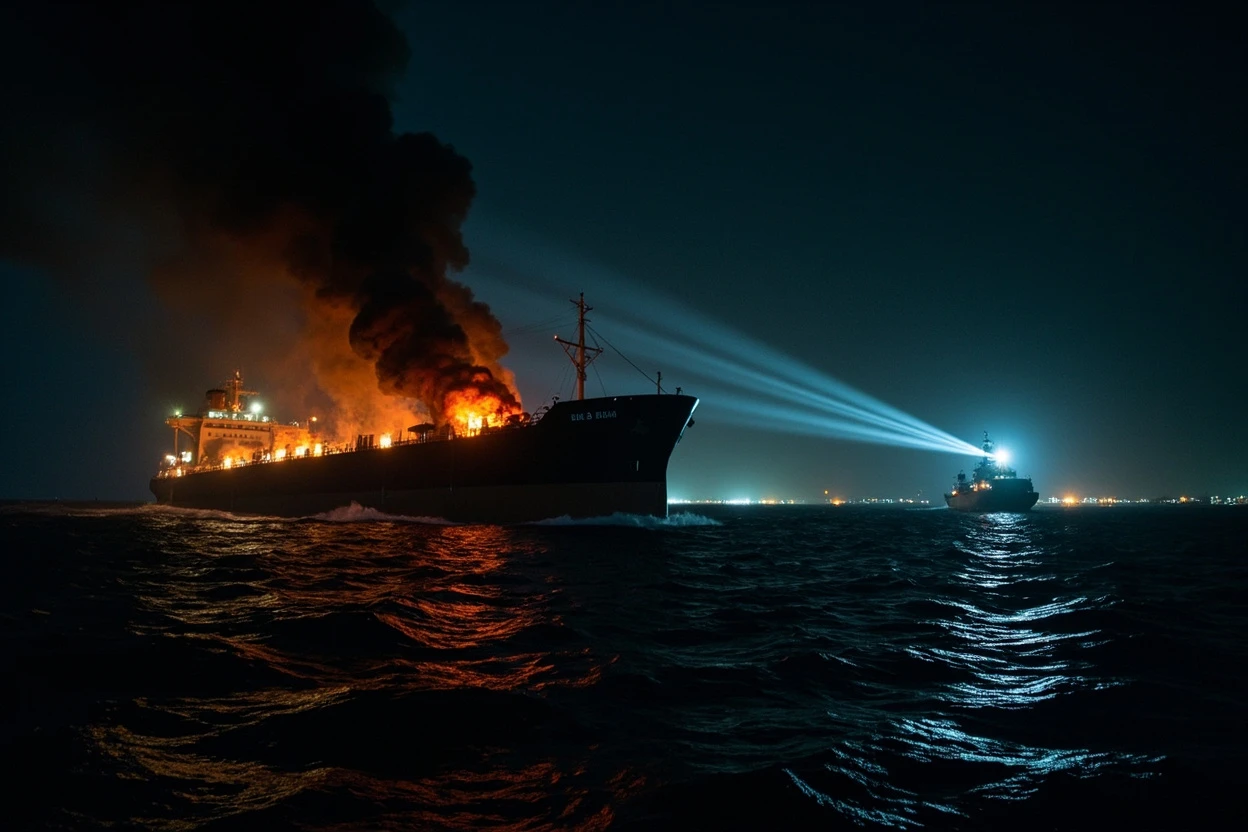
Iran’s Revolutionary Guard said it struck two oil supertankers inside the strait. The United Arab Emirates defense ministry said the vessels were Emirati-linked and that the attack killed one crew member. Iran also fired missiles and drones at US military assets in Kuwait and Bahrain, calling it retaliation for the American strikes.
Trump escalated further on Monday, saying the US would reimpose a naval blockade of Iranian ports and charge vessels a transit fee, equal to 20 percent of cargo value, to move through the strait under American protection.
“We are reinstating the Iranian blockade, so named because it is only stopping Iran’s ships or customers from entering or leaving,” he wrote on his social media platform. “All other countries will have fair and open use of the Strait.”
CENTCOM followed with its own message, saying its forces were “positioned and prepared to ensure that freedom of navigation remains available despite unwarranted Iranian aggression, harassment, threats, and arbitrary declarations.”
Tehran’s Toll Counteroffer
Iran wants a cut of every tanker crossing the strait too. Foreign Minister Abbas Araghchi said Tehran would “be fair” in setting any charge for safe passage.
“Whoever provides secure and safe passage of commercial vessels through the Strait of Hormuz should be compensated for this service,” Araghchi said.
Iran’s Revolutionary Guard has reportedly been informally billing tankers around $1 a barrel, or roughly $2 million for a single very large crude carrier, industry accounts of the toll say, though Tehran has not confirmed an official rate. It would not be the Guard’s first attempt to monetize the waterway; months earlier it ran an earlier bitcoin-based toll experiment in the strait, billing shippers in cryptocurrency for safe passage.
Three different parties now have a price in mind for the same stretch of water.
| Party | Proposed Charge | Estimated Cost |
|---|---|---|
| United States (Trump administration) | Transit fee for strait “protection” | 20% of cargo value per shipment |
| Iran’s Revolutionary Guard | Informal passage toll | About $1 a barrel, roughly $2 million per supertanker |
| War-risk insurers (March peak) | Hull war-risk premium | 2.5% to 5% of hull value, about $5 million per supertanker |
A Congressional Research Service report for lawmakers tracks the conflict’s impacts on oil, gas and other commodities that extend well beyond the strait itself.
The Strait Has Done This Before
Five months into the war, the strait has now driven oil into a spike twice. The first one unwound almost as fast as it built.
- Late February 2026: The US and Israel launch strikes on Iran, igniting the war that has since roiled the Strait of Hormuz.
- March 2026: The strait crisis deepens and Brent futures peak near $118 to $120 a barrel, roughly 64 percent above pre-crisis levels.
- April 21, 2026: The International Maritime Organization reports roughly 20,000 mariners and 2,000 ships stranded in the Persian Gulf.
- June 2026: Washington and Tehran sign a memorandum of understanding, and Brent eases back toward $72 a barrel.
- July 7, 2026: Fresh tanker attacks resume in the strait, and Washington revokes an Iranian oil-sale authorization.
- July 12 to 13, 2026: Trump announces a reinstated blockade and transit fees; Brent settles up 9.6 percent at $83.30, its steepest one-day jump in more than six years.
- July 14, 2026: Brent trades near $85.92 a barrel, its highest since June 15, as strikes enter a third day.
At the height of the March closure, the International Energy Agency, the Paris-based energy watchdog, estimated that affected producers had lost more than 14 million barrels a day of output, calling it the largest supply disruption in the history of the oil market.
The reopening did not last long. Weeks after the strait reopened with 62 million barrels of cargo cleared to sail, and after Iran secured oil-export waivers in Geneva talks that briefly pulled Brent under $79 a barrel, the same waterway is back to trading on fire and smoke.
A Federal Reserve Bank of Dallas analysis examined what a full closure would mean for the economy and found the damage compounds the longer tankers stay away, not just on the day prices spike.
Is the Strait Actually Open for Business?
Officially, no. Iran declared the strait closed “until further notice” on Sunday, and its forces have since fired on tankers inside it. In practice, oil is still moving: the US Department of Energy says 8.5 million barrels crossed the strait a day earlier under military escort, a flow it called consistent with recent averages.
Both descriptions fit the same waterway: legally closed, physically patrolled, and only partly functioning.
What We Know
- Iran declared the strait closed “until further notice” as of Sunday.
- The US Department of Energy says 8.5 million barrels moved through the strait Sunday under military escort.
- MarineTraffic recorded only 57 transits from Friday through Sunday, more than 50 percent below the prior week’s pace.
What’s Unconfirmed
- Whether Iran can enforce a full closure while the US Navy continues escort operations.
- How long shipping lines will keep waiting out the standoff before rerouting decisions harden.
- The exact toll Iran’s Revolutionary Guard is charging tankers, with industry accounts citing about $1 a barrel but no confirmed official rate.
“The US military will ensure oil flows continue, with or without the Iranians, to keep markets well supplied,” the Department of Energy said in a statement. A spokesperson for Qatar’s foreign ministry separately demanded that “the Islamic Republic of Iran immediately cease all practices that undermine regional security or threaten the safety of international maritime navigation.”
Tanker Traffic Craters as Mariners Bear the Cost
The clearest sign of how shippers are actually behaving is traffic, not statements. Ship-tracking platform MarineTraffic recorded a sharp drop in transits over the weekend.
- About 130 vessels a day transited the strait before the February strikes began.
- Just 57 transits were recorded from Friday through Sunday, more than half below the prior week’s pace.
- Roughly 13 million barrels a day normally flow through the strait, close to one-fifth of global oil consumption.
- About 20,000 mariners and 2,000 ships sat stranded in the Persian Gulf when the IMO counted them in April.
War-risk premiums on Gulf transits reached 2.5 to 5 percent of a ship’s hull value at March’s peak, close to $5 million for a single very large crude carrier, before easing to about 1 percent by April. Barclays and Goldman Sachs have both flagged the downstream risk of sustained high prices feeding inflation and denting growth in oil-importing economies.
The Buffer That Cushioned This Crisis Is Almost Gone
“Crude oil is fast losing its strategic petroleum reserve buffer, and a violent repricing up cannot be discounted until the market sees toned-down rhetoric from both parties,” said June Goh, a senior oil market analyst at Sparta Commodities in Singapore, referring to the emergency stockpile the Trump administration has drawn down to soften the supply shock.
The oil market has proven extremely patient through this crisis, in large part thanks to an ample stock cushion upon which we were able to draw to blunt the sharpness of the supply shock. Unfortunately, much of that cushion has now been depleted, leaving us much more vulnerable to a rerun of March and April.
Rory Johnston, who founded the oil market research firm Commodity Context, wrote that assessment as transit data confirmed traffic through the strait had fallen back to, or below, its pace just before June’s peace deal.
TD Securities’ Bart Melek, based in Toronto, said a further leg higher looks likely. “I suspect that a move to $100 is quite possible, should it become apparent that physical shortage risks are real and increasingly likely,” he said.
The Atlantic Council describes the dilemma ahead as a choice to ration oil now or pay a steeper price later, a trade-off Washington avoided this spring only by spending down the reserve it is now short on.
Iran said Monday it was still talking with mediators from Qatar, Pakistan and Oman. Five months ago, this same war took Brent to $120 a barrel. On Tuesday, it was $85.92, with the cushion that stopped it the first time largely gone.
 Scotland’s Facial Recognition Push Sparks Mask Ban Call
  Galaxy Z Flip 8 Hits $799 Only If Your Trade-In Qualifies
  If England Had Kept Water Public Like Scotland
  Samsung Smart Switch Now Moves Passwords and eSIM From iPhone
  Old Firm Spend Pulls Clear as Premiership Rivals Patch Squads
  Vivo V80 Lite 5G Hits Pakistan With Curved Screen and Split Identity