
 Ishan Crawford
 Around 31 supertankers carrying an estimated 62 million barrels of crude have been stacked inside the Persian Gulf, waiting for the Strait of Hormuz to reopen. The interim deal between the United States and Iran was signed on Wednesday at the Palace of Versailles, with a formal ceremony scheduled in Switzerland on Friday. The cargoes will reach India in about a week and East Asia in three weeks. Asia’s refiners spent the war locking in alternative supply and are now well stocked for both this month and next. Goldman Sachs and Morgan Stanley have cut their oil forecasts as a result.
Bank forecasts have turned. Goldman Sachs cut its 2026 Brent crude forecast to $85 a barrel from $90. Morgan Stanley sees Dated Brent at $90 in the fourth quarter, down from $100. The benchmark forward curves for Middle Eastern grades Dubai and Murban have flipped into a bearish contango for the first time since the conflict began. Oman crude traded at a discount to its Dubai benchmark this week, a reversal of the premium it usually commands.
62 Million Barrels Are Already Stacked Behind the Strait
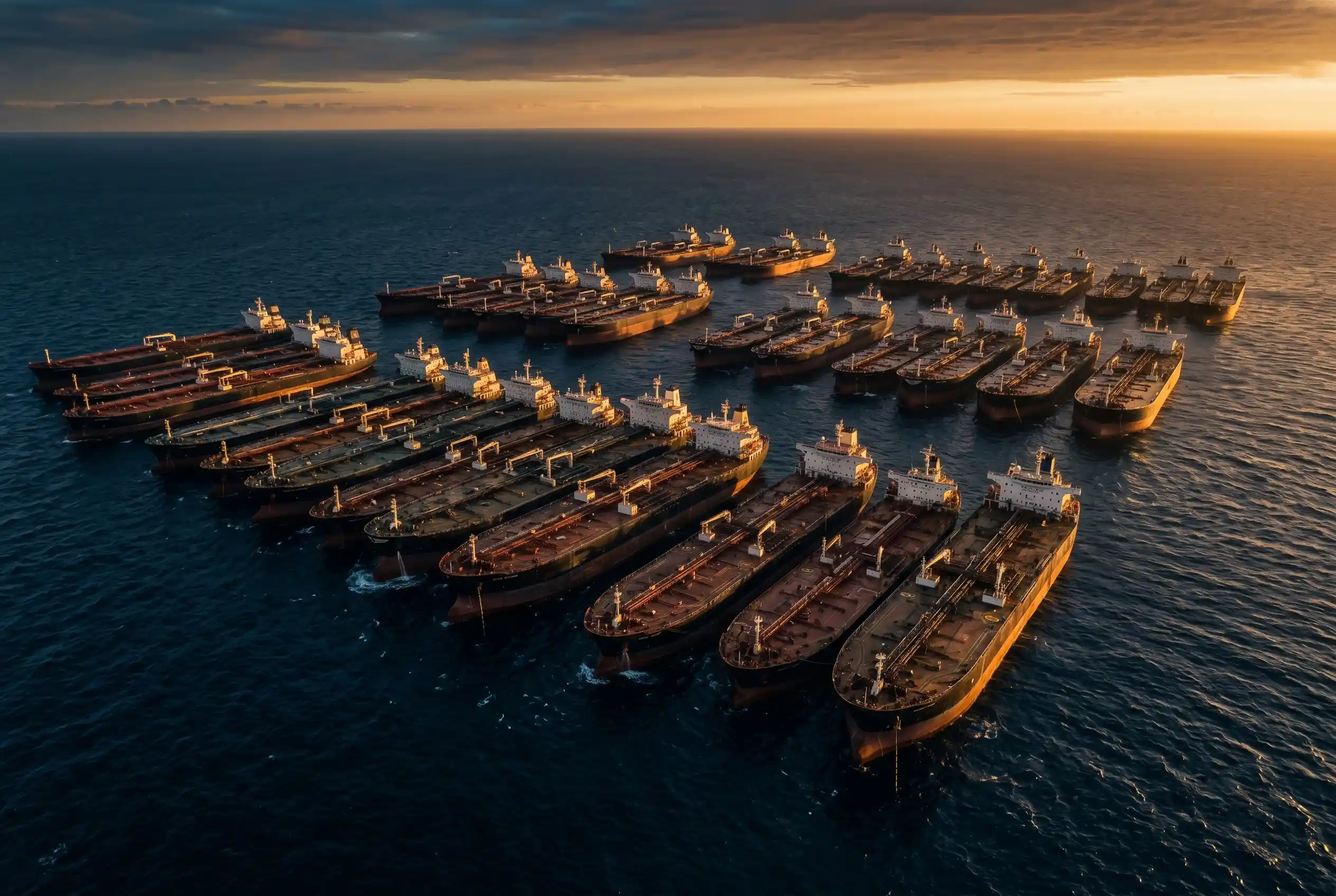
Tanker tracking from Signal Group, cited by Bloomberg, counted around 31 supertankers inside the Persian Gulf, capable of carrying about 62 million barrels of crude. The actual number may be higher: some vessels have turned off their satellite transponders, hiding on dark shipping routes that bypass the strait. All are waiting for the waterway to reopen. The Strait of Hormuz carried about 25% of the world’s seaborne oil before the war, and its closure rerouted trade across an active conflict zone.
The cargoes will not arrive everywhere at once. Crude leaving the Persian Gulf will take about one week to reach India and three weeks to reach East Asia. Three supertankers operated by Bahri, Saudi Arabia’s national shipping company, have already emerged in the Gulf of Oman after being last seen inside the Persian Gulf about two months ago. At least three Iran-flagged tankers carrying a combined five million barrels have sailed from Iran since the US and Iran reached an agreement on Sunday, according to analytics firm Kpler, none of them via the Strait of Hormuz. Production in Iraq has jumped and is set to keep climbing.
The 14-Point Deal That Reopens It
US President Donald Trump and Iranian President Masoud Pezeshkian signed a memorandum of understanding late on Wednesday at the Palace of Versailles, with French President Emmanuel Macron publishing video of the signing at a dinner during the G7 summit. Iran’s Parliament Speaker Mohammad Bagher Ghalibaf had digitally signed the document on Sunday alongside US Vice President JD Vance, witnessed by Trump, according to a senior US official. Iran had asked that the text not be released until Wednesday evening.
The 14 points, as provided to NBC News by a senior US official, include an immediate and permanent end to military operations on all fronts, including Lebanon. Iran agrees to allow “safe passage of commercial vessels with no charge for 60 days only,” followed by negotiations with Oman to “define the future administration” of the waterway. The US commits to terminating all sanctions tied to the agreement and to making frozen Iranian funds and assets available. Iran “reaffirms that it shall not procure or develop nuclear weapons,” with the disposal mechanism for its enriched uranium stockpile to be agreed during the talks. The Strait of Hormuz carried some 20% of the world’s oil before the war. The full text of the 14-point memorandum lays out each commitment.
One of the most expensive-looking points on the page is the pledge to develop a $300 billion fund for Iranian reconstruction and economic development, with regional partners rather than the US Treasury expected to carry the cost. Trump has said the US will not pay, suggesting the money may come from Gulf States and Iran’s frozen funds. The mechanism is to be hammered out during the 60-day negotiation period. The $300 billion reconstruction fund commitment is the deal’s largest single line item.
World leaders have lined up behind the deal. French President Emmanuel Macron called it a step that “paves the way for lasting peace.” NATO Secretary General Mark Rutte said the memorandum will “degrade” Iran’s nuclear capability and “restore the freedom of navigation.” Pakistan’s Prime Minister Shehbaz Sharif, whose government mediated the talks, said both sides had declared the immediate and permanent termination of military operations on all fronts. Trump, asked about the signing as he left Versailles, said: “It’s signed. Signed in Versailles. Just signed it.”
The Deal with the Islamic Republic of Iran is now complete. I hereby fully authorize the toll free opening of the Strait of Hormuz, and, simultaneously herewith, authorize the immediate removal of the United States Naval blockade. Ships of the World, start your engines. Let the oil flow!
Trump posted the message on Truth Social on Sunday, hours after Pakistani Prime Minister Shehbaz Sharif announced the deal on X. The full 14-point text was made public on Wednesday after the Versailles ceremony.
Asia’s Refiners Spent the War Hedging Against This
During the war, Brent peaked at $126 a barrel in March, the largest monthly price move on record. Refiners across Asia responded by locking in US crude and other non-Middle East barrels. The scramble to secure supply defined the operating reality of the past three months, and India moved to build a 30-day strategic LPG reserve after the conflict exposed the thinness of its storage cushion.
Now traders familiar with the matter say the incoming wave is large enough to prompt Asian refiners to consider putting barrels into operational storage tanks or raising processing rates. Storage ties up capital; higher runs put more fuel into a market where demand has been soft. Asia’s refiners are already stocked for this month and next.
That mix has left buyers with supply already booked and demand running soft. Persian Gulf sellers including Abu Dhabi National Oil Co. and Kuwait Petroleum Corp. have continued to market supply and move some cargoes through Hormuz during the disruption. The forward curve has flipped before a single queued cargo has sailed. Buyers facing the new arrivals can choose to store, refine, or pass.
- China stayed largely out of the spot market and drew on strategic reserves.
- Japan drew on domestic storage rather than chasing Middle East barrels.
- Refiners across the region cut processing rates as high prices curbed fuel demand.
The Forward Curve Has Already Turned
Pricing has already moved ahead of the cargoes. The forward curve for benchmark Middle Eastern grades Dubai and Murban has shifted into a bearish contango, the first time since the war began that later-dated contracts trade above near-term ones. A contango signals the market expects more supply, or weaker prompt demand, or both. None of the queued tankers have yet loaded for India or East Asia.
The breakdown is visible across the barrel. Oman crude traded at a discount to its Dubai benchmark this week, a reversal of the premium it usually commands. At least one diesel cargo changed hands at a discount to its benchmark, compared with trades at premiums earlier in the war. At least one South Korean refiner has been offering a larger-than-usual volume of distillate fuels, including diesel and jet fuel, for sale. Refiners are trying to bring supply to market ahead of a full Hormuz reopening that may further pressure prices, traders said. The forward curve in Dubai also shows how Hormuz oil prices climbed during Iranian missile strikes, the same path the market is now reversing.
Two of the largest oil forecasters on Wall Street have cut their oil price forecasts since the deal was reported. Both banks have revised their Brent and Dated Brent benchmarks lower. The new figures are in the table below.
Goldman Sachs analysts led by Daan Struyven wrote in a note that the bank now assumes Persian Gulf exports normalize to pre-war levels by the end of July, about a month sooner than previously expected. Morgan Stanley’s separate forecast for next year sees Dated Brent at $80 a barrel. The Goldman Sachs and Morgan Stanley oil price forecasts are subject to the deal holding and the cargoes moving. Both banks revised their 2026 forecasts lower after the deal was reported.
| Bank | Benchmark | New Forecast | Prior Estimate |
|---|---|---|---|
| Goldman Sachs | Brent crude (2026 average) | $85/barrel | $90/barrel |
| Morgan Stanley | Dated Brent (Q4 2026) | $90/barrel | $100/barrel |
Why the Strait Mattered Before the War
Before the war, the Strait of Hormuz was open and carried about 25% of the world’s seaborne oil trade and 20% of global LNG. An estimated 84% of crude oil and condensate shipments through the strait were destined for Asian markets in 2024. The waterway sits between Iran and Oman at its narrowest 34 kilometers wide, the only sea passage from the Persian Gulf to the open ocean.
China received a third of its oil via the strait before the war and held about a billion barrels in oil reserves, a few months of supply. Japan and South Korea drew heavily on Gulf crude. Europe sourced 12% to 14% of its LNG from Qatar through the strait. When US and Israeli forces launched their war on Iran on February 28, Iran announced the strait was closed four days later and warned that any ship attempting to pass would be attacked.
Tanker traffic dropped first by about 70%, then to near zero. Over 150 ships anchored outside the strait to avoid the risk. The International Maritime Organization reported on April 21 that around 20,000 mariners and 2,000 ships were stranded in the Persian Gulf. Brent crude rose past $100 a barrel on March 8 for the first time in four years and peaked at $126 in March, the largest monthly increase in oil prices on record. The closure became the largest disruption to world energy supply since the 1970s energy crisis.
The Deal’s Next 60 Days
The deal sets a 60-day clock for both sides to negotiate a comprehensive final agreement, extendable with mutual consent. Initial talks are scheduled to begin Friday at the Bürgenstock resort in Switzerland, with around 2,000 Swiss soldiers securing the site and a no-fly zone imposed from June 18 to June 20. The MoU covers the Lebanon front as well, though Israel is not a direct party to the US-Iran agreement. Trump, asked about Lebanon on Wednesday, said: “The Lebanon peace is something we’ll have to work on a little bit.”
Iran has the most to gain, and the most to lose, on the deal’s execution. Oil sales generate about 50% of Iranian government revenue, according to the US Energy Information Administration, and before the war Iran was exporting up to 2.25 million barrels per day. The deal removes the US naval blockade, allows Tehran to sell its oil freely, and begins unfreezing its assets. At least three Iran-flagged tankers carrying a combined five million barrels have already sailed from Iran since Sunday. Trump’s senior officials have warned the US retains the tools to restart military operations if Iran does not comply, and Iran’s lead negotiator Ghalibaf called the agreement a “record of America’s failure” in a state TV address.
Frequently Asked Questions
What did the US-Iran deal actually change for oil markets?
The memorandum of understanding reopened the Strait of Hormuz after more than 100 days of disruption, lifted the US naval blockade of Iranian ports, and committed the US to removing sanctions and unfreezing Iranian assets in stages tied to a 60-day negotiation window. It also commits Iran to allowing free passage of commercial vessels for 60 days, after which Oman joins talks on the waterway’s future administration.
How much crude is queued to leave the Strait of Hormuz?
Around 31 supertankers carrying an estimated 62 million barrels of crude are stuck inside the Persian Gulf, according to Signal Group tanker tracking data cited by Bloomberg. The cargoes will take about one week to reach India and three weeks to reach East Asia. Three oil supertankers operated by Saudi Arabia’s Bahri have already emerged in the Gulf of Oman after about two months inside the Gulf.
Why is Goldman Sachs cutting its Brent forecast?
Goldman Sachs analysts led by Daan Struyven wrote in a note that they now assume Persian Gulf exports normalize to pre-war levels by the end of July, about a month sooner than previously expected. The bank cut its 2026 Brent forecast to $85 a barrel from $90. Morgan Stanley separately cut its Dated Brent forecast for the fourth quarter to $90 from $100.
How long will the Strait of Hormuz stay open?
The MoU commits Iran to allow “safe passage of commercial vessels with no charge for 60 days only,” followed by negotiations with Oman to “define the future administration” of the vital trade route. Both sides then have 60 days to negotiate a comprehensive final deal. Trump’s senior officials have warned the US retains the tools to restart military operations if Iran does not comply with the terms.
Could the deal fall apart?
Yes. Trump warned on Wednesday that the US could resume attacks if Iran fails to honor his commitments, and his senior officials have repeated the warning publicly. Senator Chuck Schumer called the agreement “one of the biggest American disasters.” Iran’s lead negotiator Mohammad Bagher Ghalibaf said the deal was “a record of America’s failure,” even as Iran continues to implement the blockade’s end.
Disclaimer: This article is for informational purposes only and does not constitute investment or trading advice. Oil prices, forecasts, and geopolitical conditions can change rapidly. Figures cited are accurate as of publication on June 18, 2026. Consult a qualified financial professional before making financial decisions.
 Hyderabad Gold Dip Freezes Buying as Duty Talk Hits Wedding Season
  India Pushes Japan CEPA Review After 15 Years of One-Way Gains
  HDFC Bank’s US Class Action Turns Deposit Scheme Into Securities Reckoning
  Gold Holds Above $4600 as Treasury Buybacks Fuel Debasement Bid
  Scotland’s Prevention Push Leaves Community Groups Squeezed
  Amazon Locks Three Million Nvidia GPUs Even as Trainium Grows